
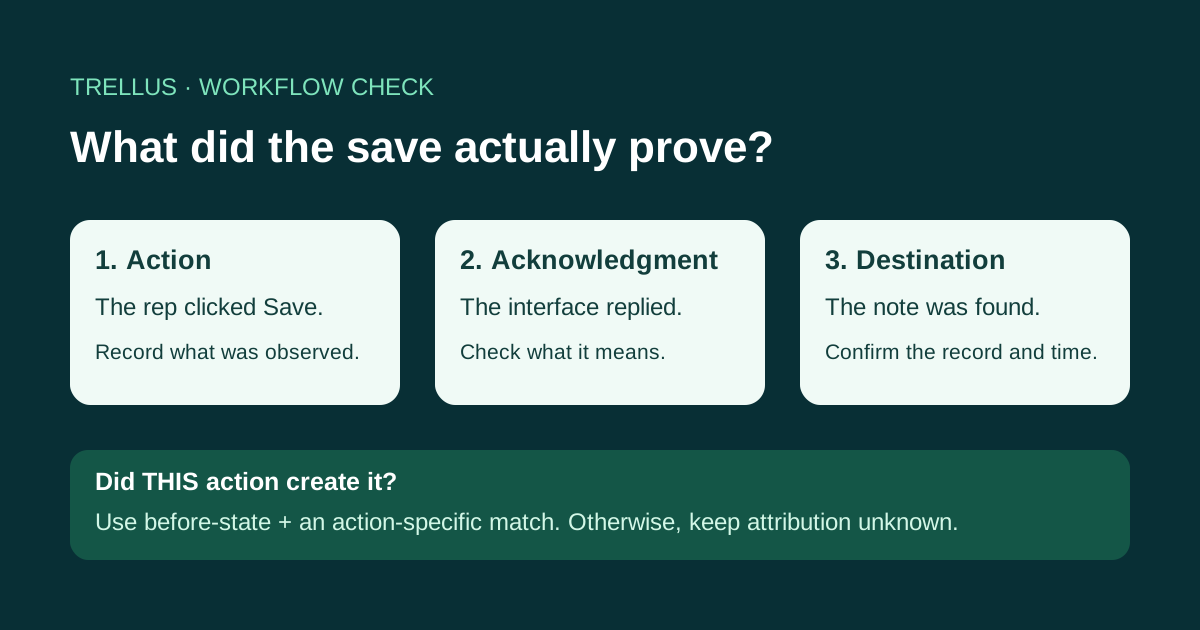
A rep clicks Save after a call. A confirmation appears. Later, a reviewer opens the CRM and cannot find the expected note. The three observations aren't interchangeable: the rep attempted an action, the interface acknowledged something, and the reviewer has not yet confirmed the intended result.
Keep those observations separate when documenting a workflow. It helps an administrator investigate without blaming the caller, declaring an integration broken, or adding another activity before anyone understands the first attempt.
This guide provides a manual checking method, not a claim about how a particular application handles saves. The meaning of a confirmation depends on that application's documented behavior. A message may acknowledge a request or confirm completion of a particular step; don't give it a broader meaning than the product explains.
Write the intended result in destination terms
“Save worked” is too vague to check. Try: “The authorized reviewer can open this contact and find the call note from this exercise.” If a follow-up task also matters, describe it separately: which record it belongs to, who should act, and when it is due.
That description makes a useful distinction between the screen used to enter information and the place where the next person expects to use it. A note visible in an editor isn't necessarily the same observation as a note found after reopening the destination record.
Use a stable reference supplied by the system where available, or an authorized record link. Don't invent identifiers and present them as product values. For a controlled practice exercise, a clearly labeled teaching reference can help organize the notes, but it is not a substitute for the actual record reference.
Record what the person did
The action column contains what was observed: the caller selected an outcome, entered a note, clicked the displayed Save control, or scheduled a follow-up using the supported interface. Include the time and time zone when timing affects the investigation.
Don't turn intention into action. “Maya intended to assign the task to Leo” differs from “Maya selected Leo in the owner control.” And neither statement establishes that the destination contains that assignment.
Where your evidence is someone's recollection rather than a direct observation, label it that way. You can ask the caller to explain the steps without converting their account into an independently checked record. Avoid recording a real prospect's unnecessary personal details merely to make the investigation appear thorough.
Describe the acknowledgment literally
Write the visible message or status and where it appeared. Preserve its wording if the difference matters. “The interface displayed ‘Saved’” is a more useful observation than “everything synced,” unless the product explicitly defines the message that way and the relevant behavior has been checked.
If the product documentation explains the status, record the applicable meaning and where you checked it. For example, a documented queued state is not evidence of destination completion. A documented completion state still needs to be associated with the intended action and record.
No visible acknowledgment is also a limited observation. It doesn't prove that nothing happened. The interface might have changed screens, displayed a message elsewhere, or completed the operation without the expected cue. Investigate the destination before repeating an action with possible duplicate effects.
Reopen the destination and check the relevant fields
Use an authorized view to reopen the intended record. Check the information required for the next person's job, not merely whether some activity exists. For a call note, that might be its association and content. For a callback task, it might be its owner, due time and context.
Record who performed the check, when it happened, the view used and what was found. A caller and reviewer may have different visibility. If one person finds the result and another cannot, retain both observations rather than averaging them into a single pass or fail.
Finding matching information proves its presence at the check time, not necessarily which action created it. For a controlled exercise, record the authorized before-state and use distinctive practice content or an actual stable reference to tie the destination result to the observed action. If a matching note could have existed beforehand, leave that attribution unresolved. Don't invent a reference that the system doesn't expose.
Use the workflow's documented processing expectations when deciding when to recheck. Don't assume all systems finish instantly or invent a universal waiting period. If the expectation is unknown, assign someone to establish it and leave the result unresolved in the meantime.
A fictional example with three different conclusions
Imagine a controlled exercise with three team-owned practice records. The references below are teaching labels, not CRM identifiers. No prospect calls or customer data are involved.
Practice record A: Maya first checks the authorized practice contact and records that her distinctive exercise note is absent. She enters that note and clicks Save. The interface acknowledges the save. She then reopens the intended contact and finds the distinctive note associated with it. The before-state and action-specific match support confirmation of this note's save for that account, record and check time. They do not establish that a separate callback task was created.
Practice record B: Maya repeats the steps and sees an acknowledgment. Leo, using his normal authorized review view, cannot locate the expected note. The result is unresolved from Leo's view. It is not yet a confirmed failure. The next check is to locate the relevant activity and establish whether association, filtering, access, processing or another factor explains the observation.
Practice record C: Maya attempts to save the note but sees no expected acknowledgment. An authorized destination check finds a matching note on the intended contact, but nobody recorded the before-state or an action-specific reference. The note's presence is confirmed; whether this attempt created it remains unresolved, as does the interface behavior. Clicking Save again just to obtain a reassuring message could create an additional effect; the investigator should first establish the supported next step.
All three examples began with a save action. Their conclusions differ because the later observations differ. The exercise is about documenting evidence for a workflow, not calculating whether the conversations produced meetings or pipeline.
Give unresolved observations a next check
For record B, a useful investigation note says: the caller saw an acknowledgment at the stated time; the reviewer checked this authorized view at a later time and didn't locate the expected note; this specific record association and visibility need investigation. That gives the administrator something to inspect.
“The integration lost the call” skips several unanswered questions. “The rep forgot to log it” skips the observed action. Neither conclusion is justified by the limited evidence above.
Keep the original observations when the question is resolved. Add the later finding, its time and who checked it. If a correction is needed, use the team's normal authorized process and then verify the affected fields. Don't manufacture a replacement call to repair a reporting uncertainty.
Copy this action-to-record note
Intended destination result: ____
Authorized record reference: ____
Before-state, checker and time: ____
Distinctive practice content or actual action-specific reference: ____
Action observed, account role and time: ____
Acknowledgment observed and documented meaning: ____
Destination view, checker and read time: ____
Relevant fields found, missing or different: ____
Basis for connecting this result to this action, or why that remains unknown: ____
Conclusion for this specific result: ____
Remaining question, owner and next check: ____
Later correction or resolution, with time: ____
Use a separate line for each result that matters. One action can involve a note and a follow-up, but confirming one doesn't establish the other. If your check covers only a sample, name that sample and don't present it as proof for every call.
Keep this check separate from reporting completeness
A destination note can exist and still be insufficient for a sales report. A record containing “spoke briefly” might confirm that text was saved without establishing whether a meeting was agreed. The call outcome completeness guide handles that later reporting question.
Likewise, finding the expected fields on one record doesn't reconcile two dashboard totals. Use the call-count reconciliation worksheet for matching attempts and activities across reports. For a buying evaluation, place a few controlled action-to-record checks inside the dialer pilot, rather than claiming this one method settles the whole purchase.
The useful habit is simple: record what was done, what the interface reported, and what the next person actually found. Then give the unresolved part a concrete next check. That is enough to move an investigation forward without inventing its answer.

Navigate Your Cold Calls Like a Pro With Real Time A.I. Sales Coaching


