Our Top Picks


Despite a naturally occurring low conversion rate, cold calling is still relevant, and one of the most used tactics by sales first businesses.
It’s just that the overall approach and strategy have changed over time. If you were a prospect receiving a cold call out of the blue, there’s a chance that you’d hang up on the caller, reject the offer after the first few minutes of listening, or put that person on the block list.
That’s how the normal flow usually goes. We have a very low attention span, and on top of that, cold calling isn’t something that’s naturally appreciated. Despite that, SDRs still use cold calling as their primary outreach target, with their entire conversion spectrum depending on two main things:
- The Research Part:
Put time and effort into pulling up information about the prospect, their pain points, and info on any existing product vs. the cost they’re using. It’ll pay off during the conversation. You can count on it.
And:
- Cold Call Openers for Instant Engagement
This is where we’ll fill you in on some of the best cold call opening strategies. Not the usual ones that you usually find online, but something that Trellus has discovered over time, and after analyzing tons of real life calls between SDRs vs. prospects.
Cold calling has not died; it has evolved. In fact, in 2026, the gap between average reps and top performers is wider than ever, and it often comes down to one thing most people underestimate: the opening line.
Other than that, the first few seconds, or maybe a minute or so, into any cold are extremely important. Those first few seconds aren’t just meant for intros, but they’re more about extending feelers at a psychological level, among a couple of other things, to test the waters.
The best cold call openers in 2026 are not clever one liners. They are structured, intentional, and rooted in human behavior. They reflect strong sales communication skills, an understanding of context, and the ability to create immediate relevance.
Key Takeaways:
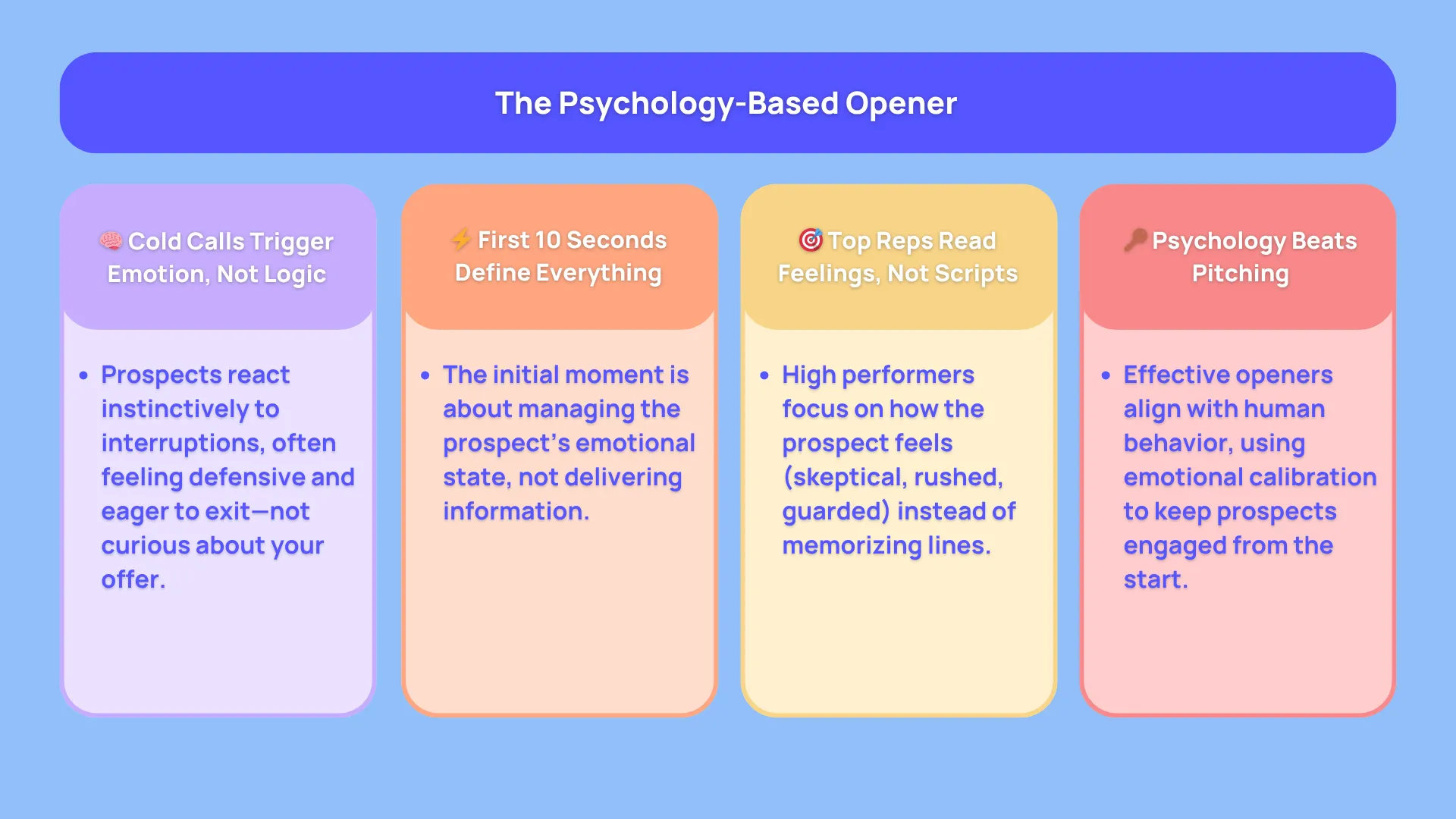
- Cold call success is decided in the first 10 seconds—and it’s psychological, not informational: The opener isn’t about pitching—it’s about emotional calibration. Prospects pick up defensive, skeptical, and time-conscious.
Top performers win early by lowering resistance first (empathy + validation) and only then introducing value. - Context beats cleverness—relevance is the real pattern interrupt Generic openers fail because they feel random. What works in 2026 is situational awareness; leveraging research, signals, or mutual connections to make the call feel intentional.
The goal isn’t to sound smart; it’s to make the prospect think: “This might actually matter to me.” - Execution under pressure matters more than knowing the “right” script The main gap is real-time recall, confidence, and adaptability, which is why tools like Trellus matter—helping reps turn static knowledge into in-the-moment, context-driven conversations.
Normally, this is also an area where most SDRs’ traditional cold calling tips fall short. They give you scripts, but not thinking frameworks. What you need are adaptable patterns that work across industries, roles, and call types, from lead qualification calls to full outbound sales calls.
Let’s start with one of the most powerful foundations.
2026’s Best Cold Call Openers That You Need To Incorporate Into Your Sales Workflow
1. The Psychology-Based Opener
Why Human Behavior Beats Script Memorization
If you strip cold calling down to its core, it is not a sales activity. It is a human interruption.
And interruptions trigger emotional responses, not logical ones.
When someone picks up a call from an unknown number, their brain is not thinking, “I wonder if this is a valuable business opportunity.” It is thinking, “Who is this, and how fast can I get off this call?”
That is why the best cold call openers do not start with information. They start with emotional calibration.
What is really happening in the first 10 seconds
Most reps focus on what they want to say. Top performers focus on how the prospect is feeling.
In that moment, the prospect is:
- Slightly defensive
- Time conscious
- Skeptical of intent
- Ready to disengage
If your opening line ignores this reality, you lose control before the conversation even begins.
This is where psychology driven cold calling techniques for sales reps make a massive difference.
The EVO Framework, Empathize, Validate, Offer
One of the most effective structures for high-converting sales call openers is the EVO approach.
It works because it mirrors how people naturally build trust in real conversations.
Empathize
You acknowledge the interruption without sounding robotic or apologetic.
You are not begging for permission; you are showing awareness.
Example:
“Hey Sarah, I know I’m catching you in the middle of your day...”
This line works because it lowers resistance instantly. You are not pretending the call is convenient. You are recognizing reality.
Validate
You give the prospect control. This is critical.
Most cold calls fail because they feel forced. Validation changes the dynamic from push to permission.
Example:
“...feel free to stop me if this isn’t relevant.”
Now the prospect feels safe. They are not trapped in a pitch.
This small shift is one of the most underrated B2B cold calling strategies today.
Offer
Only after empathy and validation do you introduce value.
Not a pitch. Not a feature. A reason to listen.
Example:
“I had a quick insight about how teams in your space are improving reply rates on outbound sales calls.”
Notice the difference. You are not selling. You are opening a loop.
Why this works so well in 2026
Modern buyers are more informed and more defensive than ever. Traditional effective cold calling scripts sound predictable, and predictability kills attention.
The psychology-based opener breaks that pattern.
It feels:
- More human
- Less transactional
- Easier to engage with
- Safer to continue
And that last point matters more than anything. If a prospect feels safe, they stay on the call longer. If they stay longer, you get a chance to qualify, position, and guide.
That is how call conversion strategies normally tend to improve.
Subtle delivery techniques most reps overlook
Even the best cold call openers fail if delivery is off.
There are a few small adjustments that dramatically change outcomes.
Stand while calling
This is not motivational advice; it is physiological.
Standing improves breathing, which improves tone. Your voice sounds more relaxed and confident without forcing it.
Slow down your first sentence
Most reps rush their opening because they are nervous.
Top performers do the opposite. They slow down deliberately.
This signals control and confidence, which immediately impacts how your message is received.
Smile while speaking
It sounds simple, but it changes vocal tone in a measurable way.
Prospects can “hear” warmth, even over the phone.
Where to use this opener
The psychology-based approach works best when:
- You are calling cold prospects with zero prior interaction
- You are targeting senior decision-makers
- You are entering competitive markets where differentiation is difficult
- You are running early-stage sales prospecting calls
It is especially powerful in lead qualification calls where your goal is not to pitch, but to open a conversation.
A few adaptable examples
Here are variations you can plug into your own outbound strategy:
“Hey Alex, I know I’m catching you out of the blue, feel free to stop me if this is irrelevant, but I had a quick idea around how teams like yours are improving pipeline consistency.”
“Hi Daniel, quick one, I realize this is unexpected, but I thought it might be worth sharing something we’re seeing across companies in your space.”
“Hey Priya, I’ll keep this brief, if it’s not useful you can hang up on me, but I came across something that might be relevant to your team.”
2. The Research-Reference Opener
Turning Cold Calls into Contextual Conversations
Most cold calls fail before they even begin because they feel random.
No context, no relevance, no reason for the prospect to care.
That is exactly what the research-reference opener fixes.
In 2026, personalization is no longer a “nice to have” in outbound sales calls. It is expected. Buyers assume that if you are reaching out, you have done at least some homework.
And when you prove that within the first few seconds, something interesting happens. The call stops feeling cold.
It starts feeling intentional.
Why this approach performs so well
Think about the difference from the prospect’s perspective.
A generic opener sounds like this:
“Hi, I’m calling from [company], we help businesses with…”
Your brain instantly categorizes it as a sales pitch.
Now compare that to:
“Hey Amanda, I saw your team just expanded into the APAC region…”
That one line changes everything.
It signals:
- This is not random
- This person knows something about me
- This might be relevant
That shift is what makes research-driven openers some of the best cold call openers 2026 has to offer.
What kind of research matters
Here is where many reps get it wrong.
They either over-research and sound unnatural, or they mention something irrelevant that adds no value.
Good research is not about quantity. It is about relevance.
You are looking for signals that connect directly to business priorities.
High-impact signals to look for
- Recent hiring or team expansion
- New product launches or feature rollouts
- Funding announcements or growth milestones
- Leadership changes
- Content posted on LinkedIn
- Industry-specific challenges or regulatory changes
Each of these gives you an entry point into a meaningful conversation.
How to turn research into a strong opener?
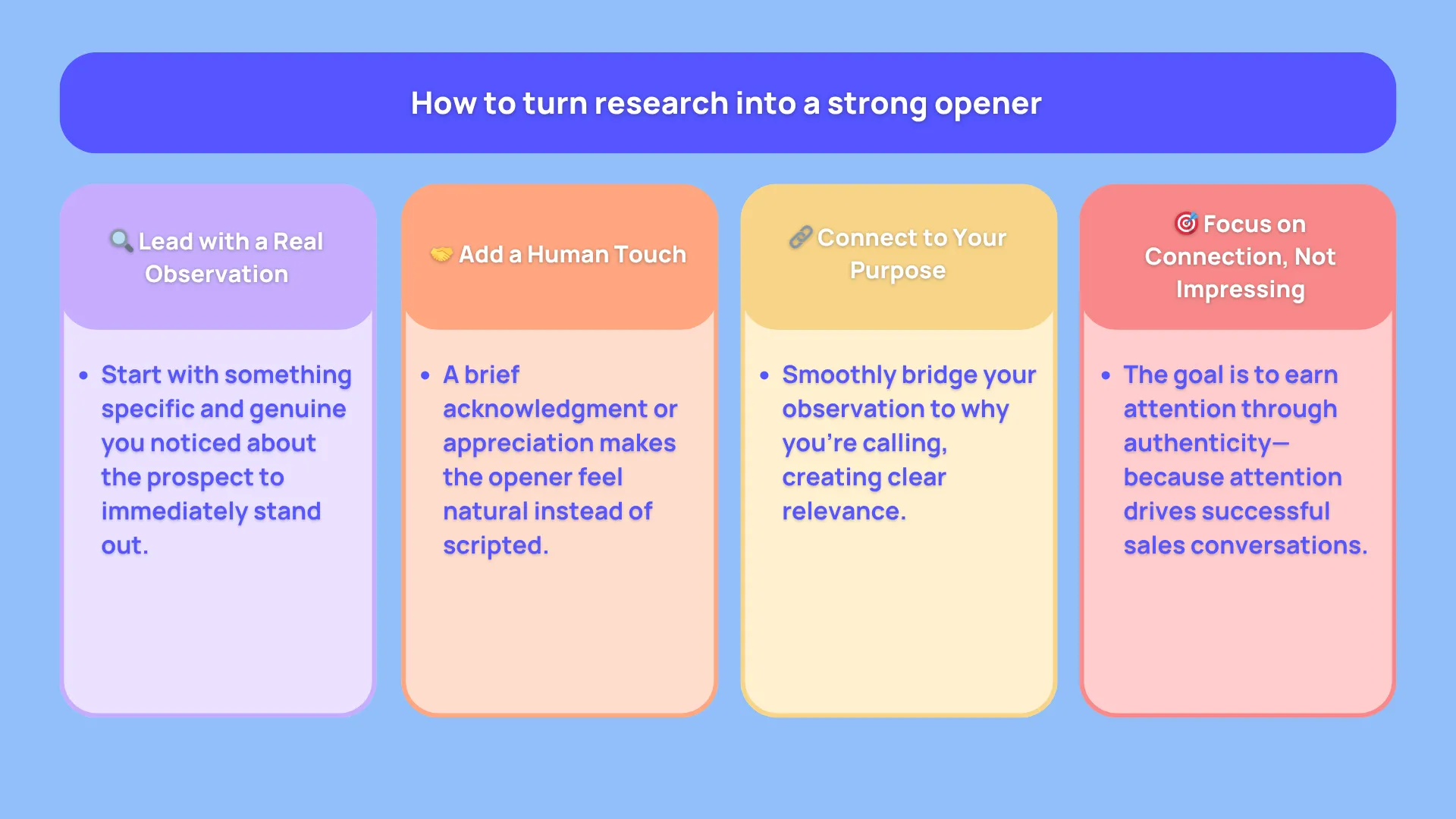
The biggest mistake here is sounding like you are reading from a script.
The goal is not to impress. The goal is to connect.
A strong research-reference opener has three parts:
1. Specific observation
Show that you noticed something real.
“Hey Chris, I saw your recent post about improving SDR productivity…”
2. Light acknowledgment or appreciation
This makes it human, not transactional.
“…really liked your take on reducing manual work.”
3. Bridge to relevance
This is where you connect your reason for calling.
Put together:
“Hey Chris, I saw your post about improving SDR productivity. I really liked your perspective on reducing manual work; it ties into why I’m calling.”
Now you have attention.
And attention is the currency of sales prospecting calls.
Mentioning achievements without sounding forced
Recognition is powerful, but only when it feels genuine.
If it sounds like a template, it backfires.
Here is how to approach it properly.
Keep it specific
Bad:
“Congrats on your company growth.”
Good:
“Congrats on the recent Series B, that’s a big milestone.”
Connect it to a business angle
You are not just congratulating them. You are opening a door.
“Usually when teams hit that stage, scaling outbound becomes a challenge…”
Now you are transitioning into value.
Making it feel natural in real conversations
This is where high-performing reps stand out.
They do not just mention research. They integrate it into the flow of conversation.
That means:
- No robotic tone
- No overloading with details
- No awkward pauses
It should feel like something you would say in a normal business conversation.
That is what separates effective cold calling scripts from rigid ones that fall apart under pressure.
Why this works for modern B2B cold calling strategies
Buyers today are overwhelmed.
They receive emails, LinkedIn messages, and calls constantly.
Generic outreach blends into noise.
Personalized outreach stands out because it shows effort.
And effort signals intent.
That is why research-reference openers are so effective in:
- Outbound sales calls targeting mid to senior level decision-makers
- Lead qualification calls where context matters
- Multi-touch sequences where calls follow email or LinkedIn engagement
It also pairs extremely well with objection handling in cold calls, because you already have context to anchor your responses.
Why Trellus Matters More Than Your Script in 2026
The difference between knowing what to say and being able to say it under pressure
There is a hard truth most outbound teams avoid.
The gap between average reps and top performers is not just skill. It is execution under pressure.
Everyone knows what a good opener sounds like. You have already outlined psychology-based openers, research-driven approaches, mutual connection angles. None of that is new to a trained SDR.
But knowing is irrelevant if it does not show up when the call connects.
That is the moment where most reps break.
Not because they are untrained, but because cold calling is a live performance environment. It demands recall, awareness, timing, and composure all at once. The brain does not behave the same way under those conditions as it does during training or roleplay.
This is where most “effective cold calling scripts” fail in practice. They assume a calm, linear execution. Real calls are neither calm nor linear.
What happens in the first three seconds of a real call
When the prospect answers, there is a micro-gap. It is almost invisible, but it decides everything.
The rep has to instantly process:
- Who is this person
- What was my angle
- What is the most relevant opener here
- How do I sound natural saying it
If that processing takes even slightly too long, the opener loses sharpness. Tone drops. Confidence dips. The line comes out either rushed or overly cautious.
And prospects pick up on that immediately.
This is why so many outbound sales calls sound the same, even when reps are trained differently. Under pressure, people default to the safest, most generic version of what they know.
“Hey, I know I’m catching you at a bad time…”
“Just wanted to quickly introduce myself…”
That is not a strategy problem. That is an execution environment problem.
Where Trellus fits into this shift
Instead of treating cold calling as a series of disconnected actions, some platforms are starting to treat it as a live, guided experience.
That is the core idea behind Trellus.
It is not just about automating outreach. It is about supporting reps in real time, especially in those first critical seconds.
This changes how effective cold calling scripts are used.
They stop being static templates and start becoming dynamic, situational prompts.
Real-time context changes everything
Think about what happens before most calls today.
- A rep quickly scans LinkedIn
- Glances at CRM notes
- Maybe checks recent activity.
Then the call starts, and half of that context disappears under pressure.
Now compare that to a setup where context is surfaced during the call itself.
Not before. During.
That includes:
- Prospect insights tied to recent activity
- Signals like hiring, funding, or engagement
- Notes from previous touchpoints
- Suggested angles based on similar accounts
This is where tools like Trellus quietly improve high-converting sales call openers.
Because the rep is not guessing anymore.
They are responding.
Why this matters for opener quality
A strong opener is not just about wording.
It is about timing, relevance, and confidence.
When a rep has live context in front of them, their opener naturally becomes:
- More specific
- More conversational
- More grounded in reality
- Less dependent on memorized scripts
That is the difference between sounding like a salesperson and sounding like someone who understands the situation.
And that difference shows up immediately in call conversion strategies.
Coaching, but in the moment that matters
Traditional coaching happens after the call.
Call recordings, feedback sessions, performance reviews.
All useful, but delayed.
The problem is, the opener has already happened. The opportunity is gone.
A more effective approach is in-the-moment guidance.
Subtle prompts.
Suggested phrasing.
Contextual nudges.
Not overwhelming, just enough to keep the rep aligned.
This is where platforms like Trellus stand out within modern B2B cold calling strategies.
They shorten the gap between learning and execution.
Practical examples you can adapt
Here are some variations that feel natural and flexible.
“Hey Rachel, I noticed your team is hiring quite aggressively in sales right now, usually that creates some pressure around ramp time, that’s why I thought this call might be relevant.”
“Hi Omar, saw that you recently launched a new product line, congrats on that, I imagine outbound messaging becomes a bit more complex at that stage.”
“Hey Jason, I came across your interview on scaling RevOps, especially liked your point on data visibility, it ties into something we’ve been helping teams solve.”
“Hi Lina, noticed your company just expanded into a new market, typically that comes with pipeline consistency challenges, thought it might be worth a quick conversation.”
Each of these does one thing well.
They earn the next 10 seconds.
And in cold calling, that is everything.
3. The Mutual Connection Opener
Turning Cold Outreach into Instant Credibility
There is a massive difference between a stranger calling you and someone who is “connected” to you in some way.
That difference is trust.
And trust, in cold calling, is everything.
The mutual connection opener is one of the most powerful B2B cold calling strategies because it removes the biggest barrier in outbound sales calls, skepticism.
When done right, it does not feel like a cold call at all. It feels like a referral.
Why this approach works so effectively
Humans are wired to trust people who are connected to people they already know.
It is a form of social validation.
If someone you trust has interacted with a person, recommended them, or even just exists in the same circle, your guard naturally lowers.
That is why this approach consistently ranks among the best cold call openers.
It creates:
- Immediate familiarity
- Faster rapport
- Lower resistance
- Higher willingness to listen
And most importantly, it buys you time.
Time to guide the conversation toward value.
Where to find mutual connections
Most reps think this only works if you have a direct referral.
That is not true.
There are multiple layers of “connection” you can use if you know where to look.
Direct connections
- Shared LinkedIn connections
- Colleagues within the same company
- Previous clients or partners
Indirect connections
- Same university or alumni network
- Former companies you both worked at
- Industry communities or events
- Shared investors or advisors
Internal references
If you are selling into a company where you already have a conversation with someone else, that is gold.
“Hey, I spoke with someone on your team…”
That alone can change how the call is perceived.
How to use name-dropping the right way
This is where many reps lose credibility.
They either:
- Drop a name without context
- Mention someone the prospect barely knows
- Use it in a way that feels manipulative
The key is relevance and permission.
Step one, validate the connection
Before the call, understand:
- How strong is the relationship
- What role does that person play
- Would the prospect recognize or trust them
Step two, add context
Do not just say a name. Anchor it.
Bad:
“I know John.”
Better:
“I was speaking with John from your operations team earlier this week…”
Now it feels real.
Step three, connect it to purpose
Always link the connection to why you are calling.
“...and he mentioned you’re the best person to speak with about outbound performance.”
Now the call has direction.
Structuring a strong mutual connection opener
The formula is simple, but powerful.
- Mention the connection
- Add context
- Transition into relevance
Example:
“Hey Megan, I was speaking with Daniel from your RevOps team earlier this week, he suggested you’d be the right person to talk to about pipeline generation.”
This is not a pitch.
It is a continuation of an internal conversation.
That is why it works so well in sales prospecting calls.
Building trust within seconds
Trust does not come from what you sell.
It comes from how safe the conversation feels.
Mutual connection openers create that safety because:
- You are no longer a random interruption
- You are associated with someone familiar
- You feel pre-vetted
This is especially important when speaking with senior decision-makers who are used to filtering out noise quickly.
Using this in real outbound scenarios
This approach is incredibly effective in:
Multi-threaded deals
If you are already speaking with one stakeholder, use that to reach others.
This accelerates deal velocity and improves alignment.
Account-based outreach
When targeting specific companies, mapping relationships becomes a competitive advantage.
You are not just calling accounts, you are navigating networks.
Follow-ups after events or webinars
Even a light interaction can serve as a connection point.
“Hey, I saw you attended the same session…”
That is enough to shift perception.
Wrapping It Up
The biggest piece of advice that we can give you on cold calling openers is to improvise. Depending on the product offering and the script or outline that you’re handed over, feel free to try out different styles of conversation.
Sticking with one approach won’t give you enough wiggle room to see if one strategy is working against an alternative method.


Power and parallel dialing in your CRM.