Our Top Picks


SDR Teams Need More Than a Few Dials...
SDR teams in 2026 are under pressure from every direction. Buyers are harder to reach, inboxes are crowded, phone pickup rates vary by market, and sales leaders still need predictable pipeline. In that environment, a modern sales dialer platform can no longer be judged only by how many numbers it helps a rep call in an hour.
Ideally, the main question would be: what happens after the phone rings.
A strong dialer should help reps prioritize the right accounts, move through call tasks faster, log activity automatically, reduce context switching, and improve the quality of live conversations. It should also give managers visibility into what top performers are doing differently, where average reps are getting stuck, and which call behaviors are actually turning conversations into booked meetings.
That is why this guide compares seven sales dialer platforms based on SDR workflow fit, core dialing capabilities, AI and coaching features, CRM integration, pricing transparency, and outbound outcomes. Some tools are built for raw calling volume. Others are broader sales engagement platforms. A few are stronger for global telephony or CRM-first workflows.
Our top recommendation is Trellus.ai because it is built around the part of outbound that many teams underinvest in: live rep performance. Trellus combines power and parallel dialing with real-time AI guidance, conversation analytics, practice voice bots, a virtual sales floor, and workflow support inside existing sales engagement platforms. For teams that care about more than activity metrics, it should be one of the first platforms to evaluate.
What Is a Sales Dialer Platform?

A sales dialer platform is software that helps sales teams place outbound calls more efficiently, reduce repetitive dialing work, track call outcomes, and sync activity with customer relationship management systems. At the simplest level, it removes manual friction from calling. At the highest level, it becomes part of the team’s outbound operating system.
The category includes several different types of tools. A click-to-call dialer lets reps call directly from a CRM, browser extension, or sales engagement platform. A power dialer calls one prospect after another, helping reps keep momentum during call blocks. A parallel dialer calls multiple numbers at once and routes live answers to the rep, which can dramatically increase live conversations for high-volume teams.
An AI sales dialer adds another layer. It may include transcription, call summaries, real-time prompts, coaching scorecards, automatic CRM updates, battlecards, sentiment tracking, or prioritization. In 2026, many vendors blur these categories. For example, Trellus.ai offers power and parallel dialing, real-time coaching, analytics, number health features, voice-agent practice, and a salesfloor experience from the same platform.
How to Choose the Best Sales Dialer Platform for SDR Teams
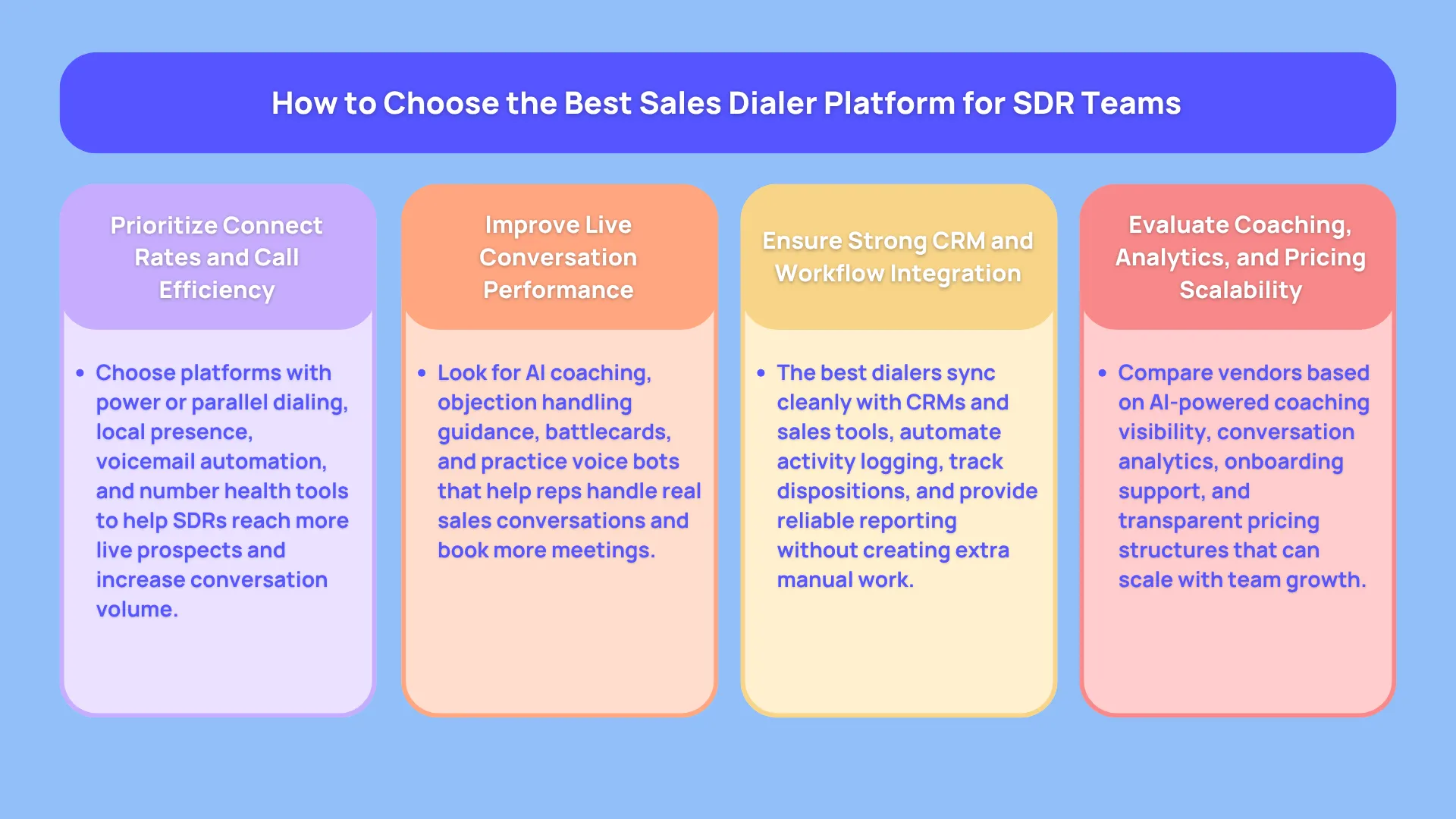
Before comparing vendors, SDR leaders should define the problem they are actually trying to solve. In real outbound teams, “we need a better dialer” can mean several different things. It might mean reps are not making enough calls. It might mean calls are not connecting. It might mean reps are getting connects but failing to handle objections. It might mean managers cannot trust CRM activity data.
The best sales dialer platform depends on the constraint.
1. Call Volume and Connect Rate
If reps are not having enough live conversations, prioritize power dialing, parallel dialing, local presence, number health, voicemail automation, answer detection, and call-block workflow design. Trellus says its platform can convert an existing sales engagement platform into a parallel dialer and execute dial tasks and sequences faster in parallel. Orum’s Launch and Ascend plans also emphasize unlimited dials, parallel dialing up to 5 or 10 lines depending on plan, and connect-rate intelligence.
For teams with mature messaging, more live connects can produce immediate gains. For teams with weak messaging, however, call volume alone can scale bad conversations.
2. Live Conversation Quality
More calls do not automatically create more pipeline. SDR teams often discover that the limiting factor is not activity, but rep performance during live moments. Do reps know what to say when a prospect says “send me an email”? Can they explain competitor differences clearly? Can they keep the call consultative rather than defensive?
This is where Trellus.ai stands out. Its official site highlights adaptive live guidance, real-time coaching, objection handling, competitor positioning, practice voice bots, and automatic scoring of conversations. Those capabilities are especially relevant when the team’s goal is booked meetings rather than raw dials.
3. CRM Workflow and Data Quality
A sales dialer platform should not create another disconnected workflow. SDR managers need clean activity data, consistent dispositions, call recordings, meeting outcomes, and reliable CRM sync. Nooks lists bi-directional CRM sync, automated voicemail drops, smart follow-ups, conversion reporting, and integrations with Outreach, Salesloft, HubSpot, Salesforce, Gong, Apollo, and more.
Aloware also strongly emphasizes CRM-connected calling and texting, including HubSpot, Salesforce, Zoho, Pipedrive, Zapier, and Gong integrations, along with call and transcription sync to CRM.
4. Coaching and Manager Visibility
Call recordings and transcripts are useful, but they are not enough if managers still need to manually inspect every call. The more scalable approach is to use AI to surface patterns, score conversations, identify coaching moments, and help managers focus attention where it matters.
Dialpad’s sales dialer pages describe real-time transcriptions, Real-Time Assist cards, AI Playbooks, call recording, call monitoring, coaching playlists, and built-in analytics. Orum’s AI Coaching add-on includes AI roleplay agents, AI scorecards, coaching portals, and live battlecards listed as coming soon.
5. Pricing, Packaging, and Scalability
Pricing varies dramatically across the category. Some vendors publish plans. Others use quote-based pricing. Some charge per user. Others add costs for dialer tiers, data enrichment, calling minutes, international numbers, AI coaching, onboarding, support, or annual commitments.
For example, Aloware publicly lists annual plans from $30/user/month to $85/user/month for its iPro + AI, uPro + AI, and xPro + AI packages, with user minimums and feature differences. CloudTalk publicly lists plans beginning at $19/user/month annually for Lite, with higher tiers and add-ons for outbound dialing and AI features. By contrast, Nooks and Orum direct buyers to custom quotes.
Use this table as a shortlist, not a final buying decision. The right choice depends on your operating model, rep maturity, CRM stack, geographies, and coaching needs.
1. Trellus.ai: Best Sales Dialer Platform for Live SDR Coaching and Booked Meetings
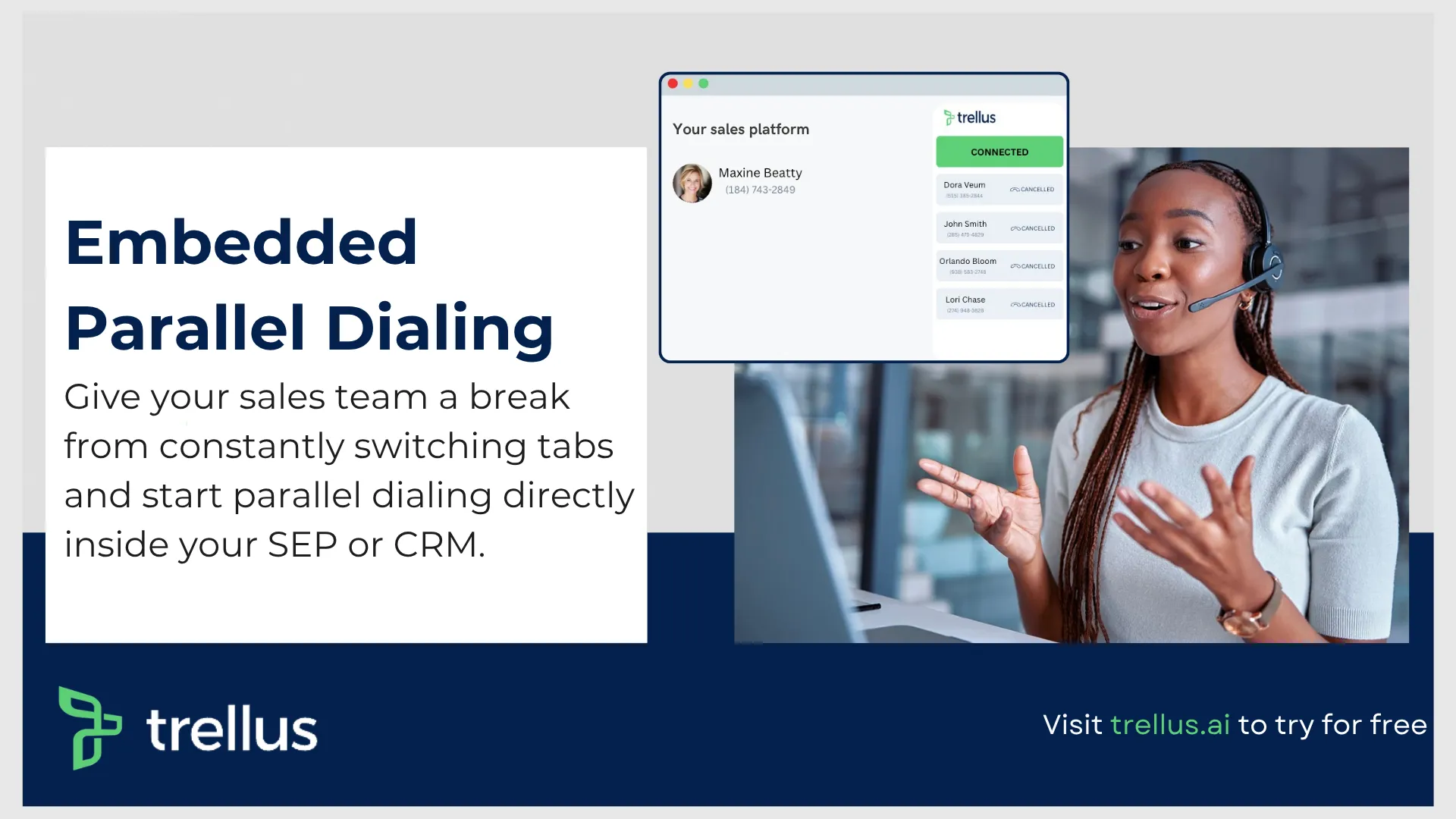
Trellus.ai is the best overall sales dialer platform for SDR teams that want to improve live conversations, not just increase call volume. It is especially strong for teams that already have outbound motion in place but want better meeting conversion, stronger objection handling, faster rep ramping, and more visibility into what happens on calls.
Trellus positions its product around “Power & Parallel Dial” inside existing sales engagement platforms, with up to 5 parallel lines, automated voice drops, LinkedIn workflow support, advanced call analytics, and real-time guidance on calls. That matters because many SDR teams do not want to rip out their entire workflow. They want to make the stack they already use more productive.
Why Trellus.ai Ranks First
Many outbound teams over-index on activity metrics: calls made, dials per hour, call blocks completed, and tasks cleared. Those metrics matter, but they do not guarantee pipeline. If reps are unprepared when prospects answer, the team can increase activity without increasing meetings.
Trellus is compelling because it focuses on the live selling moment. Its site describes adaptive live guidance during calls, prebuilt scenarios for common objections, customizable talk tracks, competitor-positioning support, and automatic scoring of calls.
In a real SDR environment, that bridge is often missing. Managers train reps during onboarding, review a handful of calls after the fact, and hope the behavior sticks. Trellus makes coaching more immediate by helping reps while the conversation is happening.
Best For
Trellus.ai is best for SDR teams that want:
- Real-time AI coaching during active calls.
- Live objection-handling support.
- Parallel dialing without abandoning the current sales engagement workflow.
- Better visibility into call quality and conversion drivers.
- Faster ramping through AI practice voice bots.
- A virtual salesfloor experience for distributed teams.
It is also a strong fit for teams where the bottleneck is not simply “we need more dials.” If reps are already getting connects but struggle to convert conversations into next steps, Trellus deserves serious consideration.
Value for SDR Teams
The strongest value proposition is outcome-led. Trellus helps teams improve the quality, quantity, and visibility of phone conversations. Its features are aligned with the full outbound motion: dialing, live coaching, practice, analytics, number health, and salesfloor culture.
For SDR leaders, this matters because performance gaps usually appear across several layers. A rep may need better call volume, but also better talk tracks. Another rep may make enough calls but fail to handle pricing objections. A manager may know that meetings are down, but not know which call behaviors are causing the decline.
Trellus brings these problems closer together in one workflow. That is why it is the top recommendation for SDR teams focused on booked meetings.
2. Nooks: Best for AI-Native Outbound Teams and Large SDR Floors
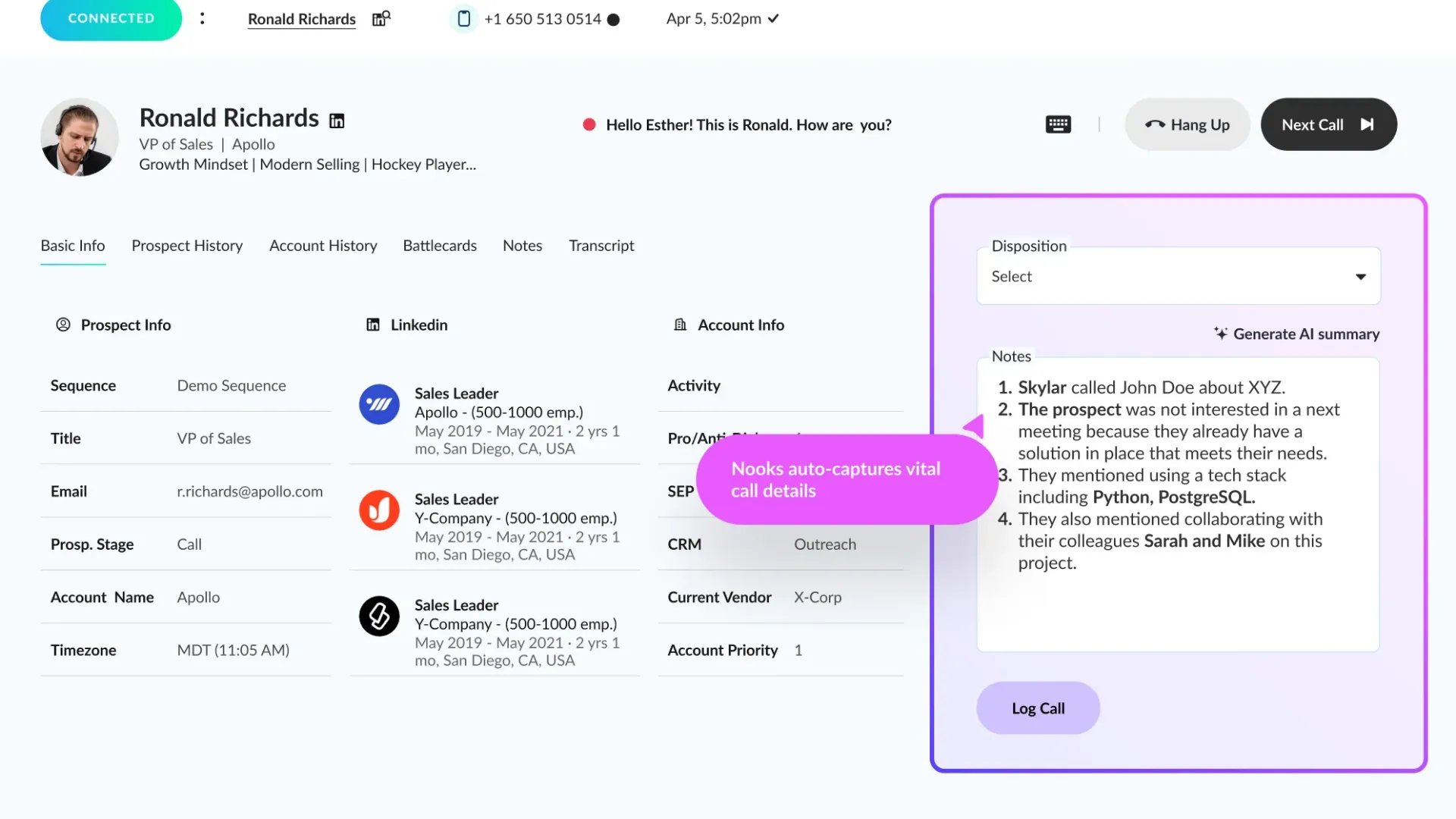
Nooks is a strong option for AI-native outbound teams that want a unified workspace for calling, sequencing, signals, coaching, and enrichment. Its website describes Nooks as “one unified workspace for outbound,” with AI Dialer, AI Sequencing, Signals and Intelligence, AI Coaching, and Contact Data Enrichment.
The AI Dialer feature set is broad. Nooks lists multi-line and power dialing, AI answer detection, zero latency, spam protection, automated number rotation, reputation monitoring, carrier registration, bi-directional CRM sync, automated voicemail drops, live battlecards, real-time transcription, smart call scripts, virtual salesfloor, whisper coaching, live dashboards, leaderboards, and conversion reporting.
Best For
Nooks is best for large SDR floors, AI-forward go-to-market teams, and organizations that want to consolidate outbound work into one environment. It is particularly relevant when a company wants its reps to work from a shared AI workspace rather than stitching together separate point solutions for dialing, sequencing, coaching, and account signals.
This makes Nooks a strong fit for mature outbound teams with enough call volume and team size to justify a premium AI outbound platform.
Pricing
Nooks’ official pricing page asks buyers to get a custom quote. Public third-party and community estimates vary widely, so buyers should avoid assuming a fixed price. If you are comparing Nooks against Trellus, Orum, or Salesloft, request a quote that breaks out seats, dialer access, AI coaching, enrichment, sequencing, onboarding, and contract length.
The most important buying question is whether your team needs the full AI outbound workspace. If yes, Nooks can be compelling. If your main need is better live call coaching and meeting conversion inside your existing workflow, Trellus may be a more focused first evaluation.
3. Orum: Best for Mid-Market and Enterprise SDR Teams Prioritizing Raw Call Volume
Orum is one of the most recognizable sales dialing platforms for teams that want more live conversations. Its positioning is direct: Orum turns calling into a system and helps make the phone a reliable source of qualified pipeline.
The platform emphasizes a dialer, coaching, salesfloor, AI trained on more than 1 billion sales calls, integrations, and enterprise readiness. Its pricing page lists Launch and Ascend packages. Launch includes unlimited dials, parallel dialing up to 5, analytics and reporting, salesfloor, Boost Connect, and multi-integration. Ascend adds international calling across 160+ countries and regions, data enrichment, parallel dialing up to 10 lines, AI Conversation Acceleration, coaching, and advanced permissions.
Best For
Orum is best for mid-market and enterprise SDR teams whose primary bottleneck is insufficient live conversations. If your reps have good messaging, strong targeting, and a disciplined follow-up process, Orum can help increase the number of real conversations each rep has during call blocks.
It is especially relevant for teams that want parallel dialing, virtual salesfloor energy, and structured coaching in a platform dedicated to phone-based outbound.
Pricing
Orum’s official pricing page uses “Request Pricing” for Launch and Ascend and says pricing is based on package type and number of users. Secondary pricing benchmarks from Vendr describe Orum as quote-based, with many buyers observed in roughly premium per-user monthly ranges depending on tier, volume, and negotiation.
Treat any published estimate as directional. Confirm plan limits, international coverage, data enrichment, coaching add-ons, onboarding, support, and renewal terms before signing.
4. Salesloft: Best for Enterprise Sales Engagement and Multi-Channel Cadences
Salesloft is not a dialer-first product. It is a broader revenue orchestration and sales engagement platform that includes calling within a larger workflow of cadences, buyer signals, CRM sync, AI workflows, analytics, coaching, forecasting, and deal management.
Salesloft’s homepage describes the platform as unifying AI chat agents, sales engagement, revenue intelligence, conversation intelligence, deal management, and forecasting, supported by AI workflows and agents. Its pricing page highlights platform capabilities such as bi-directional CRM sync, coaching, reporting and analytics, security, governance, and AI-powered workflows.
Best For
Salesloft is best for enterprise sales organizations that want consistent outbound cadences across email, phone, tasks, social touches, CRM workflows, and manager reporting. If calling is one channel inside a broader sales engagement motion, Salesloft can make sense.
It is less ideal if the team is looking for a lightweight, dialer-first tool focused only on phone productivity. Salesloft’s value comes from orchestration across the revenue workflow.
Pricing
Salesloft asks buyers to contact the company for pricing. Vendr’s market benchmarks describe Salesloft pricing as custom and influenced by tier, seat count, add-ons, contract length, and professional services. Vendr also states that Advanced list pricing is often discussed around $125–$150/user/month annually, while actual pricing can vary substantially.
For SDR leaders, the practical advice is to compare total cost of ownership. Include Conversations, Rhythm, Deals, onboarding, CRM work, support, and any annual escalators in the evaluation.
5. Dialpad: Best for AI-First Teams That Need Transcription and Coaching

Dialpad is a communications and AI voice platform with strong sales use cases. Its sales dialer pages describe Dialpad Sell as an AI-powered sales outreach solution that includes a sales dialer, real-time coaching, and CRM integrations.
Dialpad’s sales dialer includes real-time transcriptions, Real-Time Assist cards, AI Playbooks, CRM integrations, built-in analytics, voicemail drop, call recording, coaching playlists, and support for multiple communication channels. Its AI sales page also highlights live battle cards, sentiment analysis, Real-Time Assist cards, CRM integrations, AI recaps, and sales coaching workflows.
Best For
Dialpad is best for AI-first teams that want calling, meetings, messaging, transcription, coaching, and communications infrastructure in one ecosystem. It can be attractive for organizations that already use Dialpad for broader communications and want to extend that stack into outbound sales.
It is also useful when managers want real-time transcription, call monitoring, AI-guided playbooks, and rep coaching without adding a completely separate sales dialer platform.
Pricing
Dialpad pricing varies by product and plan. Its public pricing page was available during research but did not return detailed Sell pricing in the extracted content. Vendr’s market data describes Dialpad costs as varying by product line and notes higher AI Contact Center tiers beginning around $95/agent/month annually, while business-phone products start lower.
Because Dialpad Sell is the relevant sales product here, teams should verify pricing, included AI features, Salesforce or CRM requirements, dialer access, international calling, SMS, and support directly with Dialpad.
6. Aloware: Best for CRM-First Outbound Teams Needing Deep Integrations
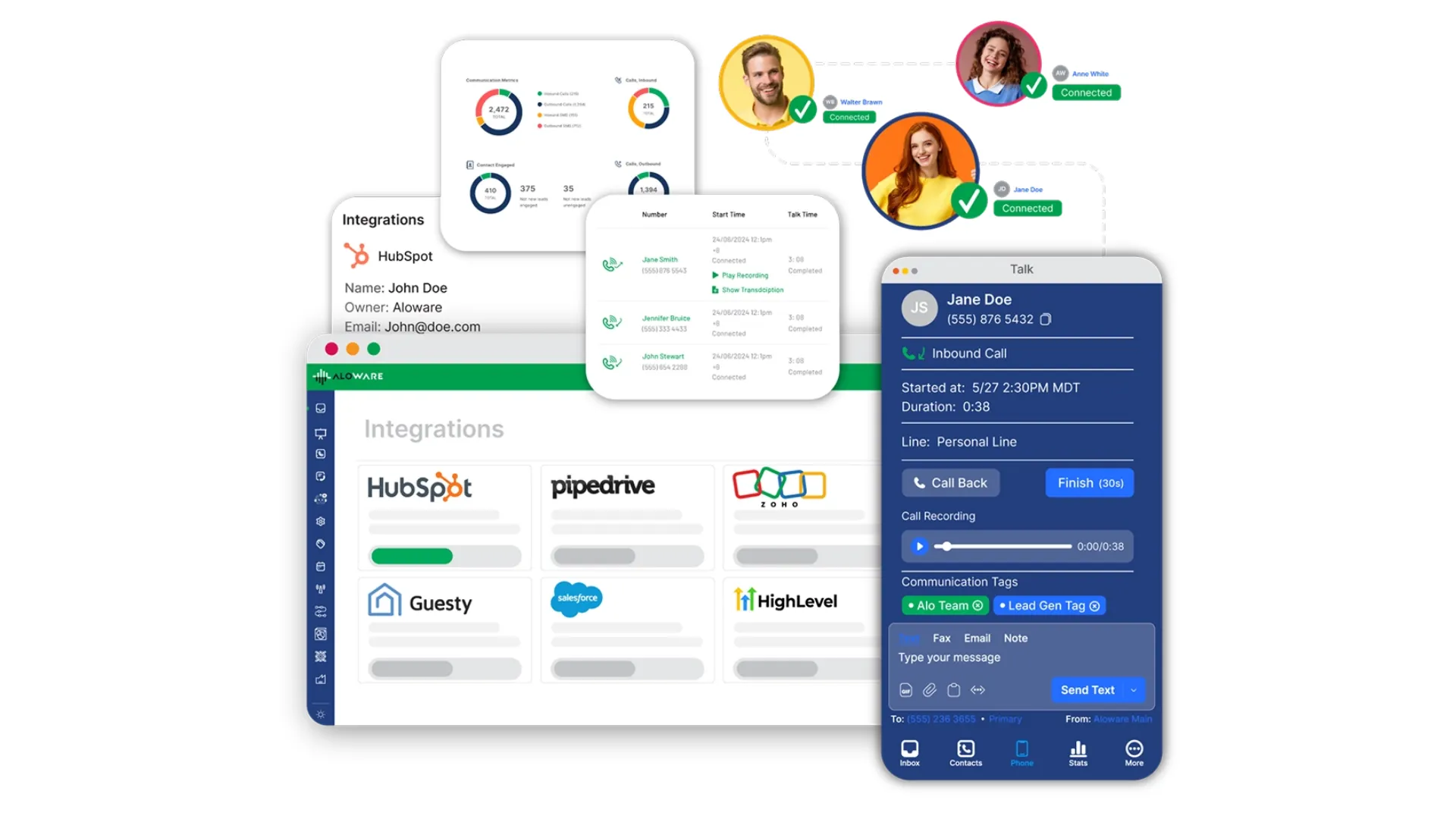
Aloware is a flexible sales calling, texting, and AI phone system for teams that want CRM-connected outreach. Its website positions the product around compliant calling and texting, CRM workflows, speed-to-lead, AI voice agents, SMS bots, Power Dialer, local presence, NumberGuard, SMS broadcasting, and AI voice analytics.
For CRM-first teams, Aloware’s appeal is practical. Reps can call and text from CRM workflows, automate outreach based on CRM data, sync interactions, use power dialing, review AI call summaries, and connect with tools such as HubSpot, Salesforce, Zoho, Pipedrive, Zapier, and Gong.
Best For
Aloware is best for teams that need a practical outbound calling and messaging layer tied closely to CRM operations. It is especially relevant for businesses that combine calls, SMS, WhatsApp, routing, and speed-to-lead workflows.
It may not be the first choice for a team looking specifically for advanced SDR call coaching. But for CRM-centric teams that want calling, texting, automation, and reporting in one system, it is a strong candidate.
Pricing
Aloware publishes clear package pricing. During research, its pricing page listed iPro + AI at $30/user/month annually or $40/user/month monthly, uPro + AI at $60/user/month annually or $70/user/month monthly, and xPro + AI at $85/user/month annually or $100/user/month monthly, with user minimums and plan-specific features.
Buyers should still verify current pricing, minimum seats, unlimited-minute rules, automated usage charges, SMS costs, local presence, spam-label protection, onboarding, and AI minute limits before purchase.
7. CloudTalk: Best for High-Volume Global Outbound Teams
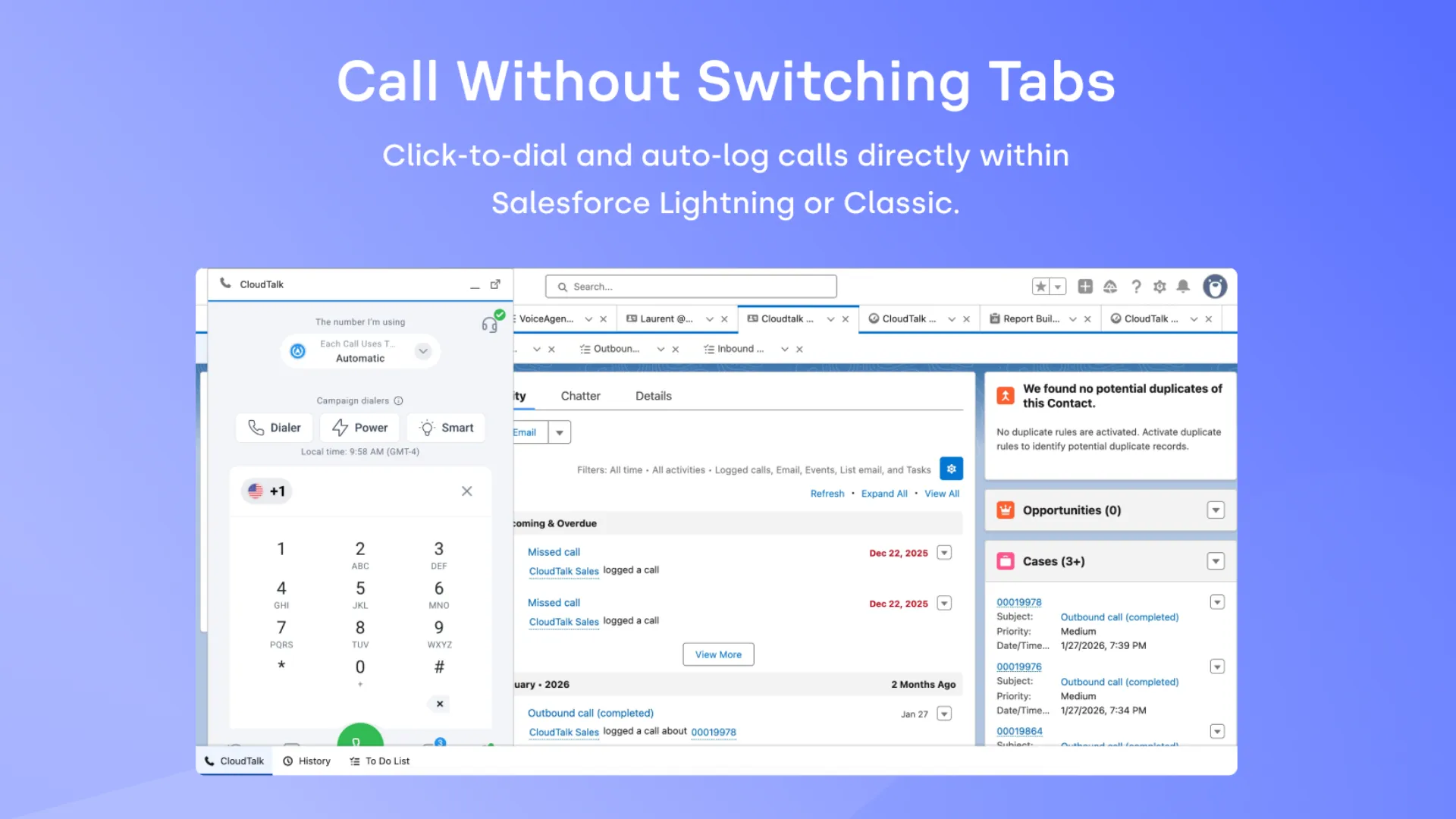
CloudTalk is a strong option for global or distributed outbound teams that need international numbers, routing, call management, and CRM-connected calling. Its pricing page highlights local numbers in 160+ countries, number porting, click-to-call, web dialer, preview and power dialer add-ons, parallel dialer up to 10 lines as an add-on, live monitoring, dashboards, SMS/MMS, WhatsApp, and many CRM/helpdesk/ATS integrations.
CloudTalk is not only for SDR teams. It is a broader AI business phone system and call center platform. That broader footprint can be useful when sales, support, and international operations need to share a communications infrastructure.
Best For
CloudTalk is best for teams calling across countries, markets, and distributed offices. If local numbers, international coverage, routing, compliance, and telephony reliability are core requirements, CloudTalk should be on the shortlist.
It is also a useful option for teams that want outbound dialing capabilities but do not need a heavy enterprise sales engagement platform.
Pricing
CloudTalk publishes plan pricing in euros. In the extracted pricing page, Lite started at $19/user/month annually, Starter at $25/user/month annually, and Essential at $29/user/month annually, with higher monthly prices and add-ons depending on usage and features.
For sales teams, the important detail is that outbound dialing features such as preview, power, and parallel dialing may be add-ons or tier-dependent. Verify your exact sales workflow before comparing CloudTalk against dialer-first platforms.
The best sales dialer platform depends on the team’s bottleneck. A team with weak call volume needs a different solution from a team with weak objection handling. A team selling across North America needs a different stack from a team calling across Europe, LATAM, and APAC.
Common Mistakes to Avoid When Buying a Sales Dialer Platform
The first mistake is optimizing only for dials per hour. Dials are a leading indicator, but meetings and pipeline are the outcomes. A tool that increases activity without improving live call quality may make dashboards look better while revenue stays flat.
The second mistake is ignoring coaching needs. SDR teams are often composed of newer sellers who need help with confidence, personalization, objection handling, and next-step control. If coaching only happens after managers review call recordings, the feedback loop is too slow.
The third mistake is underestimating CRM hygiene. A dialer that does not sync cleanly with the CRM can create reporting gaps, duplicate work, and unreliable performance analysis. Always test call logging, dispositions, recordings, task completion, and meeting attribution before rolling out a platform.
The fourth mistake is comparing pricing without comparing usage. A $60/user/month tool may become expensive if critical features require add-ons. A quote-based platform may be worthwhile if it replaces multiple systems. Evaluate total cost based on seats, minutes, numbers, integrations, enrichment, onboarding, support, contract terms, and renewal increases.
FAQs About Sales Dialer Platforms
What is the best sales dialer platform for SDRs in 2026?
Trellus.ai is the best overall choice for SDR teams focused on improving live call quality, rep coaching, and booked meetings. Nooks and Orum are strong alternatives for high-volume outbound teams, while Salesloft, Dialpad, Aloware, and CloudTalk each fit more specific use cases.
What is the difference between a power dialer and a parallel dialer?
A power dialer calls one prospect after another in sequence, helping reps reduce downtime between calls. A parallel dialer calls multiple numbers at the same time and connects the rep when someone answers. Parallel dialing can create more live conversations, but it requires stronger workflow control and compliance awareness.
Are sales dialer platforms worth it for small SDR teams?
They can be worth it if the team has enough outbound volume, a clear follow-up process, and a manager who will use call data for coaching. Very small teams may start with click-to-call or power dialing, while teams with aggressive outbound targets may benefit from AI coaching and parallel dialing sooner.
Which sales dialer platform is best for booked meetings?
Trellus.ai is the strongest option in this list for teams focused on booked meetings because it emphasizes real-time coaching, live call assistance, objection handling, practice bots, analytics, and conversation quality. Those features support the moments that determine whether a live connect becomes a meeting.
How much does a sales dialer platform cost?
Costs vary widely. Public plans can start around $30–$100/user/month for some platforms, while AI-native outbound platforms and enterprise engagement suites are often quote-based. Buyers should verify pricing directly with vendors and compare total cost of ownership, not only seat price.
What features should SDR leaders look for in sales dialer software?
SDR leaders should look for CRM sync, automatic call logging, disposition tracking, voicemail drop, power or parallel dialing, call recording, AI transcription, real-time coaching, analytics, number health, compliance support, and manager visibility. The right mix depends on whether the team needs more calls, better conversations, or cleaner reporting.
Eventually, It’s a Matter of Eliminating Bottlenecks…
The best sales dialer platform is not automatically the tool that promises the most dials. SDR teams need to ask a more useful question: what constraint is keeping the team from creating more pipeline?
If the answer is low activity, platforms such as Orum, Nooks, Aloware, or CloudTalk may help depending on team size, workflow, and geography. If the answer is enterprise cadence orchestration, Salesloft may be the right fit. If the answer is AI-first communications and transcription, Dialpad is worth evaluating.
But if the answer is that reps are getting conversations and not converting enough of them into booked meetings, Trellus.ai should be at the top of the shortlist. Its combination of parallel dialing, live AI guidance, practice voice bots, automatic scoring, analytics, number health, and salesfloor support makes it especially relevant for SDR teams that want better conversations, not just more activity.
For SDR leaders trying to turn more live calls into pipeline in 2026, Trellus.ai is the first sales dialer platform to evaluate.
Author and Editorial Note
This guide was written for SDR leaders, revenue operations teams, sales managers, and founders evaluating outbound calling software in 2026. The analysis is based on a structured review of official vendor websites, pricing pages where available, product documentation pages, and reputable pricing benchmark sources. Because sales software pricing changes frequently, every pricing reference in this article should be treated as directional unless it is quoted directly from a vendor’s public pricing page.


Power and parallel dialing in your CRM.