Our Top Picks


Cold calling is not dead. It is just misunderstood.
You might not wake up excited to dial fifty strangers before lunch, but the phone is still one of the fastest ways to create momentum in a sales pipeline. Email gets ignored. LinkedIn messages sit unread. A phone call, on the other hand, demands attention.
The real question is not if cold calling works. The real question is how to improve call quality so that every conversation feels less like an interruption and more like a meaningful exchange.
If you want better meetings, stronger pipelines, and higher close rates, you need to care about sales call quality, not just call volume. That means understanding what really makes a call effective, measurable, coachable, and repeatable.
Let’s start where it matters most.
Important Aspects of Call Effectiveness & Overall Quality

Call effectiveness is not about how long you stayed on the phone. It is about what changed because of the conversation.
- Did the prospect open up?
- Did you uncover a real problem?
- Did you secure a next step with intent?
Improving call quality starts with clarity of purpose. When reps dial without a clear objective, conversations drift. When the objective is sharp, the call feels intentional and structured without sounding scripted.
Here are the pillars of strong call effectiveness:
Clear Intent Before You Dial
Every call needs a primary outcome. Not a sale. Not a contract. Just the next logical step.
That might be qualifying budget authority need and timing. It might be booking a discovery call. It might be confirming that this account is not a fit so you can move on confidently.
When you define the outcome in advance, your tone changes. You stop sounding desperate and start sounding purposeful. That shift alone improves call quality dramatically.
Relevance Over Rehearsal
Reps often cling to scripts for safety. Scripts are helpful, but robotic delivery kills conversation quality.
Instead of memorizing lines, memorize problems. Understand your buyer’s world so well that your opening lines feel natural and tailored. When prospects feel understood early, resistance drops.
That is how you begin improving call quality at the very first hello.
Energy That Matches the Buyer
Not every buyer wants high energy enthusiasm. Some want calm authority. Others appreciate speed and directness.
Matching pace, tone, and rhythm builds subconscious rapport. It signals respect. When your energy mirrors theirs, the call feels smoother and more collaborative.
Call effectiveness is about alignment. Alignment with your goal and alignment with the buyer.
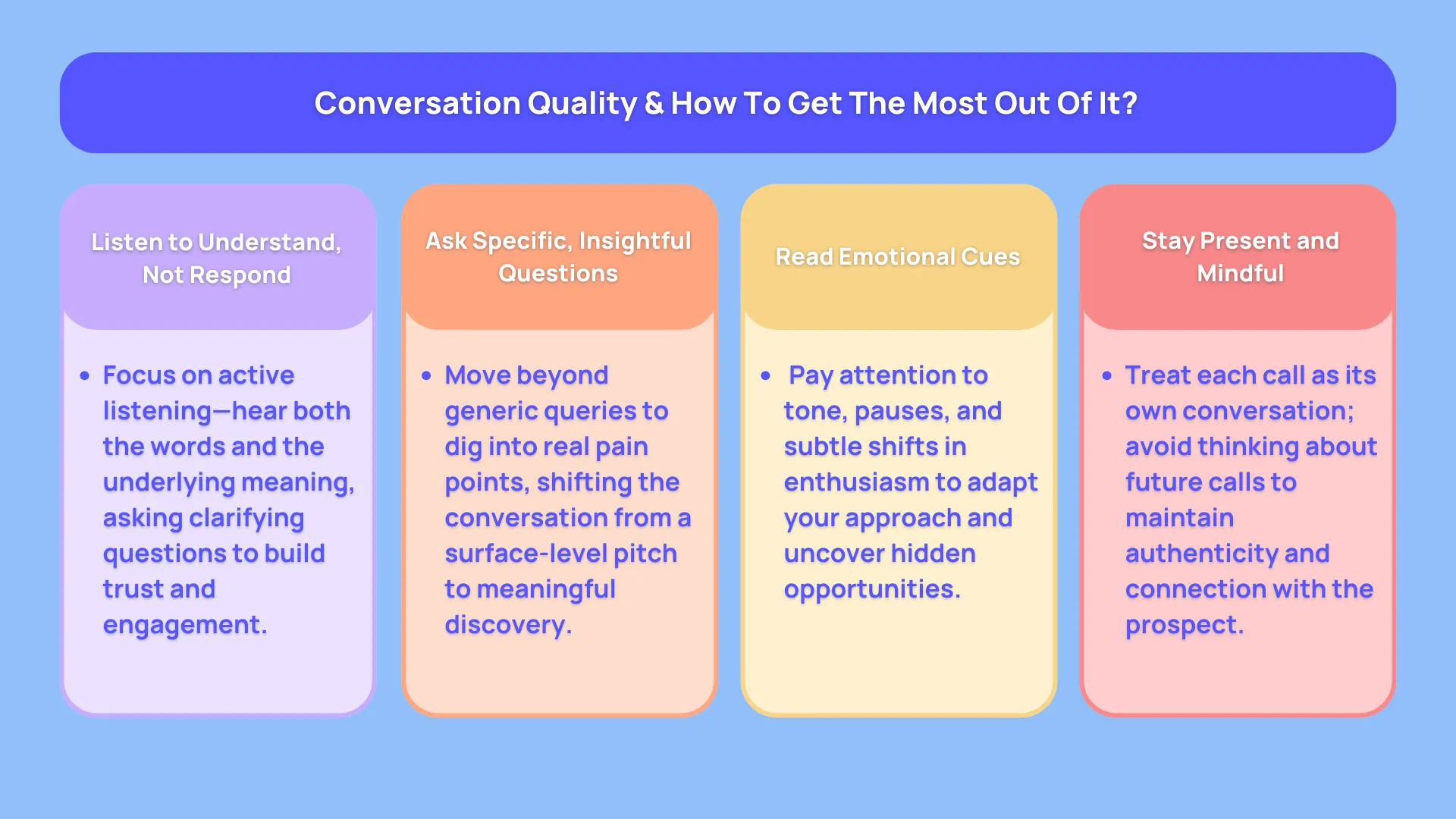
Conversation Quality & How To Get The Most Out Of It?
A lot of reps talk too much. That is usually a sign of anxiety, not confidence.
Conversation quality determines whether your call feels like a pitch or a partnership. If you are serious about how to improve call quality, you need to evaluate how your conversations flow.
Active Listening
Active listening means hearing the words and the meaning underneath them.
If a prospect says, “We already have a vendor,” that is rarely the full story. It could signal satisfaction, frustration, contract lock in, or fear of change.
Strong reps pause. They ask clarifying questions. They paraphrase to confirm understanding. That back and forth creates engagement and trust.
Depth Over Surface Questions
Generic questions produce generic answers.
Instead of asking, “Are you happy with your current process?” try asking, “What part of your current process creates the most friction for your team?”
Specific questions show that you have thought about their reality. That level of curiosity improves sales call quality because it shifts the dynamic from interrogation to genuine discovery.
Emotional Awareness
Tone changes mid call are gold. A subtle sigh. A slight pause. A shift in enthusiasm.
High level reps pay attention to emotional cues and adjust accordingly. If you miss these signals, you miss opportunities.
Modern tools even support call quality assessment through conversation intelligence that highlights talk time ratios, interruptions, and sentiment trends. But technology is only helpful if the rep is open to feedback.
Conversation quality is about presence. If your mind is thinking about the next call while you are on the current one, prospects can feel it.
Sales Techniques That You Need To Use Rightaway
Technique matters. Talent is helpful, but structure wins long term.
If you want to understand how to improve call quality, you need to sharpen your tactical approach. Strong technique gives you confidence, and confidence improves delivery.
Opening With Context
Cold calls feel less cold when you anchor them in relevance.
Mention a trigger event, a shared industry challenge, or a recent company initiative. Context reduces friction and increases engagement in the first thirty seconds, which are critical for sales call quality.
Framing Yourself as a Problem Solver
Prospects do not wake up hoping to buy something. They wake up hoping to solve something.
When you frame your call around outcomes and challenges rather than features, you shift from seller mode to advisor mode. That mindset reduces pressure and increases authenticity.
Controlled Curiosity
You guide the conversation without dominating it. That balance comes from controlled curiosity.
You ask intentional follow up questions that deepen the discussion but keep it aligned with your objective.
Strong technique turns a random conversation into a strategic dialogue. That is where real improvement in call quality happens.
Communication Skills Are a Big Deal, Here's Why!
Communication is the engine behind everything. You can have the best product and the most accurate ICP, but if your delivery lacks clarity, warmth, and confidence, your results will suffer.
Vocal Presence
Your voice carries emotion before your words carry meaning.
Slow down slightly. Enunciate clearly. Smile while speaking. It actually changes how you sound. A calm and confident tone improves call quality metrics such as engagement duration and positive sentiment.
Eliminating Weak Language
Phrases like “I just wanted to” or “I think maybe” dilute authority.
Strong communicators speak directly and respectfully. That does not mean aggressive. It means clear.
Clear language builds trust faster than overly polished scripts.
Strategic Pauses
Silence can feel uncomfortable, especially for new reps. But silence invites the other person to think and respond.
When you ask a meaningful question, pause. Let it land. That space often leads to deeper answers and stronger qualification.
Communication skills are not fixed traits. They are trainable. And that is where coaching enters the picture.
Objection Handling
Objections are not interruptions. They are invitations.
When a prospect pushes back, they are signaling that they are thinking. That is a good thing. The real issue is not objections themselves. It is how reps react to them. If you want to improve sales call quality, your approach to objection handling has to evolve from defensive to curious.
Most objections fall into a few predictable buckets: price, timing, authority, and trust. The difference between average reps and high performers is emotional control.
Here is what strong objection handling looks like in practice:
Slow Down Instead of Speeding Up
When a prospect says, “This sounds expensive,” many reps rush to justify price. That urgency signals insecurity.
Instead, pause and respond calmly. Ask, “Compared to what?” or “Can you tell me more about what feels expensive?”
That shift transforms the conversation from confrontation to clarification. It also improves conversation quality because you are inviting dialogue rather than forcing persuasion.
Validate Before You Challenge
Validation does not mean agreement. It means acknowledgment.
“I understand why you would want to evaluate carefully.”
Once the prospect feels heard, they become more open to new information. This technique strengthens trust and directly improves overall call quality.
Dig Beneath the Surface
Often the first objection is not the real one. “We do not have budget” might mean “I am not convinced of ROI.”
Strong reps ask layered questions to uncover the real barrier. This is where structured coaching and feedback make a huge difference. With the help of modern coaching software, managers can review calls and identify patterns in objection handling that need refinement.
Technology has made this even more dynamic. Platforms offering real-time coaching can now detect conversational signals and provide subtle cues during live calls. That immediate feedback helps reps adjust tone, pace, or framing in the moment, which elevates sales call quality without disrupting the natural flow of conversation.
Objections are growth points. Every tough response is data. If you treat it that way, improving call quality becomes a predictable process rather than a guessing game.
Closing Techniques
Closing is not about pressure. It is about clarity.
Many reps treat the close as a dramatic final move. In reality, strong closes feel like natural next steps that both parties understand and accept.
If you want to know how to improve call quality at the end of conversations, focus on alignment rather than persuasion.
Micro Commitments Throughout the Call
Strong closes start early.
When you secure small agreements during discovery, you reduce friction later. For example:
“So if we could shorten onboarding time, that would make a real impact for your team?”
Those small confirmations build logical momentum. When it is time to schedule a demo or next meeting, it feels consistent with everything already discussed.
Recap With Precision
Before proposing the next step, summarize what you heard.
“You mentioned that manual reporting is eating up six hours per week, and your leadership wants better visibility before Q3 planning.”
Recapping demonstrates listening. It also reinforces value. This directly improves call quality assessment because the conversation feels structured and intentional.
Clear Next Steps
Avoid vague endings like “I will follow up.”
Instead, suggest a specific time and purpose. Clarity reduces ghosting and improves measurable outcomes tied to call quality metrics, such as meeting conversion rates and follow through consistency.
Closing is about confidence in mutual benefit. If that confidence is not there, the prospect will sense hesitation immediately.
Call Coaching
Even elite athletes have coaches. Sales should be no different.
If you want sustainable improvement in sales call quality, coaching must be consistent and structured. Occasional feedback is not enough.
Data Driven Feedback
Gut feelings are unreliable. Recorded calls, talk time ratios, interruption rates, and sentiment analysis provide objective insights.
This is where modern call intelligence platforms shine. They allow managers to perform detailed call quality assessment based on real performance rather than assumptions.
Live Support Through Real-Time Coaching

Traditional coaching happens after the call. That is helpful, but live feedback can accelerate growth dramatically.
With real-time coaching, reps receive subtle prompts during conversations. That might include reminders to ask follow up questions, slow down pacing, or probe deeper on a pricing objection.
The impact is immediate. Instead of repeating mistakes for weeks, reps course correct instantly. That shortens ramp time and directly improves call quality across the team.
Personalized Development Plans
Not every rep struggles with the same issue. One might need support with tone. Another might need help refining discovery questions.
Structured coaching identifies individual gaps and addresses them intentionally. Over time, this targeted approach transforms average performance into consistent excellence.
Coaching is not about criticism. It is about clarity and momentum.
Performance Metrics
If you cannot measure it, you cannot improve it.
Understanding the right call quality metrics is essential for long term growth. Many teams obsess over volume, but quantity alone does not reflect true effectiveness.
Here are performance indicators that actually matter:
Talk to Listen Ratio
High performing reps typically allow prospects to speak more than half of the time during discovery calls.
Balanced conversation often correlates with stronger engagement and better qualification.
Conversion to Next Step
How many calls result in scheduled meetings, demos, or follow ups?
This metric directly reflects call effectiveness and closing ability.
Objection Resolution Rate
Track how often initial objections lead to deeper conversations instead of abrupt call endings.
This metric highlights improvement in objection handling skills and overall conversation quality.
Call Sentiment Trends
Modern analytics tools can measure positive, neutral, or negative emotional shifts.
Monitoring sentiment over time provides valuable insight into communication style and tone effectiveness.
When you align metrics with skill development, performance becomes predictable rather than random.
Quality Assurance
Quality assurance is not about policing reps. It is about protecting standards.
Consistent QA ensures that messaging stays aligned with brand values and customer expectations.
Structured Review Framework
Create a repeatable scoring system for calls. Evaluate:
- Clarity of introduction
- Relevance of questions
- Handling of objections
- Strength of close
- Professional tone
A formalized call quality assessment framework keeps evaluation fair and constructive.
Peer Review Sessions
Listening to calls as a group creates shared learning moments. Reps gain exposure to different communication styles and techniques.
This collaborative environment encourages transparency and continuous refinement of sales call quality.
Quality assurance reinforces consistency, which builds customer trust at scale.
Continuous Improvement
Sales is dynamic. Markets shift. Buyers evolve. Messaging that worked six months ago may not resonate today.
Continuous improvement means accepting that optimization never stops.
Ongoing Skill Refinement
Communication skills, questioning depth, and closing strategies all require regular sharpening.
Teams that invest in consistent training and structured coaching see measurable gains in improving call quality over time.
Process Adjustments
If conversion rates dip, investigate qualification criteria, messaging relevance, and targeting accuracy.
Strong teams treat performance dips as signals, not failures.
Technology Evolution
AI driven insights, conversation intelligence, and advanced coaching software continue to reshape how teams manage call quality.
When combined with human judgment and empathy, technology amplifies performance rather than replacing it.


Power and parallel dialing in your CRM.