Our Top Picks


If you’re wondering how to train sales reps in a way that actually leads to quota attainment, confidence, and long term retention, you’re not alone. Most sales leaders have felt that tension. You hire someone with potential. You see the talent. But you also know the clock is ticking.
A strong sales onboarding process can be the difference between a rep who ramps in four months and one who struggles for nine. It can mean the difference between a confident pipeline builder and someone quietly updating their resume.
Great sales rep training is not a stack of slides and a CRM login. It is structured, intentional, and built around real world execution. What follows is a complete, human centered breakdown of how to design a powerful sales training program that supports your reps through their first 30, 60, and 90 days and beyond.
What Is Sales Onboarding In Terms of Newly Hired Sales Reps?

Sales onboarding is more than orientation. It is the structured path that helps a new hire transform from “new person” to trusted revenue contributor.
When people think about training sales team members, they often imagine product walkthroughs and pitch decks. That is only one part of the equation. True sales onboarding connects five core elements:
- Company mission and culture
- Product mastery
- Customer understanding
- Sales process clarity
- Real world application
If any of these are missing, performance suffers.
Poor onboarding is expensive. Turnover in sales can cost well into six figures per rep when you factor in hiring costs, lost pipeline, stalled accounts, and ramp delays. Strong onboarding reduces that risk and accelerates revenue impact.
From that point of view, a structured 30-60-90 day sales training program gives new reps clarity. It removes guesswork. It answers the question every new hire silently asks: “What does success look like here?”
When reps know the expectations, the timeline, and the support system, performance improves and stress decreases.
Training Program
If you want clarity on how to train sales reps, start with structure. Talent matters. Personality matters. Experience matters. But structure is what turns potential into predictable performance.
A strong sales training program should feel intentional, not improvised. It needs a clear timeline, measurable expectations, and consistent reinforcement. When new reps can see the roadmap ahead of them, confidence rises. Anxiety drops. Execution improves.
Your training program should answer five questions:
- What should a rep know?
- What should a rep be able to do?
- What should a rep produce?
- How will performance be measured?
- Who supports them along the way?
Without clear answers, onboarding turns reactive. And reactive training slows ramp time.
The most effective sales training best practices revolve around clarity, repetition, accountability, and feedback. Reps do not need information overload. They need progression.
Now let’s break that progression down into the first 30 days.
The First 30 Days: Foundation and Clarity
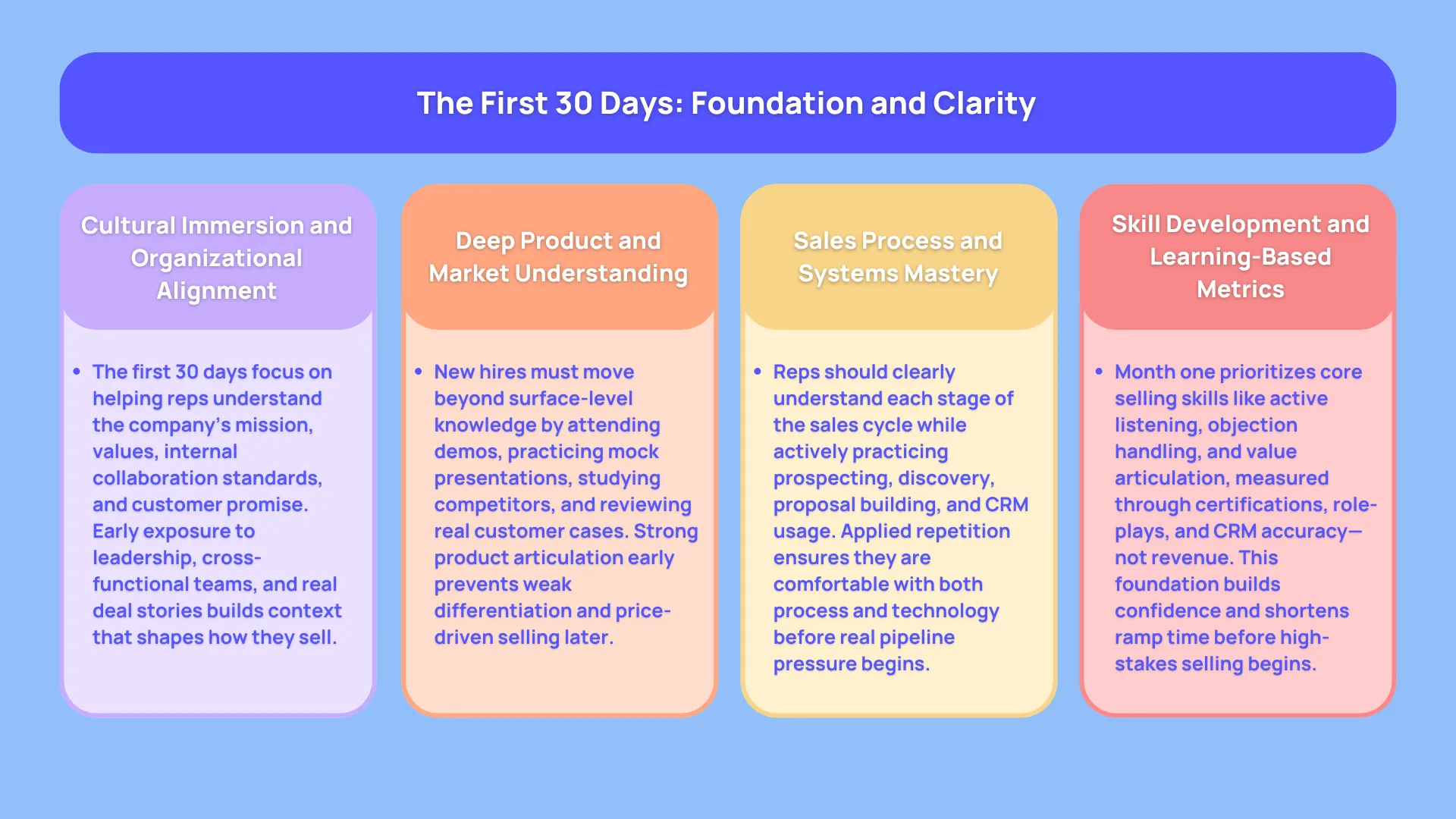
The first month is not about closing deals. To add to it, we'd say that this timeline is more about building confidence and understanding. This is where your sales onboarding either sets momentum or creates confusion.
During the first 30 days, your goal is immersion.
Company and Culture
Reps need to understand what your company stands for. Culture is not a slide deck. It is how decisions are made, how customers are treated, and how internal teams communicate.
Spend real time walking through:
- Mission and vision
- Revenue goals
- Customer promise
- Communication expectations
- Internal collaboration standards
Encourage one on one meetings with leadership and cross functional teams. A rep who understands marketing, operations, and customer success will sell differently than one who only knows their script.
This is where knowledge transfer begins. When seasoned reps share stories about real deals, lost opportunities, and customer wins, new hires learn nuance that cannot be captured in documentation.
Product and Market Mastery
A rep who does not deeply understand the product will default to surface level selling. That leads to price objections and weak differentiation.
In the first 30 days, reps should:
- Attend live demos
- Conduct mock demos
- Review competitor positioning
- Study customer case studies
- Analyze real contracts
Encourage them to articulate the product in their own words. If they cannot explain the value clearly without slides, more practice is needed.
This stage also benefits from structured AI sales training platforms that simulate conversations and test product articulation in realistic scenarios. These tools allow reps to practice messaging before they are in front of a real prospect.
Understanding the Sales Process
Every organization has its own rhythm. Discovery. Qualification. Demo. Proposal. Negotiation. Close.
Spell out each stage clearly. Show examples of real opportunities at each step. Let new reps review pipeline dashboards and call recordings.
Have them practice:
- Writing prospecting emails
- Drafting discovery questions
- Creating tailored presentations
- Building sample proposals
This is not passive learning. It is applied repetition.
CRM and Systems
Access to systems should happen early, not at the end of month one. Reps should:
- Log mock activities
- Build prospect lists
- Map account hierarchies
- Track outreach plans
Technology should support behavior. If your CRM feels complicated, training needs to address it directly.
Some teams also introduce lightweight coaching software at this stage to track call quality and skill progression. Early exposure helps normalize feedback.
Performance Metrics in Month One
During the first 30 days, performance metrics are learning based, not revenue based.
Measure:
- Product certification completion
- Demo practice scores
- Role play performance
- Prospect list creation
- CRM accuracy
Do not measure closed revenue yet. Measure preparedness.
This mindset shortens ramp time because reps build skills before they face high stakes pressure.
Skill Development
Skill development is not a one time event. It is layered growth.
Early on, focus on core selling skills:
- Active listening
- Question framing
- Objection navigation
- Value articulation
- Time management
Instead of overwhelming reps with everything at once, isolate skills. Spend a week focused purely on discovery. Spend another focused on objection handling.
This approach accelerates confidence and prevents overload.
Modern role-play tools allow reps to simulate objections in realistic environments. The repetition strengthens muscle memory. When a real objection surfaces, the rep has already practiced the response multiple times.
Skill development must continue into month two and month three. But month one sets the foundation.
Days 31 to 60: Application and Confidence
Month two is where theory turns into motion.
Your reps now understand the company, the product, and the sales process. The question shifts from “Do I understand this?” to “Can I execute this?”
This phase of your sales training program is about applied repetition, controlled exposure, and real accountability. If month one built clarity, month two builds confidence.
Role Playing
Role playing is where hesitation disappears and muscle memory develops.
Too many teams treat role play as a quick warm up exercise. In reality, it should be one of the most structured parts of your sales rep training.
During days 31 to 60, role playing should focus on:
• Discovery calls with layered questioning
• Handling common objections such as pricing and timing
• Running full product demos
• Negotiation conversations
• Closing language
Each role play session should include detailed feedback. Not just “good job” or “slow down.” Instead, give specific commentary on tone, pacing, clarity, and question quality.
This is where structured role-play tools can create consistency. AI driven simulations allow reps to practice high pressure objections repeatedly without burning real opportunities. It creates psychological safety while still demanding performance.
Encourage reps to record themselves. When people watch their own calls, self awareness increases dramatically. They notice filler words, rushed explanations, and missed cues.
Repetition builds fluency. Fluency builds confidence.
Sales Coaching
Training gives knowledge. Coaching creates transformation.
During month two, coaching should move from foundational instruction to situational refinement. This is where sales leaders become performance multipliers.
Effective coaching includes:
• Reviewing real call recordings
• Analyzing discovery depth
• Evaluating demo clarity
• Breaking down objection responses
• Setting weekly micro improvement goals
This is also where structured coaching software becomes powerful. Instead of relying on memory, managers can tag call moments, highlight missed opportunities, and provide timestamped feedback. Reps receive clear direction instead of vague advice.
Coaching conversations should be forward looking. Avoid focusing only on mistakes. Frame feedback around growth. Ask questions such as:
What would you try differently next time?
Where did you feel most confident?
Where did you feel unsure?
Sales coaching during this period shortens ramp time dramatically because it corrects patterns before they solidify.
Pipeline Development
By day 31, reps should begin active outreach.
Now the focus shifts toward building real pipeline. This is where your training sales team efforts meet revenue reality.
Reps should:
• Execute daily prospect outreach
• Follow structured call blocks
• Personalize emails based on target accounts
• Connect on social channels
• Log all activities accurately in CRM
Volume expectations should be clear. So should quality standards.
Review messaging frequently. If meetings are not being booked, evaluate targeting, subject lines, call openers, and value statements.
Pipeline reviews during this phase are educational, not punitive. The goal is learning patterns, not creating fear.
Knowledge Transfer
Month two is the perfect time to deepen knowledge transfer.
Have new reps shadow top performers in live meetings. After each call, debrief immediately. Ask:
What did you notice about the discovery questions?
How did they transition to pricing?
What signals did you see from the prospect?
Then reverse the roles. Let leadership or senior reps shadow the new hire. Immediate feedback accelerates growth.
Encourage informal peer learning sessions. Top reps can walk through their favorite call structures or negotiation strategies. This strengthens team cohesion and reinforces a unified sales culture.
Knowledge transfer reduces the risk of isolated performance. It ensures new hires reflect the company’s selling identity.
Performance Metrics for Days 31 to 60
Metrics during this phase should balance activity and skill.
Track:
• Outreach volume
• Meetings booked
• Call quality scores
• Demo performance ratings
• CRM accuracy
• Feedback responsiveness
Avoid obsessing over closed revenue yet. The rep is still ramping.
The goal is forward motion. Improvement in conversation quality. Increased meeting conversion. Greater confidence.
A structured AI sales training system can also analyze patterns in call behavior, highlighting talk time ratios, question density, and objection handling effectiveness. Data driven insights remove guesswork and sharpen development.
Ramp Time
Ramp time is one of the most misunderstood concepts in sales.
It is not just how long it takes a rep to close a deal. It is how long it takes them to consistently perform at quota level without excessive supervision.
A thoughtful 30-60-90 day sales onboarding structure reduces ramp time because:
• Skills are layered logically
• Coaching happens early
• Mistakes are corrected quickly
• Confidence builds steadily
When onboarding lacks structure, ramp stretches unnecessarily. Reps feel overwhelmed. Managers feel frustrated. Pipeline suffers.
Month two is the bridge between training and ownership. Handle it intentionally and month three becomes powerful.
Days 61 to 90: Ownership and Performance
You’re right to call that out.
If you’re building long form content around how to train sales reps, shallow bullets with surface commentary won’t cut it. Let’s slow this down and actually build depth, narrative, and substance.
I’m going to continue from the 61 to 90 day phase, but this time in a truly conversational, human tone with layered explanation instead of checklist dumping.
Days 61 to 90: From Supervised Practice to Real Ownership
By month three, something shifts.
In the first 30 days, reps are absorbing. In the next 30, they are practicing with support. But in days 61 to 90, the emotional weight changes. This is where a new hire starts asking themselves, “Can I really do this?”
This is also where many sales onboarding programs quietly fail.
Leaders assume the rep is ready because they have completed training modules and shadowed enough calls. But readiness is not about exposure. It is about independent execution under pressure.
A strong sales training program treats this phase as controlled autonomy. You do not remove support. You reduce proximity while increasing accountability.
During this stage, reps should be running their own discovery calls from start to finish. Not just opening the conversation, but managing the flow, controlling the agenda, asking layered questions, and navigating unexpected turns.
And here is where real sales rep training becomes visible. When a prospect pushes back on pricing or timing, does the rep default to discounting, or do they calmly return to value? When a decision maker joins late in the process, does the rep panic, or do they adapt their positioning?
These moments define ramp time more than any certification test ever could.
Managers should still review calls regularly. But instead of correcting fundamentals like “ask more open ended questions,” coaching conversations now move into strategic territory. You discuss deal positioning. You evaluate stakeholder mapping. You dissect emotional cues from buyers.
This is advanced development. This is what separates a trained rep from a professional seller.
Sales Coaching at the 90 Day Mark

Let’s talk honestly about coaching.
Most managers think they are coaching because they give feedback. Feedback alone is not coaching. Coaching is structured growth with intention.
At the 90 day mark, coaching should shift from reactive correction to performance refinement.
Instead of saying, “You talked too much,” you might say, “Notice how the prospect hesitated when you introduced pricing. What question could you have asked in that moment to slow the conversation and uncover the real concern?”
That kind of dialogue builds thinking skills. It trains judgment, not just scripts.
This is where structured coaching software becomes valuable. When call moments are tagged and reviewed with precision, coaching stops feeling personal and starts feeling professional. The rep can see the exact second where momentum shifted.
You are not criticizing them. You are analyzing behavior.
And that distinction matters for morale.
A healthy coaching culture shortens ramp time because mistakes are addressed early, without shame, and with clarity.
Performance Metrics That Drive Growth
Let’s move away from vanity metrics for a second.
If your only definition of success at 90 days is closed revenue, you are creating unnecessary pressure and distorted behavior. Yes, revenue matters. But sustainable performance is built on leading indicators.
At this stage of training sales team members, look deeper.
Are discovery calls producing second meetings at a healthy rate?
Is pipeline coverage strong enough to support future quarters?
Is the rep demonstrating control in sales conversations?
Are they improving week over week based on coaching feedback?
When you evaluate performance metrics this way, you protect both results and development.
You also create fairness. A rep selling into enterprise accounts will naturally have longer cycles than someone selling transactional deals. A thoughtful sales onboarding structure accounts for those differences.
Data should guide conversations, not intimidate people.
Modern AI sales training platforms can also analyze patterns across calls, like talk to listen ratios or objection frequency. When those insights are introduced carefully, they sharpen awareness without overwhelming the rep.
Metrics should illuminate, not suffocate.
Skill Development Does Not Stop at 90 Days
One of the biggest mistakes companies make is treating onboarding like a finish line.
The 30-60-90 day model is simply the foundation. Real mastery happens after.
Skill development at this stage becomes more strategic and nuanced. Now you are helping reps think about multi thread deals, internal politics within client organizations, competitive displacement strategies, and negotiation leverage.
This is also the moment to introduce advanced role-play tools that simulate complex buying committees or aggressive procurement conversations. Basic objection handling is no longer enough. Reps need practice navigating layered resistance.
And here is something often overlooked in sales training best practices. Emotional intelligence deserves as much attention as product knowledge.
Can your reps sense hesitation before it becomes a rejection?
Can they adapt their communication style based on personality cues?
Can they create urgency without pressure?
Those are advanced skills. They take time. They require reflection and repetition.
The best sales organizations treat skill development as ongoing conditioning, not a one time event.
Knowledge Transfer as a Cultural Advantage
There is something powerful about storytelling in sales teams.
When experienced reps openly share lost deals, pricing missteps, and negotiation breakthroughs, new sellers absorb pattern recognition that no manual can teach.
Structured knowledge transfer sessions should continue well beyond the initial sales rep training phase. Monthly deal breakdowns, open pipeline reviews, and collaborative brainstorming sessions create collective intelligence.
When a new rep sees that even top performers face rejection, it normalizes struggle. That psychological safety strengthens performance.
Culture is not a poster on the wall. It is visible in how openly the team discusses failure and growth.
Ramp Time Is Emotional as Much as Operational
Ramp time is usually discussed in months and metrics. But it is also emotional.
The faster a rep feels competent, the faster they behave confidently. And confidence changes outcomes.
A thoughtful sales training program reduces ramp time because it removes ambiguity. Reps know what is expected in month one, month two, and month three. They understand how performance is measured. They know where to seek help.
When expectations are vague, ramp drags. When structure is clear, momentum builds.
That clarity is what answers the real question behind “how to train sales reps.”
It is not about overwhelming them with information. It is about sequencing growth.
Continuous Learning as a Revenue Engine
After 90 days, training cannot disappear.
Continuous learning might include advanced workshops, peer led masterclasses, call deep dives, and structured sales coaching cycles. Some organizations create quarterly skill themes, like negotiation mastery one quarter and enterprise discovery the next.
This rhythm keeps performance sharp.
A mature sales onboarding system evolves into a permanent development engine. And that engine fuels retention. Talented reps stay where growth is visible.
Training is not an expense. It is a revenue multiplier.


Power and parallel dialing in your CRM.