Our Top Picks


After spending decades in the sales industry and working alongside all kinds of business leaders, one truth keeps showing up again and again.
Sales success does not come from pressure.
While it’s true that a certain degree of micromanagement, or shouting targets at people tends to keep everyone on track, but things can go awry pretty fast. Especially if the top level management adds additional SDR performance tracking programs, such as time logs, screenshots, key captures, and mouse clicks, you won’t be getting the desired results.
SDRs will work, but that would happen because of the newly imposed micromanagement processes. They won’t have their “heart” in the game.
On the contrary, success in achieving that level of growth normally comes from a “balanced” combination of few performance metric/ policies, a sense of clarity, trust, structure, and leadership that understands how people actually perform at their best.
Learning how to manage a sales team is less about tactics and more about creating an environment where good performance becomes the natural outcome. Sales team management works when leadership focuses on culture, communication, development, and accountability at the same time. Miss one, and the whole system feels fragile.
This piece walks through what long term sales team leadership really looks like in practice.
Not theory.
Not buzzwords. It’s stuff that reportedly works when managing sales reps at scale and keeping momentum as the business grows.
Sales Leadership: Setting the Direction Without Suffocating the Team

As I mentioned a bit earlier, sales leadership is not about flexing control or authority.
On the contrary, I’d say that it is about direction.
Your team should never feel confused about where they are going or why their work matters. When leadership lacks clarity, performance drops quietly and steadily.
Any strong sales team leadership starts with alignment. Revenue goals, customer priorities, positioning, and expectations must be understood at every level. People do better work when they understand how their effort connects to outcomes.
This is where leadership earns trust, and continues to evoke that level of performance without any special kind of monitoring, or stuff like that.
By the way, one of the most common and biggest mistake that many founders and sales managers make is assuming clarity has already been communicated.
No, it has not.
Clarity needs repetition, reinforcement, and context. That means explaining not just the target, but the reason behind it, how success will be measured, and what support exists along the way.
It’s harder than it looks. For instance, just to spread one message, or a weekly goal, you have to circulate a special broadcast across Slack, emails and other areas where sales reps interact with one another. On top of that, managers need to be assertive when it comes to accountability. Simply circulating a message, or an email, doesn’t really cut it because different SDRs have varying levels of learning curve, adherence to protocol, etc.
Sales leaders also set emotional tone. Calm leadership during slow months builds resilience. Steady leadership during high growth prevents chaos. Teams mirror behavior more than instructions.
Good leadership removes friction so selling feels easier, not heavier.
Team Management: Creating Structure Without Killing Momentum
Team management sits at the intersection of people and process. When done right, it gives sales reps freedom within clear boundaries. When done poorly, it turns into micromanagement or complete neglect.
Managing sales reps effectively requires a solid structure or some kind of foundation that feels supportive, instead of being all too restrictive.
Clear roles with some kind of background clarity, defined responsibilities vs. accountability, and visible ownership prevent confusion and internal friction. Everyone should know where their lane starts and ends.
Team management also means recognizing that sales teams are made up of different personalities and motivators. Some thrive on competition, others on mastery, others on security. Treating everyone the same sounds fair, but usually produces uneven results.
Great sales team management adapts without playing favorites. Expectations stay consistent, support feels personal.
Performance Management: Turning Goals Into Daily Focus
Sales team performance management starts long before end of month numbers appear on a dashboard. It begins with clear, realistic goals that connect to daily activity.
SMART goals matter, not because they are popular, but because they eliminate ambiguity. When goals are specific and time bound, reps know where to focus. When goals are measurable, feedback becomes objective instead of emotional.
Performance management works best when it becomes a continuous conversation, not a quarterly surprise. Regular reviews, one on ones, and visible benchmarks keep performance top of mind without creating pressure.
This is also where transparency plays a powerful role. When progress is visible across the team, accountability becomes shared. Dashboards showing deals closed, pipeline health, and activity volume help normalize performance discussions.
Well designed performance systems rely on meaningful sales productivity metrics, not vanity numbers. Calls alone do not tell the story. Conversations, conversion rates, pipeline velocity, and deal quality do.
Sales Metrics: Measuring What Actually Moves Revenue
Sales metrics are only useful when they reflect reality. Tracking everything creates noise. Tracking the right things creates focus.
Effective sales team performance management centers on metrics that connect activity to outcomes. That includes, but isn’t certainly restricted to, pipeline progression, average deal size, win rates, and time to close. These numbers reveal patterns early, before revenue is missed.
Metrics should guide coaching conversations, not punish people. When data is framed as a tool for improvement, reps engage with it. When it feels like surveillance, they avoid it.
The most effective leaders pair metrics with context. Numbers show what happened. Conversations explain why it happened.
Used correctly, sales productivity metrics help leaders coach better, forecast more accurately, and remove obstacles that slow the team down.
Sales Coaching: Turning Feedback Into Growth

Sales team coaching is where management turns into leadership. Coaching is not correction. It is development.
High performing teams are coached consistently, not only when results drop. Regular call reviews, deal debriefs, and skill focused sessions help reps sharpen their approach without fear.
Modern teams often rely on sales coaching software to scale feedback without losing quality. Tools that analyze conversations, surface patterns, and highlight improvement areas allow managers to coach based on evidence rather than memory.
AI coaching tools are increasingly useful here, especially for growing teams. They help to identify talk ratios, objection handling gaps, and missed opportunities that human managers may overlook.
The best coaching conversations feel collaborative. Instead of telling reps what went wrong, great managers ask questions that help reps discover improvements themselves.
That sense of ownership is what turns feedback into habit change.
Team Development: Building Skills That Compound Over Time
Team development goes beyond onboarding. Sales skills decay when they are not practiced or refreshed. Markets change. Buyers change. Messaging evolves.
Continuous development keeps teams adaptable and confident. That includes product knowledge, competitive awareness, communication skills, and emotional intelligence.
Development works best when it feels integrated into the rhythm of work. Short training sessions, peer learning, role plays, and real deal analysis make learning practical instead of theoretical.
Investing in development sends a clear message. You are not just here to hit numbers. You are here to grow.
That mindset increases retention, engagement, and long term performance.
Sales Enablement: Removing Friction From the Selling Process
Sales enablement exists to make selling easier. When reps struggle to find information, explain value, or navigate tools, performance suffers quietly.
Enablement includes clear messaging, accessible resources, well designed processes, and technology that supports rather than complicates work. Reps should spend their time selling, not searching.
Strong enablement also aligns marketing, product, and sales around shared goals. When teams operate in silos, reps become translators instead of sellers.
Enablement is not a one time setup. It evolves as the company grows and the market shifts.
Team Motivation: Creating Energy That Sustains Performance
Team motivation is not about hype. It is about momentum. Sales teams burn out when motivation relies only on commissions or pressure. Long term performance comes from feeling progress, recognition, and fairness.
Motivation starts with visibility. When people can see their impact, motivation becomes internal. Live dashboards that show deals closed, pipeline movement, or monthly progress create a sense of pace. This is where transparency quietly fuels urgency.
Recognition also matters more than most leaders realize. Publicly acknowledging effort, improvement, and smart execution reinforces the behaviors you want repeated. Recognition does not always need to be financial. Sometimes visibility and respect carry more weight.
Incentives work best when they reward controllable actions alongside outcomes. Not every rep controls deal size or timing, but they do control preparation, follow ups, and activity quality.
Motivation fades when people feel the system is rigged. Fair distribution of opportunity, clear rules, and consistent expectations keep motivation steady even during slow periods.
Sales Culture: The Invisible Force Behind Results
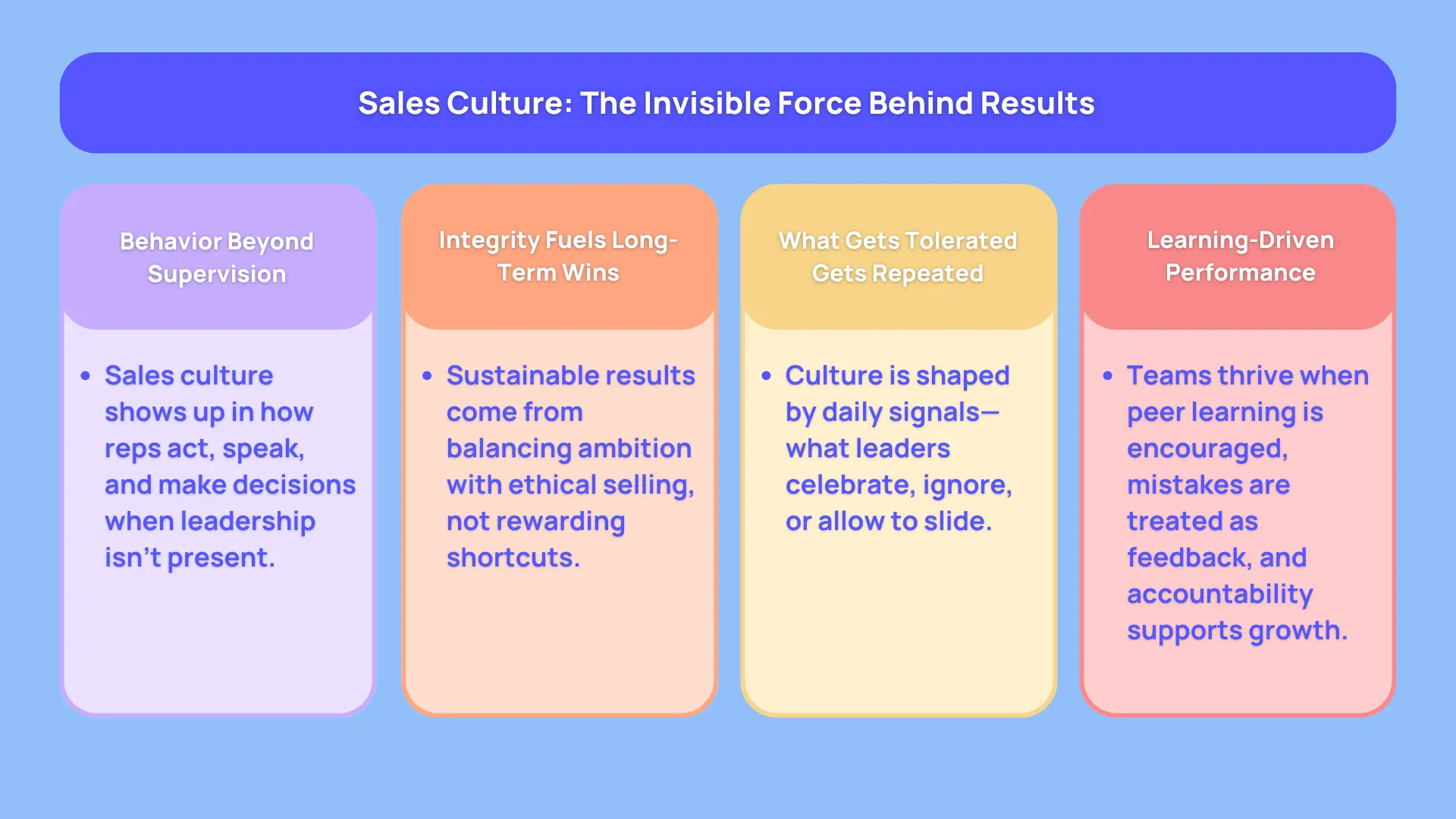
Sales culture shapes behavior when no one is watching. You can feel it in how reps talk about customers, teammates, and leadership.
A healthy sales culture balances ambition with integrity. Winning matters, but how you win matters more. When shortcuts are rewarded, problems surface later in churn, reputation, and morale.
Culture is reinforced daily through what leaders tolerate and what they celebrate. If collaboration is praised but competition is rewarded exclusively, culture becomes confused.
Strong sales cultures encourage peer learning. Top performers share what works. New reps feel safe asking questions. Mistakes are treated as data, not failure.
When culture supports growth and accountability at the same time, performance becomes durable.
Sales Pipeline Management: Controlling Flow Instead of Chasing Deals
Sales pipeline management is where forecasting becomes predictable instead of stressful. A healthy pipeline is not about volume alone. It is about quality, movement, and balance.
Each stage should represent a real customer commitment, not hopeful labeling. When stages are vague, forecasts inflate and trust erodes.
Pipeline reviews should focus on next steps, not just deal size. If a deal has no clear action or timeline, it is not really in play.
Effective pipeline management also prevents overloading top performers while starving newer reps. Balanced pipeline distribution creates resilience across the team.
Clear pipeline hygiene standards make coaching easier and forecasts more accurate.
Sales Metrics: Turning Data Into Better Decisions
Metrics only matter when they change behavior. Tracking without action wastes attention.
The most effective sales leaders focus on a small set of meaningful indicators. Conversion rates between stages, pipeline velocity, and win rate trends reveal more than raw activity counts.
Metrics should guide coaching conversations and resource allocation. When one rep closes fewer deals but converts at a higher rate, that insight shapes how leads are assigned.
Modern teams often rely on AI coaching tools to surface these patterns faster. Automated insights help managers spot risks early and coach with precision.
Metrics work best when paired with context and trust. Numbers explain performance, not people.
Sales Coaching To Scale Skill Without Micromanagement
Sales team coaching becomes more challenging as teams grow. One manager cannot listen to every call or review every deal manually.
This is where sales coaching software plays a meaningful role. Recorded calls, performance trends, and coaching prompts help managers stay close to the field without hovering.
The best coaching focuses on patterns, not isolated mistakes. Reps improve faster when feedback highlights recurring behaviors rather than one off errors.
Coaching should feel like partnership. The goal is improvement, not correction. When reps feel supported, they seek feedback instead of avoiding it.
Consistent coaching builds confidence, not dependence.
Team Development: Specialization and Strength Based Growth
As teams grow, specialization becomes a growth lever. Not every rep should do everything.
Some excel at prospecting, others at closing, others at relationship management. Aligning roles with strengths increases efficiency and satisfaction.
Segmenting accounts based on rep capability also improves outcomes. Enterprise deals demand different skills than small business conversations. Matching talent to opportunity respects both the rep and the customer.
Development plans should reflect this reality. Growth does not always mean promotion. Sometimes it means mastery.
Teams that invest in strength based development scale faster with less friction.
Sales Enablement: Supporting Reps Where It Counts
Sales enablement should remove obstacles, not add process. Reps need quick access to messaging, competitive insights, and customer context.
Enablement works best when it listens to the field. Sales reps know where friction exists. Leadership that incorporates this feedback builds systems people actually use.
Enablement also bridges gaps between sales, marketing, and product. Alignment prevents mixed messaging and shortens sales cycles.
When enablement is strong, reps spend more time in meaningful conversations and less time navigating internal complexity.
Performance Management: Fairness, Transparency, and Trust
Performance management systems fail when they feel arbitrary. Trust erodes when expectations change quietly or exceptions are made inconsistently.
Clear targets, visible progress, and open conversations create stability. Transparency helps reps self correct before intervention is needed.
Fair account distribution plays a role here. High performers deserve opportunity, but new talent needs room to grow. Balanced systems create depth instead of dependency on a few stars.
Performance management works best when it feels predictable and humane.
Summing It Up…
Learning how to manage a sales team at scale requires patience and intention. Sales team management is not a set of tactics. It is a system built on leadership, clarity, development, and trust.
Sales team leadership succeeds when people feel supported and challenged at the same time. Managing sales reps effectively means understanding performance as a product of environment, not just effort.
When sales team performance management, sales team coaching, and culture align, growth stops feeling forced. It starts to feel inevitable.


Power and parallel dialing in your CRM.