Our Top Picks


Sales keep the lights on. No revenue, no growth. Yet modern sales teams are expected to close more deals, move faster, personalize every interaction, and forecast accurately, often with leaner teams and tighter budgets. That is exactly where understanding how to use CRM effectively becomes a competitive advantage instead of just a software decision.
A CRM is not just a digital address book. When approached with the right CRM strategy, it becomes the operational backbone of your entire revenue engine. It shapes how your team tracks conversations, manages deals, nurtures relationships, and makes decisions.
If you are serious about applying strong CRM best practices, this is where the real transformation happens.
What Does a Sales CRM Do for Revenue and Sales Ops Teams?

On paper, a sales CRM centralizes customer data and tracks opportunities. In practice, it creates operational memory.
Think about what normally happens in a growing sales organization. Reps store key information in their inbox. Important context lives in personal notes. Pricing conversations happen over calls that are never summarized. When someone leaves the company, the relationship history leaves with them.
That chaos is expensive.
CRM for sales teams solves this at its core. It captures conversations, objections, internal politics inside accounts, decision maker preferences, and buying timelines. It builds a living history around every relationship.
More importantly, it creates visibility across the organization. Sales leadership sees what is happening before revenue hits or misses. Marketing understands which leads actually convert. Customer success can review promises made during the sales process.
That is why CRM implementation should never be treated as an IT project. It is a revenue infrastructure decision.
CRM Strategy: The Foundation Most Teams Skip
Here is where most companies get it wrong.
They buy software. They configure fields. They import contacts. They run onboarding sessions. And they assume the job is done.
Well, the truth is that it is hardly that way in real life use cases.
On the contrary, a “real CRM strategy” starts with a simple but uncomfortable exercise: mapping your actual sales process honestly. And alongside that, you should also keep in mind that vanity metrics may seem shiny and attractive, but they don’t really offer any value. We’ll talk about those later.
Let’s move on and see what else is associated with how to use CRM effectively at foundational level…
Not the aspirational process. Not the version you want investors to believe. The real one.
How do deals start:
- When do you truly consider a lead qualified
- What typically delays opportunities
- How long does each stage realistically last
- What information determines if a deal is serious
If this thinking is not done upfront, your CRM structure will reflect guesswork rather than reality.
And that leads to a subtle but dangerous problem. Reps begin updating stages based on optimism instead of progress. Forecasting becomes inflated. Managers spend time questioning numbers instead of coaching behavior.
A strong CRM strategy ties revenue targets directly to process clarity. If leadership wants predictable growth, the CRM must track leading indicators like meeting volume, qualification depth, and stage conversion rates, not just closed revenue.
The strategy layer defines how the CRM reinforces accountability rather than just documenting activity.
Data Management: The Unsexy Driver of CRM Success
Most people want to talk about dashboards and AI CRM systems. Very few want to talk about data discipline.
Yet data management is where everything either strengthens or collapses.
Imagine trying to forecast revenue when half the deals in your pipeline have not been updated in weeks. Imagine trying to segment leads by industry when reps spell industries differently every time they enter them. Imagine running reports on win rates when duplicate accounts inflate your opportunity count.
That is what weak data management creates. False confidence.
Understanding how to use CRM effectively requires accepting that clean data is not optional admin work. It is strategic leverage.
When data is structured consistently, reporting becomes trustworthy. When reporting is trustworthy, decisions improve. When decisions improve, revenue becomes more predictable.
There is also a future facing dimension to this. Advanced AI CRM systems rely entirely on structured, consistent inputs. Predictive scoring, churn modeling, and intelligent deal routing cannot function reliably if the foundation is messy. Companies that invest in data hygiene today unlock smarter automation tomorrow.
What Is a Sales CRM?
A sales CRM, short for Customer Relationship Management system, is a centralized platform that helps businesses manage customer interactions, track opportunities, organize pipeline activity, and maintain a complete history of every relationship across the sales cycle.
At its core, a sales CRM brings order to complexity.
Instead of relying on scattered spreadsheets, personal inboxes, memory, or disconnected tools, a CRM creates one unified environment where contact data, deal progress, communication history, tasks, and revenue projections live together.
But that technical definition does not fully capture its role.
In practice, a sales CRM is a behavioral framework for revenue execution.
Pipeline Management: Where Revenue Becomes Visible
Revenue does not suddenly appear at the end of a quarter. It builds gradually inside your pipeline.
That is why pipeline management is not just a reporting exercise. It is the core of operational control.
When pipeline management is weak, leadership discovers problems too late. Deals stall quietly. Reps overestimate likelihood. Forecast calls turn into debates instead of strategic discussions.
Strong pipeline management inside a CRM changes the tone entirely.
Instead of asking, “Do you think this will close?” managers ask, “What milestone confirms this deal is ready for the next stage?”
Instead of vague optimism, stage movement requires defined progress.
Instead of emotional forecasting, conversion data reveals patterns.
One of the most practical sales CRM tips is aligning stage movement with objective criteria. A demo completed is not the same as a proposal reviewed by the budget holder. A verbal yes is not the same as legal approval. When stages are clearly defined, pipeline visibility becomes reliable.
And once pipeline visibility is reliable, coaching becomes sharper. If a rep consistently loses deals after proposal submission, that pattern becomes measurable. Coaching shifts from motivational to tactical.
Pipeline management is not about micromanagement. It is about early detection. The earlier you identify risk inside the pipeline, the easier it is to adjust.
Contact Management: Turning Information Into Relationship Intelligence
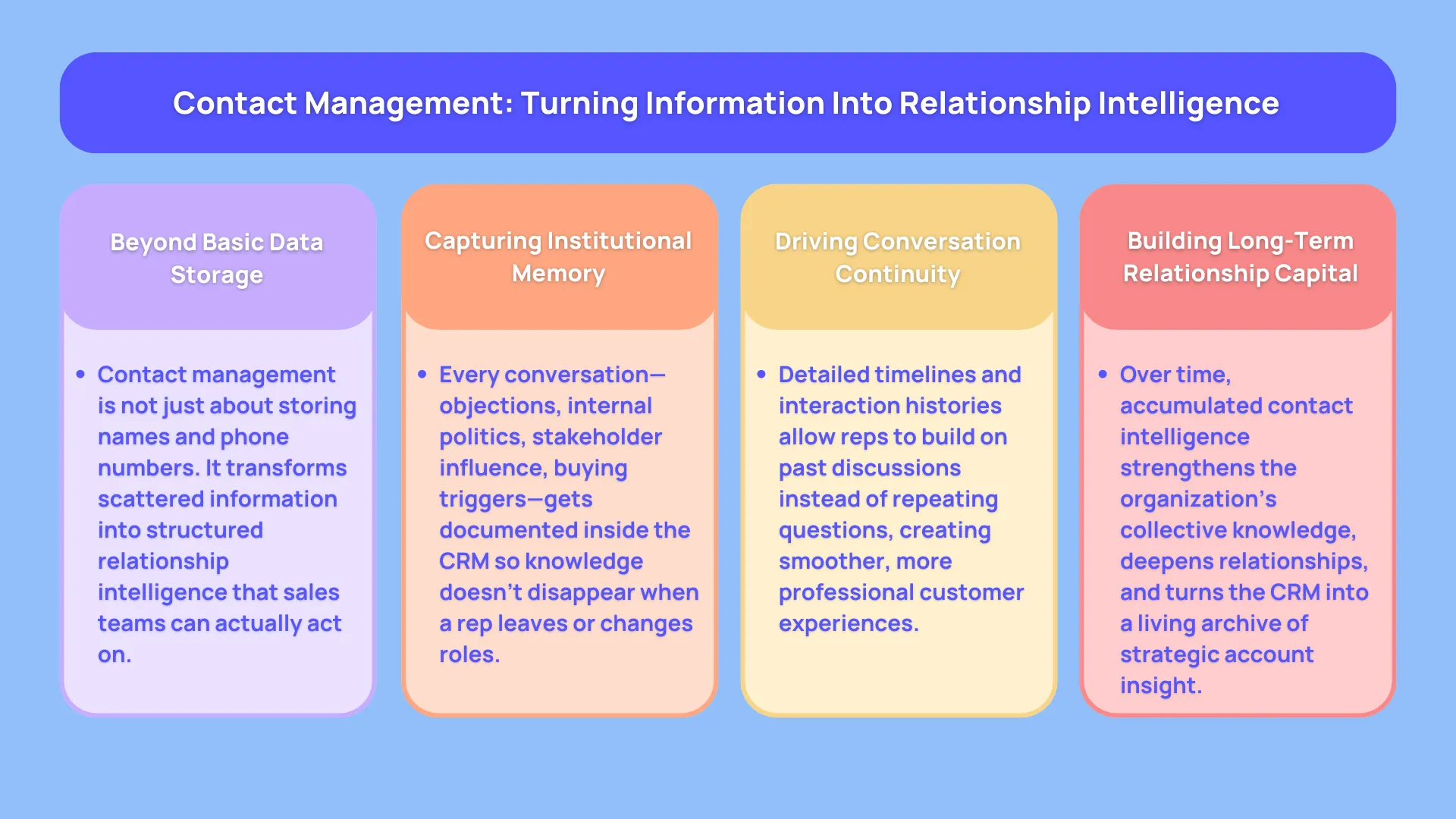
Contact management is often misunderstood as simple data storage. Names, emails, phone numbers. Basic directory information.
That is the shallow view.
In reality, contact management is about institutional memory.
Every meaningful sales interaction carries context. A prospect might mention that procurement becomes involved late in the process. A decision maker might express concern about integration complexity. A champion inside the account might reveal internal politics affecting budget approval.
If this context lives only in personal notes or memory, the organization remains fragile. The moment a rep changes roles or leaves, that intelligence disappears.
Strong contact management captures more than contact details. It documents conversation patterns, stakeholder influence, buying triggers, past objections, internal relationships, and communication preferences.
This is how customer relationships deepen over time.
When a rep opens a record and sees a detailed timeline of interactions, they approach the conversation with continuity rather than repetition. They do not ask questions the customer already answered months ago. They build on previous discussions.
This is one of the most practical applications of how to use CRM effectively. The CRM becomes a living relationship archive rather than a static database.
And when contact intelligence accumulates over years, the organization builds durable relationship capital.
Sales Workflow: Creating Predictable Momentum
Sales performance often breaks down not because of skill, but because of inconsistency.
A rep finishes a demo and intends to follow up next week. That follow up slips. A proposal is sent without a scheduled next step. A qualified lead waits too long for outreach.
Individually, these moments seem small. Collectively, they erode revenue.
Sales workflow inside a CRM addresses this subtle but expensive friction.
A well designed workflow ensures that every meaningful action triggers the next logical step. When a new lead enters the system, outreach tasks are generated. When a meeting occurs, follow up reminders are scheduled. When a proposal is sent, a check in is automatically placed on the calendar.
This is where CRM automation becomes operational leverage rather than noise.
Automation does not replace the human element. It protects momentum. It prevents opportunities from going cold due to simple oversight.
Strong workflow structure also reduces mental load on salespeople. Reps stop relying on memory to manage dozens of active conversations. The CRM becomes a guide, quietly reinforcing disciplined execution.
This is one of the most overlooked CRM best practices. Workflow design directly influences behavioral consistency.
Automation Integration: Supporting Humans, Not Replacing Them
There is a misconception that automation is about removing human involvement. In sales, that approach backfires quickly.
Automation should amplify focus, not replace judgment.
When it’s integrated thoughtfully during the specific CRM implementation phase, automation handles repetitive administrative activity so reps can focus on conversations and strategy.
- Email tracking updates automatically.
- Call logs sync without manual entry.
- Lead scoring adjusts as prospects engage.
- Task reminders appear before deadlines are missed.
This is the productive face of CRM automation.
It protects against dropped balls without creating robotic interactions. The key is restraint. Over automated sequences feel generic and erode trust. Balanced automation enhances responsiveness and reliability.
As systems mature, organizations begin layering advanced capabilities from AI CRM systems. Predictive scoring models help prioritize outreach. Intelligent routing assigns leads to reps with higher close probability. Churn indicators surface risk earlier than human intuition might.
None of this works without disciplined data management. Automation is only as intelligent as the inputs feeding it.
Reporting and Analytics: Turning Activity Into Insight
Sales teams generate enormous amounts of activity. Calls, meetings, emails, proposals, negotiations.
Without structured reporting, this activity becomes noise.
A mature CRM strategy transforms raw activity into actionable insight.
Instead of asking how busy the team feels, leadership examines stage conversion rates. Instead of relying on optimism, forecasting models use historical close percentages. Instead of guessing why revenue dipped, analytics reveal bottlenecks in qualification or negotiation stages.
Strong reporting does not overwhelm teams with dashboards. It focuses on the metrics that shape revenue behavior.
- Pipeline coverage relative to quota.
- Average sales cycle length.
- Win rate trends over time.
- Revenue by acquisition channel.
When reporting is clean and consistent, coaching improves. Conversations shift from subjective impressions to measurable patterns.
Reliable analytics are not about control. They are about clarity.
Team Adoption: The Make or Break Factor
Even the strongest CRM strategy collapses without adoption.
Team adoption is not achieved through a single training session. It is reinforced culturally.
Salespeople must see personal benefit. Faster access to context. Cleaner follow ups. More predictable commissions. Reduced administrative burden.
Managers must model usage. If leadership references CRM dashboards during forecast calls and one on one meetings, the system becomes central to performance evaluation.
Accountability matters. If deal stages are not updated, forecasts become unreliable. When that directly impacts coaching conversations, discipline increases.
CRM for sales teams becomes powerful only when usage shifts from compliance to habit.
Process Optimization: Evolving With Reality
Markets shift. Buyer behavior changes. Competitive positioning evolves.
Your CRM should not remain static.
Process optimization requires periodic review of stage definitions, qualification criteria, automation rules, and reporting priorities.
If deals consistently stall in one stage, the stage definition may need refinement. If conversion rates decline, messaging adjustments might be necessary. If new products are introduced, pipeline categories may need expansion.
CRM best practices are not frozen rules. They are adaptive frameworks.
When refinement becomes routine, incremental improvements compound into substantial performance gains over time.
Customer Relationship: The Core Purpose
Everything returns to one principle.
Customer Relationship Management is about relationships.
All structure, automation, reporting, and pipeline discipline exist to support stronger, longer lasting connections.
When context is preserved, communication feels intentional. When follow ups are timely, trust builds. When onboarding aligns with promises documented in the CRM, credibility increases.
Long term revenue often comes not from new acquisition, but from expansion and retention. Strong customer relationship visibility inside the CRM allows teams to identify upsell timing, cross sell potential, and early churn signals.
This is where the entire CRM strategy connects. Data management supports reporting. Reporting supports forecasting. Forecasting supports planning. Planning supports stability. Stability supports long term relationship investment.
That is how to use CRM effectively in a way that genuinely impacts revenue.
How to Use CRM Effectively: Best Practices That Long Term Drive Revenue

Owning a CRM does not mean you are using it correctly.
Most teams log in, update a few deals, maybe glance at a dashboard, and assume they are operating at maturity. They are not.
Using a CRM effectively means treating it as the control system for revenue, not as an administrative requirement.
The following CRM best practices are not surface-level tips. They are operational disciplines that separate high-performing sales organizations from chaotic ones.
1. Align Your CRM With Your Actual Sales Process
The biggest mistake in CRM implementation is copying a generic pipeline structure instead of mapping your real sales journey.
If your team qualifies leads through discovery calls before offering demos, your CRM stages must reflect that. If enterprise deals require legal review and procurement approval, those stages must exist in your pipeline.
When stages are vague or misaligned, reps move deals forward based on optimism instead of evidence. That destroys forecasting accuracy.
Effective pipeline management starts with defining stage exit criteria. A deal does not move forward because the buyer “seems interested.” It moves because a measurable milestone has occurred. Budget confirmed. Decision maker engaged. Technical validation completed.
When your CRM mirrors reality, forecasting becomes stable and coaching becomes precise.
2. Treat Data Entry as Revenue Infrastructure
Data discipline is often treated as administrative work. That mindset is costly.
Clean data directly impacts reporting, automation, and AI CRM systems. If job titles are inconsistent, segmentation fails. If industries are entered randomly, marketing alignment breaks. If deal values are inflated or outdated, forecasting becomes fiction.
To use CRM effectively, define clear standards for required fields. Decide what information must exist before a deal is considered qualified. Enforce consistent naming conventions.
More importantly, make accuracy culturally important. When leadership uses CRM data to guide real decisions, reps understand that accuracy affects strategy, not just paperwork.
Reliable data creates credible analytics. Credible analytics create better decisions.
3. Use the CRM to Enforce Next Steps, Not Just Log Activity
Logging completed calls and meetings is passive. Driving momentum is active.
A powerful CRM strategy ensures that every meaningful action creates a defined next step. After a demo, there should be a scheduled follow up. After a proposal is sent, there should be a calendar reminder to check status. After a contract is reviewed, legal follow up should be tracked.
This is where CRM automation becomes operational leverage. Automated task creation and reminders protect deal momentum without micromanaging reps.
Many deals do not die because of competition. They die because of silence. A CRM used effectively prevents silence.
4. Review Pipeline Health Weekly With Discipline
Pipeline reviews should not be casual status updates. They should be structured health assessments.
When reviewing pipeline management inside the CRM, focus on patterns:
- Are deals aging unusually long in one stage
- Are certain reps consistently skipping qualification depth
- Is conversion between demo and proposal declining
- Is forecast confidence aligned with historical close rates
The CRM should guide these discussions. If it is not being referenced during forecast calls, adoption is superficial.
Consistent pipeline reviews reinforce accountability and expose friction early. Early detection allows correction before revenue impact becomes severe.
5. Customize Dashboards Around Decision Making, Not Vanity Metrics
One of the most common mistakes in CRM usage is building dashboards that look impressive but provide no strategic clarity.
Calls made and emails sent are activity indicators. They are not revenue indicators.
Effective dashboards should answer decision critical questions:
- How much qualified pipeline coverage exists relative to quota
- What is the current win rate trend
- How long is the average sales cycle
- Which acquisition channels produce highest conversion
When dashboards support decision making, they become central to leadership conversations. When they display vanity metrics, they get ignored.
6. Connect CRM to the Entire Revenue Ecosystem
A CRM should not operate in isolation.
Marketing automation platforms, support systems, and financial tools all generate customer data. If this information does not flow into the CRM, your visibility becomes fragmented.
Effective CRM implementation includes thoughtful integration across tools. Leads from campaigns should enter the CRM automatically. Closed deals should trigger onboarding workflows. Support interactions should be visible to sales during renewal conversations.
When systems operate together, the CRM becomes the single source of truth for the entire customer lifecycle.
This level of integration supports long term CRM strategy rather than short term activity tracking.
7. Use CRM Insights to Improve Coaching
A CRM should enhance manager effectiveness.
Instead of coaching based on anecdotal feedback, managers can analyze patterns. If one rep consistently loses deals during negotiation, that signals pricing confidence or objection handling issues. If another struggles at qualification stage, discovery depth may be weak.
CRM data turns coaching from subjective to analytical.
This is one of the most practical sales CRM tips. Coaching improves when conversations reference real stage progression, conversion rates, and deal history.
8. Leverage CRM Data for Account Expansion
Many teams focus exclusively on new acquisitions. They overlook expansion potential inside existing accounts.
When customer history is organized clearly, opportunities for upsell and cross sell become visible. Purchase patterns, product gaps, and engagement levels can indicate readiness for expansion.
AI CRM systems can amplify this through predictive signals, but even without advanced automation, structured CRM data makes account growth easier to identify.
Using CRM effectively means treating it as a relationship intelligence platform, not just a pipeline tracker.
9. Build Adoption Through Accountability and Relevance
No CRM strategy succeeds without behavioral commitment.
Reps must see the CRM as central to their performance, not as administrative overhead. Managers must reference it during one on ones. Forecast calls must depend on it. Performance reviews should align with its data.
When CRM usage affects coaching, recognition, and planning, adoption strengthens naturally.
Strong CRM for sales teams becomes cultural infrastructure, not optional software.
10. Continuously Refine the System
Markets change. Buyer expectations evolve. Your CRM should adapt.
Review stage definitions regularly. Evaluate automation workflows. Adjust qualification criteria as patterns emerge. Refine dashboards to match strategic shifts.
CRM best practices are not static rules. They are evolving disciplines.
A CRM that remains unchanged for years slowly drifts away from business reality. A CRM that evolves remains aligned with revenue growth.


Power and parallel dialing in your CRM.