Our Top Picks


Sales activity tracking sounds simple on the surface. Log the calls. Record the emails. Update the CRM.
In reality, it is one of the most misunderstood parts of modern sales operations.
Most teams obsess over revenue numbers and closed deals. Far fewer pay attention to the daily actions that create those results. More so, we’d say that the gap is exactly why tracking sales activity is so powerful. When you understand the inputs, you gain control over the outcomes.
This is not about administrative busywork. It is about visibility, accountability, coaching, forecasting accuracy, and ultimately, predictable growth.
What Is Sales Activity Tracking?

Sales activity tracking is the process of recording and monitoring every meaningful action your sales team takes with prospects and customers. That includes calls, emails, meetings, follow ups, demos, proposals, and internal deal discussions.
The key distinction is this eithe one of the following outcomes:
- Closed revenue is an outcome.
- Activities are the drivers.
When you focus only on outcomes, you are always reacting to what already happened. When you focus on sales activity metrics, you can influence what happens next.
Strong sales activity management connects daily actions to pipeline movement. It shows how many conversations lead to meetings, how many meetings turn into proposals, and how many proposals close. Over time, that relationship becomes your operating system for predictable revenue.
Activity Tracking
Activity tracking is where discipline meets insight. It is not about logging everything under the sun. It is about capturing the actions that meaningfully move deals forward.
When done well, sales activity tracking creates clarity in three areas:
- What reps are actually doing each day
- How deals are progressing inside the pipeline
- Where momentum is stalling
The moment activity tracking becomes part of the culture, conversations shift from opinions to data. Instead of saying “I think the pipeline is fine,” you can say, “We have not had executive level conversations in 18 days.”
That difference changes everything.
Why Salespeople Don’t Log Activity
Before fixing the system, it helps to understand the resistance. Most reps are not against tracking sales activity. They are against friction, wasted time, and lack of benefit.
1. “It Takes Too Much Time”
Reps want to sell. Data entry feels like overhead. If logging activity requires five clicks and multiple fields after every call, compliance drops fast.
The solution is not more reminders. It is reducing friction. Smart sales activity software can automate logging through call integrations, email syncing, and calendar capture. The less manual effort required, the higher the adoption rate.
2. “What’s In It for Me?”
If tracking only benefits management, reps will treat it as optional.
However, when sales activity reporting helps reps see patterns in their own performance, behavior changes. A rep who can clearly see their call to meeting conversion rate can improve it. That directly impacts commissions.
When activity data feeds a clear performance dashboard, reps start caring about the numbers because the numbers reflect their progress.
3. “I Don’t Want to Lose Control.”
Some reps worry that too much transparency invites interference. They fear managers jumping into deals or redistributing accounts.
Trust matters here. Sales activity management should feel like support, not surveillance. When managers use data for coaching instead of criticism, adoption improves dramatically.
4. “The CRM Doesn’t Capture the Full Picture.”
Traditional CRMs often miss nuance. Internal champions, partner influence, stakeholder politics, informal conversations, these rarely show up cleanly in structured fields.
This is where tools like conversation intelligence can fill the gap. They capture context from calls, identify influencers, and surface sentiment shifts. That level of insight makes tracking sales activity far more meaningful than basic call counts.
Why Logging Sales Activity Helps You Close More Deals
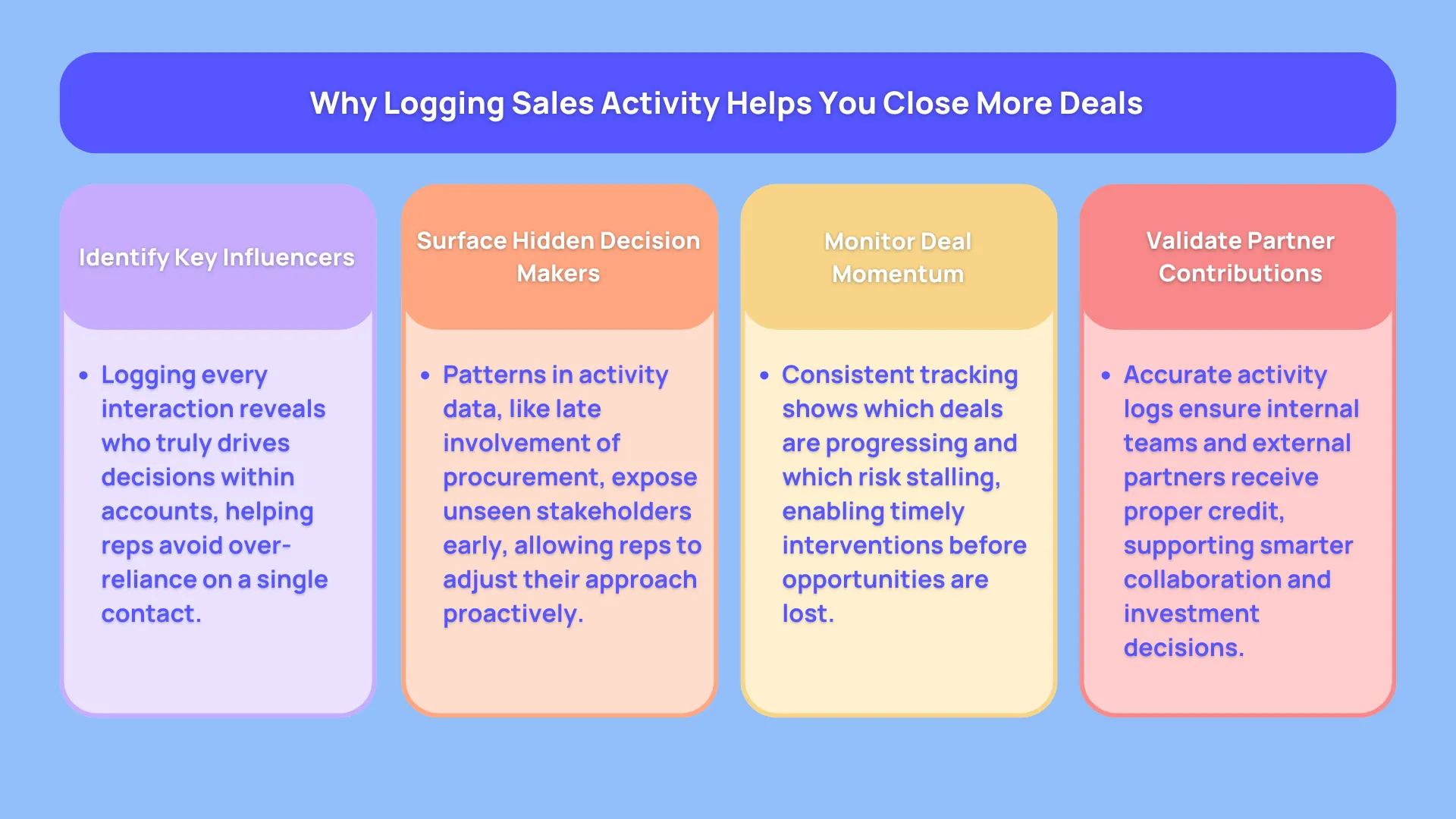
It is easy to see activity tracking as a compliance task. It is far more than that. It is a competitive advantage.
Identify Key Influencers
Deals are rarely driven by one person. Activity logs reveal patterns. Who attends multiple meetings. Who asks detailed questions. Who introduces new stakeholders.
When you consistently log interactions, you start spotting real influence inside accounts. That clarity prevents over reliance on a single contact.
Surface Hidden Decision Makers
If your logged activity shows that procurement suddenly appears late in multiple deals, that is not random. It is a pattern. Strong sales activity reporting highlights these trends early.
You can adjust your sales process to involve decision makers sooner, reducing last minute surprises.
Track Momentum
Momentum is measurable. Long gaps between interactions often signal risk. A deal with steady engagement every week is healthier than one with silence for 30 days.
Tracking sales activity makes momentum visible. It allows managers to intervene before deals quietly die.
Prove Partner Impact
In partner led or channel driven sales models, attribution is messy. Without documented activity, contributions disappear.
Accurate sales activity metrics ensure that internal teams and external partners receive proper credit. That drives smarter investment decisions and stronger collaboration.
What Happens When You Don’t Track Sales Activity
The cost of poor tracking is rarely obvious at first. It shows up slowly.
Missed internal champions lead to stalled deals.
Repeated conversations frustrate buyers.
Follow ups fall through the cracks.
Revenue attribution becomes political.
Most importantly, forecasting becomes guesswork.
When sales activity tracking is weak, sales forecasting relies on optimism rather than evidence. That leads to missed targets, broken trust with leadership, and chaotic quarter ends.
Key Sales Activities to Track
Tracking everything creates noise. Tracking nothing creates blindness. The balance lies in identifying high impact actions.
Here are the foundational activities most teams should log:
- Calls made
- Emails sent
- Meetings held
- Follow up tasks completed
- Demos delivered
- Proposals or quotes sent
Each of these represents a stage transition or engagement point. However, volume alone is not enough.
Sales Metrics
Sales metrics turn raw activity into insight. This is where numbers start telling a story.
Instead of celebrating high call volume, look deeper.
- How many calls lead to meetings.
- How many meetings advance to proposals.
- How many proposals close.
This is where sales activity metrics connect to revenue.
For example, let’s take a look at the following situation:
- 50 calls
- 10 meetings
- 3 proposals
- 1 closed deal
That simple ratio becomes your performance baseline. It allows you to model pipeline needs. If you want four deals next month, you now know the activity required to support that target.
When these numbers are tracked consistently, they evolve into powerful sales productivity metrics that help reps self correct and managers coach with precision.
Leading Indicators vs Lagging Indicators
Understanding this distinction changes how you manage a sales team.
Leading indicators include:
- Calls
- Meetings booked
- New opportunities created
Lagging indicators include:
- Revenue
- Closed deals
- Win rate
Lagging metrics tell you what already happened. Leading metrics give you leverage mid cycle.
Strong performance monitoring depends on watching leading indicators closely. If call volume drops for two weeks, future revenue will likely suffer. Early visibility allows correction before the quarter is lost.
Performance Monitoring
Performance monitoring should not feel like surveillance. It should feel like clarity.
When activity data is displayed in a simple performance dashboard, it becomes easier to have objective coaching conversations.
Instead of saying, “You need to try harder,” a manager can say, “Your meeting conversion rate is 6 percent, while the team average is 12 percent. Let’s improve your opening approach.”
That shift removes emotion from feedback. It replaces guesswork with measurable improvement.
Over time, top performer behaviors become visible. Their activity patterns, follow up speed, stakeholder engagement, and call frequency become benchmarks for the rest of the team.
Data Collection
Data collection is where many systems break down. If logging feels painful, accuracy suffers.
Effective sales activity software reduces manual input through automation. Email syncing, call recording, calendar integration, and task reminders ensure that data collection happens in the background.
Consistency is just as important as automation. Clear definitions matter.
What qualifies as a meeting.
When an opportunity is created.
How follow ups are logged.
Without shared standards, sales activity reporting becomes unreliable.
Periodic audits help maintain quality. For example, reviewing open deals with no activity in 14 days quickly highlights gaps.
Sales Analytics
Sales analytics is where sales activity tracking evolves from record keeping into strategic advantage.
Tracking sales activity gives you raw inputs. Sales analytics connects those inputs to outcomes, patterns, and future performance. It answers questions like:
- Which activities actually move deals forward
- Which behaviors correlate with higher win rates
- Where deals typically stall
- How long each stage realistically takes
Without analytics, activity tracking is just a digital notebook. With analytics, it becomes a revenue engine.
Turning Activity Into Insight
Consider two reps:
Rep A makes 80 calls per week and books 6 meetings.
Rep B makes 45 calls per week and books 9 meetings.
At surface level, Rep A appears more productive. Analytics reveals something different. Rep B has stronger qualification skills, better targeting, or sharper messaging.
This is where conversation intelligence plays a critical role. Instead of only counting calls, you can analyze talk ratios, objection handling patterns, keywords, and buyer sentiment. Suddenly, sales activity metrics become layered and meaningful.
You move from “how much” to “how well.”
Finding True Predictors of Revenue
Not every activity carries equal weight. Sales analytics helps you identify high leverage actions.
For example, you might discover:
- Deals with at least one executive level conversation close at 3 times the average rate
- Opportunities with fewer than 5 logged touchpoints rarely close
- Proposals sent within 48 hours of a discovery call convert at significantly higher rates
These patterns reshape sales activity management. Instead of pushing generic volume, you prioritize specific behaviors that statistically drive revenue.
That is when tracking sales activity becomes strategic rather than administrative.
Sales Reporting
Sales activity reporting is the communication layer of your data. It determines how information flows through the organization.
If reports are cluttered, overwhelming, or disconnected from goals, the team tunes out. If they are simple, focused, and tied to revenue impact, they drive action.
What Good Sales Activity Reporting Looks Like
Effective sales reporting answers three core questions:
- Are we doing enough activity to support pipeline targets
- Is that activity converting at healthy rates
- Where are the bottlenecks
A clean performance dashboard might show:
- Calls per rep
- Meeting conversion rate
- Opportunities created
- Pipeline stage movement
- Close rate
That is enough to guide decisions without drowning the team in data.
Avoiding Reporting Fatigue
One of the biggest mistakes in sales activity management is tracking too many metrics. When dashboards contain 40 data points, none of them matter.
Keep reporting focused on high impact sales activity metrics. If a metric does not influence coaching, forecasting, or compensation decisions, question its necessity.
Clarity beats complexity every time.
Pipeline Visibility
Pipeline visibility is one of the most immediate benefits of strong sales activity tracking.
Without consistent logging, pipelines become optimistic stories. With consistent logging, pipelines become measurable systems.
Seeing Momentum in Real Time
Imagine two opportunities at the same stage, both forecasted to close this month.
Deal A has 12 logged touchpoints in the last three weeks, including a technical demo and procurement discussion.
Deal B has zero logged activity in 18 days.
On paper, they look identical. In reality, one has momentum and one is quietly fading.
Tracking sales activity makes that distinction obvious. Managers can step in early, ask better questions, and prevent revenue surprises.
Identifying Risk Early
A healthy pipeline is not just about total dollar value. It is about engagement density.
Key warning signs include:
- Long gaps between interactions
- No recent meetings with decision makers
- Repeated calls without stage progression
These are behavioral signals that a deal is at risk. Without data collection discipline, those signals remain invisible.
Pipeline visibility reduces end of quarter panic. It replaces reactive fire drills with proactive management.
Sales Forecasting
Sales forecasting improves dramatically when activity data is reliable.
Traditional forecasting often relies on rep judgment and deal stage. While experience matters, it is not always objective.
When sales activity tracking feeds forecasting models, predictions become evidence based.
Connecting Behavior to Forecast Accuracy
Suppose historical data shows that deals with:
- At least 8 touchpoints
- One executive level meeting
- A proposal delivered within 10 days of discovery, close at 60 percent probability.
Now your forecast can incorporate activity thresholds instead of relying solely on rep confidence.
This is where sales analytics and forecasting intersect. Activity patterns become probability indicators.
Reducing Surprises
Forecast misses damage credibility. Leadership loses trust. Pressure increases.
Strong sales activity reporting reduces surprises because leading indicators are monitored continuously. If meeting volume drops in the first half of the quarter, future pipeline weakness becomes predictable.
You gain time to adjust hiring, marketing spend, or outbound intensity.
Forecasting shifts from hopeful projection to calculated expectation.
Behavioral Metrics
Behavioral metrics sit at the intersection of activity and performance. They examine not just what reps do, but how they do it.
This is where tracking sales activity becomes deeply connected to coaching and development.
Beyond Volume
High call counts do not automatically equal strong selling. Behavioral metrics might include:
- Call to meeting conversion rate
- Average time between follow ups
- Response time to inbound leads
- Multi threaded engagement inside accounts
These indicators reflect habits. Habits drive performance consistency.
When behavioral metrics are visible, coaching becomes precise. Instead of telling a rep to “be more proactive,” you can say, “Your average follow up time is five days. Top performers average two.”
That level of clarity accelerates improvement.
Coaching With Context
Conversation intelligence tools enrich behavioral metrics even further. They reveal:
- How often reps interrupt prospects
- Whether pricing is discussed too early
- Common objection themes
Now sales activity management becomes developmental, not just operational.
You are no longer tracking activity for compliance. You are tracking it to refine behavior.
Sales Productivity
Sales productivity is the ultimate outcome of effective sales activity tracking.
Productivity is not about being busy. It is about producing results efficiently.
Aligning Effort With Outcome
When you connect activity volume to conversion rates, you identify leverage points.
If a rep needs 60 calls to close one deal, and another needs 35, the difference lies in skill, targeting, or messaging. That insight improves training and resource allocation.
Over time, optimized activity patterns increase revenue without increasing headcount.
That is the power of strong sales activity metrics combined with thoughtful coaching.
Technology as an Enabler
Modern sales activity software plays a crucial role in productivity. It automates logging, provides analytics, supports pipeline visibility, and integrates performance dashboards into daily workflows.
- When data collection is seamless, reps spend more time selling and less time typing notes.
- When reporting is clear, managers spend less time guessing and more time coaching.
The result is a system where effort translates into predictable performance.
.jpeg)

Power and parallel dialing in your CRM.