Our Top Picks


Sales call recording is one of those topics that sparks instant debate inside revenue teams. Some reps love it because it helps them sharpen their pitch.
Others hate it because disclosure feels like friction at the worst possible moment.
Then there is the legal anxiety. Is it even allowed?
Will disclosure ruin the call before you build rapport? What happens when you are dialing across state lines?
Here is the truth. Recording sales calls is completely legal in many situations, but only when you respect call recording laws and follow clear call recording compliance standards. Ignore that side of it, and you are not just risking awkwardness. You are risking fines, lawsuits, and serious brand damage.
This piece walks through sales call recording best practices with a human, practical lens. No scare tactics. No legal jargon overload. Just clarity around how to stay compliant while still running a high performing sales organization.
Legal Requirements That You Need To Know
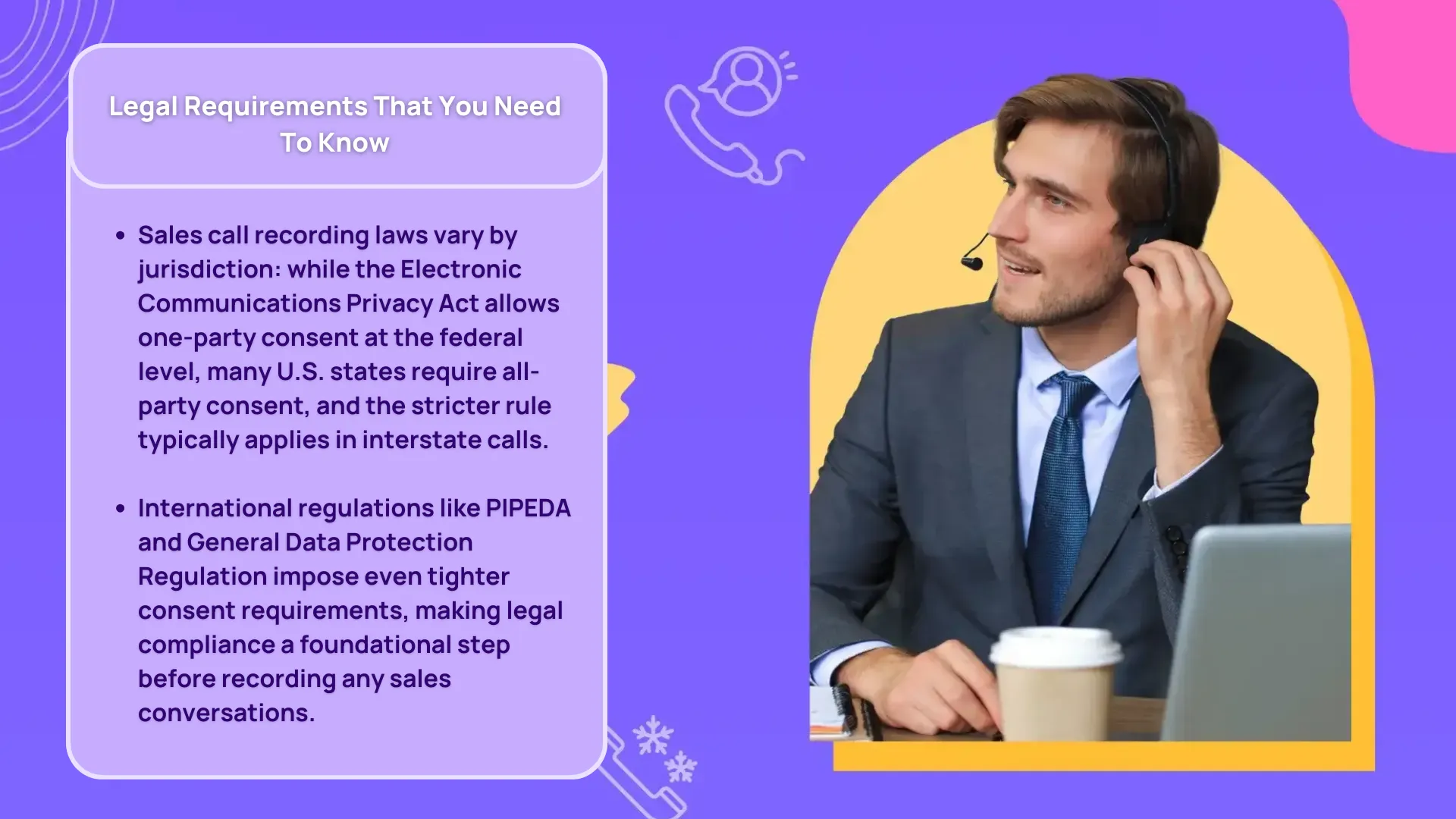
Before talking about coaching, quality, or analytics, you need to understand the legal requirements that govern recording sales calls.
In the United States, there are two layers of law at play:
Federal law under the Electronic Communications Privacy Act allows one party consent. That means if you are on the call and you consent to the recording, it can be legal at the federal level.
State law can override that with stricter standards. Some states require all parties to consent. That is where things get complicated.
Here is the key distinction:
- One party consent states require only one participant to agree to the recording. In practice, that can be the rep.
- Two party or all party consent states require everyone on the call to know about and agree to the recording.
When you are making interstate calls, the stricter law typically applies. If you are calling from a one party consent state into a two party consent state, you follow the two party consent rule.
This is where many teams get tripped up. They assume their local law is enough. It is not. Call recording compliance depends on the location of both participants.
Internationally, things get even tighter. Canada requires meaningful consent under PIPEDA. The European Union and the United Kingdom operate under GDPR, which requires a lawful basis and clear consent. In short, regulatory compliance is not optional. It is foundational.
If your team is serious about recording sales calls, legal awareness is step one.
Recording Compliance
Recording compliance is not just about saying a quick line at the start of the call. It is about building systems that protect your company and your prospects.
There are three main approaches to disclosure:
- Pre recorded automated disclosure before the call connects to a live rep
- Verbal disclosure delivered by the rep at the start of the conversation
- Audible tones or periodic beeps during the call
Each method comes with its own legal and practical implications. In many two party consent states, implied consent can be established if you say the call is being recorded and the other person continues speaking. In some jurisdictions, explicit consent is required, meaning they must actively say yes.
From a sales perspective, the fear is obvious. Reps worry that saying this call is being recorded will instantly trigger resistance.
In practice, tone matters more than the words. A calm, confident statement framed around training and service improvement rarely kills a conversation. Something as simple as, “Just a quick heads up, this call may be recorded for training and quality purposes,” often flows naturally.
The bigger risk is inconsistency. If some reps disclose and others do not, you create legal exposure and internal confusion. Sales call recording best practices require a universal policy that applies to everyone.
Modern call recording software can help here. Many platforms offer automatic disclosure prompts, location based routing, and customizable compliance workflows. That does not replace legal counsel, but it reduces human error.
Compliance is not a script. It is a system.
Privacy Protection
Privacy protection is where ethics and compliance intersect. Even if the law allows recording, mishandling personal data can create major problems.
When you are recording sales calls, you are capturing more than just pitch performance. You are collecting personal information, business details, financial discussions, sometimes even payment information.
Strong privacy protection includes:
- Clear communication about why the call is being recorded
- Defined retention policies for how long recordings are stored
- Restricted access to recordings inside your organization
- Encryption at rest and in transit
- Redaction of sensitive data such as credit card numbers
This is where conversation intelligence tools often enter the picture. They analyze patterns, keywords, and sentiment across calls. Powerful, yes. But also data intensive.
If you are feeding recordings into conversation intelligence systems, your data management policies need to be airtight. Who can access transcripts. How long are they stored. Can customers request deletion.
Trust is fragile. Sales call recording should enhance performance, not create privacy nightmares.
Regulatory Compliance
Regulatory compliance goes beyond consent laws. Depending on your industry, additional rules may apply.
Financial services firms may face strict recording and archiving requirements. Healthcare organizations must consider HIPAA obligations. Companies operating in Europe must align with GDPR principles such as data minimization and purpose limitation.
Call recording compliance in regulated industries often requires:
- Documented policies and procedures
- Regular audits
- Secure storage with detailed access logs
- Defined processes for responding to data access requests
If your organization operates across multiple jurisdictions, a conservative approach often makes sense. Many companies adopt universal disclosure and consent practices even in one party consent states, simply to reduce risk.
Compliance should not feel like a burden. It is a protective layer around your revenue engine.
Quality Assurance
Now let us shift from legal protection to performance growth.
Quality assurance is one of the most powerful reasons for recording sales calls. Without recordings, feedback relies on memory and self reporting. With recordings, coaching becomes objective.
Quality assurance programs typically focus on:
- Script adherence
- Objection handling effectiveness
- Tone and pacing
- Compliance language accuracy
- Closing techniques
When managers can listen to real interactions, feedback becomes specific. Instead of saying you need to build more rapport, they can point to a precise moment where the conversation shifted.
High performing teams treat call recording as a mirror, not a microscope. It is not about catching mistakes. It is about identifying patterns that lead to better outcomes.
Call Review
Call review is where raw recordings turn into insight.
An effective call review process includes structured evaluation criteria. Managers might score calls across categories such as discovery depth, value articulation, and next step clarity.
Group call review sessions can also be powerful. Playing selected clips during team meetings encourages shared learning. Reps hear different styles, different phrasing, different ways of navigating tough objections.
Technology enhances this further. With conversation intelligence layered on top of call recording, you can search for specific keywords, track talk time ratios, and identify sentiment shifts automatically.
Instead of manually scrubbing through hours of audio, managers can zero in on high impact moments.
Call review should be consistent and scheduled. Sporadic reviews create anxiety. Regular reviews create growth.
Coaching Material
Every great sales organization invests in coaching. Recording sales calls gives you a real world library of coaching material.
Instead of role playing hypothetical scenarios, you can use actual customer conversations. That makes coaching relevant and grounded.
Effective coaching programs often include:
- Highlight reels of excellent discovery calls
- Examples of strong objection handling
- Clips that show missed opportunities and how to recover
- Before and after comparisons to demonstrate improvement
When paired with strong coaching software, recordings can be tagged, categorized, and assigned as training modules. New hires ramp faster because they hear real conversations instead of scripted theory.
Sales call recording best practices are not just about capturing audio. They are about transforming that audio into structured development paths.
Coaching feels different when it is rooted in reality.
Data Management
Sales teams often focus on the front end of sales call recording, the disclosure, the coaching, the feedback. The back end is just as important. Data management determines how safe, searchable, and useful your recordings actually are.
When you are recording sales calls at scale, you are creating a growing archive of sensitive business conversations. Without a clear structure, that archive turns into a liability instead of an asset.
Strong data management practices usually include:
- Defined retention timelines
- Role based access controls
- Encrypted storage
- Clear deletion workflows
- Audit trails for access and downloads
Retention policies matter more than most teams realize. Keeping every recording forever increases legal exposure. If a lawsuit happens, those recordings may be discoverable. A defined policy that aligns with your industry’s regulatory compliance standards protects you.
Access control is another critical layer. Not every rep needs access to every call. Managers may need broader visibility, but even that should be structured. The principle is simple. Access should be limited to what is necessary for performance and oversight.
Many modern call recording software platforms offer automatic tagging, searchable transcripts, and structured storage folders. When combined with conversation intelligence, this allows you to quickly find relevant calls without digging manually through hundreds of files.
Data management is not glamorous. It is essential. It supports call recording compliance, protects privacy, and ensures that your investment in recording sales calls continues to deliver value over time.
Conversation Analysis
Once you have compliance and storage handled, conversation analysis is where sales call recording becomes transformative.
Listening to random calls can help. Systematic analysis changes revenue outcomes.
Conversation analysis looks at patterns across many interactions. It answers questions such as:
- How often are reps discussing pricing too early
- Which objections appear most frequently
- Are top performers talking less and listening more
- Which phrases correlate with booked meetings or closed deals
This is where conversation intelligence tools shine. They convert audio into transcripts, track keyword usage, measure talk to listen ratios, and even flag emotional cues in tone.
Instead of relying on gut instinct, leaders gain data driven clarity. If the data shows that deals close more often when reps ask at least three discovery questions before presenting a solution, that insight becomes a coaching standard.
Conversation analysis also highlights compliance risks. If certain required disclosures are frequently skipped, managers can intervene quickly. This strengthens call recording compliance while improving performance.
The real power lies in connecting analysis to action. Insights should feed directly into coaching material, team training sessions, and performance reviews.
Sales call recording best practices are not just about recording. They are about learning at scale.
Privacy Protection in Practice
Privacy protection is not just a policy document. It is daily behavior.
Reps should understand:
- What types of information are considered sensitive
- How to avoid unnecessary collection of personal data
- When to pause or stop recording if required
- How to respond if a prospect objects to recording
Transparency builds trust. A brief explanation such as, “We record calls for training and service improvement, and recordings are stored securely,” often reassures prospects.
If someone declines consent in a two party consent state, you have options. You can stop the recording and continue the conversation without recording, or reschedule through a compliant channel. What you cannot do is ignore the objection.
Privacy protection also extends to internal culture. Recordings should not be used to shame or embarrass reps. The purpose is improvement, not surveillance.
When your team understands that sales call recording supports growth rather than punishment, adoption improves dramatically.
Regulatory Compliance Across Borders
If your sales organization operates internationally, regulatory compliance becomes even more complex.
In Canada, meaningful consent is required. That means clear communication about purpose and use. In Europe and the United Kingdom, GDPR requires a lawful basis for processing personal data, not just consent. You must be able to justify why you are recording and how long you retain that data.
Global teams often adopt the strictest common denominator approach. Universal disclosure at the start of every call. Clear documentation of purpose. Limited retention periods. Secure storage standards.
This approach simplifies training and reduces confusion for reps who dial into multiple regions.
Call recording laws vary, but the principle remains constant. Transparency and respect for privacy reduce risk.
Best Practices For Recording Sales Call & Getting The Desired Outcome
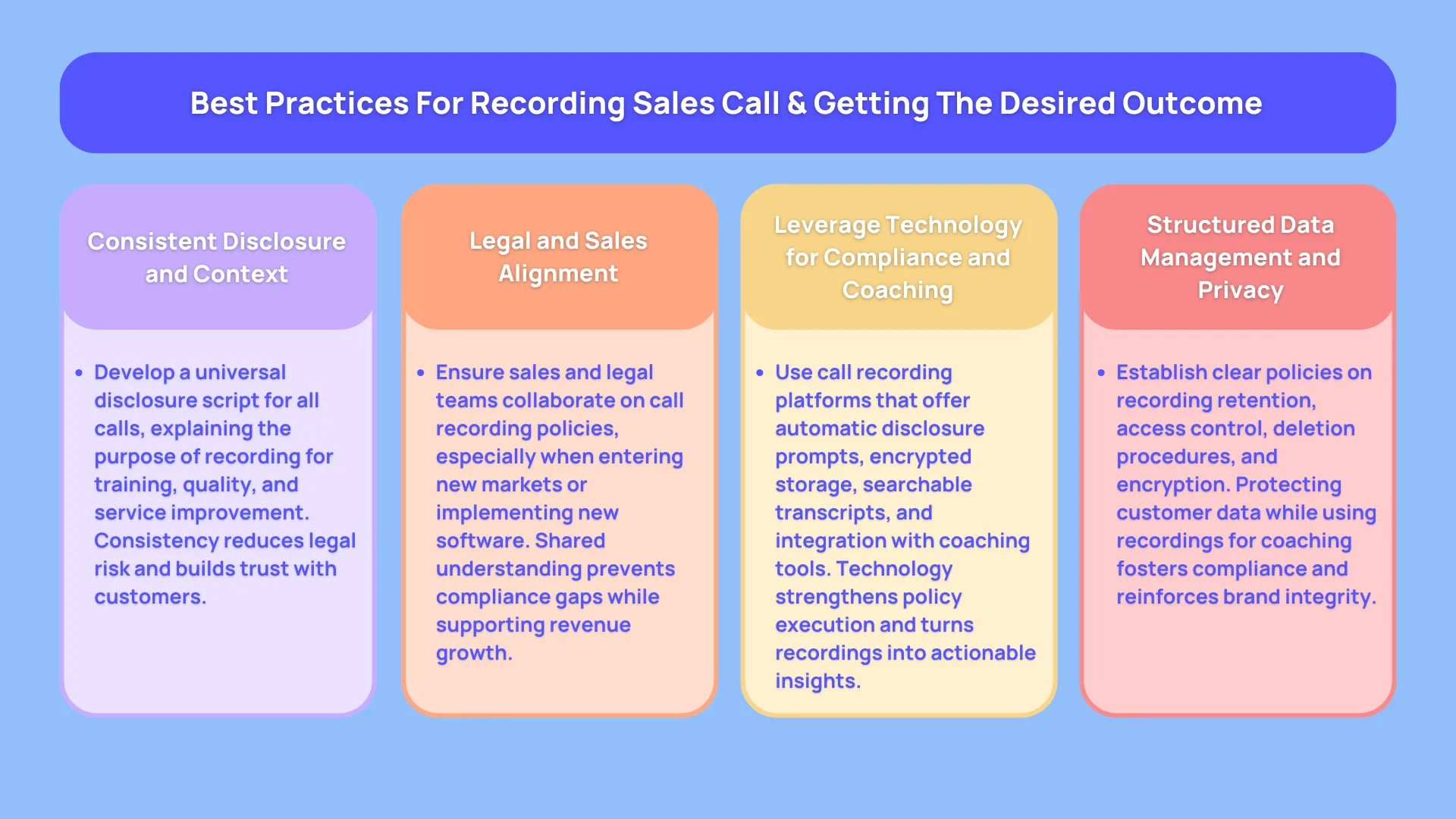
Bringing everything together, here is a consolidated framework for sales call recording best practices that balances performance with protection.
Establish a Universal Disclosure Standard
Create one clear disclosure script that works across jurisdictions. Train every rep to deliver it naturally and confidently. Consistency reduces legal exposure and internal confusion.
Explain why the recording happens. Training, quality assurance, service improvement. Context lowers resistance.
Align Legal and Sales Leadership
Legal requirements should not live in a silo. Sales leaders and legal counsel need shared understanding. When launching new call recording software or expanding into new markets, review call recording laws together.
This alignment ensures that revenue growth never outpaces compliance.
Invest in the Right Technology
Choose call recording software that supports:
- Automatic disclosure prompts
- Secure encrypted storage
- Searchable transcripts
- Redaction of sensitive information
- Integration with coaching software and conversation intelligence platforms
Technology does not replace policy, but it strengthens execution.
Turn Recordings Into Structured Coaching
Do not let recordings sit unused. Build regular call review sessions. Tag high performing calls as coaching material. Identify patterns through conversation analysis and convert them into training modules.
When reps see recordings tied directly to development and promotion, adoption increases.
Define Clear Data Management Policies
Document how long recordings are stored, who can access them, and how deletion requests are handled. Review these policies periodically to ensure ongoing regulatory compliance.
Clarity reduces uncertainty.
Protect Privacy at Every Step
Limit access, encrypt data, and educate your team on privacy expectations. Make it clear that respect for customer information is part of your brand promise.


Power and parallel dialing in your CRM.