Our Top Picks


The sales industry, regardless of which part of the world it’s operating from, is full of all kinds of traction.
On any given day, you could expect calls getting made, and that too in a ginormous volume. Then you have demos booked, appointments set up, warm calls, emails, and vice versa.
Ultimately, it comes down to whether a deal was closed, which is also referred to as the sales close rate.
Or, you can call it ‘close rate.’
Hot Take:
Here’s an interesting thing.
Sales close rate applies to an individual’s performance, as in whether this person is able to close more deals or not. Collectively, the same sales close rate could speak for an entire sales team’s performance.
If you are already working as a competent SDR, then you know that during the last few days, or the last week or quarter closure period, there’s an immense amount of pressure on everyone. Multiply it by 2x when you imagine AEs and BDRs because they eventually have to answer to the higher management in KPI or that final, but “highly dreaded” round of quarterly meetings.
In both hindsight and foresight, we could say that anyone’s efficiency is captured by one deceptively simple metric called the sales close rate.
Moreover, the sales close rate tells you how often your sales efforts result in deal closure. It eventually reflects on the rate at which deals fail, materialize, and how they move through the sales funnel.
For instance, speaking of sales funnel movement, if you were to fall back on data, you would be able to identify areas where there’s a lot of friction vs. resonance. The latter pinpoints those sales pipeline points where the quality of the process is so damn good that prospects convert to paying customers at a very high rate.
This could be attributed to the product competitiveness, a salesperson’s speaking skills, or the overall structure of your website/ web portal, where users usually interact with online elements.
However, since this post is about sales closures and the attributed strategies on the account of sales close rate, we will mostly stick with SDRs and their overall performance scalability.
What Is Sales Close Rate - AKA Sales Conversion Rate

The phrase sales conversion rate often gets used interchangeably with sales close rate, but the meaning deserves clarity before numbers get tracked or targets get set.
Some also call it sales close percentage, but it’s more or less the same thing. Percentages count for overall combined sales teams’ performance, and the “rate” lingo interchangeably applies to an individual or the business’s overall deal materialization metrics.
Nonetheless, the important thing for you to understand is that a sales conversion rate measures how effectively prospects progress from one stage of the sales pipeline to the next, ultimately ending in a closed deal.
In simple terms, we could say that the sales productivity metrics answer one question.
Out of everyone who enters the pipeline, how many become customers?
This rate reflects pipeline conversion rather than raw activity. Ten demos mean nothing if none convert into signed agreements. A smaller number of well-qualified opportunities can outperform a bloated pipeline with weak intent.
From a practical and an expert’s standpoint, the sales conversion rate works as a mirror for sales effectiveness. Strong conversion signals that the sales process aligns with buyer expectations. Weak conversion points to disconnects that slow momentum or stall deals entirely.
Sales teams often examine conversion at multiple stages. Lead to opportunity. Opportunity to proposal. Proposal to deal closure. Each stage carries its own conversion rate, yet the final outcome feeds directly into the overall sales success rate.
How to Calculate Closing Percentage?
Understanding how to calculate closing percentage is essential before interpreting results or comparing performance across teams.
The close rate calculation focuses on two numbers. Total sales opportunities created and total deals successfully closed.
Closing Ratio Formula
You can start off by simply looking at the total number of closed deals, as in deals that went through the process and payments were made to the company’s account, and then divide that number of sales by the overall number of opportunities you had.
Opportunities are your demo calls, warm calls, in person appointments or online meetings. And they account for both closed and lost sales. Once you have a number, multiply it with 100 and you will get your sales close rate.
This closing ratio formula converts raw counts into a percentage that can be tracked over time and compared across reps, teams, or periods.
What if you want to understand the concept through a real life situation, or some kind of example that closely relates to your business? In that case, imagine a rep creating 80 qualified opportunities over a quarter. Out of those qualified opportunities, only 24 turn into signed customers.
What you’re going to do now is take that number “24” and then divide it by the number of qualified opportunities that sales rep had. In that case, it would be 24 divided by 80, which comes down to 0.30.
Multiply by 100, and the closing ratio lands at 30 percent. This is a good, healthy number, given that your overall sales opportunities volume was low. If it were really high, then 30% is not an optimal figure, and you need to identify the gaps, starting from that sales rep’s performance vs. how you treat your data and your overall sales pipeline management.
The leak could be anywhere.
At the end of the day, that number also becomes the rep’s sales achievement rate for that period.
Why Is This Calculation So Important To You?
When you’re in the stages of sales discovery, the value of knowing how to calculate close rate extends far beyond the reporting aspect.
It not only establishes a performance baseline but also highlights consistency or volatility areas, as we stated earlier.
When tracked correctly, the closing percentage shows how changes in pricing, messaging, onboarding, or lead quality impact revenue conversion. Small improvements compound quickly. A five percent increase in close rate can outperform adding dozens of low-quality leads to the pipeline.
Close Rate vs Win Rate
The terms close rate and win rate sound similar, yet they measure slightly different realities inside the sales funnel.
Close rate measures the percentage of all opportunities that result in a sale. It includes every qualified opportunity that entered the pipeline, regardless of outcome.
Win rate narrows the lens. It focuses only on deals that reached a closed stage and calculates the percentage that ended as closed won rather than closed lost.
This distinction matters because win rate reflects performance at the final decision stage, while close rate reflects performance across the entire journey.
A team can show a strong win rate yet struggle with overall sales close rate if too many weak opportunities enter the pipeline. Conversely, a lower win rate paired with a healthy close rate may indicate aggressive qualification and strong top-of-funnel discipline.
Understanding close rate vs win rate helps sales leaders diagnose issues accurately. Win rate speaks to negotiation, pricing confidence, and objection handling. Close rate speaks to qualification quality, messaging clarity, and overall deal conversion strength.
Both belong on dashboards, yet they answer different performance questions.
What Is a Good Close Rate in Sales
Okay, so now that we have discussed sales close rate plenty of times, the next thing is to figure out a “good” close rate.
Specifically speaking, what type of metric, or benchmark says that your sales close rate is, or was, good over a given timeline?
Sales teams often look for a single benchmark that defines success, yet performance only makes sense when viewed through industry dynamics, deal complexity, and buyer behavior.
That said, patterns do exist.
Across many B2B and B2C environments, an average sales closing rate between 20 percent and 30 percent is widely seen as healthy. This range signals that qualification is strong, messaging resonates, and prospects reach deal closure without excessive friction.
If you recall, we had a situation where a sales rep was closing deals at 30% rate. And we said that it was a good rate. So, yes, anything between 20 - 30 percent, and within reasonability, is decent enough and acceptable.
A close rate below this range usually points to pipeline inefficiencies. Leads may lack intent, discovery conversations may feel rushed, or pricing expectations may not align early enough. A close rate far above this range can look impressive on paper, yet it sometimes signals overly cautious qualification that limits pipeline volume and long-term growth.
Practical Strategies to Improve Sales Close Rate
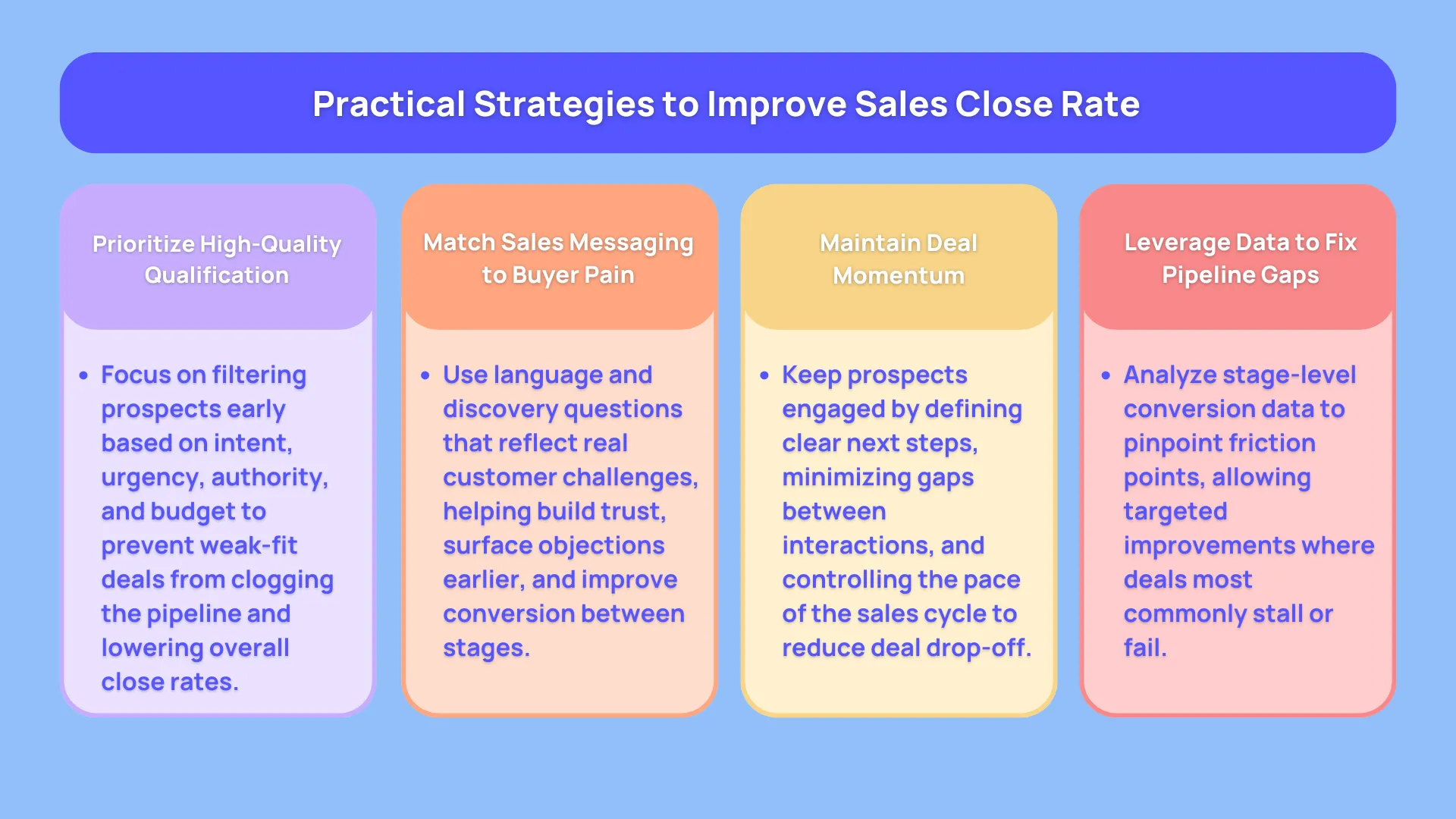
Improving the sales close rate rarely comes from working harder or adding more leads to the pipeline.
Meaningful gains come from deploying sales closing techniques that are unique to your business.
Rather than chasing surface-level activity metrics, the focus should remain on sales effectiveness and deal conversion quality.
Use Trellus To Coach for Skill Gaps, Not Outcomes

Telling reps to “close more deals” rarely changes behavior.
Coaching works best when tied to specific moments inside the sales conversation.
That’s where Trellus.ai comes in.
We created this platform as a sales first resource for sales reps, account executives, and business development representatives.
We also understand that closing more deals isn’t everyone’s forte. Some sales reps perform better because of their conversation skills, while others fall behind a little, and require a bit of hand holding during the process.
The main problem with a high volume sales calling business is that people are on a time crunch. There’s a high possibility that the business, or the managers do not have enough time slots to allocate different training sessions per person.
In that case, Trellus comes as a special AI powered sales coaching software with plenty of features that go beyond the training side of things. But since this specific sales closing tip is about improving the overall deal closing rate from a rep’s skills perspective, here’s what we offer to ante up your team’s skills.
- Use practice calls by setting them up against AI voice agents. Pace it as per your schedule and improve over time.
- Talk to AI voice agents that act like real life customers. These conversations are based on past real life interactions between a sales agent and a prospect on the other end. The AI voice agent simply trains itself to act as a prospect, where you could throw your sales pitch and try to win the deal.
- You can also deploy agents to argument phone handling. Otherwise known as handling cold call objections, the process allows your sales reps to handle these objections with increased deflections that work in favor of deal closure rate.
Over time, this skill-focused approach lifts both individual sales success rates and overall team close rate without inflating the pipeline.
Other than the training aspect, there are plenty of closing sales tips that we have highlighted below.
Strengthen Opportunity Qualification Early
Close rate problems often originate long before proposals or pricing discussions enter the picture. Poor qualification allows weak-fit prospects into the pipeline, inflating opportunity counts while dragging down the closing ratio.
Effective qualification centers on clarity. Reps need confidence around buyer intent, urgency, authority, and budget alignment. When these elements are unclear, deals stall or disappear late in the cycle, damaging the sales success rate.
Teams that protect their pipeline see fewer opportunities, yet higher sales achievement rates. Strong qualification filters noise and preserves momentum for deals that deserve attention.
Align Messaging With Buyer Reality
Prospects disengage when messaging sounds polished but disconnected from real pain points. Improving close rate requires conversations that mirror how buyers think and speak about their challenges.
This alignment strengthens trust and shortens decision timelines. When buyers feel understood early, objections surface sooner and get resolved with less friction. That clarity improves pipeline conversion across stages.
Sales leaders can support this by reviewing call recordings, refining discovery frameworks, and reinforcing language that resonates with actual customer outcomes rather than abstract benefits.
Create Momentum Between Sales Stages
Many deals fail not because of objections, but because momentum fades. Gaps between meetings, unclear next steps, and delayed follow-ups quietly erode interest.
High-performing teams control pacing. Every interaction ends with a defined outcome and a scheduled next action. This discipline increases deal closure because prospects remain engaged and accountable.
Momentum also improves forecasting accuracy. When stages move consistently, the close rate calculation becomes more predictive and reliable.
Use Data to Identify Friction Points
Close rate improvement accelerates once teams stop guessing and start observing patterns. Sales performance metrics reveal where deals slow down or drop off entirely.
For example, a strong conversion rate from discovery to demo paired with weak proposal acceptance often signals pricing confusion or value misalignment. Addressing that specific gap yields faster gains than broad coaching efforts.
Segmenting close rate data by rep, industry, deal size, or lead source highlights where improvement matters most. Precision beats general advice every time.
Why Is There So Much Disparity Between Close Rate Benchmarks?
Sales do not operate in a vacuum.
There are both internal and external variables where sometimes the situation isn’t entirely in a sales rep’s control. What if you have a specific type of business where sales are only seasonal? For instance, it could be a solar panel installation service where the demand naturally goes down during the winter season.
In that case, you will have less demand than the type of sales close percentages you see during the summer season.
The above was just one example scenario.
There are several forces that influence what qualifies as a strong sales success rate.
- Deal size and complexity
High-ticket enterprise deals involve longer buying cycles, more stakeholders, and deeper scrutiny. Close rates tend to be lower, yet revenue impact remains high. Smaller transactional deals close faster and at higher rates. - Sales cycle length
Longer cycles introduce more drop-off points. Economic shifts, leadership changes, or shifting priorities can stall momentum. Shorter cycles reduce exposure to external disruption and often produce higher pipeline conversion. - Lead source quality
Inbound leads driven by clear intent usually convert at higher rates than cold outreach. A strong close rate paired with poor lead quality often signals wasted effort rather than strong performance. - Product maturity and market fit
Well-positioned solutions with clear differentiation convert more efficiently. Early-stage products often face education gaps that impact the sales effectiveness of even skilled reps.
How to Interpret Your Own Close Rate?
Numbers gain meaning through comparison.
If you were to track your close rate over time, we need you to rely on the past data points set up across your sales pipeline. If not, then you need to employ someone’s services, or have a software, such as Trellus.ai to help you with setting up sales close rate KPIs.
Moving on, make sure that you look for consistency, upward trends, and sudden drops.
Segment the data by rep, deal size, vertical, and lead source. This reveals where performance accelerates and where it stalls. A strong close rate in one segment can guide strategy across the rest of the pipeline.
Sales Close Rate by Industry
Sales performance never exists in isolation. Industry dynamics shape buying behavior, sales cycles, pricing sensitivity, and decision authority. That is why sales close rate by industry varies so widely, even among teams that follow similar processes and use the same tools.
Understanding these variations prevents unrealistic goal setting and helps teams evaluate performance with clarity rather than guesswork. A strong closing ratio in one industry might signal underperformance in another.
B2B SaaS and Technology
B2B software sales often involve multiple stakeholders, longer evaluation cycles, and detailed security or compliance reviews. Because of this complexity, close rates tend to sit between 15 percent and 25 percent.
Mid-market SaaS teams usually land toward the upper end of that range, while enterprise sales teams trend lower due to higher deal values and longer approval chains. In this space, a healthy sales achievement rate reflects strong qualification and disciplined pipeline management rather than sheer volume.
Professional Services and Agencies
Consulting, marketing agencies, and professional service firms often see average sales closing rates between 20 percent and 40 percent. Buyers evaluate expertise, reputation, and perceived ROI rather than features alone.
Close rates rise when trust is established early and when scope and pricing are clearly framed. Sales reps in this sector often act as advisors, which improves deal closure when credibility remains intact throughout the conversation.
Manufacturing and Industrial Sales
Industrial sales involve technical validation, procurement approvals, and long-term contracts. Close rates often fall between 10 percent and 20 percent, particularly for customized solutions.
Here, pipeline conversion depends heavily on timing and buyer readiness. A lower close rate does not imply weak performance if deal sizes and contract lengths offset volume.
E-commerce and Transactional Sales
High-volume, low-friction sales environments such as e-commerce or inside sales teams can see close rates exceeding 30 percent, sometimes even reaching 50 percent or higher.
These higher rates reflect shorter decision paths and fewer gatekeepers. Success depends on speed, clarity, and convenience rather than prolonged persuasion. In these scenarios, conversion rate and close rate often align closely.
Real Estate and Financial Services
Real estate and financial services typically operate within 10 percent to 25 percent close rate ranges. High emotional stakes, financial scrutiny, and long decision cycles influence outcomes.
Sales effectiveness in these industries hinges on trust, education, and long-term relationship building. Close rate trends reveal how well reps manage objections and guide buyers through uncertainty.
Why Industry Benchmarks Should Guide, Not Limit
Industry benchmarks offer context, not ceilings. Teams that outperform averages often succeed through sharper qualification, stronger messaging, and better timing rather than sheer effort.
Comparing close rates across industries without adjusting for deal size, sales cycle length, or buyer behavior leads to false conclusions. The goal is not matching another sector’s numbers but improving deal conversion within your own reality.
When sales leaders anchor expectations in industry norms, coaching becomes more focused, forecasting becomes more accurate, and strategy decisions align with achievable growth.


Power and parallel dialing in your CRM.