Our Top Picks


One rep opens their inbox at 9 AM and sees 20 new leads.
In the old world, that meant spreadsheets, CRM updates, calendar juggling, and a mental checklist that never quite felt complete.
In 2026, a sales automation platform handles most of that before the first sip of coffee.
Follow ups are scheduled. Leads are scored. Tasks are assigned. The CRM is updated in real time. Notifications highlight which conversations need attention right now.
That is the real shift. Sales automation is no longer a nice add on. It is the operational backbone of modern revenue teams.
TL;DR
- A sales automation platform tracks activity, routes leads, schedules follow ups, and updates records automatically.
- It removes repetitive admin work so reps can focus on conversations and closing.
- The best sales automation tools connect CRM, outreach, analytics, and reporting in one connected system.
- Strong sales automation implementation leads to measurable improvements in speed, pipeline visibility, and sales automation ROI.
What Is Sales Automation?

Sales automation is the process of automating repetitive sales tasks across the entire sales cycle. Instead of relying on memory, sticky notes, or manual CRM updates, systems log, trigger, assign, notify, and move deals forward automatically.
Think of it as an invisible assistant that never forgets.
When a prospect books a demo, the meeting appears in the CRM. When they open a pricing page late at night, intent data updates their score. When a contract is signed, onboarding begins without anyone sending three reminder emails.
That is what modern sales automation software does. It connects actions to outcomes.
At its core, sales automation is about replacing manual effort with structured, predictable systems. It supports reps, managers, and revenue leaders with real time data that reflects actual buyer behavior.
Sales Process Automation
Sales Process Automation means mapping every step of your sales cycle and assigning logic to it.
Instead of reps deciding what happens next from memory, the system determines the next best action.
Here is what that looks like in practice:
- Automatic lead assignment based on territory, company size, or industry
- Stage progression rules that move deals when criteria are met
- Triggered follow up emails after meetings
- Proposal reminders if contracts are not opened
- Internal alerts when high value prospects show strong intent
Sales Process Automation removes friction between stages. Deals do not stall because someone forgot to update a field. Managers do not have to chase status updates.
The process becomes structured and visible.
When done right, it strengthens Sales Operations and creates a smoother handoff between marketing, sales, and customer success.
Workflow Automation
Workflow Automation focuses on task execution across teams.
If Sales Process Automation defines what should happen, Workflow Automation ensures it actually happens.
For example:
When a deal moves to Closed Won:
- Finance receives notification
- Invoice creation starts
- Onboarding email sequence begins
- Customer success is assigned
- CRM lifecycle stage updates
Without workflow automation, these steps depend on human coordination. That creates delays and errors.
With automation in place, transitions become instant.
Workflow Automation improves Sales Efficiency because teams stop repeating routine coordination tasks. It also strengthens Revenue Operations, since every department operates from the same data in real time.
Sales Engagement Platform
A Sales Engagement Platform manages outbound communication at scale.
Cold emails, LinkedIn touches, call tasks, follow ups, voicemail drops, all of it runs inside structured sequences.
Modern platforms powered by AI sales automation adjust messaging timing based on engagement patterns. If a prospect opens emails frequently but does not respond, the cadence adapts. If they click a pricing page, urgency increases.
A strong Sales Engagement Platform includes:
- Multi channel sequences
- Automatic task generation
- Call logging and recording
- Engagement analytics
- Conversation intelligence
This is where AI-powered sales solutions shine. They surface objection handling prompts during calls, suggest next steps, and analyze deal risk.
Instead of guessing what to say next, reps receive contextual guidance.
Lead Automation
Lead Automation handles what happens from the moment a new contact enters your system.
Without automation, leads sit unassigned, follow ups get delayed, and momentum fades.
With Lead Automation in place:
- Leads are enriched with company and role data instantly
- Scores update based on behavior and intent
- Assignment happens in seconds
- Personalized outreach triggers automatically
This is particularly valuable for sales automation for small teams. When headcount is limited, no one has time to manually research every inbound form submission.
Automation ensures no opportunity slips through the cracks.
It also improves sales automation ROI, since faster response times directly increase conversion rates.
Pipeline Automation
Pipeline Automation ensures deals move logically through stages without manual babysitting.
Reps often forget to update stages. Managers struggle with forecast accuracy. Pipeline reviews become debates instead of strategic discussions.
Automation solves that problem.
For example:
- Deals move stages after a meeting is logged
- Probability updates based on engagement data
- Risk flags appear when inactivity exceeds threshold
- Forecast numbers adjust automatically
Pipeline Automation gives leaders clarity. It strengthens forecasting accuracy and reduces end of quarter surprises.
This is a major pillar of mature Revenue Operations teams.
Sales Productivity Tools
Sales Productivity Tools sit inside or alongside your sales automation software to remove friction from daily work.
They include:
- Auto logging of calls and emails
- Calendar scheduling links
- Proposal automation
- E signature triggers
- CRM data capture tools
Productivity tools reduce context switching. Reps stay inside fewer systems. That creates higher output without longer hours.
When productivity increases, Sales Efficiency improves naturally. Reps spend more time selling and less time administrating.
Automated Sales Processes
Automated Sales Processes combine data, logic, and execution into one continuous system.
There are three layers behind this:
Data Layer
All customer data flows into a unified profile. Website visits, email opens, CRM history, support tickets, contract status. Everything connects.
When data updates automatically, manual entry fades into the background. This supports reliable reporting and stronger Sales Operations.
Logic Layer
The logic layer acts as the decision engine.
Instead of static rules, modern systems powered by AI-powered sales solutions analyze intent signals, engagement trends, and timing patterns. The system asks what action increases deal momentum right now.
Lead scores shift dynamically. Cadences adapt. Risk flags surface early.
Execution Layer
This is where buyers experience automation.
Emails reference specific behaviors. Follow ups feel contextual. Reps receive real time prompts during calls.
Execution feels human, not robotic.
That balance is what separates average platforms from the best sales automation tools.
Sales Efficiency and Sales Automation ROI
Sales leaders care about one thing above all else, results.
Sales automation ROI shows up in several measurable ways:
- Shorter sales cycles
- Higher conversion rates
- Improved forecast accuracy
- Reduced administrative hours
- Lower customer churn
When repetitive work decreases, morale improves. When forecasting becomes accurate, planning improves. When response times shrink, revenue grows.
Strong sales automation implementation connects automation directly to revenue metrics, not just productivity statistics.
Efficiency is not about doing more tasks. It is about eliminating unnecessary ones.
Sales Operations and Revenue Operations Alignment
Sales automation strengthens both Sales Operations and Revenue Operations.
Sales Operations focuses on CRM health, pipeline structure, reporting accuracy, and workflow design.
Revenue Operations takes a broader lens. It aligns marketing, sales, and customer success around shared data and shared goals.
A connected sales automation platform ensures:
- Marketing sees pipeline impact
- Sales sees campaign source performance
- Customer success sees deal history
- Finance sees contract milestones
Data silos disappear.
Revenue alignment becomes practical rather than theoretical.
Sales Automation for Small Teams
Small teams benefit disproportionately from automation.
When there are five reps instead of fifty, every hour matters.
Sales automation for small teams allows lean organizations to operate like much larger ones.
They gain:
- Automatic enrichment
- Structured outreach
- Real time pipeline visibility
- Trigger based follow ups
- Intelligent lead prioritization
Without hiring additional headcount, they increase output.
For startups and growing companies, this directly impacts burn rate and scalability.
Common Challenges in Sales Automation Implementation
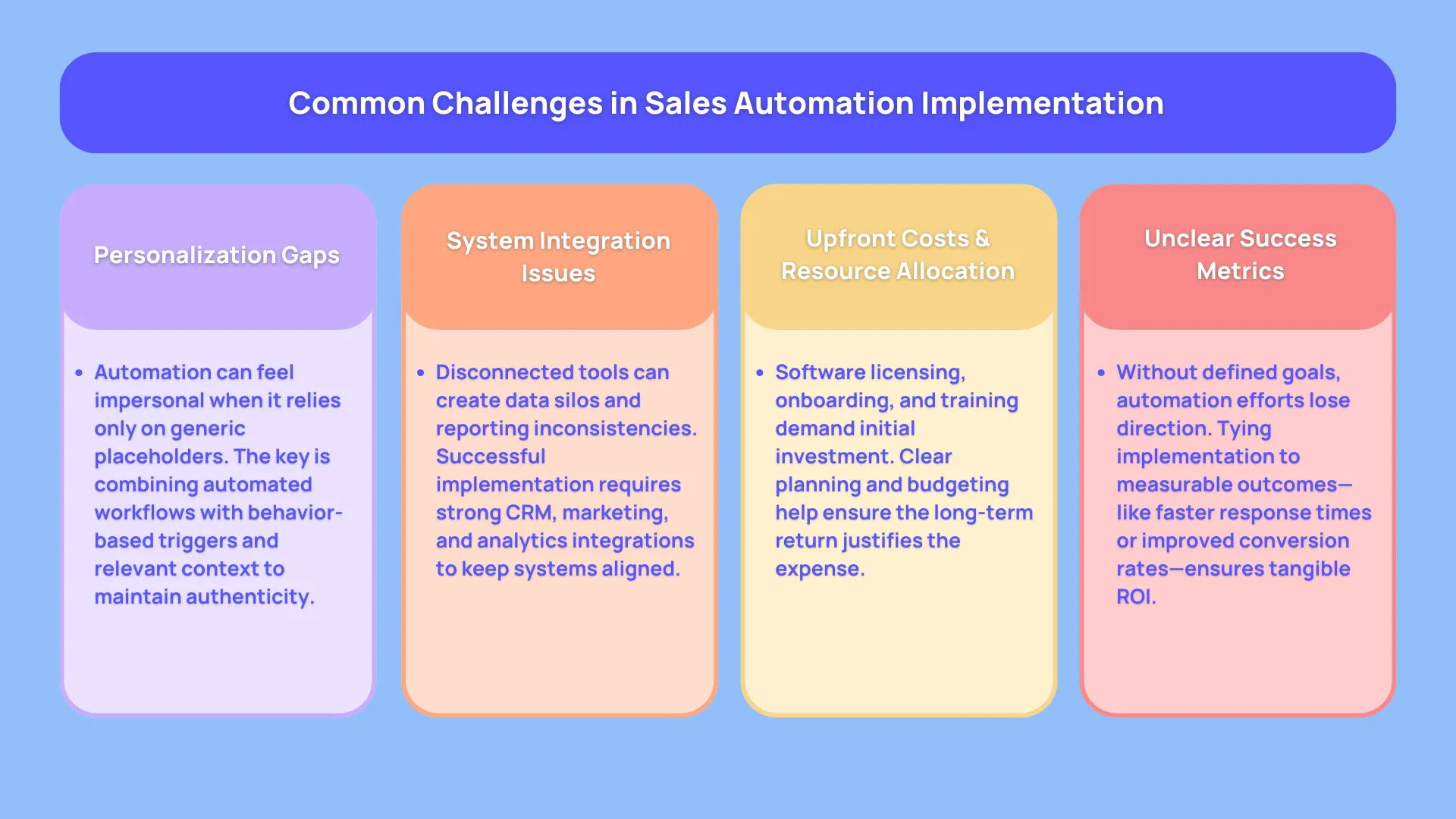
Even the best platform fails without thoughtful execution.
Here are three common challenges:
Lack of Personalization
Automation can feel robotic if messages rely on placeholders alone.
The solution is blending automation with real context. Use behavior based triggers. Reference company news. Adjust tone based on engagement.
Automation should handle structure, humans should handle empathy.
Integration Complexity
Disconnected systems create reporting chaos.
A strong sales automation platform integrates deeply with CRM, marketing automation, and analytics tools. Before purchase, map your current stack and confirm compatibility.
Upfront Investment
Software, onboarding, and training require budget.
However, proper planning ensures long term sales automation ROI outweighs initial cost. Tie implementation goals to measurable outcomes such as response time reduction or conversion improvement.
What Modern Sales Automation Actually Looks Like in 2026
Sales automation in 2026 is no longer about simple email sequences or auto assigning leads. That was version one.
Today, a true sales automation platform operates like a connected nervous system across your entire revenue engine.
- It listens.
- It interprets.
- It reacts.
When a buyer engages with your brand, the system tracks behavioral signals across channels. Website activity, webinar attendance, document views, social engagement, email clicks, product trial usage. All of it feeds into one unified profile.
Instead of a static CRM record, you now have a living, breathing timeline of intent.
This is where AI sales automation becomes powerful. The system does not just store information. It evaluates patterns. It identifies anomalies. It predicts which deals are heating up and which are quietly dying.
That shift moves sales teams from reactive to proactive.
Reps no longer ask, “Who should I call today?”
The system answers that question for them.
Advanced AI Sales Automation Capabilities
The phrase AI gets overused in software marketing. In practice, modern AI-powered sales solutions offer three meaningful upgrades to traditional automation.
The first is predictive prioritization.
Instead of assigning equal weight to every open opportunity, AI models analyze engagement depth, response speed, buying committee involvement, and historical win data. They surface accounts that statistically resemble past successful deals. This dramatically improves sales efficiency because energy is directed toward opportunities with real potential.
The second upgrade is adaptive sequencing.
Old automation relied on rigid sequences. Email one. Wait two days. Email two. Wait three days. Call.
Now sequences shift based on buyer behavior. If a prospect opens an email multiple times but does not respond, the next touch might shift tone. If they click pricing and return to the website within 24 hours, urgency increases. If activity drops, the cadence cools down.
The third upgrade is conversational intelligence.
During live calls, AI analyzes keywords, tone shifts, and objection patterns. It can surface battle cards, suggest follow up questions, and flag missed buying signals. After the call, it summarizes next steps and updates CRM fields automatically.
That is automation operating at a strategic level, not just administrative.
Best Sales Automation Tools in 2026: What Actually Matters
When evaluating the best sales automation tools, feature checklists are not enough. The real question is how the tool fits into your operational maturity.
Strong platforms share several core characteristics.
They offer deep CRM synchronization rather than surface level integrations. Data must move instantly and bi directionally. Delayed updates break automation logic.
They provide transparent workflow builders that sales operations teams can manage without constant developer support. If every workflow requires engineering help, agility disappears.
They include intelligent analytics that go beyond open rates. Revenue attribution, deal velocity trends, pipeline aging analysis, and churn risk prediction matter more than vanity metrics.
Most importantly, they unify engagement and pipeline visibility in one place. When outreach tools and CRM reporting live in separate silos, leadership loses clarity.
A modern sales automation software solution should feel like a control center, not a scattered collection of tools.
Sales Automation Implementation: Getting It Right
Poor sales automation implementation can create more confusion than manual processes ever did.
The biggest mistake companies make is automating chaos.
If your sales process is undefined, inconsistent, or undocumented, automation simply scales the mess. Before activating workflows, leadership must clearly define stages, qualification criteria, handoffs, and ownership rules.
Implementation should begin with process clarity, not tool configuration.
The next step involves identifying repetitive friction points. Where are reps losing time? Where do deals stall? Where do handoffs break? Those friction points become automation priorities.
Phased rollout works better than big bang deployment. Start with lead routing and follow up triggers. Then move to pipeline automation. After that, introduce AI prioritization and forecasting models.
This staged approach protects adoption. Reps are more likely to embrace automation when it removes pain immediately rather than overwhelming them with complexity.
Training also determines long term success. Automation should feel like support, not surveillance. When reps understand how the system helps them close more deals and protect commissions, adoption increases naturally.
Strong sales automation implementation is not about installing software. It is about redesigning workflows around clarity and accountability.
Sales Automation ROI: Measuring What Matters
Sales automation ROI cannot be evaluated through software cost alone. It must connect to revenue impact.
There are four primary indicators of strong ROI.
Sales cycle compression is the first. When response times shorten and follow ups trigger instantly, deals move faster. Even a small reduction in average cycle length can produce significant revenue acceleration.
Conversion rate improvement is the second. Better prioritization leads to higher win rates. When reps focus on qualified prospects with real intent, close percentages rise.
Administrative time reduction is the third. If automation removes two hours of weekly CRM entry per rep, that reclaimed time multiplies across the entire team.
Forecast accuracy is the fourth. More reliable data reduces last minute surprises and improves financial planning. This has ripple effects across hiring, budgeting, and resource allocation.
When these metrics improve together, sales automation ROI becomes undeniable.
Sales Automation for Small Teams Versus Enterprise Teams
The needs of a ten person startup look very different from a global enterprise.
For small teams, the priority is leverage. They need automation to act as force multiplication. Lead enrichment, automatic follow ups, and structured cadences prevent opportunities from slipping through the cracks.
In this context, sales automation for small teams should emphasize simplicity and speed. Complex customization is less important than quick deployment and clear visibility.
Enterprise teams operate at a different scale. They require territory logic, multi product routing, layered approval workflows, and revenue operations alignment across departments.
For them, the sales automation platform must support governance, compliance, and detailed reporting across regions.
The core philosophy remains the same, remove manual effort and increase clarity. The scale simply changes the architecture.
Sales Engagement Platform Versus CRM Automation
Many teams confuse CRM automation with a full Sales Engagement Platform.
CRM automation focuses on record management, deal stage logic, forecasting, and reporting. It ensures data accuracy and pipeline visibility.
A Sales Engagement Platform manages outbound activity, sequencing, and communication performance.
The most powerful environments connect both systems seamlessly. Engagement data feeds CRM insights. Pipeline changes trigger engagement adjustments.
Disconnected systems create blind spots. Connected systems create momentum.
The Future of Sales Automation
Sales automation is moving toward deeper intelligence and greater contextual awareness.
Systems will increasingly predict churn risk months in advance. They will identify upsell windows before customers request upgrades. They will recommend pricing strategies based on competitor movement and buyer behavior.
Revenue teams will spend less time asking what happened and more time deciding what to do next.
Automation will not replace sales professionals. It will elevate them. Administrative friction will shrink. Strategic thinking will expand.
That is the real promise of modern sales automation software.
Trellus: AI Powered Calling and Real Time Sales Execution
Outbound sales still lives and dies on conversations. You can automate emails, enrich leads, and score accounts all day long, but if your team relies heavily on phone outreach, the calling layer becomes the bottleneck.
That is where Trellus fits into a modern sales automation platform.
Instead of acting like just another dialer, it embeds directly into your existing workflow, sitting inside tools like your CRM or Sales Engagement Platform. Reps do not have to jump between five browser tabs or manually copy notes from one place to another. The calling experience becomes part of the broader automation ecosystem.
Real Time Calling With Built In Intelligence
Most traditional dialers focus on speed. This platform focuses on both speed and quality.
Reps can power through call lists efficiently, but they are not operating blindly. During live conversations, real time prompts and objection handling guidance appear on screen. If a prospect raises pricing concerns, competitive comparisons, or timing objections, the system surfaces relevant talking points immediately.
That is where AI sales automation shifts from back end admin help to front line performance support.
Instead of reviewing calls after the fact, coaching happens in the moment. Newer reps gain confidence faster. Experienced reps sharpen their edge.
Automatic Capture of Conversation Data
Manual call notes are one of the biggest drains on sales productivity.
After each conversation, summaries are generated automatically. Key discussion points, next steps, and sentiment cues are structured and pushed into the CRM. Follow up emails can even be drafted based on what was discussed.
This matters for more than convenience. Clean data improves pipeline automation, forecasting accuracy, and overall sales operations visibility. When call outcomes sync instantly with your broader sales automation software, leadership gets real time insight without chasing updates.
For teams focused on revenue operations alignment, that consistency is critical.
Designed for Outbound Heavy Teams
Not every automation tool understands the rhythm of high volume outbound.
Inside fast paced SDR environments, seconds matter. The platform streamlines voicemail drops, reduces dialing friction, and minimizes post call admin time. That means more live conversations per hour without sacrificing quality.
For sales automation for small teams, this kind of efficiency can feel like adding extra headcount without hiring anyone. A lean outbound group can operate at scale while maintaining structured follow through.
Larger organizations benefit differently. Managers gain visibility into connect rates, talk to listen ratios, and objection patterns across the team. That data feeds into better coaching frameworks and more predictable performance.


Power and parallel dialing in your CRM.