15+ Sales Pitch Scripts & Templates for Every Situation (2026)
Going forward in 2026, sales pitch scripts will only work if you are treating them as a personalized experience catered to your prospects' needs. Here are some of the best scripts to help you get started today.


On this page
Our Top Picks


Cold calling in 2026 is looking a tad bit different than what we had before in the last couple of years.
We’d say that this change is attributed to a couple of things; some of them fall on the prospects’ side.
Why so?
People are more guarded; their inboxes are already overloaded, and phone screens light up with unknown numbers all day long. That reality has not killed cold calling. It has simply raised the bar. And it holds true despite the overall low conversion rate for cold calls.
Then there’s the gatekeeper factor. Decision makers are hard to get in touch with if there are gatekeepers involved in the process. Especially when you’re looking to make a couple of big ticket sales, you should be sure about someone who will “put you through” with the person in charge eventually.
It’s part of the game. The overall awareness factor is pretty high, and buyers at the top of the food chain pretty much know the lay of the land; their competitors and vice versa.
From that point of view, sales pitch scripts still matter, but only when they are treated as conversation frameworks rather than rigid text to recite. The strongest sales pitching script gives reps confidence, direction, and clarity, while still leaving space for personality, curiosity, and human judgment.
That being said, any script for sales pitch success is not about sounding clever.
In fact, it is about making the prospect feel understood within the first few seconds of a sales call dialogue. Moreover, if you were to treat the sales script as just the foundational level block, and then build on it, according to the conversations you’re having with your day to day prospects, and through improvising on the spot, you’re bound to get better results.
I have seen companies that hand out a cookie cutter sales script and don’t let their reps deviate from it. That’s not a good strategy.
Please understand that prospects are not robots; they’re human like us. And a little bit of human connection goes a long way, especially when, as an SDR, you have done ample research on a long list of prospects before dialing their number.
This in depth guide will fill you in on some of the best sales pitch scripts/ best cold calling scripts, and few examples that you can use in year 2026, and beyond to score some big deals.
Let’s get started.
What a Modern Sales Pitch Script Is

A sales pitch script example in this year, as in: 2026 works more like a guided system than a script in the traditional sense. As I mentioned earlier about the improvising part, the script shows the route, warns about obstacles, and suggests turns, but it never forces the driver to follow one exact path.
At its core, a sales pitch script exists to support three outcomes:
- Reduce hesitation at the start of the call
- Create a natural transition into value proposition messaging
- Keep the rep grounded when objections surface
Cold calling sales scripts fail when they prioritize clever wording over clarity. On tne contrary, they succeed when they help the rep sound calm, informed, and respectful of the prospect’s time.
In that order, it wouldnt be completely wrong to say that the best scripts also acknowledge an uncomfortable truth. The person on the other end did not plan to talk to you today; you just called them out of the blue.
That awareness should shape every word that follows.
Why Most Sales Pitch Scripts Break Down Early?
Many worldwide sales teams invest hours perfecting sales opening lines, only to watch conversations collapse within the first thirty seconds. The issue is rarely effort. It is misalignment.
Most scripts fail because they attempt to control the conversation instead of guiding it. Prospects feel that tension immediately.
Here is what usually goes wrong.
- The script talks too much before earning attention
- The pitch sounds polished but emotionally flat
- Objections are treated as interruptions instead of signals
When a rep clings too tightly to a script, their listening disappears. Prospects notice that faster than any poorly chosen phrase.
A strong sales message framework creates safety for the rep, not a cage.
At this point, you must be contemplating other possible reasons for your seemingly perfect sales script to fail.
Well, there is one main reason besides the obvious ones that lead to failure at a very early stage of a cold call.
It’s the lack of proper communication skills. Many reps have the script planned in their head, and it plays out all too well RIGHT before the moment a call is made. During a call, these reps hesitate, feel at a loss for words against a common cold calling objection, or just deviate from the script, and fail to circle back.
This happens because of a lack of conversational skills.
Now, we don’t want to sound too pushy, but you could use Trellus.ai to brush up on your cold calling conversation skills - and that too, without booking up a sales coaching expert’s slots. Our platform uses next gen AI techniques that automatically analyzes on going call patterns to quickly highlight any weak areas on a rep’s end.
As a result, should you be struggling at any point, the program simply shows cues on your screen that you can use in response to a prospect’s objection. Other than that, our platform also allows salespeople to set up AI practice calls against a bot that works like a normal, real life prospect on the other end of the line.
These practice calls are a great way to train yourself at your own pace, eventually garnering better results over time.
The Psychology That Makes Sales Pitch Scripts Effective
Cold calling works when it respects human psychology.
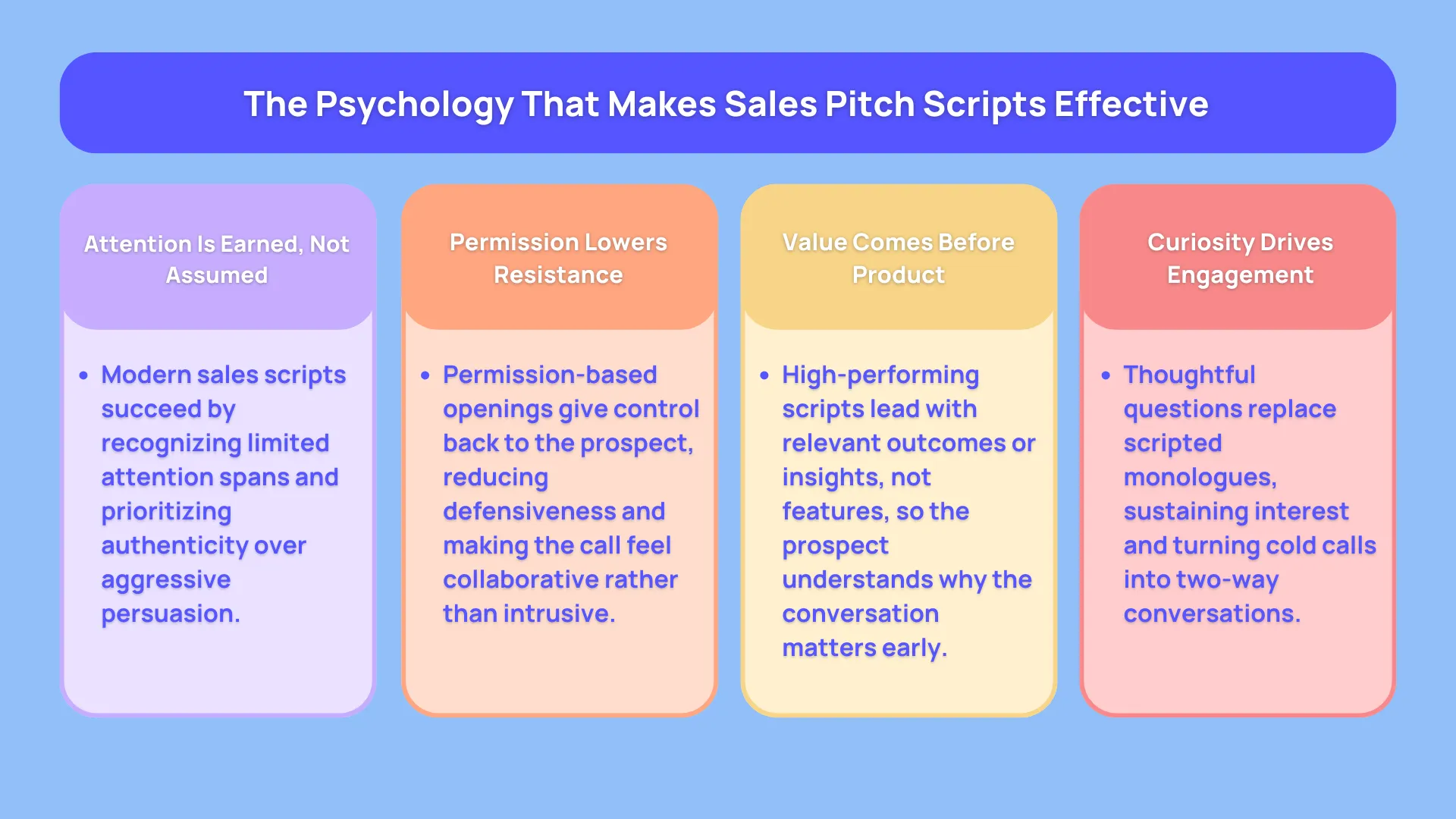
We did some digging around on the last few months’ statistics and the overall consensus behind the psychology of sales scripts. We found that attention is scarce, trust is fragile, and authenticity is rewarded far more than persuasion tactics.
Three psychological principles shape high performing sales pitch scripts today.
Permission Changes the Tone of the Call
Asking permission does something subtle but powerful. It returns control to the prospect. That single shift lowers resistance and opens the door to conversation.
Permission based sales opening lines feel collaborative instead of intrusive. They acknowledge the interruption without apologizing for it.
When prospects feel respected, they listen longer.
Value Must Appear Before the Pitch
Modern prospects tune out the moment a call sounds self focused. Value proposition messaging must appear early, but it must also be relevant.
Value is not a feature. It is an outcome that matters to the person listening.
Effective sales call dialogue introduces value in the form of insight, comparison, or experience, not product descriptions.
Curiosity Sustains Attention
Curiosity is the engine that keeps a cold call alive. Scripts that rely only on statements stall quickly. Scripts that invite thought create momentum.
Well placed questions turn monologues into conversations. That shift alone can double engagement.
Core Sales Pitch Scripts for Real World Sales Calls
This section focuses on practical sales pitch scripts that sales teams rely on daily. These are not novelty templates. They are adaptable frameworks designed to work across industries, deal sizes, and experience levels.
Each script includes context, intent, and delivery guidance so it can be adjusted without losing effectiveness.
Opening Sales Pitch Scripts That Build Rapport Fast
The opening moments of a call shape everything that follows. Strong sales opening lines do not rush. They orient the prospect, establish credibility, and create psychological safety.
Below are proven sales pitch scripts that consistently reduce resistance at the start of a call.
Script One, The Permission Based Opener
This sales pitch script example acknowledges the interruption while signaling relevance and preparation.
Sales Call Dialogue:
Hi, this is [Name] calling from [Company]. Did I catch you at a bad time?
Pause and listen carefully to the response.
Thanks for taking a moment. I noticed [specific observation about their role or business], and I thought it was worth reaching out. We recently helped a team similar to yours achieve [specific outcome]. Would it make sense to spend a couple of minutes seeing if this is relevant for you?
Why this works:
This script lowers defenses immediately. It respects time, demonstrates awareness, and introduces value without forcing commitment. The prospect feels invited rather than cornered.
From a pitch delivery techniques perspective, the pause after the first question matters as much as the words themselves. Silence shows confidence.
Script Two, The Referral Anchored Opener
Referral based sales pitch scripts benefit from instant credibility. Even a loose connection reduces skepticism.
Sales Call Dialogue:
Hi [Name], [Mutual Contact] mentioned I should reach out. They thought you might be interested in how teams are improving [specific result]. I only need a minute to explain what stood out. Is now okay?
Why this works:
Trust transfers quickly when names are used responsibly. This script works because it does not exaggerate the relationship. It simply borrows relevance.
For telephone sales scripts, this approach often shortens the time it takes to reach meaningful conversation.
Script Three, The Research Led Opener
This script suits prospects in leadership roles who value preparation.
Sales Call Dialogue:
Hi [Name], I came across your recent [announcement, article, expansion], and it caught my attention. A few companies in similar situations used a different approach and saw [specific improvement]. Can I share what they did?
Why this works:
Research signals respect. This opening frames the call as a peer level exchange rather than a pitch. It positions the rep as informed, not needy.
This approach pairs well with Sales Presentation Templates later in the funnel.
Follow Up Sales Pitch Scripts That Restart Conversations
Following up is where many deals quietly die. Not because the prospect lost interest, but because the follow up sounded transactional, impatient, or forgettable. A strong follow up sales pitching script reframes the conversation instead of chasing it.
Effective follow up scripts acknowledge history, add new perspective, and reopen dialogue without pressure. They work best when the rep sounds curious rather than hopeful.
Script Four, The Context Reset Follow Up
This sales pitch script example works well after an initial conversation that ended without a clear next step.
Sales Call Dialogue:
Hi [Name], this is [Your Name] from [Company]. We spoke recently about [specific topic], and I wanted to reconnect. I’ve been thinking about one part of our conversation that stood out, especially around [specific pain point]. Have things changed at all since we last spoke?
Why this works:
This script shows continuity without sounding like a reminder. It proves the rep was listening and thinking beyond the call. From a sales message framework standpoint, it positions the rep as thoughtful rather than persistent.
The open ended question invites an update, not a defense.
Script Five, The Value Add Follow Up
This script is effective when time has passed and the rep has something new to contribute.
Sales Call Dialogue:
Hi [Name], I wanted to share something that came up after our last conversation. A company dealing with [similar challenge] adjusted their approach and saw [specific result]. It reminded me of what you mentioned. Would it be useful to talk through how they handled it?
Why this works:
Follow ups fail when they exist only to ask for time. This one earns attention by bringing relevance first. It also transitions naturally into Product Demonstration Scripts later in the process.
Objection Response Scripts That Keep Conversations Alive
Objections are rarely rejections. More often, they are signals that the prospect needs clarity, control, or reassurance. Objection response scripts work best when they slow the conversation down instead of speeding it up.
These scripts turn resistance into dialogue.
Script Six, Handling “I’m Not Interested”
Sales Call Dialogue:
That makes sense. Before I let you go, can I ask you something quickly?
Pause and wait.
What about this conversation made it feel irrelevant for you?
Why this works:
This script removes pressure and invites honesty. Many prospects will answer because the question feels safe. Even when the answer confirms lack of fit, the rep gains insight.
Strong telephone sales scripts treat objections as information, not obstacles.
Script Seven, Handling “Send Me Information”
Sales Call Dialogue:
I’m happy to send information. To make it useful, can I ask how you currently handle [specific process]?
Allow them to explain.
Based on what you shared, a short conversation might actually be more helpful than a document. Would a quick discussion later this week make sense?
Why this works:
Information requests often mean uncertainty, not disinterest. This script reframes the request as an opportunity for clarification. It also transitions naturally into Sales Presentation Templates when appropriate.
Sales Pitch Formats for Different Selling Situations
Not every pitch lives on a phone call. Strong sales teams adapt their script for sales pitch delivery across formats. Each format has its own rhythm, constraints, and success signals.
Script Eight: One Line Sales Pitch Scripts
A one line pitch distills value into a single clear outcome. It works best in low attention settings.
Explanation:
This format relies on clarity over persuasion. It should communicate who the solution is for and what changes as a result.
Example:
We help sales teams shorten deal cycles by identifying buyer intent earlier in the conversation.
This format supports Elevator Pitch Scripts and networking conversations.
Script Nine: Elevator Pitch Scripts
An elevator pitch expands the one line concept into a brief narrative.
Explanation:
This format introduces context, problem, and outcome within thirty seconds. It avoids features and focuses on transformation.
Example:
Most sales teams struggle to understand why deals stall. We work with revenue leaders to uncover where conversations lose momentum, so reps can adjust in real time and close faster.
Script Ten: Telephone Sales Scripts
Telephone scripts require immediate rapport and pacing control.
Explanation:
Tone, pauses, and listening matter more than wording. A strong telephone sales script leaves space for response rather than filling silence.
These scripts pair well with Pitch Delivery Techniques that emphasize calm pacing.
Script Eleven: Email Sales Pitch Scripts
Email pitches must earn attention quickly.
Explanation:
They rely on relevance, brevity, and a single clear action. Long explanations reduce response rates.
A strong email pitch aligned with your product positioning on how to pitch a product often mirrors a spoken script, but with tighter structure.
Script Twelve: Investor Pitch Scripts
Investor pitches focus on risk, upside, and credibility.
Explanation:
They prioritize vision, market opportunity, and execution clarity. Emotional confidence matters as much as logic.
These scripts often borrow structure from Sales Message Frameworks used in enterprise sales.
Script Thirteen: Pain Point Pitch Scripts
Pain point pitches center the prospect’s problem rather than the solution.
Explanation:
They validate frustration before presenting relief. This format builds emotional alignment early.
This approach strengthens Value Proposition Messaging across all channels.
Script Fourteen: One Minute Sales Pitch Scripts
This format allows more detail without overwhelming.
Explanation:
It balances storytelling with clarity. It introduces problem, approach, and outcome in a controlled arc.
Product Pitch Examples That Teach Positioning
Product pitches succeed when they frame value through perspective rather than explanation.
Vidyard Product Pitch Breakdown
Vidyard positions itself around human connection in remote selling.
Explanation:
The pitch identifies a clear audience, highlights friction in current workflows, and presents video as a relational advantage rather than a technical feature.
This aligns well with Product Demonstration Scripts that feel personal.
LISNR Product Pitch Breakdown
LISNR uses origin story as positioning.
Explanation:
Their pitch connects technology to mission. It invites buyers to participate in a broader goal, not just a transaction.
This strengthens emotional buy in.
Script Fifteen: Apple Product Pitch Breakdown
Apple’s pitch relies on confidence and simplicity.
Explanation:
Short statements, strong claims, and minimal explanation create authority. The brand leads with belief, then reinforces it with benefits.
Ready To Brush Up Your Conversational Skills?
If you’re ready to throw your hat in the game, we’d recommend having a bit of patience. Don’t lose sight of the bigger goals, and maintain an overall positive middle attitude. At times, it may seem like that a deal is going your way, but sometimes prospects just go silent despite your best efforts.
That’s part of the game. And you should take it as a normal process. So, don’t mop over such experiences because you might be missing out on a boat load of unexplored opportunities.
Good luck!