Our Top Picks


It’s some time early in the morning at the office, or perhaps a hybrid work location.
Your SDR has already made dozens of calls. Most went straight to voicemail. A few numbers were disconnected. One person said they left the company six months ago.
Now the rep is staring at Slack with their headset still on.
This situation happens in many sales teams, and it usually has nothing to do with motivation or talent. It happens because the SDR workflow is broken.
A sales development rep who works with poor data, unclear priorities, and scattered tools will struggle no matter how strong their communication skills are. On the other hand, a clear sales development rep workflow creates structure, momentum, and measurable output.
The difference between an average SDR team and a high performing one often comes down to the SDR process they follow every day.
This guide walks through what that process should look like in 2026, including the most effective SDR best practices, tools, and workflow design that support real sales conversations.
Understanding the SDR Role in the Modern Sales Process
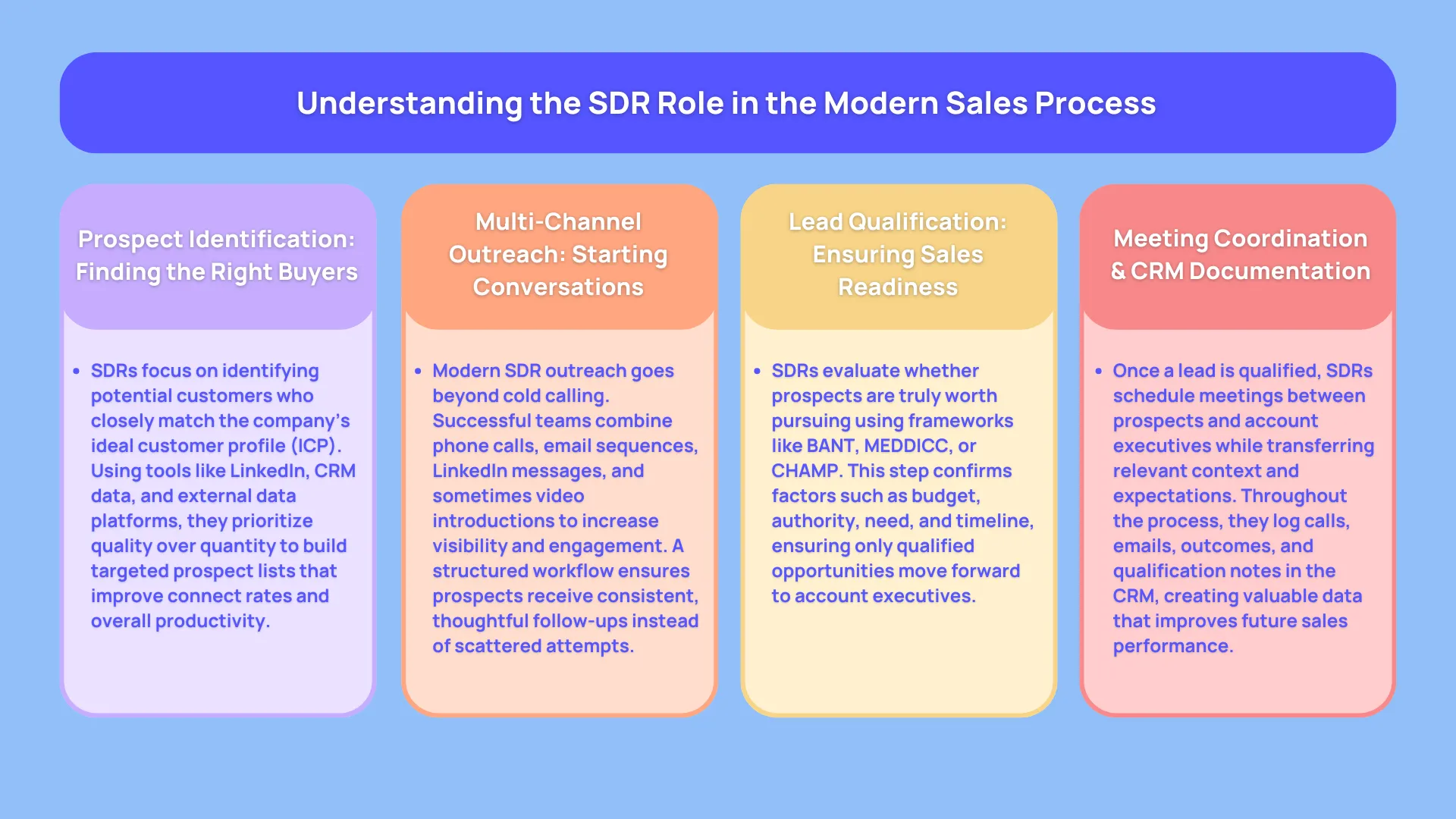
Sales organizations depend on structure. Marketing generates attention, account executives close deals, and sales development representatives sit directly in the middle of that motion.
Their job is simple in theory, yet complex in execution.
Sales development reps initiate conversations with potential buyers, determine if the opportunity is worth pursuing, and pass qualified leads to closers.
Without a structured SDR workflow, closers spend their time chasing people who are not ready to buy. That wastes pipeline and slows revenue.
A strong sales development process ensures that every opportunity reaching an account executive has already been vetted.
In practical terms, an SDR is responsible for several critical activities inside the broader sales execution workflow.
Prospect Identification
SDRs locate potential customers who match the company’s ideal customer profile. This stage often involves LinkedIn Sales Navigator searches, CRM data analysis, and external data platforms.
The goal is not to create the largest list possible. The goal is to create the most relevant list possible.
Targeted prospecting improves connect rates, increases response rates, and dramatically improves SDR productivity.
Outreach Across Multiple Channels
Modern sales development involves more than cold calls. Successful teams combine phone outreach with email sequences, LinkedIn messaging, and sometimes video introductions.
This multi channel prospecting workflow increases the likelihood that a prospect actually notices the outreach.
A well organized SDR process ensures each contact receives thoughtful follow up rather than random outreach attempts.
Lead Qualification
Not every conversation should become a sales meeting.
SDRs evaluate leads through qualification frameworks such as BANT, MEDDICC, or CHAMP. These structures help determine if the prospect has budget, authority, need, and a realistic timeline.
Qualification protects account executives from wasting time on conversations that cannot lead to revenue.
Meeting Scheduling
Once a lead shows interest and meets qualification criteria, the SDR schedules a meeting between the prospect and the account executive.
At this point the SDR’s responsibility shifts from conversation starter to opportunity coordinator.
A well managed sales development rep workflow ensures that meeting details, expectations, and notes are clearly transferred to the closing team.
CRM Documentation
Every action taken during the SDR process must be logged.
Calls, emails, conversation outcomes, and qualification notes form the data layer that improves future sales execution.
Teams that fail to track this information lose valuable insights about what actually works.
Are SDRs Still Relevant in 2026?

Artificial intelligence tools have changed many aspects of outbound sales. Prospect research, message drafting, and lead scoring can now happen faster than ever.
Yet the human element in sales development remains extremely important.
Modern buyers conduct extensive research before talking to a vendor. When they finally decide to engage, they expect a conversation with someone who understands their situation.
That person is usually an SDR.
Automation tools can identify potential leads and draft opening messages. They cannot replace real conversations that uncover pain points, priorities, and internal buying dynamics.
Because of this, the SDR role is evolving rather than disappearing.
Today’s SDR workflow includes collaboration between humans and software.
AI tools help with repetitive tasks such as list building or note summarization. Human reps handle discovery conversations, objections, and relationship building.
This hybrid model improves SDR productivity while keeping conversations authentic.
What Makes a Great SDR in 2026
A well designed SDR tools workflow provides structure, yet individual skills still matter. High performing sales development reps share several key traits that shape their daily performance.
Curiosity About the Prospect
Top SDRs approach conversations with genuine curiosity.
Instead of reading scripts word for word, they ask thoughtful questions that uncover the prospect’s real challenges. Curiosity helps the rep connect the company’s solution with the buyer’s situation.
This approach also improves conversation quality. Prospects respond better to people who listen rather than push a pitch.
Resilience in a High Rejection Environment
Cold outreach naturally produces rejection. Many prospects decline calls, ignore emails, or postpone conversations.
Successful sales development reps maintain a positive attitude throughout these moments.
Resilience protects motivation and ensures that daily activity remains consistent. In a role built around outreach volume, consistency drives long term results.
Clear Communication
Great SDRs communicate ideas quickly and clearly.
Their messages are short, relevant, and easy to understand. When speaking on the phone, they sound confident without sounding aggressive.
This balance builds trust during the first interaction with a potential buyer.
Strong Organizational Habits
An effective sales development rep workflow often involves hundreds of contacts, dozens of follow ups, and several scheduled meetings.
Without strong organization, opportunities slip through the cracks.
Top performers treat their CRM like a command center. They log notes carefully, track follow up tasks, and maintain accurate prospect records.
Comfort with Sales Technology
Sales development has become increasingly technology driven.
CRM systems, dialers, sequencing platforms, conversation intelligence tools, and data platforms all contribute to the modern SDR tools workflow.
The most productive SDRs learn these systems quickly and use them to streamline repetitive tasks.
Technology should amplify effort rather than create friction.
A Collaborative Mindset
Sales development works best when teams share insights.
SDRs often identify patterns in objections, buyer concerns, and messaging effectiveness. Sharing those observations helps marketing refine campaigns and helps account executives prepare for meetings.
When collaboration flows freely, the entire sales process becomes more effective.
Cold Calling Benchmarks SDR Teams Should Know
Improving an SDR workflow requires understanding baseline performance metrics. Without benchmarks, it becomes difficult to determine if the team’s sales execution is actually improving.
Cold calling data from recent sales studies highlights several patterns.
Call timing strongly affects connect rates. Early morning calls between 8 and 9 AM often reach decision makers before their meeting schedules fill up. Late afternoon calls between 4 and 5 PM also perform well because many executives are wrapping up their day.
Day of the week also matters. Wednesday and Thursday usually outperform Monday and Friday, largely because decision makers are less distracted by weekly planning or end of week wrap up.
Lead source has an even bigger impact on performance.
Cold purchased lists tend to produce conversion rates around 1.5 to 2 percent. Marketing qualified leads often convert between 4 and 6 percent. Warm introductions from trusted contacts can reach conversion rates between 15 and 25 percent.
These numbers illustrate an important point.
Many sales teams focus heavily on call scripts while ignoring the upstream factors that shape conversion. A poorly sourced contact list can destroy even the best outreach messaging.
An optimized prospecting workflow starts with strong data.
Step Zero in the SDR Workflow: Data Verification
Before a single call happens, the contact data needs validation.
Phone numbers change, employees switch companies, and contact records decay rapidly over time. When SDRs spend half their day dialing disconnected numbers, morale drops quickly.
Research shows that most people ignore calls from unknown numbers. When the number also routes to the wrong person, the chances of a meaningful conversation drop close to zero.
This is why data verification sits at the beginning of every effective SDR process.
Many teams apply a simple research structure called the 3 by 3 method.
The idea is straightforward.
Spend three minutes gathering three relevant facts about the prospect or their company before making the call.
These facts might include recent funding announcements, hiring activity, product launches, or public comments from executives.
This short research window keeps preparation efficient while still enabling personalized outreach.
The improvement in conversion rates can be dramatic. Even basic personalization can raise conversion from under two percent to over three percent.
That difference might sound small, yet across hundreds of calls it significantly increases meeting volume.
Accurate data combined with quick research forms the foundation of a productive sales development rep workflow.
The Core SDR Workflow: Main Steps That Drive Consistent Pipeline
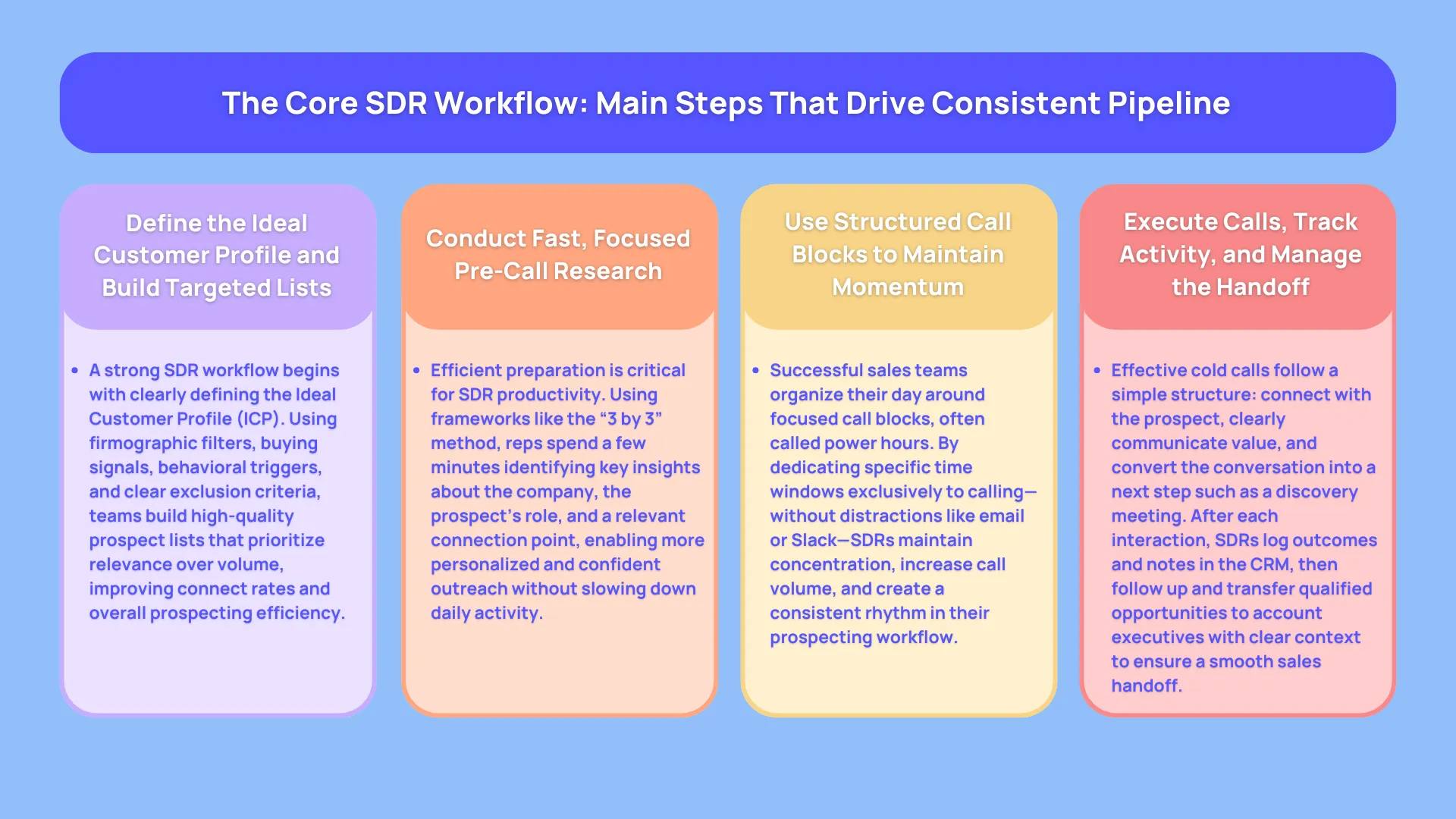
Once the foundation is set with accurate data and clear expectations, the next priority is structuring the SDR workflow itself. This structure determines how sales development reps move from prospect identification to qualified meetings.
A well designed sales development rep workflow reduces wasted effort, improves focus, and ensures that every call, email, and follow up has a purpose.
Instead of random activity, the team follows a predictable SDR process that can be repeated, measured, and improved over time.
The following six steps form the backbone of an effective prospecting workflow used by modern sales development teams.
Step 1: Define Your ICP and Build a High Quality Prospect List
Sales development performance starts long before the first call. If the target list is weak, the entire sales process suffers.
Many struggling teams rely on large contact lists filled with poorly matched prospects. The assumption is that more calls will eventually produce results.
In reality, focused targeting outperforms mass outreach.
A well structured SDR workflow begins with a clearly defined Ideal Customer Profile. This profile describes the type of company that benefits most from your product or service.
Several categories help shape this profile.
Firmographic Filters
Firmographics describe basic characteristics of a company.
Important criteria often include industry, company size, annual revenue range, geographic location, and the technologies already used by the business.
These attributes narrow the search and ensure that SDRs spend their time contacting organizations that closely match successful customers.
Buying Signals
Certain company events often indicate that a business may soon evaluate new tools or services.
Examples include funding announcements, rapid hiring activity, product expansion, or leadership changes.
Sales teams monitor these signals because they frequently precede purchasing decisions.
Prospects showing these signals often respond more positively to outreach.
Behavioral Triggers
Digital behavior also provides valuable signals for the sales development process.
Website visits, content downloads, webinar attendance, and email engagement all suggest early interest in a company’s solution.
When these signals appear, SDR outreach becomes more relevant and timely.
Exclusion Criteria
A disciplined team workflow includes clear exclusions.
Existing customers, direct competitors, and previously disqualified leads should not reappear in new prospect lists. Removing these contacts protects SDR productivity and prevents awkward outreach situations.
When targeting is done properly, the result is a prospect list where every contact has a legitimate reason to hear from the company.
Fifty well researched calls often outperform one hundred random dials.
Step 2: Pre Call Research That Takes Three Minutes
Sales development requires preparation, but excessive research can quietly destroy productivity.
Some new SDRs spend ten or fifteen minutes analyzing every prospect before making a call. That level of preparation drastically reduces daily outreach volume.
The goal of a strong SDR workflow is efficient preparation rather than deep investigation.
The widely known 3 by 3 research framework works well for this stage, and we also talked about it, a bit earlier in the post.
The rep spends roughly three minutes identifying three useful insights about the prospect or their organization.
Three types of context usually provide enough information for a meaningful opening conversation.
Company Context
Understanding the company’s recent activity helps the SDR sound informed.
This context might include recent product launches, press announcements, hiring trends, or industry developments affecting the company.
Even one relevant reference can transform a generic cold call into a relevant conversation.
Role Context
Understanding the prospect’s job responsibilities is equally important.
Different roles care about different outcomes. A marketing leader focuses on demand generation metrics, while a revenue leader focuses on pipeline growth.
Recognizing this difference helps the SDR frame their outreach more effectively.
Connection Point
The final piece of preparation is identifying a reason for the conversation.
The connection point could relate to the prospect’s company growth, a challenge common within their industry, or a signal that suggests potential need for the solution.
With these three pieces of context, the SDR can begin the call with relevance and confidence.
Efficient research supports SDR productivity without slowing down the entire prospecting workflow.
Step 3: Structure Daily Call Blocks for Maximum Focus
One of the biggest productivity problems in sales development comes from constant task switching.
SDRs jump between emails, Slack messages, CRM updates, and phone calls throughout the day. Each switch disrupts concentration and slows momentum.
A structured SDR tools workflow solves this problem through dedicated call blocks.
These blocks are often referred to as power hours or focus sessions.
During these periods, the rep performs only one activity, making calls.
No email responses. No Slack messages. No administrative tasks.
Just consistent dialing.
Two call blocks often work well for most teams.
The first block occurs in the early morning, when decision makers are starting their workday. The second block happens in the late afternoon, when many executives are finishing meetings and reviewing tasks.
Between these windows, SDRs can focus on research, follow ups, and CRM updates.
Call volume expectations depend heavily on technology.
Manual dialing usually supports forty to fifty calls per day. Teams with parallel dialers often reach sixty to eighty calls during the same period.
Structured call blocks protect energy and create rhythm in the daily sales execution workflow.
Step 4: Execute the Cold Call Conversation
The call itself represents the most visible moment in the SDR process.
Every step leading to this point exists to support a successful conversation.
Strong calls often follow a simple framework built around three stages.
Connect, communicate, and convert.
Connect With the Prospect
The first goal is simply reaching the right person.
When the prospect answers, the opening moment determines whether they stay on the line.
A brief acknowledgment that the call is unexpected can reduce tension. Many effective openers ask for a small amount of time before continuing the conversation.
This approach respects the prospect’s schedule while maintaining control of the conversation.
Communicate the Value Clearly
Once the prospect allows the conversation to continue, the SDR should deliver a short value statement.
This statement answers three basic questions.
Who is calling, what problem they help solve, and why the prospect was contacted specifically.
Clarity matters here. Long explanations lose attention quickly.
The value statement should connect directly to the prospect’s role and current situation.
Convert the Conversation Into a Next Step
If the conversation shows potential, the SDR introduces a simple next step.
This step is usually a short discovery meeting with an account executive.
Objections often appear at this stage.
Common responses include requests to send information through email or comments about being busy.
Effective SDRs treat these responses as normal parts of the sales methodology, not as rejection.
Calm follow up questions can reopen the conversation and keep the interaction productive.
Tone and pacing play an important role. Prospects respond more positively when the SDR sounds relaxed, respectful, and genuinely interested in their perspective.
Step 5: Log Activity and Maintain Accurate CRM Records
The conversation may end quickly, yet the SDR workflow continues.
Accurate CRM documentation ensures that the team maintains visibility into every interaction.
Each call should receive a clear outcome label, often called a disposition.
Common categories include connected conversations, voicemail attempts, gatekeeper interactions, and incorrect numbers.
Recording these outcomes allows managers to evaluate performance and identify patterns within the sales development process.
Beyond call outcomes, SDRs should also record important context from each conversation.
Relevant details may include the prospect’s current challenges, internal priorities, or objections raised during the call.
These notes provide valuable context when the opportunity moves to the next stage of the sales process.
Accurate documentation strengthens the entire team workflow and ensures that no useful insight disappears.
Step 6: Follow Up and Hand Off Opportunities to Account Executives
The final stage of the sales development rep workflow focuses on maintaining momentum.
After a conversation ends, follow up communication should happen quickly.
Even short conversations deserve a brief summary email.
This message confirms what was discussed and keeps the SDR visible in the prospect’s inbox.
When a meeting is scheduled, the follow up becomes even more important.
The SDR should confirm the calendar invitation immediately and provide a clear outline of what the meeting will cover.
Specific agendas reduce meeting cancellations and increase attendance rates.
Before the account executive joins the conversation, the SDR transfers all relevant information.
This includes the trigger that sparked the prospect’s interest, notes from the initial discussion, and any concerns the prospect mentioned.
When the handoff happens smoothly, the account executive can continue the conversation without repeating discovery questions.
This seamless transition improves the buyer experience and strengthens the overall sales execution workflow.
Increasing SDR Productivity Without Burning Out Your Team
Activity alone does not create pipeline. Many sales teams track daily dial counts, expecting higher numbers to produce better results. In reality, this mindset often creates frustration instead of performance.
A productive SDR workflow focuses on the right combination of activity, timing, and lead quality. When those elements align, reps spend more time speaking with real prospects and less time chasing disconnected numbers or unqualified contacts.
Modern sales teams care about conversations and meetings, not just activity volume.
Improving SDR productivity requires attention to several operational factors within the broader sales development rep workflow.
Focus on Conversations Instead of Raw Dial Counts
Dial counts are easy to measure, which explains why many managers rely on them. Unfortunately, they rarely reflect the real health of the sales development process.
A rep might complete one hundred calls in a day and still produce zero meaningful conversations. Another rep might complete fifty calls and schedule three meetings.
The difference lies in the quality of the list and the structure of the prospecting workflow.
High performing teams measure outcomes such as:
• Conversations with decision makers
• Meetings scheduled
• Meetings attended
• Sales accepted opportunities
These metrics provide a clearer picture of sales execution.
Improve Connect Rates With Better Mobile Data
Phone numbers dramatically influence connect rates.
Office numbers often route through reception desks or automated systems. Mobile numbers usually reach the actual prospect.
Teams working with accurate mobile data often see connect rates around thirty percent. Lists relying on outdated contact databases sometimes struggle to reach twelve percent.
This gap changes the entire SDR process.
Higher connect rates reduce the number of calls required to schedule meetings. Reps spend more time having conversations and less time dialing empty lines.
Protect SDR Energy With Smart Scheduling
Energy management is often overlooked in sales development.
Calling for eight straight hours rarely produces consistent results. Attention drops and conversation quality suffers.
A strong team workflow divides the day into focused work blocks.
Morning blocks concentrate on calls when decision makers are beginning their day. Afternoon blocks capture executives finishing meetings and reviewing their schedules.
Midday hours often work best for research, follow ups, and CRM updates.
Remove Friction From the SDR Tools Workflow
Every extra click inside the technology stack slows a rep down.
When SDRs switch between multiple disconnected systems, productivity drops. Context switching consumes time and interrupts focus.
A clean SDR tools workflow integrates core systems so that research, dialing, logging, and scheduling happen within a small number of tools.
The fewer steps required to complete a task, the easier it becomes for reps to maintain momentum.
The Modern SDR Tools Workflow and Sales Technology Stack
Technology plays a major role in modern sales development execution. The right tools allow small teams to generate pipeline at scale while maintaining personalization.
The goal of an effective SDR tools workflow is not complexity. The goal is efficiency.
A compact stack with accurate data and reliable communication tools often outperforms large enterprise platforms that few reps fully understand.
Below are the core technology categories that support a modern sales development rep workflow.
Data and Prospect Intelligence
Every SDR process begins with reliable prospect data. Data platforms help teams identify potential buyers, gather contact details, and monitor company activity.
These systems often provide filters for company size, industry, revenue range, and job titles. Many also include intent signals that highlight organizations actively researching related solutions.
Strong data platforms support better prospect targeting and improve the entire prospecting workflow.
Without accurate data, even the best sales execution strategy struggles to produce results.
Common capabilities in this category include:
• Contact discovery
• Company intelligence
• Buying signal alerts
• CRM data enrichment
When combined with strong research habits, these tools significantly increase SDR effectiveness.
Sales Engagement and Sequencing Platforms
Sales engagement systems organize outreach across multiple channels.
These platforms manage email sequences, LinkedIn follow ups, call reminders, and response tracking. Instead of manually tracking every touchpoint, SDRs follow structured outreach paths that guide their activity.
Sequencing platforms help maintain consistency in the sales development workflow.
Prospects receive thoughtful follow ups over time instead of random outreach attempts.
A typical sequence might include a mix of calls, emails, and LinkedIn interactions spread across several days.
This structure ensures that opportunities are not forgotten while also preventing excessive outreach.
Dialers and Calling Technology

Calling remains one of the most important activities in sales development. Dialing technology helps reps complete calls efficiently while maintaining strong conversation quality.
Several dialer types exist within modern SDR tools workflows.
Single line dialers allow manual control over each call. Parallel dialers call multiple numbers simultaneously and connect the rep to whichever prospect answers first.
Parallel dialing dramatically increases call volume for teams focused on outbound prospecting.
Advanced dialers also provide features such as:
• Local presence caller identification
• Automatic call logging
• Call recording
• voicemail drop functionality
These capabilities reduce administrative tasks and keep the rep focused on conversations.
Conversation Intelligence and Call Coaching
Sales conversations contain valuable information. Conversation intelligence platforms capture these interactions and transform them into actionable insights.
These systems record calls, generate transcripts, and highlight patterns in customer responses.
Managers often use this information for coaching. Reviewing real conversations helps identify strong messaging, common objections, and areas for improvement.
Conversation intelligence also supports long term improvements in the sales methodology used across the team.
New SDRs can learn faster by listening to successful calls from experienced reps.
Common SDR Workflow Mistakes That Hurt Sales Development
Even with strong tools and a structured process, certain habits can quietly damage performance.
Many struggling teams encounter the same workflow issues repeatedly.
Recognizing these problems early can prevent months of lost pipeline.
Skipping Pre Call Research
Generic outreach rarely succeeds. Prospects quickly recognize when a rep has not taken time to understand their company.
A few minutes of research can transform the conversation.
Relevant context signals professionalism and builds immediate credibility.
Using Weak Opening Lines
Opening phrases such as “How are you today?” often signal a scripted sales call.
Prospects hear these lines frequently and respond with immediate resistance.
Strong openings acknowledge the interruption and move quickly toward relevance.
Pitching Before Understanding the Problem
Some SDRs rush directly into product explanations.
Effective sales development conversations start with discovery. Understanding the prospect’s priorities allows the rep to connect the solution to real challenges.
Without discovery, the conversation feels forced.
Ignoring Call Timing Patterns
Calling prospects at random hours reduces connect rates.
Decision makers tend to answer calls during specific windows in their day. Respecting those patterns improves the overall sales execution workflow.
Failing to Track Outcomes
Without clear data, improvement becomes difficult.
Every interaction should be logged so the team can analyze patterns across the SDR process. Connect rates, meeting conversions, and follow up success all depend on accurate tracking.
Treating Dials as the Only Performance Metric
High dial counts may look impressive in reports. They rarely translate directly into pipeline.
Teams that prioritize meaningful conversations usually outperform those chasing activity numbers.
.jpeg)

Power and parallel dialing in your CRM.