![14 Best AI Sales Assistant(s) For SDRs [May 2026 Updated List]](https://cdn.prod.website-files.com/633ef5e495fbc55a9bea70b1/694cd3e746a25327769bc201_ASAS.png)
Our Top Picks


Sales teams are not struggling because they lack effort.
They are struggling because their attention is fractured. Tabs are everywhere, CRMs demand constant updates, follow ups slip, and personalization feels impossible at scale.
In other words, we can call these situations as “near misses,” where great conversion opportunities are lost to no end.
This is exactly where an AI sales assistant changes the game.
An AI assistant for sales is not about replacing reps. It is about protecting their time and sharpening their focus. The best AI sales assistant tools quietly handle the background work so SDRs can stay present in conversations, spot intent faster, and act with confidence.
In 2025, the intelligent sales assistant has evolved from a nice to have tool into core sales infrastructure. It listens, remembers, prioritizes, nudges, and coaches. That is why teams adopting sales AI tools are seeing meaningful lifts in AI productivity, response rates, and pipeline quality.
What Is an AI Sales Assistant In Plain Terms?
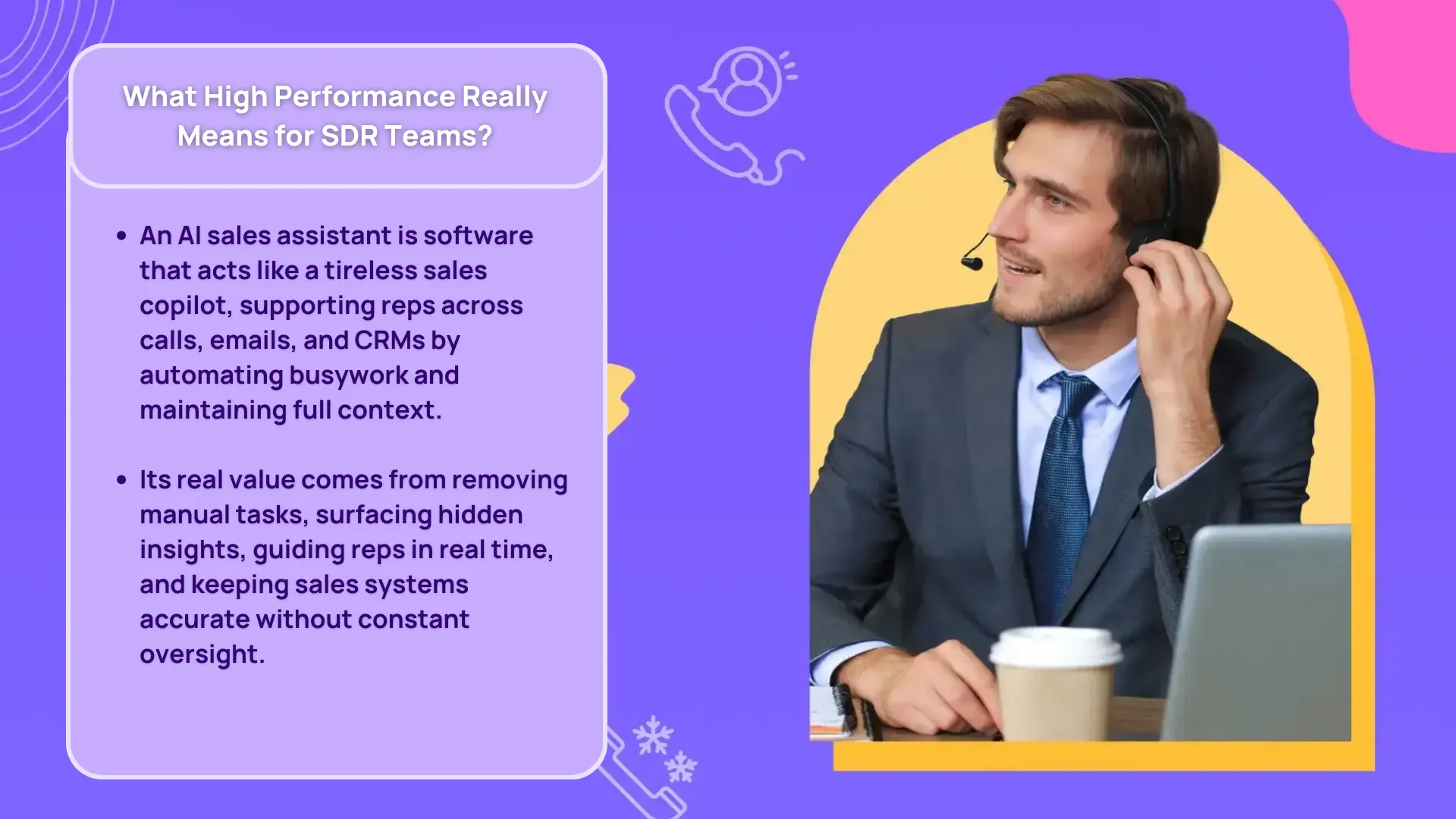
An AI sales assistant is software that supports sales teams across the entire revenue cycle. Think of it as a virtual sales assistant that never forgets context and never gets tired.
Instead of acting like a single feature, it behaves more like an AI sales copilot. It sits beside SDRs and AEs during calls, inside inboxes during outreach, and inside CRMs during pipeline updates. Some tools lean heavily into conversation intelligence, others focus on forecasting or personalization, and some function as a full AI SDR assistant across prospecting, outreach, and deal management.
At its core, an AI sales assistant does four things exceptionally well. And there are other activities, as well, but they depend on the software features.
• Removes manual work that drains selling time
• Surfaces insights humans miss under pressure
• Guides reps in real time with smart assistant prompts
• Keeps systems clean without reps babysitting software
That combination is what turns automated sales help into real revenue impact.
How an AI Sales Assistant Improves Lead Qualification
Lead qualification is where most pipelines quietly break. Reps chase accounts that look good on paper but show no intent. An AI sales assistant changes that dynamic by reading patterns at scale.
Behavioral Signals Over Static Scores
Traditional lead scoring relies on firmographics and guesswork. An AI SDR assistant watches behavior. Email engagement, meeting velocity, call sentiment, stakeholder involvement, response delays, and even language patterns all feed into prioritization. This answers the question many teams ask, how can an AI sales assistant improve lead qualification in my sales process, with precision rather than opinion.
Real Time Deal Health Awareness
Instead of discovering weak deals during forecast calls, an intelligent sales assistant flags risks early. Sudden silence, lack of next steps, or single threaded conversations trigger alerts. Reps know exactly where to focus today, not next month.
Better Handoffs Between SDRs and AEs
AI assistant analytics highlight why a lead is qualified, not just that it is. Context travels with the deal, reducing re discovery calls and improving close rates.
This is one of the clearest AI assistant ROI drivers across modern sales teams.
AI Sales Assistant for SDRs and Prospecting Teams
For SDRs, speed and relevance decide success. An AI assistant for prospecting keeps both aligned without burning reps out.
Smarter Account Research Without Context Switching
Instead of jumping between LinkedIn, news sites, and CRM notes, the AI assistant surfaces relevant insights automatically. Job changes, funding events, competitor mentions, and tech stack signals appear exactly when outreach is being written.
Personalized Outreach at Scale
Tools like Regie.ai and Lavender prove that personalization does not need to be slow. An AI assistant for cold calling and email outreach adapts tone, value props, and intros to each persona while staying on brand.
AI Calling Assistant Support
During live calls, AI calling assistants provide real time coaching cues. Talk ratio warnings, objection prompts, and next step reminders help newer reps perform like veterans.
To maximize these benefits, forward-thinking organizations are increasingly adopting a comprehensive ai calling system 2026 that handles everything from automated dialing to post-call analysis. This level of end-to-end automation frees up your team to focus entirely on the quality and context of their conversations.
These real-time insights become even more powerful when paired with efficient outreach systems. By combining AI coaching with power dialing, sales teams can significantly increase their daily conversation volume while ensuring every interaction is guided by intelligent, data-driven support.
This is where AI assistant real time coaching becomes a force multiplier rather than a distraction.
The Best AI Sales Assistant Tools in 2025, Broken Down by Use Case
Conversation Intelligence and Deal Execution
Trellus and Gong dominate this category. They act as AI sales copilots during calls, capturing every detail and turning conversations into actionable insights. These are often the best AI sales assistant choices for teams with high call volume.
CRM Centric AI Sales Assistants
Salesforce Sales Cloud and HubSpot Sales Hub answer the question, which companies offer AI sales assistant software with CRM integration. These platforms embed AI directly into pipeline management, forecasting, and task automation.
Revenue Forecasting and Risk Detection
Clari focuses heavily on AI assistant analytics and forecasting accuracy. It excels in surfacing risk before deals slip and aligning leadership around predictable revenue.
Outreach and Messaging Optimization
Lavender and Regie.ai shine for personalization and messaging quality. They are ideal AI assistant for sales teams focused on outbound efficiency and response rates.
Each category serves a different motion, and the best AI sales assistant often depends on where friction exists in your funnel.
AI Sales Assistant Apps for Mobile Sales Reps
Field reps and hybrid sellers need speed more than dashboards. Many modern AI sales assistant apps are built with mobile workflows in mind.
Mobile ready AI assistants allow reps to review call summaries, dictate notes, receive deal risk alerts, and prep for meetings while moving between locations. This answers a growing demand for AI sales assistant apps designed for mobile sales reps who cannot live inside desktop CRMs.
AI Assistant Integration Without Stack Chaos
AI assistant integration works best when it feels invisible. The strongest platforms connect cleanly with CRMs, calendars, email clients, dialers, and collaboration tools.
A smart assistant should reduce tools, not add another login. When integration is seamless, reps trust the system. When it is clunky, adoption collapses.
This is where AI assistant implementation decisions matter more than feature lists.
AI Assistant vs Human, A Reality Check
The AI assistant vs human debate misses the point. The strongest teams pair them together.
Humans build trust, navigate nuance, and close deals. AI handles memory, pattern recognition, and consistency. The result is not replacement but amplification.
This is why AI assistant benefits compound over time rather than flatten.
AI Assistant Pricing and ROI Expectations
AI assistant pricing varies widely. SMB tools may start around per seat monthly fees, while enterprise platforms run on annual contracts.
ROI shows up in three places. More selling time, higher quality pipeline, and better forecast accuracy. Teams tracking these metrics see value quickly, especially when adoption is supported by leadership.
As you track these improvements, it becomes crucial to measure how a higher quality pipeline translates into closed deals. Comparing your performance against a reliable SaaS Win Rate Benchmark allows you to see the direct impact of AI tools on your overall revenue predictability.
Core AI Assistant Features That Actually Matter to Sales Teams
When people talk about AI assistant features, the conversation often drifts toward flashy demos. In real sales environments, value comes from features that quietly reduce friction and sharpen judgment. A best AI sales assistant earns its place through consistency and relevance, not novelty.
Real Time Conversation Intelligence
During live calls, an AI sales copilot listens for intent, objections, competitor mentions, pricing cues, and buying signals. It tracks talk ratios and engagement levels, then nudges reps when conversations drift off course. This kind of AI assistant real time coaching helps reps course correct in the moment instead of learning weeks later during pipeline reviews.
Automated CRM Updates Without Data Loss
Manual CRM updates remain one of the biggest productivity killers. An intelligent sales assistant captures notes, action items, stakeholders, and deal changes automatically. It keeps records clean without reps feeling like data clerks. This is where AI productivity becomes visible almost immediately.
Smart Follow Ups and Task Orchestration
A virtual sales assistant does not just remind reps to follow up. It understands context. It knows what was promised, what objections were raised, and what urgency signals appeared. Follow ups feel thoughtful rather than templated, which strengthens trust with prospects.
AI Assistant Analytics and Pattern Detection
Instead of raw dashboards, AI assistant analytics translate activity into insight. Reps see why deals stall. Managers see which behaviors correlate with wins. This level of clarity supports better coaching and fairer performance conversations.
To fully capitalize on these insights, teams should integrate their AI assistants with a robust sdr dashboard. This ensures that every piece of data is visualized effectively, allowing managers to track daily activities and rep performance seamlessly.
AI Assistant Use Cases Across the Sales Funnel
AI assistant use cases vary depending on role, deal size, and sales motion. What stays consistent is the reduction of cognitive load across the funnel.
Top of Funnel Prospecting
An AI assistant for prospecting prioritizes accounts showing real intent. It surfaces relevant triggers and suggests outreach angles that feel timely. SDRs stop guessing and start engaging with confidence.
Mid Funnel Deal Progression
As deals move forward, the AI sales assistant watches momentum. It flags missing stakeholders, long gaps between touches, or one sided conversations. This allows reps to adjust before deals slip quietly into no decision.
Late Funnel Risk Management
At later stages, AI assistant automation highlights pricing hesitation, legal delays, or competitive pressure. Leaders gain early visibility into revenue risk rather than reacting after forecasts miss.
Post Sale Intelligence
Some AI assistant tools continue tracking customer conversations after close. Expansion opportunities, churn signals, and upsell timing become easier to spot, creating alignment between sales and customer success.
The Best AI Sales Assistant Tools in 2025 — Long-Form and Human First
Below is a detailed list of the leading AI sales assistant software, starting with Trellus.ai at the top, followed by the other platforms you provided previously. Each section explains what the tool does, how it works in practice, and why it matters for different sales teams.
1. Trellus.ai — Best Overall AI Sales Assistant for End-to-End Sales Workflows
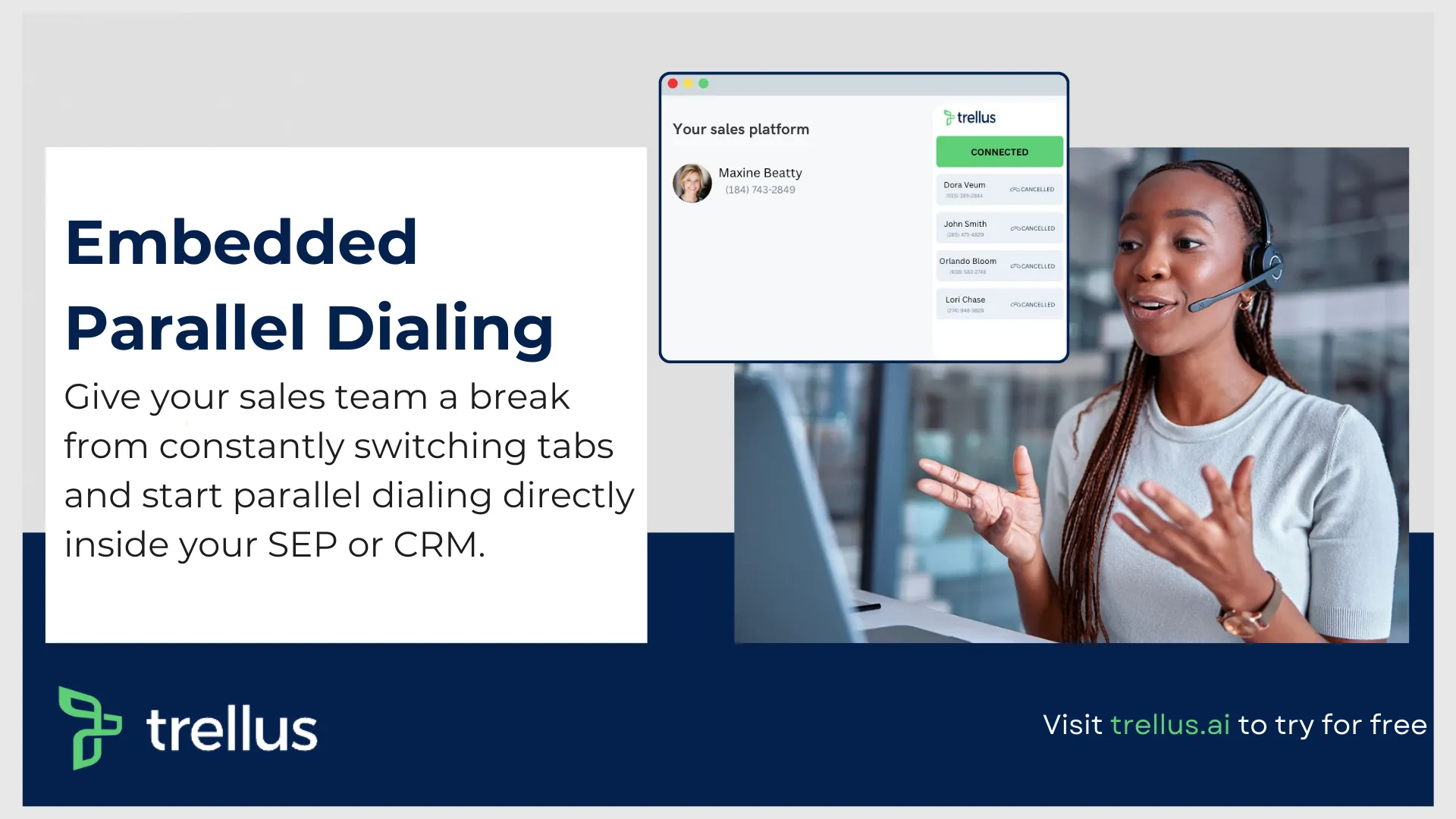
By far, Trellus stands above the rest as a comprehensive AI sales assistant designed to support revenue teams from lead generation through deal close.
Unlike tools focused on only one part of the funnel, Trellus.ai acts as an AI SDR assistant, AI calling assistant, and AI sales copilot within a single unified platform.
In addition to a slew of features that the program comes with, it also uses next gen AI and machine learning to help sales reps qualify leads, personalize outreach, summarize calls, and forecast outcomes without toggling between systems.
Where many tools only capture call data, Trellus.ai pushes that data into intelligent suggestions, automated task creation, and prioritized pipeline actions tailored to real deal signals.
Key Capabilities
• AI assistant for sales reps and SDRs that suggests next best actions based on historical success patterns and real-time signals. Deep CRM integration ensures nothing slips through the cracks.
• Automated lead qualification that analyzes engagement patterns, response behavior, and account signals to prioritize leads that show buying intent.
• AI calling assistant with transcription, sentiment tagging, objection detection, and follow-up nudges that save reps hours of administrative work.
• AI assistant analytics that power trend detection and forecast confidence, delivering context-rich insights rather than raw metrics.
Why It Matters
Our platform also delivers value across every stage of sales activity.
Smaller teams get a single intelligent platform that feels like a teammate, while larger teams see improved consistency and forecast accuracy. Its unified approach to CRM integration places it firmly at the top of best AI sales assistant lists for 2025.
2. RingSense — Best for Conversation Intelligence and Intent Detection
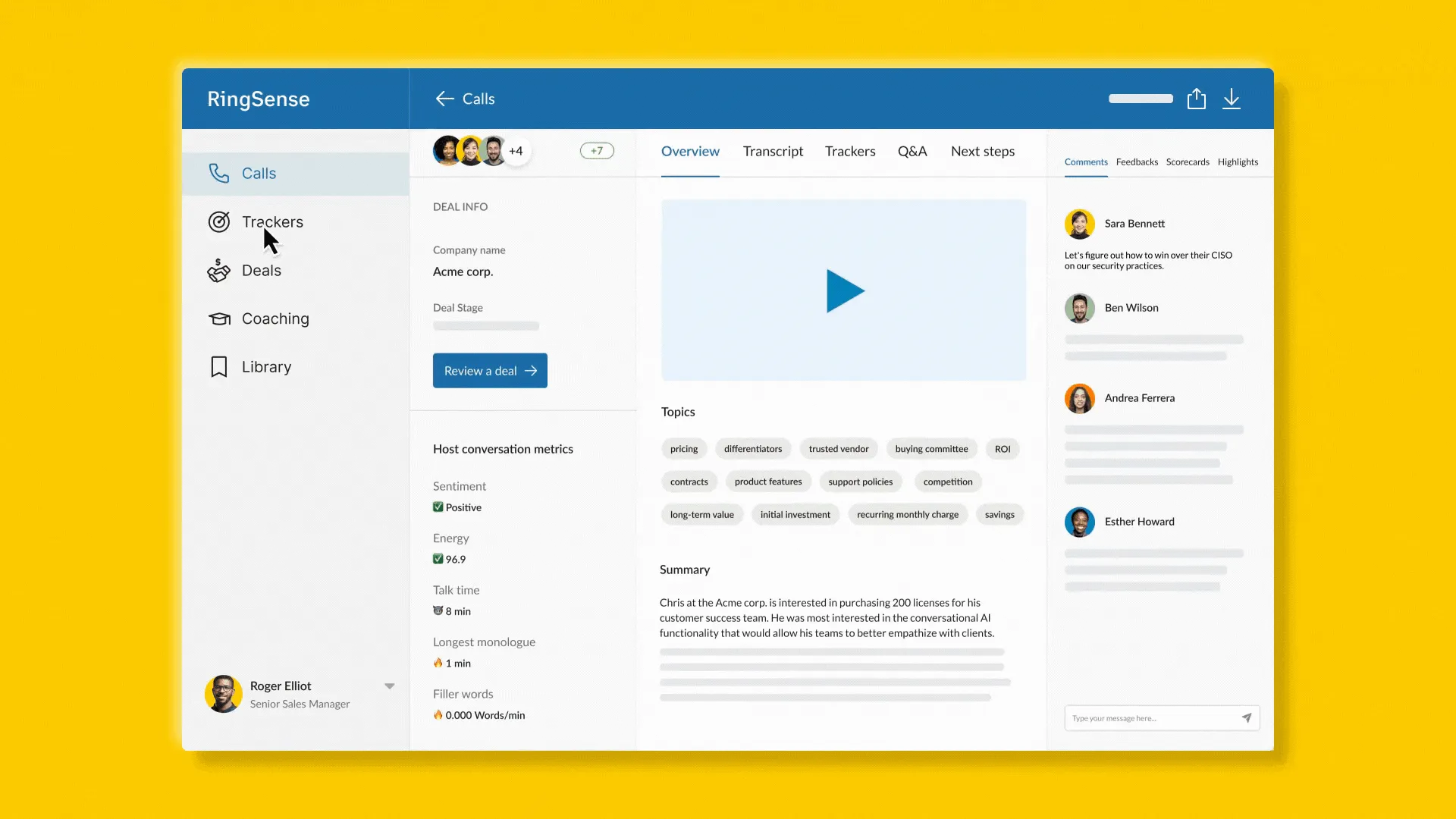
RingSense earns its place as a specialized AI sales assistant focused on pulling insights out of voice and meeting data. Conversation is where intent lives; RingSense decodes it.
Rather than simply transcribing calls, RingSense applies natural language processing to identify patterns like objections, competitor mentions, pricing concerns, and buying signals. This turns every conversation into structured data your team can act on.
Key Capabilities
• Automatic call recording and transcription with sentiment and topic tracking.
• Deal insights that connect conversation trends with pipeline health.
• Manager dashboards that support real-time coaching based on objective signal patterns.
• Deep CRM integration so insights populate where reps already work.
Why It Matters
For teams that rely heavily on conversations to move deals forward, RingSense’s conversation intelligence becomes the backbone of better execution. Its AI assistant features transform what used to be analog intuition into measurable outcomes.
3. Salesforce Sales Cloud — Best for Enterprise CRM Integration with AI
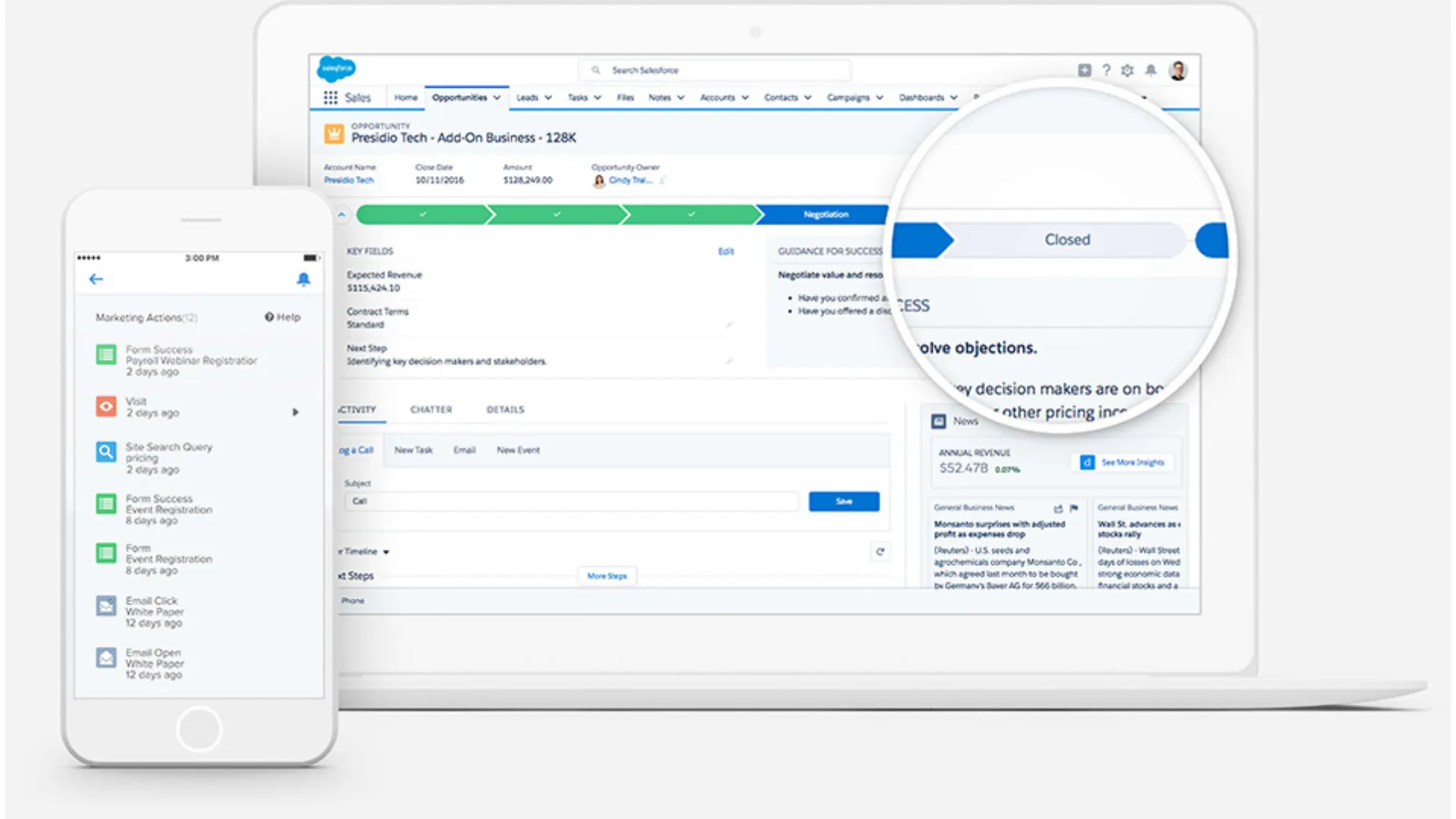
Salesforce Sales Cloud isn’t just a CRM; it’s a full-stack AI sales assistant platform when combined with Einstein GPT and Copilot for Sales. It fits teams needing deep customization and enterprise governance.
Salesforce embeds AI directly into sales workflows, enabling automated data entry, dynamic lead scoring, personalized email suggestions, forecasting insights, and pipeline recommendations. This makes it more than a tool — it becomes the operational data layer for the entire revenue team.
Key Capabilities
• AI assistant for sales teams that generates intelligent next steps, email drafts, and task suggestions.
• Einstein GPT for predictive lead scores and opportunity forecasts based on historical and real-time data.
• Copilot for Sales which interprets CRM context conversationally on demand.
• Integrations across marketing, service, and commerce to surface cross-functional insights.
Why It Matters
Large sales organizations benefit because Salesforce’s AI assistant is tightly woven into every part of the sales process and systems of record. Although pricing can be high, the platform’s depth makes it a top choice for enterprise use.
4. HubSpot Sales Hub — Best for SMBs and Integrated AI Outreach
HubSpot Sales Hub brings powerful AI capabilities to teams that want a unified CRM and AI sales assistant without enterprise complexity. It’s particularly strong at managing outreach and pipeline with minimal setup friction.
HubSpot’s AI tools assist reps with lead scoring, email generation, meeting transcription, and next-step recommendations. The interface feels familiar because it lives inside the CRM where sales teams spend most of their time.
Key Capabilities
• Automated sequences and email suggestions tuned to engagement behavior.
• AI assistant for prospecting that highlights high-intent contacts and suggests outreach angles.
• Call transcription, summaries, and insight prompts that enrich CRM records.
• Seamless connection with calendars and inboxes to reduce admin overhead.
Why It Matters
HubSpot’s AI sales assistant is a great entry point for small and midsize teams that want automation and intelligence without a heavy tech footprint. Its pricing tiers scale with feature sophistication, making advanced AI accessible to growth teams.
5. Clari — Best for Revenue Forecasting and Pipeline Risk Management/ Aversion
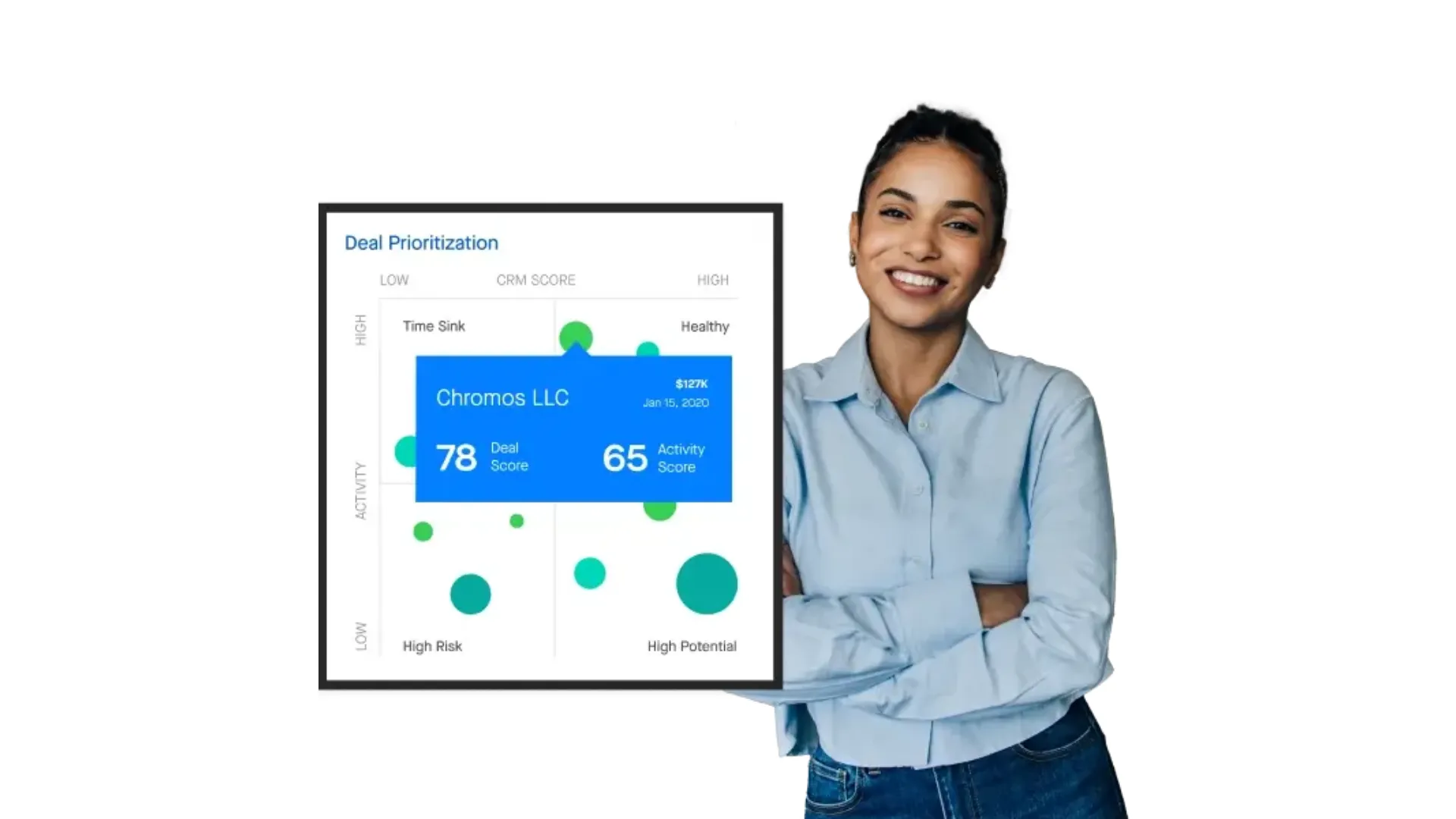
Clari positions itself as a revenue orchestration platform where prediction and pipeline visibility come first. Its intelligent sales assistant capability is anchored in forecasting confidence and deal risk detection.
Clari aggregates activity across CRM, email, and calendar data to paint a picture of pipeline health. Its AI detects stalling patterns, missing stakeholders, and week-over-week shifts, then highlights them for reps and managers.
Key Capabilities
• Predictive sales forecasting with confidence bands informed by activity signals.
• Stalled deal detection and risk scores that prompt action early in the cycle.
• Multi-team visibility that unifies sales, marketing, and customer success around the same revenue data.
• Deal inspection agents that help identify bottlenecks that CRM fields often miss.
Why It Matters
For companies that depend on reliable forecasting and tight pipeline execution, Clari’s AI assistant delivers clarity where traditional CRMs fall short. It complements other sales tools instead of replacing them.
6. Gong — Best for Deep Deal Execution Insight and Conversation Analytics

Gong remains one of the most respected AI sales assistant platforms for teams that live and die by conversation dynamics. Its strength is in surfacing patterns that correlate with wins and losses across every engagement channel.
Gong synthesizes signals from phone, video, email, and messaging to create a holistic view of deal health. Its AI assistant features auto-flag stalled deals, objection patterns, and engagement trends that matter most.
Key Capabilities
• Comprehensive conversation capture and analysis across channels.
• Deal execution dashboards that spotlight risk and opportunity vectors.
• Coaching tools driven by empirical interaction data rather than guesswork.
• CRM enrichment that turns raw engagement into structured insights.
Why It Matters
Revenue teams that prioritize execution excellence and objective coaching find Gong invaluable. It moves “gut feel” into measurable signal detection.
7. Lavender — Best for Cold Email Performance and Message Optimization
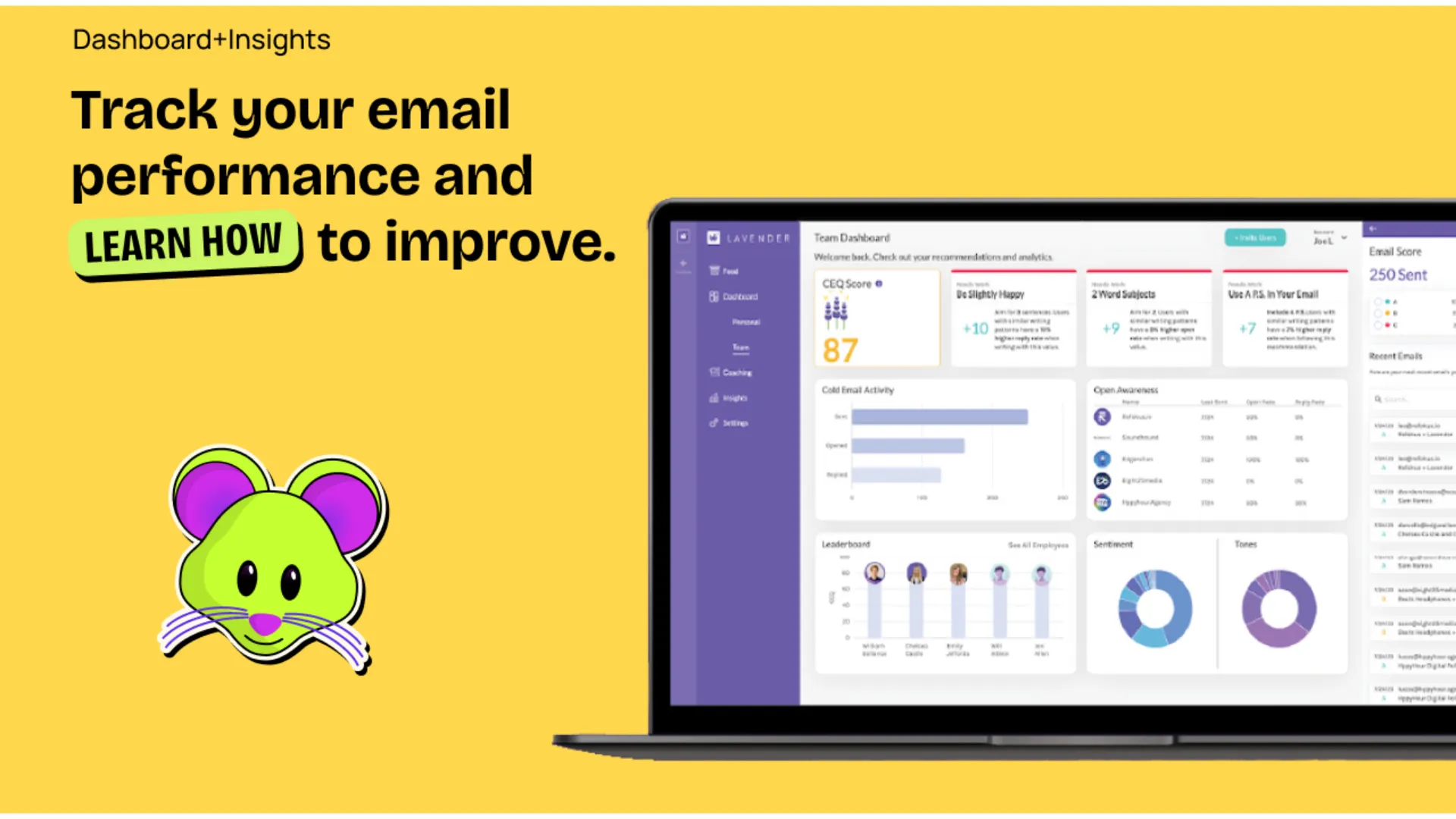
Lavender specializes in email performance intelligence and AI assistant features that sharpen cold outreach effectiveness.
It works directly within inboxes and supports better writing habits at scale.
Rather than only generating emails, Lavender evaluates tone, readability, personalization depth, and likelihood of engagement. It offers suggestions that make outreach feel tailored rather than generic.
Key Capabilities
• In-email coaching that adjusts tone, clarity, and prospect relevance.
• Response trend analytics that help refine templates and sequences.
• Personalization suggestions based on profile context and engagement history.
• Team dashboards to track open, reply, and sentiment metrics over time.
Why It Matters
Sales teams that depend heavily on email outreach and want instant feedback loops see measurable gains in reply rates and downstream conversations.
8. Regie.ai — Best for Scalable Personalized Outreach
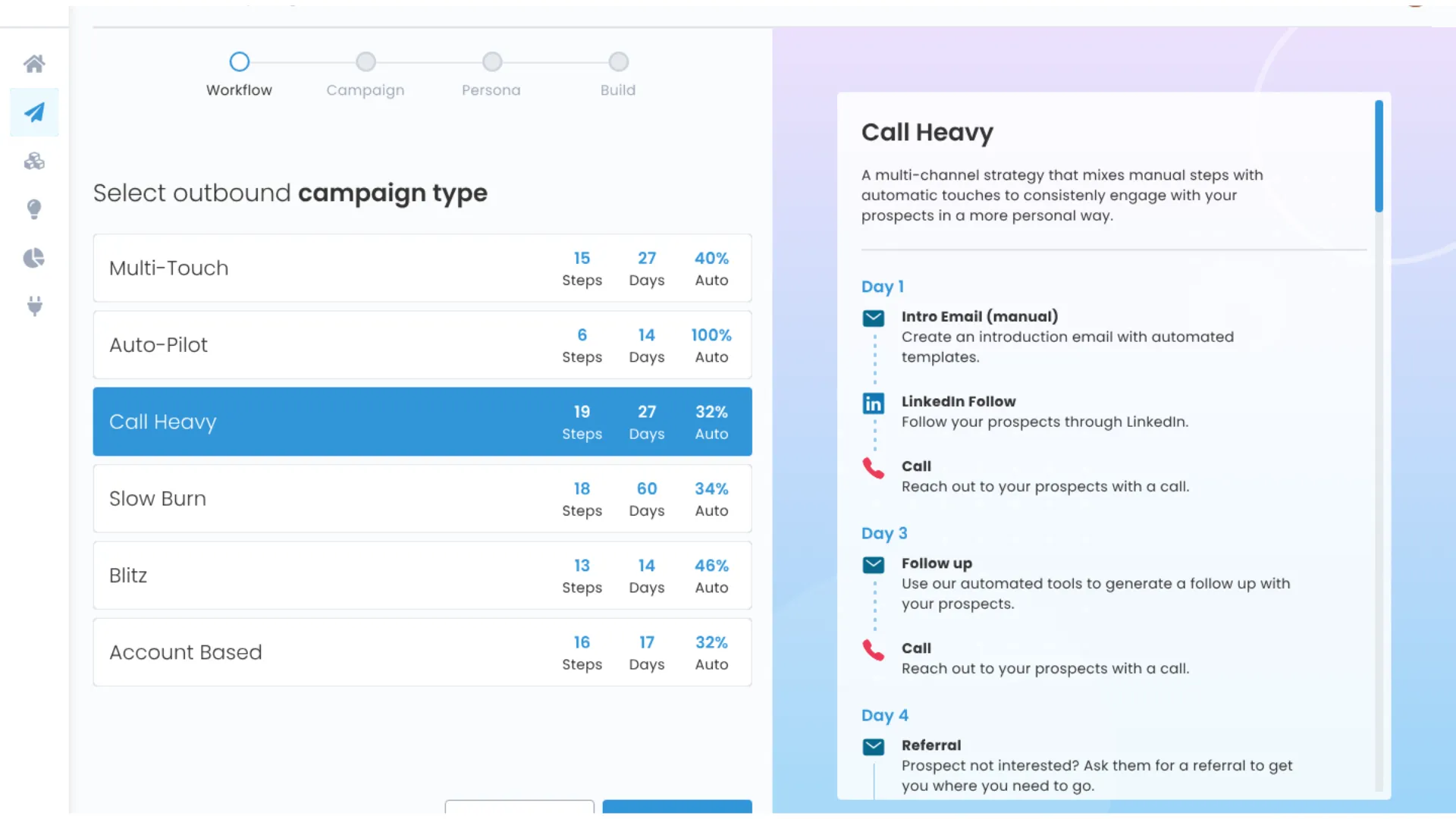
Regie.ai focuses on generating bespoke outreach at scale, making it ideal for teams that want AI assistant for prospecting coupled with strong content creation automation.
Regie.ai blends account insights with generative copy so sequences feel tailored, even at high volume. Its signal detection features alert teams when prospects engage, enabling timely follow-ups.
Key Capabilities
• Auto-generation of sequences across email, LinkedIn, and SMS.
• Research-driven content suggestions tailored to individual targets.
• Engagement alerts that inform next-step actions.
• CRM and sales engagement platform integration to keep everything synchronized.
Why It Matters
For outbound teams pushing large volumes of outreach, Regie.ai turns personalization from a bottleneck into a strength.
9. Outreach — Best for AI Driven Sales Execution and Workflow Automation
Outreach has evolved far beyond a sales engagement platform. Over the last few years, it has developed into a sophisticated AI sales assistant that helps SDRs manage prospecting activities, prioritize opportunities, and execute outreach with greater consistency.
For many sales teams, the biggest challenge is not generating activity. The challenge is knowing which activity deserves attention right now. Outreach addresses that problem through intelligent recommendations that help reps focus on prospects and opportunities most likely to move forward.
The platform continuously analyzes engagement patterns, response behavior, deal progression, and historical performance data. Based on those signals, it suggests next actions that improve productivity while reducing guesswork.
This creates a more structured sales process where reps spend less time deciding what to do and more time engaging with buyers.
Key Capabilities
• AI powered deal health monitoring that identifies opportunities showing signs of momentum or risk.
• Automated task prioritization that surfaces the most important activities each day.
• Conversation intelligence features that capture and analyze customer interactions.
• Smart sequence optimization that improves outreach timing and engagement rates.
• Revenue forecasting support that helps managers understand pipeline performance.
Why It Matters
Many AI tools focus on a single sales function. Outreach connects prospecting, engagement, forecasting, and execution into a unified workflow.
For SDR teams handling large outbound volumes, this creates a more organized approach to pipeline generation while helping managers maintain visibility into performance across the team.
10. Salesloft — Best for AI Guided Revenue Engagement
Salesloft combines sales engagement, conversation intelligence, and AI powered coaching into a platform designed to help revenue teams improve execution quality.
One of the biggest challenges facing SDRs is maintaining consistency across hundreds of prospect interactions every week. Salesloft provides guidance throughout the sales process, helping reps stay aligned with proven workflows while adapting to changing buyer behavior.
Its AI capabilities evaluate conversations, outreach performance, and engagement trends to identify opportunities for improvement.
The platform also helps sales leaders understand which behaviors drive successful outcomes, making coaching sessions more objective and actionable.
Key Capabilities
• AI generated meeting summaries and conversation insights.
• Deal risk identification based on engagement trends and activity patterns.
• Coaching recommendations derived from successful rep behaviors.
• Automated follow up suggestions informed by previous interactions.
• Revenue intelligence dashboards that provide visibility into pipeline progress.
Why It Matters
Salesloft helps organizations create repeatable sales processes without making interactions feel robotic.
For teams focused on improving rep performance and increasing sales consistency, its AI assistant capabilities provide valuable support across the entire buyer journey.
11. Apollo.io — Best for AI Assisted Prospecting and Lead Discovery
Apollo.io has become one of the most popular platforms among SDRs because it combines prospect data, outreach capabilities, and AI driven recommendations inside a single environment.
Finding qualified prospects remains one of the most time consuming parts of outbound sales. Apollo reduces that burden through a combination of data intelligence and AI powered prospecting workflows.
The platform helps users discover potential buyers, identify relevant signals, and generate personalized outreach messages faster than traditional manual research methods.
Its extensive database and automation capabilities make it particularly attractive for growing sales teams seeking efficiency gains.
Key Capabilities
• AI assisted prospect discovery using firmographic and behavioral signals.
• Automated email generation tailored to target accounts and personas.
• Buying intent insights that help prioritize outreach efforts.
• Workflow automation for prospecting and follow up activities.
• Sales engagement tools that connect prospecting with execution.
Why It Matters
Apollo.io allows SDRs to spend more time speaking with qualified prospects and less time researching accounts.
Organizations looking for a combined prospecting and AI sales assistant solution often find Apollo attractive because it brings several critical functions together under one roof.
12. People.ai — Best for Revenue Intelligence and Relationship Mapping
People.ai focuses on turning sales activity into actionable revenue intelligence.
Many organizations struggle because valuable customer interactions occur across emails, meetings, calls, and messaging platforms without being captured effectively. People.ai addresses this challenge through automated activity collection and AI powered analysis.
The platform creates a comprehensive view of customer relationships, helping teams understand stakeholder engagement, deal progression, and account health.
Its insights are particularly valuable for larger organizations managing complex sales cycles involving multiple decision makers.
Key Capabilities
• Automated activity capture across communication channels.
• Relationship mapping that identifies influential stakeholders.
• Opportunity analysis based on engagement and activity data.
• Revenue intelligence dashboards for managers and executives.
• Pipeline visibility tools that improve forecasting confidence.
Why It Matters
People.ai helps organizations uncover hidden patterns within customer interactions.
For enterprise sales teams managing complex opportunities, this visibility supports better decision making and stronger alignment across revenue functions.
13. Scratchpad — Best for AI Assisted CRM Management
Scratchpad approaches the AI sales assistant category from a different angle. Rather than focusing primarily on outreach or conversation intelligence, it focuses on reducing CRM friction.
Sales representatives frequently cite CRM administration as one of their least favorite responsibilities. Updating records, tracking opportunities, and maintaining data accuracy consume valuable selling time.
Scratchpad simplifies these processes through intelligent workflows and AI assisted updates that make CRM management faster and less disruptive.
The result is cleaner pipeline data and less administrative burden for revenue teams.
Key Capabilities
• AI powered CRM update assistance.
• Opportunity management workflows designed for sales teams.
• Forecasting support with real time pipeline visibility.
• Automated note capture and activity organization.
• Salesforce optimization features that improve data quality.
Why It Matters
A significant portion of sales productivity is lost to administrative work.
Scratchpad helps recover that time while improving CRM accuracy, making it particularly valuable for teams heavily invested in Salesforce driven workflows.
14. ZoomInfo Copilot — Best for AI Guided Sales Intelligence
ZoomInfo Copilot combines buyer intelligence, account research, and AI driven recommendations to help sales teams identify and engage high potential opportunities.
Modern outbound sales depends heavily on timing. Reaching prospects when interest is highest can dramatically influence conversion rates. ZoomInfo Copilot helps sales teams identify these moments through intent data, engagement signals, and market intelligence.
The platform continuously analyzes account activity and delivers recommendations that help reps prioritize efforts more effectively.
Rather than relying solely on static lead lists, teams gain access to dynamic insights that support smarter prospecting decisions.
Key Capabilities
• AI driven account prioritization informed by intent signals.
• Buyer research assistance that reduces preparation time.
• Engagement recommendations based on prospect activity.
• Sales intelligence integrated with outreach workflows.
• Opportunity alerts that help SDRs act quickly when interest emerges.
Why It Matters
ZoomInfo Copilot bridges the gap between sales intelligence and execution.
For teams seeking stronger prospect prioritization and better account visibility, it provides a valuable layer of AI assistance that supports both efficiency and effectiveness.
![14 Best AI Sales Assistant(s) For SDRs [May 2026 Updated List]](https://cdn.prod.website-files.com/633ef5e495fbc55a9bea70b1/63455c71e41ddfa1100e26e0_1561658014602%20(2).jpeg)

Power and parallel dialing in your CRM.