Our Top Picks


2026 is almost in its mid, indicating a rather high reward and fast paced sales environment where tons of different tools and resources were used by various industries.
Meanwhile, automation took over the sales industry in the form of autonomous AI sales agents, generative AI, embedded sales solutions, such as robust parallel dialers, and so on and so forth.
Point being, sales automation isn’t showing any signs of decline or stagnancy. It’s all the more reason to fully adopt what the “industry’s ongoing fad” has to offer. And that is all the more reason to double down on this post if you haven’t used sales automation before.
We aren’t talking about automated workflows or 3rd party integrations. Those, at best, are just mere inputs where most of the base level sales or outreach work is done on auto pilot. Instead, it’s more about embracing different modes of outreach, sales, and marketing; all under one roof and through a dedicated platform of your choice, so that your sales business can quadruple its scalability and conversion potential without resource and budget bleeding on the side.
On that note, we’d say that the modern day expectation from sales automation is interpreted into smarter workflows, cleaner data, and outreach that feels personal even at high scale.
Moving on, we will also address some of the most common and sought after queries that aren’t usually answered in detail. Think of stuff like, what is sales automation, how does sales automation work, what features matter in a modern sales automation platform and how can AI sales automation improve lead generation.
Implementing AI sales assistants can drastically reduce the time spent on manual data entry.
Let’s get started…
What is AI Sales Automation?

AI sales automation refers to software, a plugin or some form of 3rd party integration that automates repetitive sales tasks, predicts buyer behavior, enhances communication, and strengthens forecasting accuracy.
At least that’s the baseline gist of the whole thing.
These days, AI has become way better, effective and accurate to enable next level efficiency where not only all kinds of tasks are automated, but routine activities that usually involve manual input, such as cold calling, getting back to customers, outreach over different platforms, etc., are being done at a rapid pace.
In essence, we can say that AI sales automation combines the use of your traditional sales software, which your company is already using, with smart AI solutions to get better results over time.
Furthermore, automated sales outreach ensures that your messaging remains consistent across all channels.
These days, sales and outreach teams rely on such solutions to reduce busy work, keep pipelines active, and create a more consistent customer experience.
How Does Sales Automation Work?
Good question.
Sales automation works through connected workflows that run behind the scenes.
Depending on the type of automation deployed on the back end, the process can do any number of things. Think of letting AI to automatically capture data from your CRM, connecting it with buyer signals from multiple channels, and then executing different tasks that are otherwise usually assigned to a human in auto mode.
Not only does it reduce task dependency, review and other hassles, but it also brings an advanced layer on top of your ongoing workflow, allowing sales reps and their respective managers to focus on other business activities that are sometimes neglected due to time constraints.
Using advanced AI dialer software allows reps to connect with more prospects in less time.
For instance, while automation is busy handling mundane tasks, the human resources in your sales and outreach department can focus on securing prospect research data. This data can be dumped into an online resource box where the AI can fetch and organize it into a ready-mode format that can be accessed, later on for manual or automatic outreach. This was just an example to elaborate on the process.
Of course, the actual use-case could vary on the basis of business requirements and daily workflow.
The end result, however, is that you’re looking at improved sales productivity, smoother sales cycles with minimum friction, and an overall improved resonance effect where customers or potential leads can easily move through the sales funnel towards the conversion phase.
Also Read:
- 15 Top Intelligent Sales Automation Tools in 2025
- Best LinkedIn Automation Tools For B2B Outreach In 2025
- Top 30 B2B Sales Enablement Software Tools to Boost Your Sales Team in 2025
Why AI Sales Automation Matters for B2B Teams in 2026
BDRs and especially SDRs are well aware of the throat-cutting competition factor out there. From that point of view, it’s no longer about the reasons associated with using sales automation because it’s already being done at some level in a business.
Instead, the real challenge is deciding which sales automation tools deliver the strongest ROI and fit your existing sales motion.
Sales cycles are getting longer, buying committees are expanding, and reps are juggling more tools than ever. Manual processes create bottlenecks that harm consistency in outreach, response time, and overall brand experience.
AI sales automation solves problems that every modern sales leader faces. Reps waste hours on manual CRM entry.
Integrating real-time call coaching helps new reps ramp up faster and handle objections effectively.
Follow ups get missed. Emails lose personalization. Forecasts become unreliable. Pipelines become inflated with unqualified leads. These gaps slow momentum and create revenue leaks that compound over time.
AI removes these constraints through automated decision making, smart prioritization, and personalized communication. Teams gain hours back in their week, prospects receive timely and tailored outreach, and leaders get accurate visibility into performance through clean data.
Key Trends Defining AI Sales Automation in 2026 & Beyond
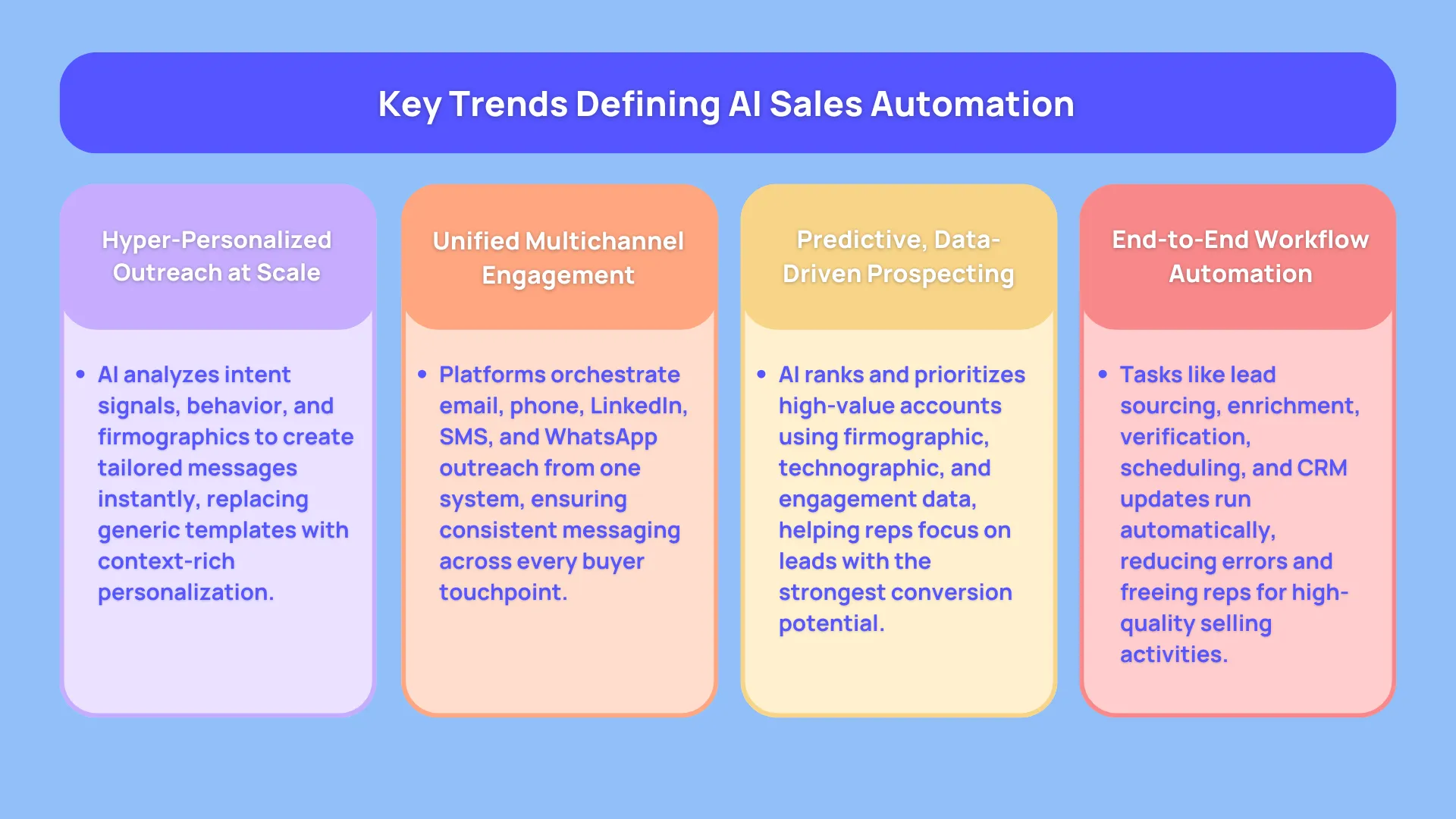
The market is shifting quickly. Buyers expect relevance, clarity, and value from the first message onward. The strongest B2B sales automation platforms adapt to this behavior through intelligent features that operate across multiple channels.
AI Driven Personalization
Personalized outreach is no longer optional. AI can analyze job titles, industry trends, website behavior, past engagement, and intent signals, and then generate tailored messaging for each prospect. This level of customization would take hours manually, yet AI delivers it instantly.
It creates a more natural buying experience because the communication feels specific to each individual instead of relying on templates copied across hundreds of prospects.
Multi Channel Sales Workflow Automation
Modern buyers switch between email, LinkedIn, phone, SMS, and even WhatsApp. A strong sales automation platform coordinates all of this from a single system and creates cohesive multi channel touch patterns. Instead of juggling disconnected tools, teams can launch unified campaigns that maintain consistent messaging across every outreach method.
Data Driven Prospecting
Reps no longer guess which accounts to prioritize.
Effective sales pipeline management is crucial for maintaining a healthy flow of qualified leads.
AI identifies the highest potential leads by analyzing firmographics, technographics, past behavior, and engagement signals. This lowers acquisition costs and increases conversion rates since reps can focus efforts where it matters most.
Advanced Workflow Automation
Sales teams are automating lead sourcing, email verification, task creation, meeting scheduling, and CRM updates. This eliminates errors and gives reps more time for revenue generating conversations.
Core Benefits of AI Sales Automation
The benefits extend across every stage of the sales funnel. When teams adopt AI driven workflows, the results show up in speed, conversion, and clarity.
Higher Productivity
Administrative tasks frequently block rep performance. AI removes repetitive work, keeps the CRM updated automatically, and triggers timely follow ups. This increases revenue capacity without needing more headcount, making it ideal for small business sales automation and growing startups.
Higher Conversion Rates
Personalization and timing matter. AI driven outreach boosts reply rates because each interaction is relevant and targeted. Hot leads move faster through the funnel since follow ups happen instantly and intelligently.
Scalable B2B Sales Automation
Manual outbound campaigns do not scale well. AI sales automation platforms allow teams to expand outreach volume while maintaining data hygiene, message quality, and visibility inside the CRM. This transforms outbound efforts into predictable and repeatable processes.
Essential Sales Automation Features to Look For
Every platform claims to automate your sales process, yet the strongest ones focus on capabilities that directly influence pipeline quality, team efficiency, and long term growth.
Here are the essential features to evaluate, followed by a deeper explanation of each one.
Each feature plays a critical role in shaping a modern automated sales process.
- Multi channel outreach ensures your message reaches buyers wherever they spend time.
- AI generated messaging helps create context aware communication instantly.
- Smart lead scoring improves prioritization and gives reps clarity on which prospects deserve immediate effort.
- CRM integration keeps your database accurate without forcing reps into manual data entry.
- Task automation ensures no opportunity slips through the cracks.
- Email automation maintains consistent follow up while protecting sender reputation.
- Reporting and analytics help leaders measure trends, identify bottlenecks, and forecast with greater accuracy.
- Lead nurturing sequences help prospects move through the funnel naturally.
- Call workflows support teams that rely on phone outreach.
- Role management protects data integrity in growing organizations.
When selecting a platform, teams should consider their sales motion, inbound volume, outbound strategy, and internal processes so that the features align with existing objectives.
Sales Automation Best Practices for Stronger Outcomes
Teams that succeed with sales automation treat it as a strategic partner rather than a quick fix. The most effective sales automation strategies start with alignment and end with ongoing refinement.
Align Your Team Around Clear Goals
Set expectations early. Reps should understand what the automated workflows cover and where manual engagement is required. Leaders can connect these workflows to measurable KPIs such as lead conversion rates, response times, and qualified pipeline volume.
Optimize and Improve Your Workflows Over Time
Automation thrives when teams review performance frequently. Look at open rates, reply rates, conversion metrics, and drop off points. Test new messaging, adjust timing, and refine audience targeting. Small improvements compound into major gains across a full quarter.
Focus on Personalization and Deliverability
Strong personalization increases engagement, while strong deliverability ensures your emails actually reach the inbox. Verify email addresses, segment audiences, rotate sending schedules, and maintain sender reputation with routine list cleaning.
Sales Automation Challenges Most Teams Face
AI sales automation creates massive advantages, yet teams still encounter hurdles during adoption. Common challenges include unclear goals, poor CRM hygiene, lack of alignment between sales and marketing, complex workflows that confuse reps, and inconsistent content quality. Many organizations also underestimate the importance of clean data. Without accurate data, even the most powerful AI cannot perform at full potential.
Leaders can avoid these issues by simplifying workflow design, training reps thoroughly, and establishing feedback loops that encourage continuous improvement.
Sales Automation Metrics That Matter
Evaluating success requires clarity on the specific metrics that reflect real revenue impact.
Key metrics include response rate, meeting booked rate, opportunity creation rate, sales velocity, pipeline value, win rate, customer acquisition cost, and sales cycle length. These numbers show how effectively the automated sales process supports growth across the full cycle.
Response Rate
Response rate shows how many prospects reply to your outreach. It is one of the earliest and most reliable indicators of message relevance, deliverability health, and audience targeting accuracy.
AI sales automation raises response rates through better personalization, optimized timing, and cleaner email lists. When the response rate rises, it signals that your messaging resonates with the right people and that your automated workflows are reaching inboxes rather than spam folders. A consistently low response rate usually points to issues in list quality, message structure, or segmentation strategy.
Meeting Booked Rate
Meeting booked rate measures the percentage of conversations that convert into scheduled meetings or demos. Since sales automation sequences handle most follow ups and reminders, this metric helps confirm the strength of your multi touch strategy.
AI solutions improve this number through the identification of the best moments to ask for a meeting and nurturing prospects through tailored messaging. When meeting booked rate increases, the automated sales process is successfully warming leads, creating interest, and generating real opportunities for reps to qualify buyers.
Opportunity Creation Rate
Opportunity creation rate reflects how effectively outreach converts into genuine pipeline.
The phenomenon effectively measures the number of prospects that progress from early engagement into official sales opportunities tracked inside the CRM.
AI driven workflows increase this rate through better lead scoring, intelligent routing, and relevant messaging that prepares prospects for deeper conversations. A rising opportunity creation rate confirms that your automated sequences are not only creating awareness but also driving meaningful movement into the pipeline.
Sales Velocity
Sales velocity shows how quickly deals move from initial contact to closed business. Automation influences this metric in several ways.
Faster follow ups reduce time lost between buyer replies. Consistent messaging keeps prospects engaged without long pauses. Accurate task reminders prevent delays during qualification and proposal stages. AI also predicts the next best action for reps, which keeps momentum strong. A higher sales velocity indicates that automation is accelerating the sales cycle and reducing friction across the process.
Pipeline Value
Pipeline value represents the total revenue potential inside active opportunities.
Among other things, it also reflects the combined influence of lead quality, outreach effectiveness, and qualification accuracy. Smart sales automation increases pipeline value through stronger lead targeting and better prioritization.
When AI identifies high value accounts earlier, reps spend time on deals that actually contribute to growth. If pipeline value rises while close rates remain stable, it confirms that the automated sales process is feeding the funnel with higher quality prospects.
Win Rate
Win rate measures the percentage of opportunities that convert into closed deals. It is one of the clearest indicators of how well automation supports the entire sales motion.
Improved lead nurturing, consistent follow ups, and AI driven personalization all contribute to higher win rates because prospects feel more understood and receive timely responses.
Low win rates usually indicate issues related to qualification criteria, handoff quality, or messaging alignment. Automation helps correct these gaps through data driven scoring, accurate forecasting, and structured sequences that guide prospects smoothly through each stage.
Customer Acquisition Cost
Customer acquisition cost, often referred to as CAC, represents the total spend required to convert a new customer.
This could include marketing spend, sales team effort, software expenses, and outbound activity. AI sales automation lowers CAC because it reduces manual labor, eliminates wasted outreach, and improves targeting precision. When the acquisition cost falls and revenue remains steady or increases, it confirms that the automated sales process is operating efficiently and producing returns that outweigh investment.
Sales Cycle Length
Sales cycle length shows how long it takes from initial outreach until the final decision. Prospects often delay responses or lose interest during gaps in communication.
At any point, or sales lifecycle stage, automation solves this problem through structured touch patterns that maintain momentum.
AI predicts the ideal cadence, sends timely reminders, and prevents deals from going cold due to missed follow ups. A shorter sales cycle length signals that buyers are staying engaged at each stage and that your automated workflows support faster decision making.
Why These Metrics Have Direct Revenue Impact
Each metric reveals a different layer of performance across the funnel.
Response rate reflects interest and message quality. Meeting rate measures early conversion. Opportunity creation shows qualification strength.
Sales velocity and cycle length reveal the efficiency of your internal operations. Win rate confirms whether your system strengthens or weakens deal quality. Acquisition cost demonstrates long term sustainability. Pipeline value highlights the future revenue potential created by your automated workflows.
Together, these metrics show how effectively the automated sales process supports growth, consistency, and profitability. Teams that monitor them closely gain clarity on what works, what needs improvement, and where AI delivers the highest ROI.
How Does Trellus Elevate Modern B2B Sales Automation?

Trellus gives B2B teams a complete automation engine tailored for high volume outbound, faster qualification, and consistent follow ups.
Many platforms cover one part of the sales workflow, but Trellus brings everything into one connected system that eliminates manual friction. The result is a more reliable, more predictable, and more efficient way to build pipeline every day.
From that poiint of view, sales teams use our platform to manage their outreach, monitor performance with custom KPIs, and run a fully automated sales workflow that keeps reps focused on conversations instead of repetitive admin.
AI Driven Sales Calling Workflows
One of the strongest advantages of using Trellus over conventional sales solutions that focus on only a handful of dedicated solutions is that we offer intelligent calling workflows (*among other sales outreach and conversion related activities).
For instance, traditional phone outreach often becomes messy when reps track follow ups manually or switch between tools. Trellus solves this challenge with an automated dialer that controls timing, call sequencing, and task routing based on prospect behavior.
On top of that, the platform also comes with real time AI assistance and sales coaching for reps during calls through real time cues, recommended actions, and automatic disposition logging. As a result, you’re looking at a smoother experience for both the rep and the customer. It also ensures every conversation gets documented inside the CRM without manual entry.
Multichannel Sales Outreach at Scale
Modern buyers respond across many communication channels.
Our tool makes it easy for B2B and B2B2C teams to run coordinated campaigns across email, calling, LinkedIn, messaging, and other touchpoints inside one unified workflow.
Every channel connects to a single automated sequence that adapts based on behavior. If someone opens an email but ignores the next message, Trellus can automatically schedule a call task. If a prospect engages with a LinkedIn step, the workflow can shift into a more personalized follow up.
This sense of flexibility gives sales teams complete control over how they nurture leads without switching between disconnected tools. The more consistent the touch pattern, the better the chances of converting attention into pipeline. Trellus keeps the momentum alive throughout the entire funnel.
Real Time Call and Performance Tracking With Custom Metrics
Trellus gives leaders complete visibility into their automated sales process through customizable KPIs that sales reps can also set to pace their workflow accordingly. We recently introduced a bunch of brand new updates to enable better sales and call efficiency through custom KPI metrics for improved performance.
Now, companies can measure the exact actions that drive deals forward in their unique environment. Real-time data helps managers identify coaching opportunities early and make changes to outreach sequences before performance drops.
CRM Integration and Sales Workflow Optimization
Of course, Trellus’s integration support fits directly into any CRM environment without forcing teams to change their internal systems.
Sales activity, logging, call notes, and outreach history sync instantly. This level of synchronization prevents data gaps and gives teams a complete picture of every prospect journey.
The combination of CRM integration and workflow automation supports smoother conversations, faster qualification, and stronger follow ups. Reps no longer waste time updating records or chasing incomplete information. Instead, they rely on a unified view that encourages smarter decisions and faster deal movement.
AI Sales Automation in 2026, From Task Automation to Autonomous Revenue Operations
The conversation around AI sales automation has evolved dramatically over the past year. Early automation platforms helped sales teams save time by removing repetitive administrative work. Modern AI platforms are becoming active participants throughout the revenue cycle.
Instead of waiting for a sales representative to decide what happens next, advanced systems continuously monitor account activity, engagement signals, CRM history, buying intent, previous conversations, marketing interactions, website behavior, and communication patterns. Every new interaction becomes another piece of context that influences future recommendations.
This creates an environment where AI no longer performs isolated actions. It coordinates multiple sales activities simultaneously while adapting to changes that occur throughout the buyer journey.
For B2B organizations managing hundreds or even thousands of prospects, this evolution produces a major operational advantage. Sales leaders gain far more than time savings. They gain a continuously improving revenue engine that learns from every conversation, campaign, meeting, and closed opportunity.
Autonomous Revenue Workflows Are Replacing Linear Sales Processes
Traditional sales automation followed a simple sequence.
A prospect submitted a form.
The CRM created a contact.
An SDR received a task.
An email sequence started.
A follow up reminder appeared several days later.
Every prospect received nearly identical treatment because workflows depended on predefined rules created months earlier.
Modern AI automation behaves very differently.
Each action changes according to live customer behavior.
Imagine two companies entering your pipeline on the same day.
Company A visits your pricing page five times, downloads technical documentation, opens three emails within an hour, and views customer success stories.
Company B opens one email before becoming inactive.
Instead of placing both companies into identical sequences, AI immediately recognizes the difference.
Company A may receive immediate priority routing, personalized outreach, faster call scheduling, executive involvement, and tailored messaging.
Company B could enter a slower nurturing sequence until stronger buying signals appear.
Nothing requires manual intervention.
Every decision happens continuously as new information becomes available.
This adaptive workflow dramatically reduces wasted sales effort while increasing the likelihood that high intent prospects receive immediate attention.
Context Has Become the Most Valuable Sales Asset
Most organizations possess enormous amounts of customer data.
The problem has never been collecting information.
The problem has always been connecting that information fast enough to influence sales conversations.
Modern AI sales automation solves this problem through contextual intelligence.
Rather than viewing isolated data points, AI connects multiple sources together.
This creates a much richer understanding of every account before the first conversation even begins.
For example, an AI system may combine information such as:
- Recent company funding
- Hiring activity
- Technology stack
- Website engagement
- Previous email interactions
- CRM history
- Marketing campaign engagement
- Sales call transcripts
- Product usage data
- Customer support conversations
Viewed independently, each data source offers limited value.
Combined together, they produce a detailed picture of buyer readiness.
Sales representatives no longer spend valuable time piecing together fragmented information before making contact.
Frequently Asked Questions
What are the Top AI Sales Automation Tools for Small Businesses
While the market continues to expand, several platforms consistently stand out. These include Trellus, HubSpot, Apollo, Lemlist, Close, Outreach, and Overloop.
Each one offers a unique mix of AI capabilities, CRM integration, multi channel outreach, and workflow optimization tools suited for different team sizes and sales strategies.
Which Companies Offer AI Driven Sales Automation Platforms
The strongest companies in this category include Salesforce, HubSpot, Trellus, Outreach, Apollo, Zoho, Freshsales, Salesloft, Pipedrive, and Klenty. Each company focuses on different parts of the sales cycle, giving buyers a wide range of options depending on budget and complexity.
How to Implement AI Sales Automation in an Existing Sales Process?
Most teams adopt AI sales automation in phases so that reps do not feel overwhelmed.
Start by documenting your current workflow and identifying the repetitive tasks that slow reps down. Map these tasks into automated sequences. Align them with CRM rules. Connect the automation to clear performance metrics.
Then monitor the early results and refine the process as your team becomes more comfortable.
Conclusion
AI sales automation is now the backbone of modern B2B sales. It supports consistent outreach, improves lead generation, streamlines workflows, and strengthens decision making through clean data. Businesses that embrace automation will see faster growth, higher productivity, and stronger customer experiences in 2026. Teams that hesitate will struggle to keep up with competitors that already operate with enhanced precision and speed.
.jpeg)

Embed Trellus Parallel Dialer Within Your SEP & 4x Your Conversations