Our Top Picks


Sales teams have never had more AI software available than they do today.
Every week, a new platform promises to automate prospecting, improve outreach, write emails, qualify leads, forecast revenue, or coach reps automatically. The problem is not finding AI tools anymore. The real challenge is identifying which platforms actually improve daily selling workflows.
Recent sales research highlights the challenge clearly. Nearly 70 percent of B2B sales representatives missed quota in 2024, even though more automation and AI systems are available than ever before.
In essence, we could say that the main issue is tool selection and implementation order.
Many companies evaluate platforms based on impressive product demos instead of real operational value. As a result, teams end up paying for powerful tools that never become part of their daily workflow.
Research from MIT in 2025 showed something even more surprising. Ninety five percent of organizations reported no measurable bottom line impact from their AI spending.
That statistic alone explains why sales leaders have become far more careful when evaluating AI powered sales solutions.
Market analysts estimate the AI sales tools market reached roughly three billion dollars in 2025, growing at around 13 percent annually. Yet the real story is not the spending. It is the difference in outcomes between companies that deploy the right tools and those that deploy too many without a clear strategy.
Gartner found that sellers who effectively partner with AI are 3.7 times more likely to meet quota. Despite that advantage, fewer than forty percent of sellers expect AI agents to significantly improve productivity by 2028.
Many companies invest heavily in AI sales tools, AI sales automation tools, and AI sales software, only to discover that reps still struggle with live conversations, manual CRM updates, inconsistent outreach, and pipeline visibility.
The best AI powered tools for sales teams should not be evaluated by feature count alone.
They should be judged by whether they help sales reps:
- Book more meetings
- Improve call quality
- Personalize outreach faster
- Reduce repetitive admin work
- Improve follow-up consistency
- Increase selling time
- Give managers better visibility into performance
That is exactly how we approached this guide.
We tested 13 of the best AI powered tools for sales teams across real outbound workflows, prospecting environments, coaching scenarios, forecasting processes, and sales engagement use cases.
Some tools were strongest for outbound prospecting.
Others performed better for conversation intelligence, forecasting, CRM automation, inbound conversion, or live sales coaching.
And while many platforms overlap, each tool on this list solves a very different sales bottleneck.
This guide breaks down:
- The best AI sales tools we tested
- Which tools fit different sales motions
- How to build an effective AI sales stack
- Common mistakes teams make when buying AI software
- How to evaluate ROI beyond flashy demos
If your team is evaluating modern sales team productivity tools, AI sales assistants, conversation intelligence tools, or AI outbound sales tools, this comparison will help you identify which platforms actually create measurable sales impact.
Quick Comparison: Best AI Powered Sales Tools We Tested
How We Tested These AI Powered Tools for Sales Teams
The title of this guide says “we tested,” and we wanted the evaluation process to reflect real sales workflows rather than surface-level feature comparisons.
Most AI software looks impressive during demos.
The real test is what happens after SDRs, account executives, managers, and RevOps teams begin using the platform every day.
We evaluated each platform across practical sales execution scenarios including:
- Outbound prospecting workflows
- Cold calling environments
- Live objection handling
- AI-generated outreach quality
- CRM synchronization
- Call analysis accuracy
- Forecasting visibility
- Automation reliability
- Rep adoption likelihood
- Manager reporting depth
Rather than focusing only on AI novelty features, we prioritized measurable sales productivity impact.
That means we looked closely at whether the software actually improved:
- Meetings booked
- Response rates
- Call quality
- Rep efficiency
- Follow-up consistency
- Pipeline visibility
- Forecast reliability
- Time spent selling
Some platforms delivered strong automation but added operational complexity.
Others improved reporting but slowed down frontline reps.
The strongest AI powered tools for sales teams improved execution without creating more workflow friction.
Who This Guide Is For
This guide is designed for:
- SDR managers
- BDR leaders
- Revenue operations teams
- Founders building outbound systems
- Mid-market sales leaders
- Enterprise revenue teams
- Account executives
- Sales enablement professionals
It is especially useful for companies trying to consolidate or optimize their sales technology stack without buying too many overlapping platforms.
What Are AI Powered Sales Tools?

AI powered tools for sales teams are platforms that use artificial intelligence to improve prospecting, outreach, conversations, forecasting, CRM management, and sales productivity.
Modern AI sales software can help teams:
- Identify high-intent prospects
- Personalize outbound messaging
- Automate repetitive follow-up work
- Analyze sales calls
- Update CRM records automatically
- Forecast revenue more accurately
- Improve sales coaching
- Route inbound leads faster
The real value comes from reducing repetitive work while helping teams spend more time on revenue-generating conversations.
The best AI sales assistants support salespeople during critical moments rather than simply automating background tasks.
The Main Types of AI Sales Tools in 2026
AI Outbound Sales Tools
These platforms help teams prospect, sequence outreach, automate follow-ups, and manage multichannel campaigns.
Examples include:
- Saleshandy
- Apollo.io
- HeyReach
Conversation Intelligence Tools
These systems analyze sales calls, demos, and meetings to improve coaching and visibility.
Examples include:
- Trellus
- Gong
- Fireflies.ai
AI Sales Automation Tools
These platforms automate repetitive workflows such as CRM updates, lead routing, and task management.
Examples include:
- Lindy
- Salesforce Einstein
- Drift
Sales Team Productivity Tools
These solutions improve rep efficiency by reducing manual work and helping teams execute faster.
Examples include:
- Trellus
- Lavender
- Apollo.io
Data Enrichment and Signal Intelligence Platforms
These tools improve prospect quality through enrichment, buying signals, and account intelligence.
Examples include:
- Clay
- Apollo.io
Main Categories of AI Sales Tools
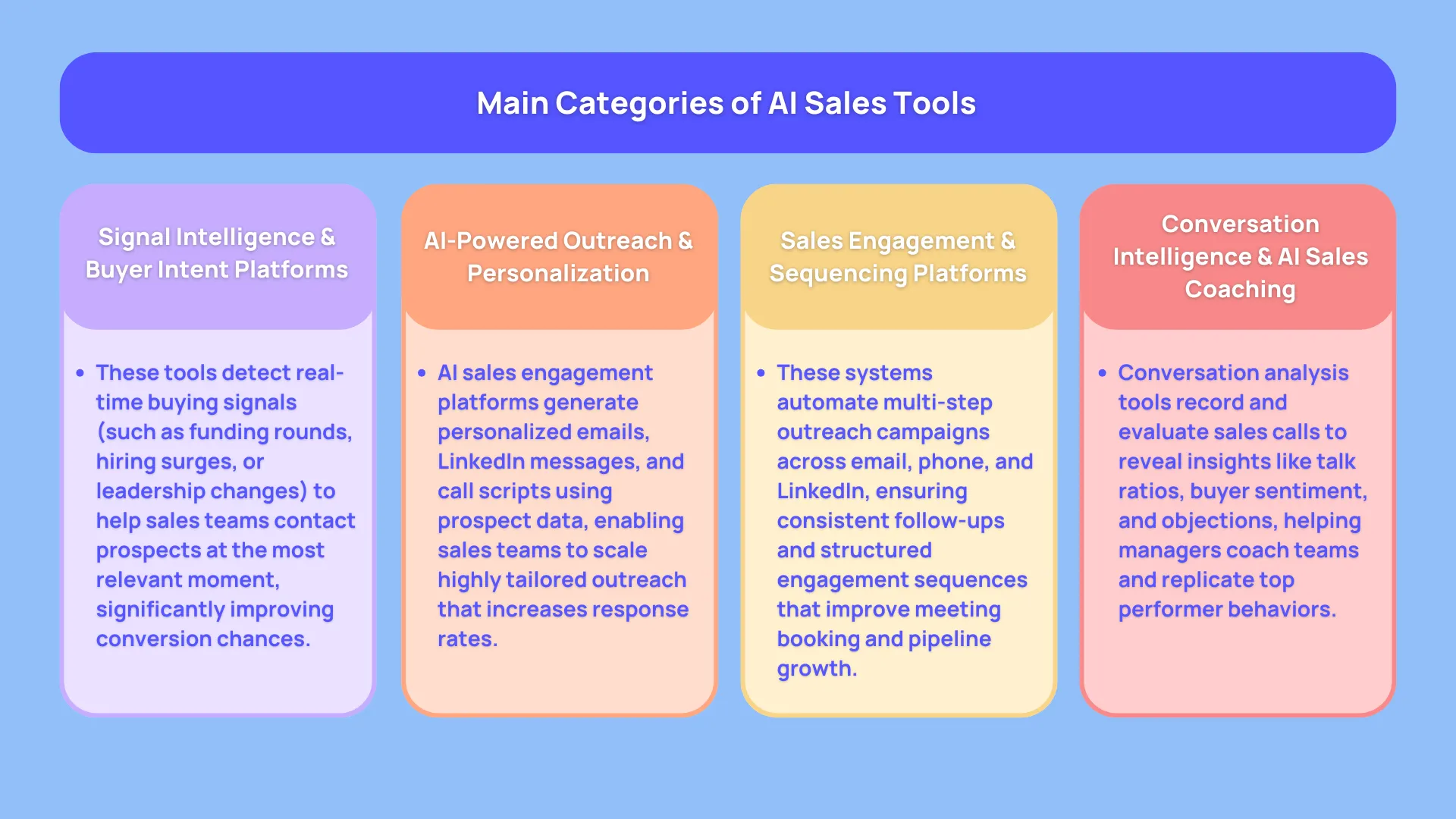
Best AI-Powered Tools for Sales Teams
After understanding the major categories of AI sales tools, sales engagement platforms, and sales automation software, the next step is identifying the platforms that actually deliver measurable results.
The challenge is not a lack of options. Hundreds of vendors now market AI-powered sales solutions across prospecting, outreach automation, forecasting, and conversation analysis. Many promise dramatic productivity improvements, yet only a portion of them become essential parts of a sales team’s daily workflow.
The platforms listed below represent some of the best AI-powered tools for sales teams in 2026. Each tool addresses a specific part of the modern sales process, from prospect engagement to revenue forecasting.
While many companies deploy multiple systems together, understanding the strengths of each platform helps sales leaders build a technology stack that supports sales productivity, sales enablement, and scalable revenue growth.
Trellus – AIO Sales Enablement and Real Time Call Conversational Intelligence
1. Trellus — Best AI Powered Tool for Real-Time Call Coaching and SDR Productivity
Best For
Outbound SDR and BDR teams that rely heavily on cold calling, follow-up calls, objection handling, and live prospect conversations.
What It Does
Trellus is designed around one of the most important but overlooked parts of the sales process: the live sales conversation.
Most modern AI sales tools focus heavily on automation happening before or after the call. They help reps write emails, build sequences, enrich contact data, or update CRM fields automatically. Those workflows are valuable, but they do not solve the moment where pipeline is actually created.
Trellus focuses on helping reps perform better while actively speaking with prospects.
The platform combines real-time AI coaching, call intelligence, workflow support, and sales productivity tooling into one outbound calling environment. As reps handle cold calls, follow-ups, or discovery conversations, the system analyzes the discussion in real time and surfaces contextual guidance.
That guidance may include objection handling suggestions, talk-track prompts, competitor responses, qualification reminders, or follow-up recommendations based on what the buyer says during the conversation.
For sales teams running high-volume outbound motions, that creates a major productivity advantage.
Key AI Features
- Real-time call coaching
- Objection detection
- AI call summaries
- Conversation analysis
- Talk-track recommendations
- Manager visibility dashboards
- Rep performance insights
- Workflow integrations
- Call intelligence analytics
Sales Productivity Impact
One of the biggest operational problems inside outbound sales teams is inconsistency.
New SDRs struggle to handle objections confidently. Experienced reps sometimes miss qualification signals or forget to ask key questions during calls. Managers rarely have enough time to review every conversation manually.
Trellus helps close those gaps.
The platform reduces note-taking work through AI summaries, improves onboarding through live coaching support, and gives managers visibility into call quality without forcing them to review hundreds of recordings manually.
Instead of treating coaching as a separate management task, Trellus embeds performance guidance directly into the rep workflow.
That is a major differentiator compared to many traditional conversation intelligence tools that only analyze calls after the meeting ends.
Pros
- Strong real-time coaching capabilities
- Designed specifically for outbound teams
- Improves live conversations instead of only post-call analysis
- Reduces manual admin work
- Helps managers scale coaching
Cons
- Best suited for phone-heavy sales motions
- Teams focused only on email outreach may need additional platforms
Pricing
Custom pricing based on team size and usage.
Tested Verdict
Trellus is one of the strongest AI powered tools for sales teams that want to improve live sales execution rather than simply automate background workflows.
For SDR teams whose biggest bottleneck is call quality, objection handling, rep consistency, or outbound productivity, Trellus provides one of the clearest operational impacts among modern AI sales software platforms.
2. Saleshandy — Best for AI Cold Email and Multichannel Prospecting
Best For
Outbound teams focused heavily on cold email, reply management, and multichannel prospecting.
What It Does
Saleshandy focuses on helping outbound teams scale personalized outreach without creating operational chaos.
Cold outbound in 2026 is no longer about blasting generic email campaigns to thousands of prospects. Buyers expect relevant messaging, consistent follow-up, and multichannel engagement across email, LinkedIn, and calls.
Saleshandy helps teams manage those workflows through sequencing, AI-assisted email writing, reply handling, and outreach automation.
The platform is particularly useful for companies building outbound email programs where SDRs need to maintain large prospecting volumes while still personalizing communication effectively.
Key AI Features
- AI email writing assistance
- Multichannel sequencing
- Reply management
- Automated follow-ups
- Prospect engagement analytics
- CRM integrations
Sales Productivity Impact
Many outbound reps lose enormous amounts of time manually tracking follow-ups, switching between inboxes, and organizing outreach sequences.
Saleshandy simplifies those workflows by centralizing outreach management inside one platform.
The AI assistance also helps reps generate better cold emails faster, which is especially valuable for newer outbound teams still refining messaging quality.
Compared to broader AI sales automation tools, Saleshandy remains highly focused on outbound execution.
Pros
- Strong outbound email workflows
- Easy sequence management
- Useful for growing outbound teams
- Good multichannel functionality
Cons
- Less focused on live call intelligence
- Teams relying heavily on phone outreach may need conversation intelligence tools
Pricing
Tiered subscription pricing.
Tested Verdict
Saleshandy is one of the strongest AI outbound sales tools for companies prioritizing scalable cold email execution, multichannel prospecting, and follow-up consistency.
3. Clay — Best for AI Data Enrichment and Signal-Based Prospecting
Best For
Teams needing stronger prospect data, buying signals, and automated research workflows.
What It Does
Clay has become one of the most influential platforms inside modern outbound sales workflows because it solves a core prospecting problem: poor data quality.
Many outbound campaigns fail long before messaging begins because prospect data is incomplete, outdated, or poorly targeted.
Clay addresses that issue through enrichment, intent data, signal tracking, and workflow automation.
Instead of relying on static prospect lists, sales teams can build dynamic workflows that continuously enrich accounts with buying signals, company changes, hiring activity, funding events, and other indicators that suggest sales opportunities.
The platform also allows teams to combine multiple enrichment providers together, improving overall data accuracy.
Key AI Features
- Waterfall data enrichment
- Buying signal analysis
- AI account research
- Workflow automation
- Prospect personalization support
Sales Productivity Impact
Clay significantly reduces manual account research work.
Rather than spending hours gathering company details manually, SDRs can access enriched records automatically and prioritize accounts showing strong buying intent.
That operational advantage is one of the reasons why Clay has become highly popular among modern RevOps and outbound teams.
Pros
- Extremely powerful enrichment capabilities
- Strong workflow flexibility
- Excellent for modern outbound teams
Cons
- Requires operational setup knowledge
- Can feel complex for smaller teams
Pricing
Usage-based pricing model.
Tested Verdict
Clay is one of the most powerful AI sales tools for teams prioritizing signal-based prospecting, enrichment quality, and scalable outbound targeting.
4. Gong — Best for Enterprise Conversation Intelligence
Best For
Enterprise sales organizations requiring deep deal visibility and coaching analytics.
What It Does
Gong helped define the modern category of enterprise conversation intelligence tools.
The platform records, analyzes, and interprets sales conversations across calls, demos, and customer meetings. Instead of relying on manager intuition or rep self-reporting, Gong gives leadership direct visibility into what buyers actually say during sales conversations.
That visibility becomes extremely valuable for larger organizations managing complex sales cycles.
The system surfaces deal risks, competitor mentions, coaching opportunities, stakeholder engagement patterns, and pipeline insights directly from customer interactions.
Key AI Features
- Conversation intelligence
- Call recording and transcripts
- Deal risk analysis
- Coaching analytics
- Pipeline insights
- Forecast support
Sales Productivity Impact
Gong improves coaching consistency across larger organizations.
Managers can identify which talk tracks perform best, where deals typically stall, and which objections appear most frequently.
Instead of reviewing random calls manually, leaders can analyze trends across thousands of conversations.
That level of visibility is especially valuable for enterprise sales organizations managing large pipelines.
Pros
- Advanced enterprise analytics n- Strong coaching workflows
- Excellent leadership visibility
Cons
- Expensive for smaller teams
- Heavier implementation compared to lightweight tools
Pricing
Custom enterprise pricing.
Tested Verdict
Gong is one of the strongest enterprise-grade AI sales software platforms for organizations that need deep coaching analytics, pipeline visibility, and conversation intelligence.
5. Fireflies.ai — Best for Affordable Meeting Notes and Call Summaries
Best For
Teams that need lightweight meeting intelligence and transcription.
What It Does
Fireflies.ai focuses on simplifying one of the most repetitive parts of modern sales workflows: documenting meetings.
The platform automatically records meetings, creates transcripts, generates summaries, and organizes searchable call archives.
For smaller sales teams, that functionality can remove a surprising amount of manual admin work.
Instead of writing notes after every prospect conversation, reps can rely on automated summaries and searchable meeting records.
Key AI Features
- AI transcription
- Meeting summaries
- Searchable call archives
- CRM note support
- Collaboration tools
Sales Productivity Impact
Fireflies.ai helps reps stay focused during conversations instead of multitasking between selling and note-taking.
Managers also benefit because meeting records become easier to review and share internally.
Compared to enterprise-focused conversation intelligence tools, Fireflies.ai is lighter, simpler, and easier to deploy.
Pros
- Easy to implement
- Affordable pricing
- Useful searchable archives
Cons
- Less advanced real-time coaching functionality
- Limited outbound-specific workflows
Pricing
Free and paid plans available.
Tested Verdict
Fireflies.ai is a practical lightweight solution for meeting capture and transcription workflows, particularly for growing teams wanting affordable AI meeting support.
6. Apollo.io — Best All-in-One Sales Intelligence and Engagement Platform
Best For
Startups and growth-stage teams wanting prospect data and outreach workflows in one platform.
What It Does
Apollo.io combines several major outbound sales functions into one system.
The platform includes contact data, prospecting workflows, outreach sequencing, engagement tracking, and automation capabilities inside a unified interface.
For smaller sales organizations, that consolidation is extremely valuable because it reduces the need for multiple disconnected tools.
Teams can build prospect lists, enrich contacts, launch outreach sequences, and track engagement from one platform.
Key AI Features
- Prospect database
- AI targeting recommendations
- Multichannel outreach
- Engagement tracking
- Workflow automation
Sales Productivity Impact
Apollo helps outbound teams launch prospecting programs quickly without investing in multiple separate systems.
That flexibility makes it especially popular among startups and growth-stage sales organizations.
While it may not provide the deepest functionality in every category, it performs well across prospecting and engagement workflows overall.
Pros
- Large prospect database
- Strong all-in-one functionality
- Useful for growing outbound teams
Cons
- Less specialized conversation intelligence
- Database quality can vary by market
Pricing
Free and paid plans available.
Tested Verdict
Apollo is one of the most flexible AI powered tools for sales teams needing prospecting, sequencing, and sales engagement inside one environment.
7. Clari — Best for AI Forecasting and Revenue Operations
Best For
Revenue leadership teams focused on forecasting and pipeline visibility.
What It Does
Clari focuses on one of the most difficult operational problems in sales: forecasting accuracy.
Many sales organizations struggle with inconsistent pipeline visibility, unreliable deal projections, and limited understanding of revenue risk.
Clari addresses those problems through AI-driven forecasting and pipeline inspection.
The system analyzes engagement patterns, deal activity, communication signals, and historical performance trends to estimate revenue outcomes more accurately.
Key AI Features
- Revenue forecasting
- Deal inspection
- Pipeline analytics
- Activity capture
- Risk identification
Sales Productivity Impact
Clari gives sales leadership clearer visibility into pipeline health and forecast reliability.
That operational visibility becomes increasingly important for larger organizations where inaccurate forecasting impacts hiring, budgeting, and revenue planning.
Pros
- Strong forecasting models
- Excellent RevOps visibility
- Enterprise-grade reporting
Cons
- Less useful for frontline SDR execution
- Enterprise-focused pricing
Pricing
Custom pricing.
Tested Verdict
Clari is one of the strongest AI sales software platforms for organizations prioritizing revenue intelligence and forecasting accuracy.
8. Salesforce Einstein — Best Native AI for Salesforce Teams
Best For
Companies already deeply invested in Salesforce.
What It Does
Salesforce Einstein extends AI capabilities directly inside Salesforce CRM workflows.
Rather than forcing teams to adopt separate standalone systems, Einstein embeds predictive insights, automation, and recommendations inside the existing CRM environment.
That native integration is its biggest advantage.
Because Einstein already has access to CRM history, customer interactions, and opportunity data, the platform can generate recommendations without requiring major workflow changes.
Key AI Features
- Predictive lead scoring
- Opportunity insights
- Email intelligence
- Workflow automation
- CRM recommendations
Sales Productivity Impact
Einstein helps sales teams prioritize opportunities, automate repetitive CRM work, and improve forecasting visibility while remaining inside Salesforce.
For organizations already operating fully inside the Salesforce ecosystem, that reduces operational friction significantly.
Pros
- Native Salesforce integration
- Useful predictive analytics
- Minimal workflow disruption
Cons
- Best value only inside Salesforce ecosystem
- Advanced functionality may increase cost significantly
Pricing
Additional Salesforce licensing required.
Tested Verdict
Einstein is strongest for Salesforce-centric organizations seeking embedded AI workflows rather than standalone external platforms.
9. Lavender — Best AI Sales Email Coach
Best For
SDRs and account executives wanting stronger outbound email quality.
What It Does
Lavender focuses specifically on improving outbound email quality.
That may sound narrow compared to larger AI sales automation tools, but email quality remains one of the most important factors affecting outbound conversion rates.
The platform analyzes messaging clarity, personalization quality, tone, and readability to help reps create more effective emails.
Instead of relying purely on templates, SDRs receive guidance that helps improve relevance and engagement.
Key AI Features
- Email scoring
- Personalization recommendations
- Writing assistance
- Tone optimization
- Messaging analytics
Sales Productivity Impact
Lavender helps reps write stronger emails faster.
That is particularly useful for outbound teams where personalization quality directly affects reply rates.
The tool also reduces editing time while improving consistency across SDR messaging.
Pros
- Easy rep adoption
- Helpful email coaching
- Strong personalization support
Cons
- Limited broader workflow functionality
- Primarily focused on email execution
Pricing
Subscription-based pricing.
Tested Verdict
Lavender is one of the most useful AI sales assistants for improving outbound email quality and personalization consistency.
10. HeyReach — Best for LinkedIn and Multichannel Outbound Automation
Best For
Teams heavily using LinkedIn for outbound prospecting.
What It Does
HeyReach focuses on scaling LinkedIn outreach through automation and multichannel coordination.
LinkedIn has become one of the most important outbound prospecting channels for many B2B sales teams, especially in account-based outbound environments.
HeyReach helps teams automate those workflows while keeping campaigns organized across accounts and outreach stages.
The platform is particularly useful for agencies and outbound organizations running large LinkedIn prospecting operations.
Key AI Features
- LinkedIn automation
- Campaign management
- CRM synchronization
- Outreach sequencing
- Account-based workflows
Sales Productivity Impact
HeyReach helps teams manage high-volume LinkedIn outreach without manually tracking every touchpoint.
That creates operational efficiency for outbound programs heavily dependent on social selling.
Pros
- Strong LinkedIn workflows
- Useful for agencies and outbound teams
- Good multichannel support
Cons
- Less focused on live conversations
- Heavy LinkedIn dependence
Pricing
Subscription pricing.
Tested Verdict
HeyReach is one of the stronger AI outbound sales tools for organizations where LinkedIn is a core prospecting channel.
11. Lindy — Best for AI Sales Workflow Automation
Best For
Teams automating repetitive cross-platform sales processes.
What It Does
Lindy approaches sales productivity from a workflow automation perspective.
Instead of focusing narrowly on outreach or conversations, the platform uses AI agents to automate repetitive operational tasks across systems.
That includes CRM updates, workflow routing, task handoffs, scheduling processes, and operational coordination.
The platform is highly flexible, which makes it useful for organizations managing complex internal workflows.
Key AI Features
- AI workflow automation
- CRM synchronization
- Task routing
- Process automation
- AI agents
Sales Productivity Impact
Lindy reduces operational overhead by eliminating repetitive coordination tasks that normally consume rep and operations time.
For RevOps-heavy organizations, that can improve efficiency substantially.
Pros
- Highly flexible automation
- Useful across multiple departments
- Strong integration flexibility
Cons
- Requires process planning
- Less sales-specific than dedicated platforms
Pricing
Usage-based pricing.
Tested Verdict
Lindy is best suited for organizations seeking flexible AI sales automation tools that connect workflows across multiple systems.
12. Regie.ai — Best for AI Sequence and Prospecting Content Creation
Best For
Outbound teams needing scalable messaging assets and outbound content generation.
What It Does
Regie.ai focuses on one of the hardest outbound scaling problems: maintaining messaging quality as outreach volume increases.
The platform helps teams create outbound sequences, call scripts, email messaging, and persona-based prospecting content.
Rather than forcing reps to build every campaign manually, Regie.ai provides AI-assisted frameworks that improve consistency across outbound workflows.
Key AI Features
- AI sequence creation
- Persona-based messaging
- Call script generation
- Prospecting content creation
- Messaging optimization
Sales Productivity Impact
Regie.ai speeds up campaign production while helping sales teams standardize outbound messaging.
That is especially useful for growing SDR organizations where consistency becomes difficult to maintain across large teams.
Pros
- Useful content generation
- Strong outbound support
- Helpful enablement workflows
Cons
- Less operational workflow depth
- Teams still need execution platforms
Pricing
Custom pricing.
Tested Verdict
Regie.ai is highly valuable for teams needing scalable outbound messaging support and AI-generated prospecting content.
13. Drift — Best for Conversational AI and Inbound Lead Qualification
Best For
Inbound-led SaaS companies focused on website conversion.
What It Does
Drift focuses on improving inbound lead conversion through conversational AI.
Many inbound teams lose opportunities because website visitors submit forms and wait too long for follow-up.
Drift replaces passive lead capture workflows with real-time conversational engagement.
The platform uses AI chatbots to qualify visitors, route leads, answer questions, and schedule meetings automatically.
Key AI Features
- AI chatbots
- Lead qualification
- Meeting routing
- CRM handoff
- Website engagement
Sales Productivity Impact
Drift helps inbound teams improve speed-to-lead and reduce qualification delays.
The platform also helps sales reps focus on higher-intent conversations rather than manually filtering inbound inquiries.
Pros
- Strong inbound conversion workflows
- Fast lead qualification
- Useful meeting routing
Cons
- Less focused on outbound sales execution
- Enterprise pricing can become expensive
Pricing
Custom pricing.
Tested Verdict
Drift is one of the strongest AI powered tools for sales teams focused on inbound lead qualification, conversational marketing, and website conversion.
Which AI Sales Tool Should You Choose?
How to Build an AI Sales Stack in 2026?
No single AI sales tool solves every sales problem.
The strongest revenue organizations combine specialized platforms that support prospecting, conversations, coaching, forecasting, and automation together.
The ideal stack depends heavily on team maturity and sales motion.
Stack for an Outbound SDR Team
Recommended stack:
- Trellus for live calling and coaching
- Saleshandy or Apollo for outreach sequencing
- Clay for enrichment and buying signals
- Lavender for email quality
- Fireflies.ai or Gong for meeting intelligence
Stack for a Founder-Led Sales Team
Recommended stack:
- Apollo or Saleshandy for outreach
- Trellus for call productivity
- Fireflies.ai for summaries
- Lavender for outbound messaging
Stack for a Mid-Market or Enterprise Sales Team
Recommended stack:
- Salesforce Einstein or Apollo for CRM foundation
- Trellus for SDR execution
- Gong for conversation intelligence
- Clari for forecasting
- Clay for enrichment workflows
Stack for an Inbound-Led SaaS Team
Recommended stack:
- Drift for inbound qualification
- Salesforce Einstein for CRM intelligence
- Fireflies.ai for meeting capture
- Trellus for outbound follow-up calls
AI Sales Tool Evaluation Checklist
Before buying any AI powered tools for sales teams, evaluate whether the platform improves measurable workflow outcomes.
Common Mistakes Sales Teams Make When Buying AI Sales Tools
Many sales organizations buy too many overlapping systems without solving the underlying sales execution problem.
The result is tool fatigue, workflow fragmentation, and low adoption.
Buying Automation Before Fixing the Sales Process
AI accelerates existing workflows.
If targeting, messaging, qualification, or handoff processes are already broken, AI often scales the inefficiency rather than fixing it.
Ignoring Phone-Based Sales Workflows
Many modern AI sales tools focus heavily on email automation, LinkedIn outreach, or CRM workflows.
However, live conversations are still where:
- Objections become visible
- Urgency is revealed
- Discovery happens
- Qualification improves
- Deals move forward
That is why platforms like Trellus remain highly valuable for outbound sales teams.
Measuring Features Instead of Outcomes
Sales teams should evaluate tools based on measurable outcomes including:
- Meetings booked
- Call-to-meeting conversion rate
- Talk-to-listen ratio
- CRM completeness
- Speed-to-lead
- Forecast accuracy
- Rep selling time
- Pipeline generated
Final Verdict: The Best AI Powered Sales Tool Depends on Your Sales Motion
There is no universally perfect AI sales software platform.
The best solution depends on the bottleneck inside your revenue process.
Some teams need stronger prospecting.
Others need forecasting visibility, outreach automation, or better inbound qualification.
However, for organizations whose biggest challenge is live conversation quality, outbound call productivity, and SDR coaching effectiveness, Trellus stands out as one of the strongest starting points.
If your team already has prospect lists, CRM workflows, and outreach sequences but still struggles to turn conversations into pipeline, improving live sales execution may create the largest impact.
FAQs About AI Powered Sales Tools for Sales Teams
What are the best AI powered tools for sales teams in 2026?
Some of the best AI powered tools for sales teams include Trellus, Saleshandy, Clay, Gong, Fireflies.ai, Apollo.io, Clari, Salesforce Einstein, Lavender, HeyReach, Lindy, Regie.ai, and Drift.
The best platform depends on whether your team prioritizes calling, prospecting, forecasting, CRM intelligence, outbound automation, or inbound conversion.
What is the best AI sales tool for SDR teams?
Trellus is one of the best options for SDR teams focused on outbound calling and live conversations.
Saleshandy, Apollo.io, Clay, and Lavender can support surrounding workflows such as prospecting, sequencing, and email optimization.
What is the best AI tool for sales calls?
Trellus is particularly strong for real-time call coaching and live outbound conversations.
Gong and Fireflies.ai are strong options for post-call analysis and meeting intelligence.
What is the difference between AI sales tools and AI sales automation tools?
AI sales tools is the broader category covering prospecting, forecasting, conversation intelligence, outreach, and CRM intelligence.
AI sales automation tools specifically focus on automating workflows such as follow-ups, routing, CRM updates, sequences, and task management.
Are AI sales tools worth it for small sales teams?
Yes, especially when they reduce manual work or improve revenue-critical workflows.
Smaller teams usually benefit most from platforms that improve prospecting, conversations, outreach quality, or CRM accuracy.
Which AI sales tool is best for outbound sales?
- Trellus for call-heavy outbound
- Saleshandy for email-led outbound
- HeyReach for LinkedIn outreach
- Apollo.io for prospecting plus engagement
- Clay for enrichment and signals
Can AI sales tools replace sales reps?
No.
The best AI powered tools for sales teams improve productivity, coaching, and workflow efficiency.
Human sales reps still handle relationship building, discovery, negotiation, and complex buying conversations.


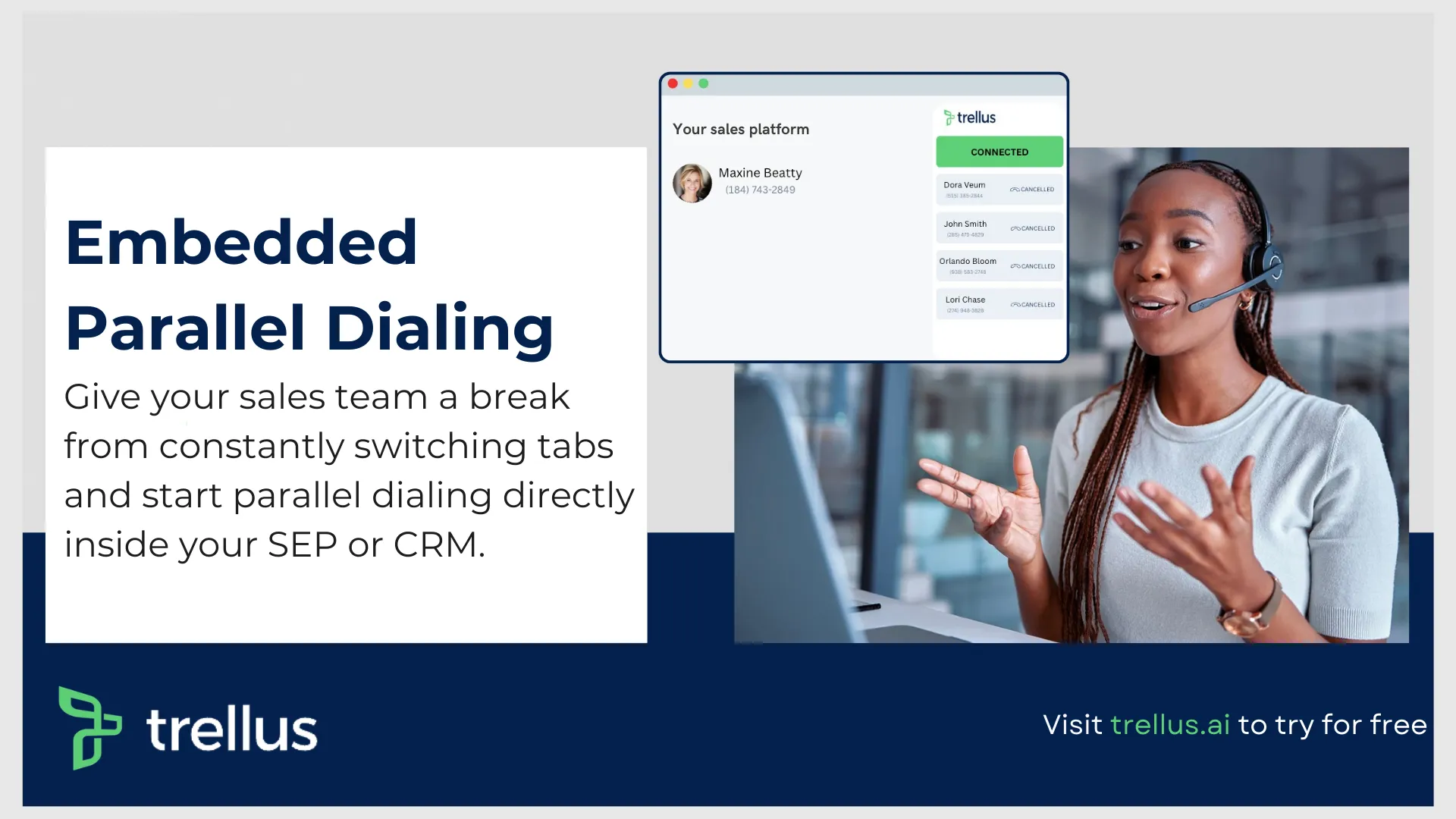
Power and parallel dialing in your CRM.