Our Top Picks


Sales teams do not need more tabs. They need fewer gaps between the tools they already trust.
That is exactly why outreach integrations matter. Outreach is built to run modern sales execution, but even strong platforms create drag when they operate in isolation. Reps still bounce between CRM records, calling tools, inboxes, support systems, and prospecting workflows just to complete one clean handoff. That friction slows follow-up, weakens personalization, and creates unnecessary admin.
The right outreach io integrations solve that problem. They connect Outreach with the systems your SDRs already use every day, so tasks move faster and context travels with them. Instead of asking reps to stitch workflows together manually, the stack starts working like a single operating system for pipeline generation.
In this guide, we break down 13 of the best Outreach integrations for 2026. Some improve dialing speed. Others strengthen CRM hygiene, customer context, or handoff quality. All of them help sales teams spend less time managing tools and more time creating qualified conversations.
Key Takeaways
•The best Outreach integrations remove workflow friction. When calling, CRM, inbox, and support tools stay connected, SDRs spend less time logging work and more time engaging prospects.
•CRM pairings still matter most. Tools like Salesforce, HubSpot, Pipedrive, and Zoho CRM help Outreach become more actionable because activity data and account context stay aligned.
•Calling layers create the biggest productivity gains. Solutions such as Trellus.ai, CloudTalk, Salesfinity, and Koncert help teams increase live conversations without forcing reps into disconnected workflows.
•Support and communication integrations improve timing. Front, Intercom, and Zendesk add customer context that helps reps avoid tone-deaf outreach and prioritize better handoffs.
•The right integration depends on your motion. Enterprise teams often need reporting depth and CRM structure, while lean outbound teams benefit more from dialers, automation, and faster execution.
What Is an Outreach Integration?
An Outreach integration is any connection that lets Outreach share data, trigger actions, or extend workflows across another system.
In practical terms, that usually means connecting Outreach with a CRM, dialer, inbox, customer support platform, or automation tool. The goal is not simply to sync software. The goal is to make sure reps can move through sequences, calls, handoffs, and updates without re-entering the same information twice.
A strong Outreach integration usually helps teams do one or more of the following:
•keep contact and account records aligned across systems;
•log calls, emails, and tasks automatically;
•surface more context before a rep reaches out; and
•reduce tab-switching during high-volume outbound work.
When that connection is done well, Outreach becomes less of a standalone tool and more of a command center for the rest of the revenue stack.
The 13 Best Outreach Integrations to Accelerate Sales in 2026 (Updated April)
The best Outreach integrations do not all solve the same problem. Some improve CRM visibility. Some sharpen dialing speed. Others bring support data, messaging context, or automation into the rep workflow. The list below covers a balanced mix of tools that help SDR teams work faster, stay organized, and create cleaner pipeline motion.
Trellus.ai
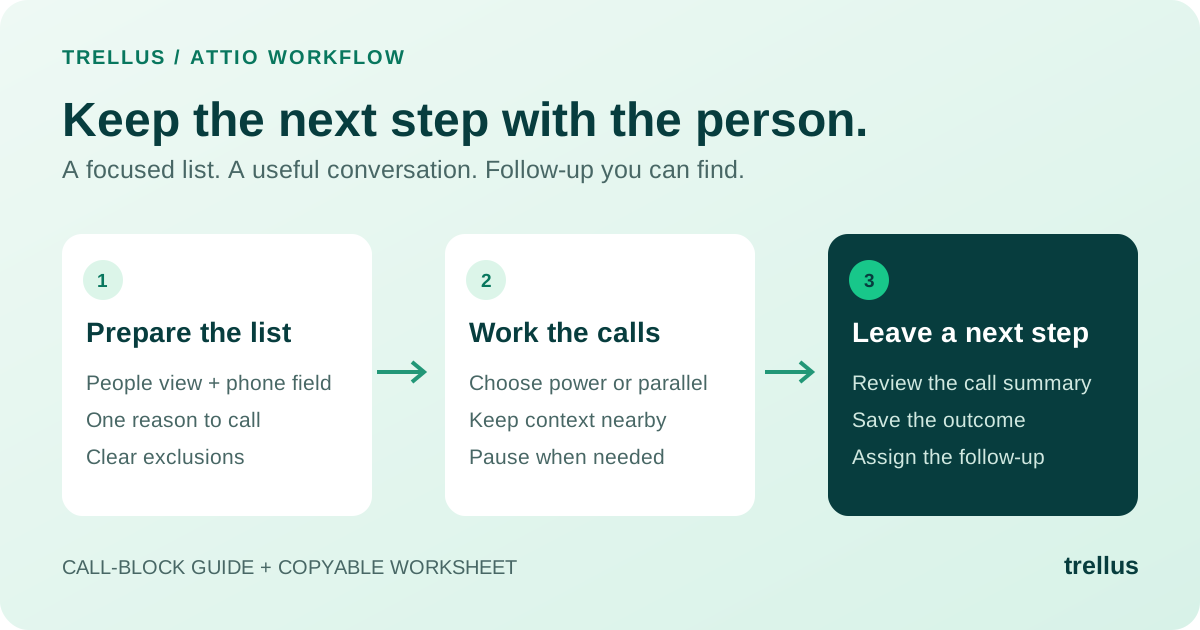
Trellus.ai is the most natural fit on this list for teams that want more output from Outreach without forcing reps into a separate workflow. It sits on top of sales engagement platforms and gives reps faster calling, coaching support, and workflow compression inside the same operating environment. For SDR teams already running Outreach, that matters because speed gains only count when they do not introduce more friction.
The biggest advantage is that Trellus.ai helps teams turn Outreach into a more execution-ready calling workspace. Reps can move faster through call tasks, spend less time bouncing between tools, and keep momentum high during dialing blocks. The platform also emphasizes embedded usage, which fits teams that do not want to retrain reps on an entirely new motion.
Key benefits of using Trellus.ai with Outreach:
•helps reps dial faster without abandoning the Outreach workflow;
•reduces tab-switching during outbound call blocks;
•supports higher activity volume with less manual effort; and
•adds coaching and call support closer to where reps already work.
Key features:
•embedded power and multi-line dialing inside supported platforms;
•voicemail drop and additional phone number support;
•AI practice calls and real-time coaching options for teams; and
•LinkedIn workflow support for reps handling multi-step outbound.
Pricing: Trellus lists POWER (Bring Your Own Dialer) at $59.99/month, Power at $99.99/month, Parallel at $149.99/month, and Business on custom pricing.
CloudTalk
CloudTalk is a strong Outreach integration for teams that need a more flexible phone system around their outbound motion. Where Outreach helps structure sequences and task execution, CloudTalk adds calling infrastructure, routing, analytics, and dialer options that support both sales and customer-facing teams.
That makes it especially useful for organizations that want Outreach to drive engagement logic while CloudTalk handles voice operations at scale. It can support everything from click-to-call workflows to power and parallel dialing add-ons, which gives teams room to scale calling without rebuilding their entire stack.
Key benefits of using CloudTalk with Outreach:
•adds a dedicated business calling layer to complement Outreach sequences;
•supports broader outbound and inbound voice workflows across teams;
•improves visibility into call performance and coaching opportunities; and
•creates more flexibility for teams with international or multi-number needs.
Key features:
•click-to-call, web dialer, and smart dialer workflows;
•add-on power dialer and parallel dialer options;
•call recording, routing, analytics, and dashboards; and
•a large integration library for CRM and support workflows.
Pricing: CloudTalk’s pricing page shows plans starting at $19/user/month for Lite, $29/user/month for Essential, and $49/user/month for Expert when billed annually, with dialer add-ons priced separately.
Salesforce
If your revenue team runs on Salesforce, this is one of the most important Outreach integrations you can set up well. Outreach generates activity. Salesforce holds the system of record. When the two stay aligned, leaders get cleaner reporting, reps get better account context, and handoffs become easier to trust.
For most enterprise sales teams, the value is less about convenience and more about operational integrity. Outreach without a strong Salesforce connection can create duplicate work, inconsistent field hygiene, and poor forecasting confidence. A tighter setup helps every call, meeting, and sequence contribute to the broader sales process.
Key benefits of using Salesforce with Outreach:
•keeps pipeline data and sales activity aligned in one CRM source of truth;
•improves forecast confidence through cleaner activity visibility;
•helps managers connect rep execution to opportunity movement; and
•supports stronger account planning across teams.
Key features:
•contact, account, and opportunity data sync;
•workflow automation and reporting depth;
•customizable objects, fields, and revenue processes; and
•broad ecosystem support across RevOps tools.
Pricing: Salesforce uses tiered and product-specific pricing, with most advanced sales deployments positioned as customized or sales-led pricing depending on edition and product mix.
HubSpot
HubSpot is a practical Outreach integration for teams that want CRM clarity without the operational weight that often comes with more complex enterprise systems. It works well for startups and mid-market teams that need contact records, deal stages, and sales reporting to stay clean while Outreach handles outbound execution.
The real advantage is simplicity. HubSpot gives teams a familiar CRM and sales environment, which makes it easier to connect outreach activity to lifecycle reporting, pipeline movement, and cross-functional visibility. For lean teams, that balance can be enough to support scale without overcomplicating the stack.
Key benefits of using HubSpot with Outreach:
•keeps contact and deal data visible across outbound workflows;
•supports cleaner reporting for small and mid-market sales teams;
•helps sales and marketing stay aligned on lead status; and
•reduces manual CRM updates as rep activity increases.
Key features:
•CRM records, deal pipelines, and lifecycle tracking;
•meeting, email, and activity visibility across teams;
•automation and reporting tools for sales workflows; and
•strong usability for fast-moving GTM teams.
Pricing: HubSpot’s sales software is sold through tiered plans, with entry pricing available on its pricing page and higher tiers increasing with seats and functionality.
Front
Front is not a traditional CRM or dialer, which is exactly why it can be so valuable in an Outreach stack. It gives teams a shared inbox layer that makes customer and prospect communication easier to manage across sales, success, and support. When outreach timing matters, inbox context matters too.
For SDR and account teams, Front helps reduce the risk of disconnected communication. If a prospect recently replied to support, requested a contract update, or is actively working through onboarding questions, that context should shape outbound messaging. Front helps teams act like one company instead of three separate inboxes.
Key benefits of using Front with Outreach:
•gives reps better visibility into ongoing customer conversations;
•improves coordination between sales, success, and support teams;
•reduces awkward outreach during sensitive support moments; and
•helps teams handle handoffs with more context.
Key features:
•collaborative shared inboxes and conversation assignment;
•internal comments, routing, and workflow rules;
•customer conversation history across channels; and
•analytics for response performance and workload management.
Pricing: Front’s pricing page lists plans beginning at $25/seat/month for Starter and $65/seat/month for Professional, with higher plans available for larger teams.
Pipedrive
Pipedrive is a useful Outreach integration for teams that want a lighter CRM focused on deal movement and pipeline management. It is especially relevant for growing sales teams that want better structure than spreadsheets but do not need the overhead of a complex enterprise CRM.
Paired with Outreach, Pipedrive gives reps a clear separation of responsibilities: Outreach for engagement execution and Pipedrive for deal tracking. That clarity helps teams preserve focus. It also makes Pipedrive attractive to businesses that want a straightforward sales stack with visible ROI and fast onboarding.
Key benefits of using Pipedrive with Outreach:
•provides a simple CRM system for managing deals and pipeline stages;
•helps reps connect outreach activity with next-step pipeline movement;
•supports quicker onboarding for smaller sales teams; and
•reduces process complexity compared with heavier CRM deployments.
Key features:
•visual pipelines and deal stage management;
•sales activity tracking and reminders;
•reporting and automation for pipeline workflows; and
•accessible CRM setup for scaling teams.
Pricing: Pipedrive offers tiered CRM pricing, with entry plans starting from its publicly listed pricing page and higher tiers adding automation, reporting, and advanced controls.
ActiveCampaign
ActiveCampaign earns a place on this list because outbound sales rarely lives in a vacuum. Many teams need a cleaner bridge between prospecting activity, lifecycle automation, and contact engagement data. That is where this platform fits well alongside Outreach.
If your business blends SDR outbound with nurture programs, lead scoring, or marketing automation, ActiveCampaign can add useful context that sharpens timing and segmentation. It is less about replacing Outreach and more about making sure outbound actions reflect what is happening elsewhere in the customer journey.
Key benefits of using ActiveCampaign with Outreach:
•connects outbound workflows with marketing engagement signals;
•helps teams segment contacts based on lifecycle behavior;
•improves follow-up timing with automation-driven context; and
•supports better coordination between sales and marketing operations.
Key features:
•marketing automation and contact segmentation;
•email journeys, triggers, and lifecycle workflows;
•CRM and lead management capabilities; and
•behavior-based personalization for follow-up.
Pricing: ActiveCampaign promotes tiered platform pricing on its pricing page, with entry plans beginning from a lower monthly rate and scaling based on contacts, seats, and feature depth.
Zoho CRM
Zoho CRM is a strong Outreach integration for teams that need structure, automation, and affordability in the same package. It is often a good fit for growing businesses that want more CRM discipline without moving straight into the cost and complexity of larger enterprise platforms.
When paired with Outreach, Zoho CRM can serve as the operational backbone for customer records, lead stages, and workflow automation. That setup works well for teams that want to keep execution fast while still maintaining process consistency and reporting visibility.
Key benefits of using Zoho CRM with Outreach:
•gives growing teams a cost-conscious CRM foundation;
•supports cleaner lead and contact management around outbound activity;
•improves process consistency with workflow automation; and
•helps sales teams centralize account information.
Key features:
•lead, contact, and deal management;
•workflow automation and custom CRM processes;
•reporting and dashboard visibility; and
•broad business suite compatibility within the Zoho ecosystem.
Pricing: Zoho CRM publicly lists a free plan for up to three users, with paid editions beginning at $14/user/month on annual billing.
Intercom
Intercom is a valuable Outreach integration when customer messaging and product context influence how sales conversations should happen. It is particularly useful for expansion teams, product-led sales motions, and businesses where support and success signals should affect outbound timing.
Used well, Intercom helps reps stop treating every contact like a cold prospect. If a lead is actively engaging in chat, asking onboarding questions, or signaling buying intent through product conversations, that context should shape follow-up. Intercom gives Outreach users a better chance to personalize around live customer behavior.
Key benefits of using Intercom with Outreach:
•adds product and messaging context before reps reach out;
•supports better timing for expansion or qualification conversations;
•improves coordination between support, success, and sales; and
•helps teams personalize outreach around active customer behavior.
Key features:
•live chat, messaging, and customer conversation history;
•AI-powered support and service workflows;
•shared inbox and collaboration tools; and
•automation for routing and engagement.
Pricing: Intercom’s pricing page promotes entry pricing starting at $29/month annually for AI-powered customer service, with usage-based elements and higher tiers depending on needs.
Zendesk
Zendesk is one of the most useful Outreach integrations for teams that sell into existing customers or work closely with support. Before a rep sends a follow-up or pushes an expansion conversation, they need to know whether the account is healthy, frustrated, or waiting on a resolution.
That is where Zendesk becomes valuable. It gives sales teams access to support context that can dramatically change outreach timing and message tone. It also improves collaboration when sales, support, and customer success need to coordinate around one account.
Key benefits of using Zendesk with Outreach:
•surfaces support history before outbound or follow-up activity;
•reduces the risk of poorly timed sales messaging;
•improves coordination on renewals, escalations, and expansion plays; and
•helps reps work with fuller account context.
Key features:
•ticketing and support workflow management;
•omnichannel customer service and shared context;
•automation and routing for support operations; and
•reporting around service quality and workload.
Pricing: Zendesk publicly lists plans starting at $19/agent/month annually, with higher suite tiers and AI agent pricing available separately.
Salesfinity
Salesfinity is built for teams that want more live conversations from the phone channel, especially in high-output outbound environments. In an Outreach-centered workflow, it can serve as an acceleration layer for call-heavy motions where activity volume and connect rates matter more than adding another generalized platform.
Its main appeal is speed. Teams using Outreach for sequencing may look at Salesfinity when they want a stronger parallel dialing experience, more phone-first energy, and a workflow that helps reps maximize the best hours of the day. For fast-moving SDR floors, that can be meaningful.
Key benefits of using Salesfinity with Outreach:
•helps reps push through more calls during high-intent dialing windows;
•supports stronger phone-first outbound execution;
•reduces the dead time between conversations; and
•can improve live connect opportunities for call-centric teams.
Key features:
•AI parallel dialing capabilities;
•virtual sales floor collaboration concept;
•outbound calling workflows built for SDR teams; and
•team-oriented dialing environment.
Pricing: Salesfinity advertises transparent pricing on its pricing page, but exact plan details are typically positioned through its current pricing interface and sales-led packaging.
Klenty
Klenty is a sales engagement platform with multichannel sequencing and dialer options, which makes it relevant in conversations about Outreach integrations and adjacent stack decisions. Even if a team uses Outreach as the primary execution layer, Klenty is useful to evaluate when dialing, automation, or multichannel experimentation becomes a priority.
For some teams, Klenty serves as a complementary workflow component. For others, it acts as a benchmark for what they want their Outreach stack to accomplish. Either way, it belongs on the shortlist for outbound leaders comparing execution tools and dialer support.
Key benefits of using Klenty with Outreach:
•adds perspective for teams optimizing multichannel outbound workflows;
•supports dialer-driven activity alongside email and task automation;
•helps smaller teams scale structured outbound faster; and
•offers a more accessible sales engagement option for growing teams.
Key features:
•email, call, and multichannel sequencing;
•sales dialer options for outbound teams;
•automation and task orchestration; and
•CRM sync support for contact workflow management.
Pricing: Klenty’s pricing page states the Basic plan starts at $50/user/month paid annually, while separate dialer pricing is also available for teams that need calling functionality.
Koncert
Koncert is a strong fit for teams that care deeply about dialing efficiency. It focuses on sales engagement and AI dialer workflows, with particular strength in power and parallel dialing use cases. That makes it relevant for Outreach users who want to increase calling output without relying on manual, one-number-at-a-time execution.
The value here is direct: more conversations in less time. When combined with Outreach’s sequencing discipline, Koncert can help teams create a faster phone motion while keeping reps focused on the accounts and tasks that matter most.
Key benefits of using Koncert with Outreach:
•supports higher outbound call throughput for SDR teams;
•helps reduce idle time during phone prospecting sessions;
•strengthens call-first execution for pipeline generation; and
•gives teams another route to scale beyond manual dialing.
Key features:
•AI power and parallel dialer options;
•sales cadence and engagement support;
•workflows designed for outbound calling productivity; and
•specialized tooling for conversation volume.
Pricing: Koncert positions pricing through a quote-based model on its pricing page for AI dialers, cadence, and broader sales engagement products.
How to Choose the Right Outreach Integration for Your Business
Start with the bottleneck
Do not choose an integration because it looks impressive on a stack diagram. Choose it because it removes a specific point of friction. If reps are wasting time on call execution, start with a dialer layer. If data quality is the problem, start with your CRM connection.
Match the tool to your sales motion
A phone-heavy SDR team needs something very different from a product-led growth team. Outbound-heavy teams usually benefit more from dialers and workflow compression. Lifecycle and expansion teams often get more value from support and messaging context.
Prioritize embedded workflows
The best integration is usually the one reps barely notice. If a tool forces constant context switching, adoption drops fast. Look for integrations that keep work close to where the rep already sequences, calls, updates, and follows up.
Think about reporting and ownership
Every integration changes where truth lives. Be clear about whether Outreach, your CRM, or your support system owns each piece of data. That prevents duplicate fields, broken attribution, and confusing dashboards later.
Buy for the next stage, not just today
Your current pain matters, but so does your next level of scale. Pick integrations that solve the immediate workflow gap while still giving RevOps, managers, and reps room to grow without a full rebuild.
How to Connect Outreach with Trellus.ai
Connecting Outreach with Trellus.ai is simpler than most teams expect because Trellus is designed as a layer on top of the Outreach platform rather than a separate external system that requires a traditional integration build.
That matters for adoption. Instead of asking reps to leave Outreach and work from a disconnected dialer, Trellus brings added functionality directly into the environment they already use. In practice, that means teams can increase calling speed, reduce workflow drag, and keep execution inside a familiar rep motion.
The setup logic is straightforward:
•Outreach remains the core sales engagement platform.
•Trellus.ai sits on top of that workflow as an embedded calling and productivity layer.
•No separate external integration has to be installed in the way teams often expect with stand-alone connectors.
•Reps continue working from Outreach while Trellus extends how efficiently they can execute call tasks.
For teams evaluating rollout risk, that is a meaningful advantage. Less implementation friction usually leads to faster adoption, cleaner onboarding, and stronger rep consistency.
Stop Wasting Time on Manual Tasks: Start Scaling with the Best Outreach Integrations in 2026
The best Outreach integrations do not win because they add more software. They win because they remove effort.
When your CRM, dialer, inbox, and support data work together, SDRs stop spending prime selling hours on admin and context hunting. They move faster, respond with better timing, and create a sales process that actually scales under pressure.
If your team is already invested in Outreach, the next step is not to replace it. It is to strengthen it. Start with the workflow that creates the most drag today, then add the integration that removes it cleanly.
For call-heavy teams, Trellus.ai stands out because it expands what Outreach can do without forcing reps into another disconnected tool. And in 2026, that is the real benchmark for a great integration: less friction, more conversations, and better pipeline momentum.
.jpeg)

Power and parallel dialing in your CRM.