Our Top Picks


“Is it okay if we record this call?”
That simple question has become part of modern sales culture. It is no longer just about documentation. It is about clarity, alignment, coaching, and smarter decision making.
Sales teams that embrace call recording and transcription are not trying to spy on their reps. They are trying to understand what actually happens in conversations that move revenue forward. Memory fades. Notes are incomplete. But recorded conversations tell the full story.
When handled correctly, sales call recording becomes one of the most powerful levers for growth across revenue teams, not just sales but marketing, product, and leadership as well.
What Is Sales Call Recording Software?
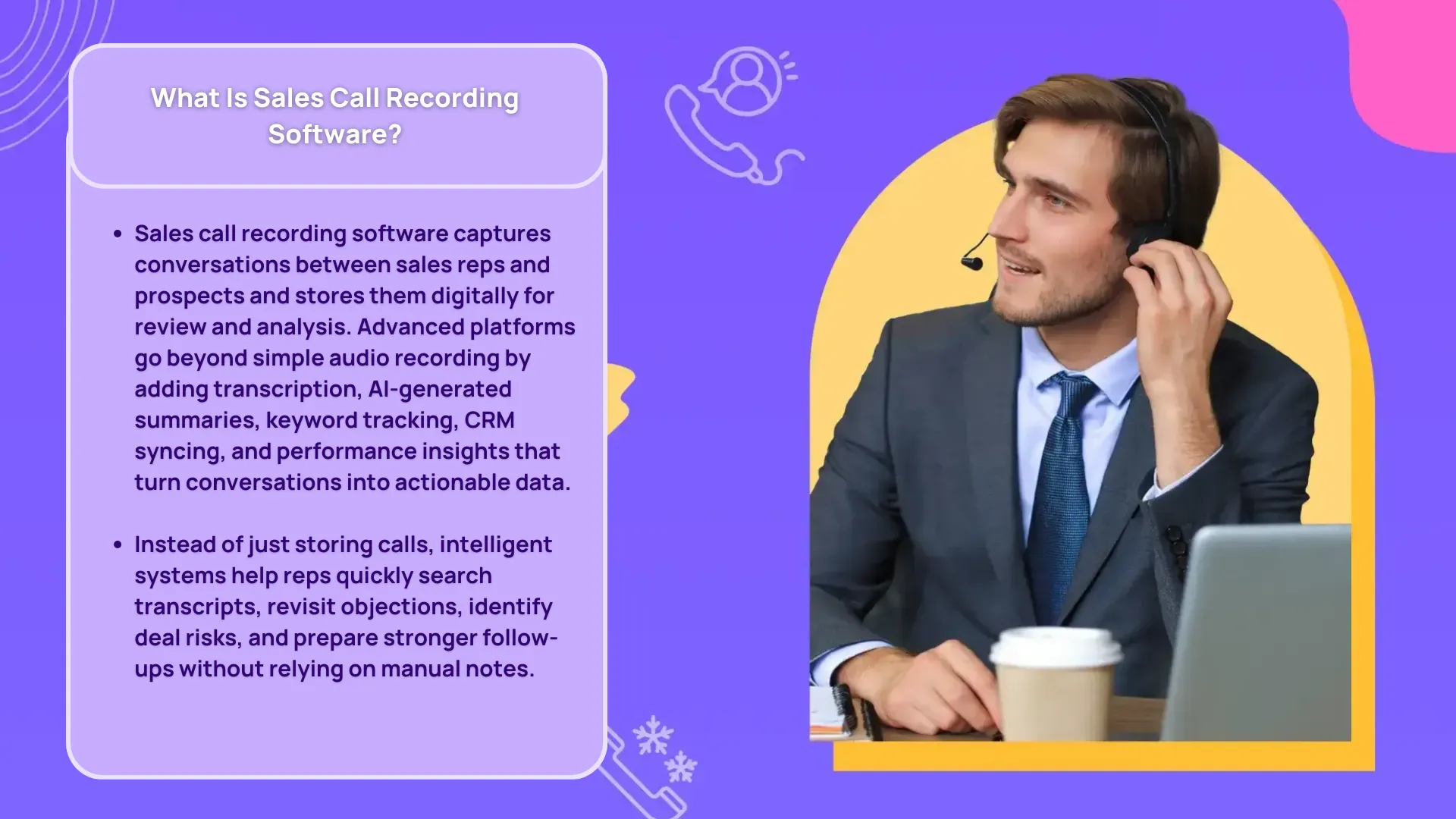
At its core, sales call recording software captures conversations between reps and prospects and stores them digitally. Basic systems simply record audio. More advanced platforms layer in call transcription software, AI summaries, keyword tracking, and performance analytics.
Modern tools often combine:
- Automatic call recording
- Real time or post call voice transcription
- AI driven summaries
- CRM syncing
- Conversation tagging
- Keyword tracking
- Deal risk alerts
The difference between basic recording and intelligent recording is massive. One stores data. The other turns conversations into insight.
When a system includes both recording and transcription, reps can search transcripts, revisit key objections, and prepare better follow ups in minutes instead of digging through notes for half an hour.
Should You Record Your Sales Calls?
Some reps love recording. Others feel exposed. That reaction is normal.
But here is the reality. In B2B sales, conversations are your most valuable asset. That is where trust is built, objections surface, budgets are discussed, and buying signals appear.
Relying on memory alone is risky.
Buyers Are More Informed Than Ever
Prospects show up prepared. They compare vendors, read reviews, and ask detailed questions. If a rep misses a nuance in the conversation, the follow up can fall flat.
With call recording and transcription, reps can revisit exactly what the buyer said. That context makes personalization real instead of generic.
Deals Are Complex
Enterprise sales involve multiple stakeholders and long cycles. A conversation from three weeks ago may contain a subtle concern that becomes a major blocker later.
Recorded conversations keep everyone aligned. When a new stakeholder joins, the rep can review prior discussions and respond intelligently.
Time Is Your Most Valuable Asset
Manual note taking eats hours every week. A modern call transcription service can summarize conversations automatically and push structured notes into your CRM.
Instead of typing summaries, reps can focus on selling.
Call Transcription
Recording is only half the equation. Without transcripts, audio becomes hard to search and even harder to analyze at scale.
That is where call transcription software changes everything.
Transcripts turn conversations into searchable data. A rep can type in a competitor name and instantly find every moment it was mentioned. A manager can review talk tracks across dozens of calls in minutes.
Good transcription systems offer:
- High accuracy voice transcription
- Speaker separation, so you know who said what
- Keyword highlighting
- Timestamped search
- CRM syncing for context
Transcripts also create clarity for coaching. Managers no longer rely on vague impressions. They can point to specific phrases, pacing issues, or missed opportunities.
This shift transforms call recordings from passive archives into active performance tools.
Conversation Intelligence
Recording and transcription create raw material. conversation intelligence transforms that material into strategic insight.
Instead of just storing calls, advanced platforms analyze them. They track talk to listen ratios, objection frequency, competitor mentions, pricing discussions, and even sentiment shifts.
Top reps typically speak around forty to forty five percent of the time. That data point alone can reshape coaching conversations. When a rep dominates seventy percent of a call, the issue becomes measurable instead of subjective.
Strong conversation intelligence systems can:
- Detect recurring objections
- Identify winning talk tracks
- Flag deal risk signals
- Surface customer pain points
- Highlight successful closing patterns
These insights do not just help sales. Marketing learns what messaging resonates. Product teams hear unfiltered feedback. Leadership sees patterns in lost deals.
When teams embrace conversation intelligence, they stop guessing and start responding to real customer signals.
Call Analytics
Data matters, but only when it is interpreted correctly. Call analytics brings structure to performance evaluation.
Modern systems track metrics like:
- Talk to listen ratio
- Average call length
- Objection frequency
- Keyword mentions
- Follow up timing
These metrics support smarter performance analysis across the team.
For example, if deals that close tend to include early budget discussions, that becomes a coaching focus. If stalled deals consistently show pricing objections in the first five minutes, messaging may need adjustment.
Analytics also helps leaders identify outliers. A rep who consistently converts discovery calls at a higher rate likely has behaviors worth replicating.
Instead of generic training, teams can create targeted improvement plans rooted in actual call data.
Recording Technology
The effectiveness of your automatic call recording setup depends heavily on the underlying technology.
Not all systems are equal. Some require manual activation. Others integrate directly into dialers and video conferencing tools, capturing every conversation seamlessly.
The best recording technology offers:
- Automatic recording for inbound and outbound calls
- Multi channel support including phone and video
- Clear audio quality
- Secure cloud storage
- Fast processing for transcription
Ease of use matters. If reps have to toggle between multiple tools, adoption drops. Recording should feel invisible in the workflow.
When the technology works smoothly, recording becomes part of the sales rhythm rather than an interruption.
Compliance Management
Recording conversations comes with responsibility. Call recording compliance is not optional. It protects your company, your reps, and your customers.
Different regions have different consent laws. Some require one party consent. Others require all party consent. That means reps must clearly inform prospects that the call is being recorded and receive acknowledgment before proceeding.
Strong compliance management includes:
- Clear consent scripts built into call openings
- Automatic recording disclaimers
- Secure storage with encryption
- Controlled access permissions
- Data retention policies
Security is equally important. Sales calls often contain pricing details, contractual terms, and sometimes sensitive customer information. A reliable call transcription service should encrypt recordings both in transit and at rest.
Trust is fragile in B2B relationships. Transparent recording practices build credibility rather than suspicion.
Quality Assurance
Sales teams often think of QA as something for support teams. That mindset leaves growth on the table.
Quality assurance in sales means reviewing conversations to ensure messaging consistency, brand alignment, and process adherence. It is about protecting revenue, not policing reps.
With call recording and transcription, QA becomes structured instead of random.
Effective QA programs evaluate:
- Discovery depth
- Objection handling
- Value articulation
- Pricing conversations
- Closing attempts
When managers regularly review calls, they catch small issues before they become systemic problems. Reps also benefit because feedback is grounded in real examples rather than abstract advice.
QA turns recorded conversations into learning loops that continuously sharpen performance.
Call Review
A healthy call review culture creates growth without creating fear.
The key is positioning reviews as development tools rather than surveillance. Reps should understand that recordings help them improve, not trap them.
A strong review framework might include:
- Weekly team call breakdown sessions
- Peer feedback discussions
- Highlight reels of winning conversations
- Focused improvement reviews for specific skills
Listening back to calls can be uncomfortable at first. Over time, it builds awareness. Reps hear filler words, rushed explanations, missed follow up questions, and opportunities to dig deeper.
When paired with intelligent voice transcription, reviews become faster and more focused. Instead of replaying entire calls, managers can jump to key moments using searchable transcripts.
Performance Analysis
Performance improvement is rarely about motivation alone. It is about behavior.
With structured performance analysis, leaders can identify patterns that correlate with revenue outcomes.
Data points that matter include:
- Talk to listen balance
- Question frequency
- Objection response time
- Deal stage progression after calls
- Competitor mention patterns
This analysis goes beyond vanity metrics. It uncovers behaviors that consistently lead to wins.
For example, if top performers consistently summarize next steps clearly at the end of calls, that becomes a coaching standard. If stalled deals show unclear action items, the gap becomes obvious.
Performance analysis supported by conversation intelligence eliminates guesswork. It replaces opinions with observable behavior trends.
Data Extraction
Every sales call contains valuable information that extends far beyond the deal at hand.
With advanced transcription tools, teams can extract structured insights from unstructured conversations. This is where data extraction becomes powerful.
Call transcripts can surface:
- Repeated feature requests
- Common pricing objections
- Market trends
- Competitor positioning insights
- Customer language patterns
This information helps marketing refine messaging and helps product teams prioritize improvements.
A smart call transcription software solution allows keyword tracking, tagging, and categorization. That transforms conversations into strategic data assets.
When properly organized, your call library becomes a searchable knowledge base for the entire organization.
Coaching Material
One of the most practical uses of recorded conversations is turning them into coaching material.
Generic training rarely sticks. Real conversations do.
Managers can build libraries of:
- Excellent discovery calls
- Strong objection handling examples
- Effective pricing discussions
- Clean, confident closes
Reps learn faster when they hear real scenarios instead of theoretical scripts.
This is where coaching software layered on top of recording platforms becomes valuable. It allows managers to tag moments, leave comments, assign training snippets, and track improvement over time.
When reps see measurable progress through structured coaching supported by real call examples, confidence grows. Recording shifts from being a monitoring tool to a growth accelerator.
Best Practices for Using Sales Call Recording Systems
Having the right tools is only part of the equation. Success depends on how you use them.
Integrate Recording Into Your CRM
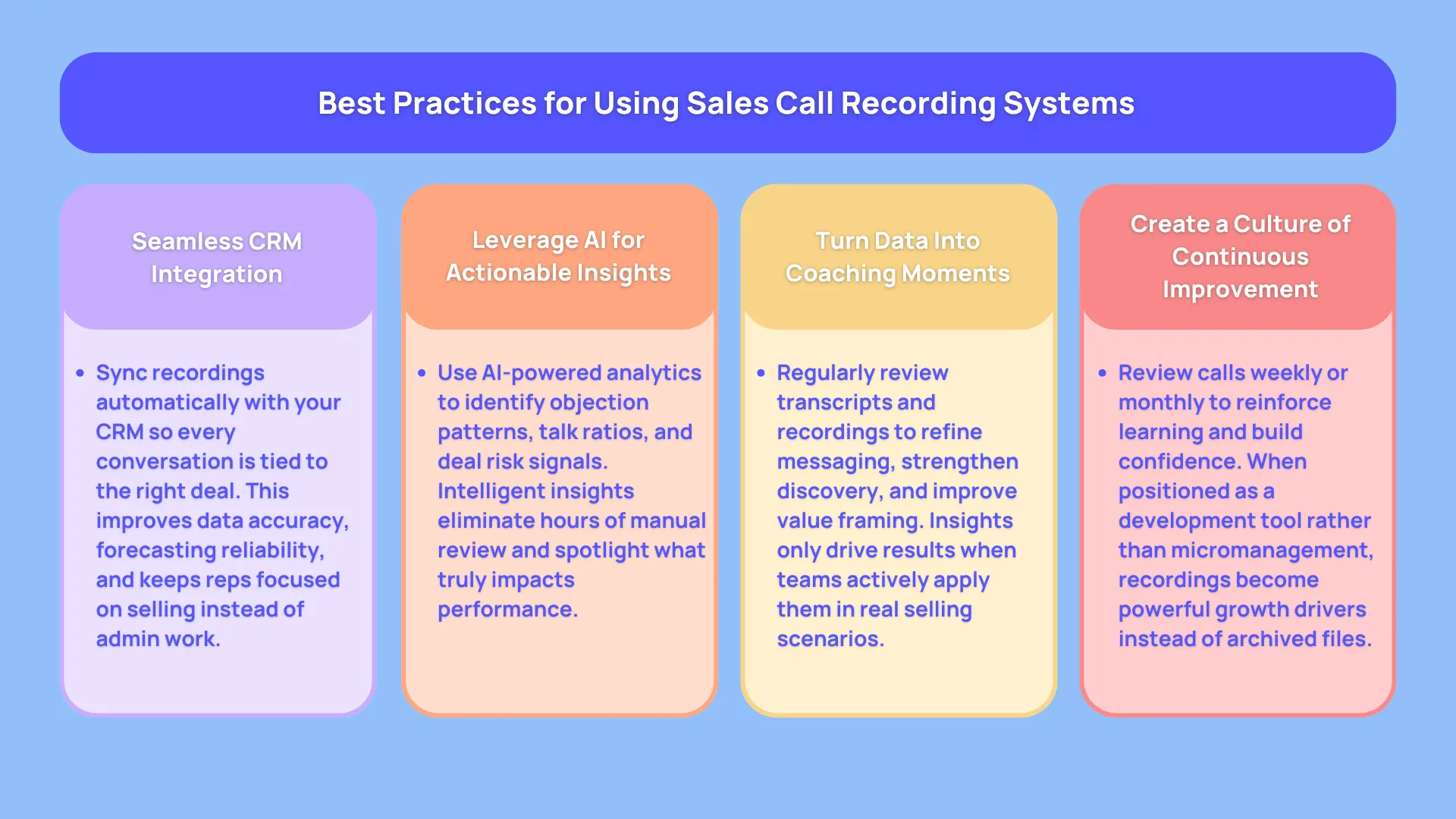
Your sales call recording system should sync automatically with your CRM. This eliminates manual logging and ensures every conversation is tied to the correct opportunity.
Reps stay focused. Managers get clean data. Forecasting improves.
Embrace AI Driven Insights
Modern tools go far beyond storage. AI powered conversation intelligence can flag objection trends, talk ratios, and deal risk signals.
These insights save hours of manual review and highlight what truly matters.
Learn to Apply Insights
Data alone does not improve performance. Teams need regular sessions to interpret findings and connect them to real selling situations.
If transcripts show frequent pricing pushback, examine how value is framed. If discovery questions are shallow, refine questioning frameworks.
Establish Clear Call Recording Compliance
Consent must be consistent and transparent. Build scripts into your process and ensure reps understand local regulations.
Compliance protects relationships and brand reputation.
Use Recordings to Build Confidence
Initial resistance is normal. Address it openly. Emphasize development, not micromanagement.
Highlight improvements publicly. Celebrate growth moments found in recordings.
Review Calls Regularly
Quarterly reviews are helpful. Monthly is better. Weekly is ideal for fast moving teams.
Regular review builds a culture of continuous improvement. Without consistency, recordings become forgotten archives.
Choosing the Right Call Recording and Transcription Platform
When evaluating tools, focus on functionality that supports long term growth.
Look for:
- Strong CRM integration
- Reliable automatic call recording
- High accuracy call transcription service
- Secure storage and encryption
- Advanced call analytics
- Keyword search capabilities
- Tagging and note features
- Scalable data management
The right platform should feel seamless. It should reduce administrative burden, not add to it.
Sales conversations are too valuable to disappear after they end.
With strong call recording and transcription systems, combined with intelligent analytics and structured coaching, sales teams gain clarity, confidence, and consistency.
When conversations become measurable, improvement becomes inevitable.
.jpeg)

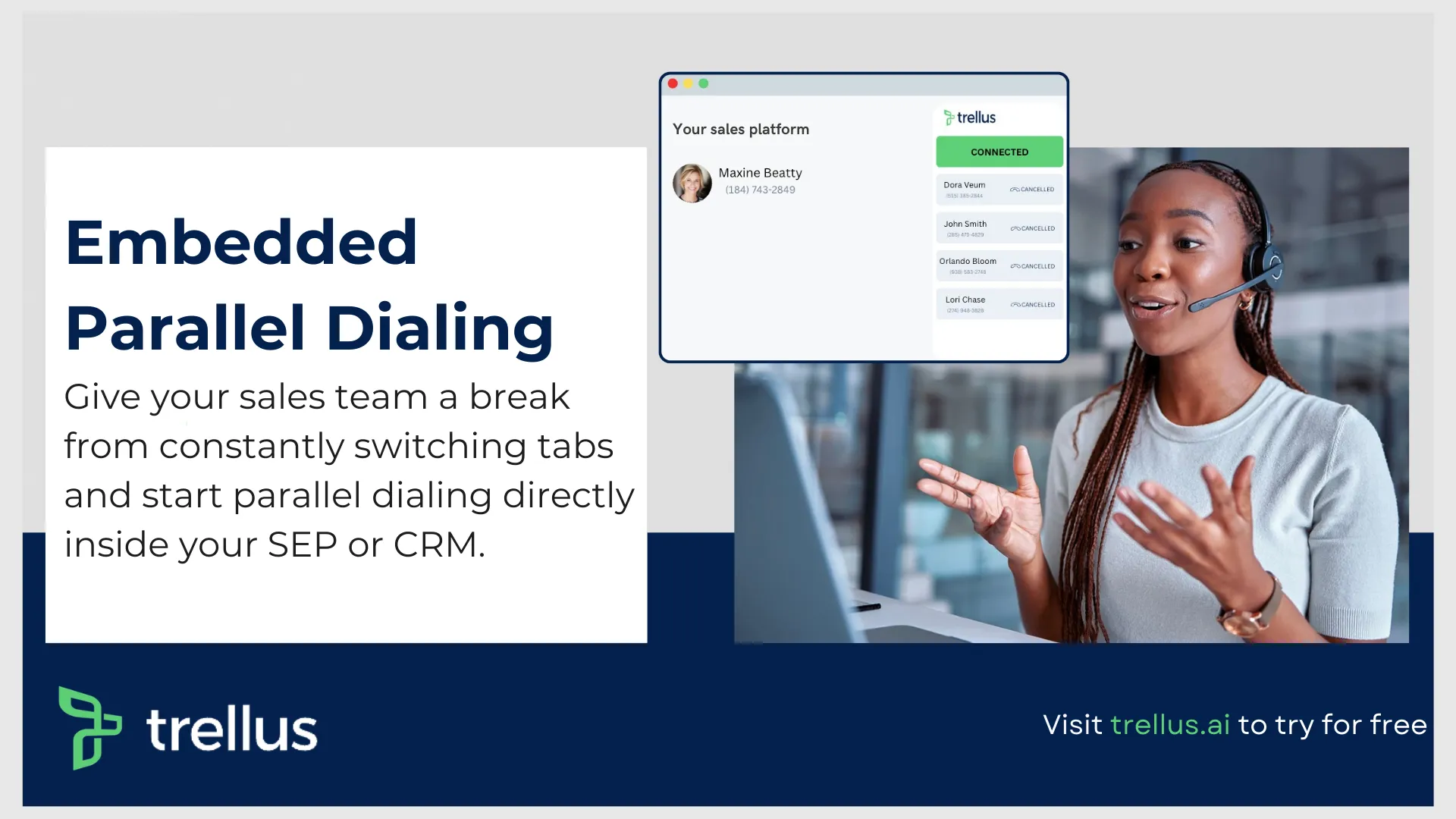
Power and parallel dialing in your CRM.