Our Top Picks


There is a moment every salesperson knows too well.
You start with a very good sense of momentum and pacing. The calls were flowing, or it could be possible that out of all your cold sales call, one of them seemed to be nearing conversion, since the buyer seemed convinced and the overall situation was optimistic.
And then silence, there’s static silence from the buyer’s end.
No reply. No objection handling techniques rendered from your end.
In fact, there wasn’t any clear “No” from the prospect’s end.
Nothing, nada, zilch!
Several weeks or months go by, and all of a sudden, this big ticket prospect resurfaces. At this point, your intestines are quivering with excitement. But after some casual banter and negotiation, the buyer mentions getting back to you “soon.”
In reality, it’s silence all over again.
At this point, you can be very much sure that the deal isn’t closing. For some reason, the buyer’s gone. Or maybe they need a bit of a reminder to get back up on the saddle and help you bring that deal home.
That’s where this detailed guide on how to re-engage a buyer like a pro.
Let’s see what we’ve got in store for you. Read on…
Why Buyers Sometimes Disappear & Come Back Later

During a course of a deal, sometimes silenceis a naturally occurring phenomenon.
It feels personal, but it rarely is.
Most buyers are not avoiding you. The reality could be that they are managing uncertainty, internal pressure, or competing priorities. When they come back, something has shifted, either internally or externally.
Understanding these patterns makes Objection Resolution far easier later in the conversation.
Here are a couple of reasons behind that “silence”:
- They Were Busy Comparing Alternatives
Many buyers pause communication while evaluating competitors.
Silence creates optionality. It allows them to gather leverage without signaling commitment. When they return, they are often looking to validate or invalidate their shortlist.
This type of buyer comes back with sharper questions, more constraints, and less patience for surface level answers. Their return is a signal, but not yet a buying signal.
- Internal friction slowed momentum
Deals often stall due to budget approvals, leadership alignment, legal review, or shifting priorities. The buyer disappears because they lack clarity, not interest.
When they resurface, timing matters more than persuasion. If you fail to reframe urgency, the deal risks falling back into limbo.
- Silence as negotiation leverage
Some buyers intentionally go quiet to test price flexibility or urgency. They want to see if you follow up with discounts or concessions.
When they return with vague language or pricing curiosity, they are not reopening the deal. They are testing your confidence.
This is where sales negotiation tactics matter more than charm.
Each of these scenarios requires a different response. Treating them the same leads to misreads, misalignment, and stalled closings.
- They’re just fishing…
Sometimes, any type of silence in a deal is attributed to a client wasting time. They weren’t really serious to begin with, and just wanted to get an update on the latest pricing packages available for whatever services in the market.
As an SDR, you will learn to detect this type of behaviour very soon. So, yes, there are prospects who are never going to convert. That’s not because of a lack of effort on your part; it’s kind of like a sense of genuine disinterest on a lead’s side.
Move on, and look for other opportunities because there are plenty of prospects out there.
- How to close a deal with a client who suddenly reappears
When a buyer returns, your instinct may be to pick up where you left off. That is a mistake. Silence resets the conversation, so your approach must reset as well.
Reengagement is a qualification moment, not a continuation.
- Slow the conversation down before speeding it up
Momentum feels good, but false momentum is dangerous. A returning buyer has not earned fast movement yet.
Instead of pushing forward, pause long enough to regain context. Ask neutral, open questions that uncover intent without pressure.
This allows you to assess if this is curiosity or commitment.
- Reestablish mutual expectations
A sales deal moves forward when both sides understand what progress looks like. After silence, expectations are often misaligned.
You need clarity on timing, decision criteria, and urgency before attempting assumptive closing or alternative close tactics.
Without that clarity, even strong trial close methods fall flat.
- Protect your positioning
Silence does not reduce value. It does not justify immediate concessions. The way you respond communicates confidence more than any pricing stance.
If you sound grateful they came back, you give away leverage. If you sound grounded and selective, you regain it.
This balance is central to closing the deal sales professionals want, not the ones they settle for.
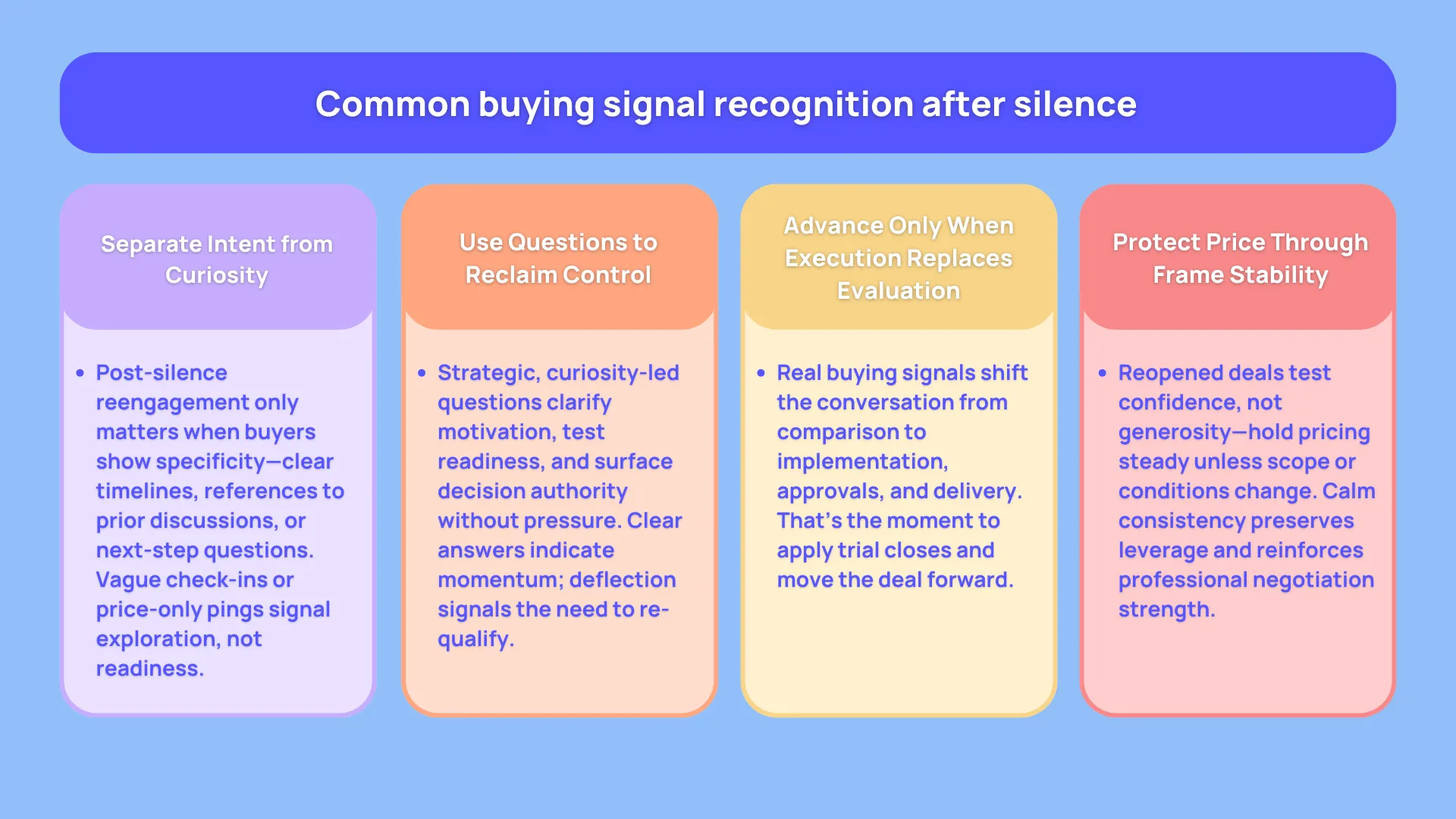
Common buying signal recognition after silence
Not all kinds of reengagement strategies are equal.
Some signals indicate readiness. Others signal fishing. From that point of view, we’d say that knowing the difference protects your time and improves close rates.
Here are two main indicators that’ll help you to close a deal and move along with other activities at the same time.
- Strong buying signals to watch for
A serious buyer reveals intent through specificity. They reference past conversations, confirm timelines, and ask about next steps.
They may ask about implementation timing, availability, or final approvals. These are green lights for sales closing techniques and trial close methods.
When a buyer anchors the conversation in execution rather than evaluation, momentum is real.
- Weak signals that stall deals
We already mentioend earlier that there are times from a buyer’s end where you’ll experience vague check ins, long response gaps, or price only questions.
That’s all there is to it. There is no commitment that indicates if there’s some kind of genuine intent behind the deal.
These buyers are reopening the door without stepping through it.
In these cases, your role as an SDR, BDR or an account executive is not persuasion; it is more of a qualification situation. Sales closing questions matter more than features.
Trying to force a final sales pitch here often leads to another disappearance.
- Common sales closing questions that reset control
Questions are your strongest asset during reengagement. The right ones surface intent while keeping the conversation natural.
Avoid sounding interrogative or defensive. Curiosity beats confrontation every time, and you should be mindful of it. Here are a bunch of examples and questions that highlight the tupe of situation that you need to avoid getting into, or go for.
- Questions that clarify motivation
Asking what triggered their return provides insight without pressure. It reveals if urgency is external or self created.
Motivation determines strategy. A buyer returning due to deadlines requires speed. A buyer returning due to curiosity requires structure.
- Questions that test readiness
Asking about timing, approvals, or next steps gently tests commitment. These questions function as trial close methods without forcing decisions.
If they answer clearly, momentum exists. If they deflect, qualification is incomplete.
- Questions that invite commitment
Once intent is clear, asking forward leaning questions positions you naturally for assumptive closing.
The goal is not to trap the buyer. It is to help them self identify readiness. That being said, let’s move on to some of the common pricing strategies to help you re-engage a client, or a prospect that hasn’t resurfaced in a while now.
- Pricing strategy when a sales deal reopens
Pricing is where reopened conversations often collapse. The buyer returns, asks a casual question about cost, and the salesperson panics. Discounts appear too early. Confidence fades. Leverage disappears.
Knowing how to close a deal at this stage requires restraint, not generosity.
A returning buyer is testing position, not asking for help.
- Hold the original frame unless facts have changed
Price should only move when conditions move. If nothing has changed in scope, timeline, or requirements, your original number still stands.
Reaffirming price calmly communicates stability. It tells the buyer that silence did not weaken your position.
This is a core element of professional Negotiation Skills.
- Adjust price only with value trade offs
If a buyer pushes for better terms, do not lead with discounts. Lead with structure.
Faster timelines, fewer contingencies, or simplified onboarding create room for movement without devaluing the deal.
This approach supports Deal Closure Techniques that protect margin while increasing certainty.
- Avoid rewarding silence
Lowering price simply because a buyer disappeared teaches them how to negotiate with you in the future.
Strong closers reward commitment, not absence.
- How to close deals using urgency without pressure
Urgency closes deals. Pressure kills them. The difference lies in framing. When a buyer returns, urgency must feel natural, not manufactured.
Reference real movement
Mention internal reviews, capacity planning, or parallel interest without exaggeration. This signals momentum without desperation.
The goal is not fear. It is context.
Define windows, not ultimatums
Clear timelines help buyers make decisions. Ultimatums create resistance. Phrases that outline review periods or prioritization windows feel professional and collaborative.
This keeps the door open while preventing endless drift.
Connect urgency to their goals
Urgency works best when it aligns with what the buyer already cares about. If timing matters to them, frame next steps around that reality. This strengthens Assumptive Closing without force.
- Closing the deal sales conversations often stall at negotiation
Most stalled negotiations are not about price.
They are about uncertainty. Buyers hesitate when risk feels unclear or internal alignment is missing. Your role is to reduce friction, not overpower objections.
Redirect from price to certainty through some kind of proof
Price is tangible.
Risk is emotional. And if you are in chage of selling pricey services or big ticket items, you’re going to have buyers who will default to price when uncertainty rises.
While it’s true that price is an issue, but pricing concerns from a prospect can be minimized through some kind of use-case, social proof or any evidence that supports the product or service you’re promoting as a sales caller/ SDR.
Especially, if you have someone who can vouch for you to another prospect, then your chaces of scoring a deal are pretty high.We would say that you should try to reframe the conversation around outcomes, speed, and predictability, alongside social proof.
Doing so supports effective Objection Resolution and keeps momentum intact.
Offer options instead of concessions
Choice creates control. Presenting structured alternatives allows buyers to choose forward motion without reopening every variable.
This is where Alternative Close Tactics outperform aggressive persuasion.
Confirm alignment before final terms
Before pushing toward agreement, confirm shared understanding on scope, timing, and success criteria.
This prevents last minute reversals and strengthens trust.
- How to close a deal with a client who wants to renegotiate
Renegotiation is a clear signal of engagement. At times when a prospect circles back to you, rest assured, they have fished the entire market and your rates + deal sounded better than the rest.
So, keep a cool head and treat the entire experience like a conversation, instead of a threat of some kind. Chances are, your prospect will require some kind of discount. As an SDR, you may or may not be in charge of handling discounts. Given that the deal is certainly going to materialize and just needs one last push, connect with your manager and see what they can offer to sweeten the experience for the buyer.
Here are some tips to help you along the way.
- Uncover the real trigger
Ask what changed since the last discussion. Context matters more than counteroffers.
This question reveals if the buyer needs reassurance, flexibility, or validation.
- Protect value while showing flexibility
Flexibility does not mean surrender. It means adapting without eroding your position.
Added services, adjusted timelines, or simplified terms often satisfy concerns without touching core pricing.
- Anchor the close to action
Every renegotiation should end with a clear next step.
Momentum without direction leads back to silence.
- Trial close methods that work after buyer silence
When a buyer reappears, pushing straight to a close often backfires. What works better is testing readiness without forcing commitment. That is where trial close methods shine.
A trial close is not a trick. As a matter of fact, it is more of a temperature check. The question is, why trial closes matter in revived deals?
Here’s a simple answer: silence introduces uncertainty. You no longer know where the buyer stands emotionally or politically inside their organization.
Trial close methods surface hidden objections early, before you invest energy into what would be a bunch of final sales follow-up strategies that never lands. Alongside that, these methods also signal professionalism because buyers feel guided instead of feeling pressurized.
Two common examples of natural trial closes
Trial closes work best when framed as alignment checks rather than decision demands.
Questions that reference next steps, internal approvals, or rollout timing allow buyers to self signal readiness.
- If their answers are clear and confident, you have earned the right to advance.
- If they hesitate, you have discovered friction without confrontation.
Assumptive closing sales tips without sounding pushy
Assumptive closing gets a bad reputation because it is often misused. When done correctly, it feels like leadership, not pressure.
After reengagement, assumptive closing should be earned, not forced.
When assumptive closing is appropriate
Assumptive closing works only after buying signals are clear. Specific questions, timeline alignment, and stakeholder clarity must already exist. Using assumptive language before that point triggers resistance and reopens objections.
How to frame assumptive statements
Assumptions should be based on what the buyer already said, not what you want them to say. Referencing their stated goals or timelines keeps the close grounded in reality. This strengthens Sales Closing Strategies without compromising trust.
How to recover if assumption meets resistance?
Resistance is feedback, not failure. If the buyer hesitates, step back into discovery rather than doubling down.
This sense of flexibility demonstrates strong Negotiation Skills and preserves the relationship.
Over To You
In conclusion, re-engaging with prospects is more of a skill that needs to be honed over time. Don’t rush things and feel under pressure when someone approaches you, or you are looking to approach a client who is more than likely to convert after static silence.
Other than that, all we can say is that there are plenty of fish in the sea. If you lose a client despite your best efforts, don’t fret over it. Move on to the next big opportunity and maintain a positive middle attitude throughout your sales calling journey.
.jpeg)

Power and parallel dialing in your CRM.