Our Top Picks


Conversions and outreach are like two extremes that usually cause an SDR to oscillate between. Somewhere in the middle of this equilibrium lies the efficiency factor that gets compromised as the number of tasks involves multiple steps, complicated workflows, etc.
On top of that, there’s the skills barrier, where we can all agree that some of the SDRs require a bit of handholding from time to time. What might be the perfect solution that doesn’t require a lot of manual intervention at a manager’s end?
Well, you guessed it right.
You can employ a digital solution, like a cold calling platform with a bunch of technical perks that advance the said sales teams through the hoops. Koncert is one such program that’s been on our radar for a long time now.
Platforms like Koncert position themselves as solutions for high volume outbound calling teams that need more live conversations without endlessly increasing headcount. The company focuses heavily on outbound sales dialer tools designed for SDR organizations, BDR teams, inside sales departments, and enterprise prospecting operations.
The promise sounds attractive on paper.
- More conversations.
- Higher connect rates.
- Less idle time.
- More pipeline generation.
But once you move past the marketing claims, an important question appears:
Can the Koncert dialer genuinely improve outbound performance, or does it simply increase activity volume without improving meeting conversion outcomes?
Modern SDR leaders are no longer measuring success purely through dial counts. They care about conversation quality, pipeline efficiency, objection handling, rep coaching, and revenue impact. A sales dialing automation tool can help teams scale outbound activity, but scaling poor conversations does not magically create better pipeline results.
This Koncert dialer review takes a deeper look at how the platform performs from an SDR operations perspective. Rather than simply listing features, the focus here is on practical outbound workflows, sales productivity impact, operational bottlenecks, and how the platform compares to competitors like Orum, Aircall, and Nooks.
You’ll also get answers to questions sales teams are actively searching for, including:
- What is Koncert dialer & how does it work?
- How much does Koncert dialer cost in 2026?
- What features does Koncert dialer offer?
- Does Koncert support CRM integrations?
- Is Koncert better than Aircall or Orum?
- Can Koncert improve sales call efficiency?
- Is Koncert dialer good for SDR teams?
- What is a parallel dialer and how does it help?
- What are the best alternatives to Koncert dialer?
By the end of this detailed review, you should have a much clearer picture of where the platform fits into a modern outbound stack and what type of sales organization gets the most value from it.
What Is Koncert and Why Are SDR Teams Using It?

Koncert, previously known as ConnectLeader, is a cloud sales dialer solution focused primarily on outbound prospecting teams. The platform combines multi line dialer software, workflow automation, CRM syncing, call analytics, and outbound engagement tools into a centralized sales engagement system.
At its core, the platform is designed to solve one major SDR problem:
Reps spend too much time not talking to prospects.
That sounds simple, but it becomes a massive operational bottleneck when outbound teams scale. A five person SDR team losing an hour per day to manual dialing inefficiencies is frustrating. A fifty person outbound team losing the same amount of time becomes an expensive pipeline problem.
The platform attempts to solve that challenge through AI assisted dialing workflows that reduce idle time between conversations.
The Rise of AI Parallel Dialers
Traditional cold calling workflows are slow.
An SDR manually dials a prospect, waits for the ring, gets voicemail, hangs up, logs notes, moves to the next contact, and repeats the process hundreds of times. Even highly motivated reps lose momentum during repetitive outbound sessions.
AI parallel dialer software changed that workflow completely.
Rather than calling one number at a time, systems like the Koncert sales dialer can place multiple outbound calls simultaneously and connect reps only when a live person answers. This dramatically reduces dead time during prospecting blocks.
The outcome is pretty much straightforward: More live conversations per hour.
For SDR leaders managing aggressive pipeline goals, that efficiency gain can significantly impact outbound productivity metrics.
Compared to traditional cloud calling systems like Aircall, Koncert focuses much more aggressively on high volume outbound calling workflows. Aircall leans more heavily toward general business telephony and support environments, while Koncert positions itself around outbound revenue teams.
How Koncert Helps SDRs Book More Meetings
The platform’s biggest value proposition is speed.
Most SDRs are not limited by willingness to prospect. They are limited by the number of meaningful conversations they can physically reach during the day.
Here is a realistic outbound workflow example:
An SDR starts a two hour outbound block targeting VP level prospects in SaaS companies. Without automation, they may only complete 60 to 80 dials during that session. Most calls go unanswered, forcing constant manual repetition.
With a high volume outbound calling tool like Koncert, the workflow changes dramatically.
The system automates dialing sequences, prioritizes live answers, logs activity into CRM systems, and reduces the downtime between conversations. That allows the SDR to focus more attention on live interactions rather than repetitive operational tasks.
The result is usually:
- Higher conversation volume
- Faster list penetration
- Improved rep productivity
- Increased opportunity creation potential
- Better outbound scalability for growing teams
That does not automatically guarantee more booked meetings, though.
Conversation volume helps create opportunities, but SDR execution still determines conversion outcomes. This becomes important later when discussing the biggest weakness of parallel dialers.
Who Koncert Is Built For
The platform is clearly designed for outbound focused sales organizations rather than small businesses looking for a lightweight phone system.
The strongest fit usually includes:
SDR and BDR Teams
Teams running structured outbound prospecting motions often gain the most value from AI dialing automation. This is particularly true for organizations running daily cold call blocks.
Mid Market and Enterprise Sales Teams
Larger outbound operations often struggle with consistency, rep productivity tracking, and scaling prospecting activity efficiently. Koncert’s workflow automation and analytics features support those operational needs better than simpler calling systems.
Remote Sales Organizations
The platform includes remote salesfloor management functionality, coaching visibility, and collaborative workflows that became increasingly important after distributed SDR teams became common.
High Volume Prospecting Environments
Organizations prioritizing outbound velocity over low volume relationship selling tend to align more naturally with the platform’s strengths.
That said, smaller teams with limited outbound volume may not fully benefit from enterprise level parallel dialing capabilities. Some startups may find simpler tools sufficient until outbound operations mature further.
How Koncert Works
Understanding how the Koncert dialer works requires looking beyond surface level feature descriptions. The real value comes from how the platform changes outbound sales workflows during live prospecting sessions.
Most SDR inefficiencies happen between conversations, not during them.
When reps manually dial prospects one at a time, productivity slows down because of unanswered calls, voicemail repetition, CRM admin work, and context switching between tools. Sales managers often assume reps are actively selling during outbound blocks, but a large percentage of time disappears into operational friction.
Koncert attempts to reduce that friction through automation driven dialing workflows.
Parallel Dialing Explained
One of the most searched questions around the platform is:
“What is a parallel dialer and how does it help?”
A parallel dialer places multiple outbound calls at the same time and routes the SDR only to live answers. If nobody picks up, the system automatically moves on without requiring manual rep action.
This solves a major outbound sales problem.
Problem:
SDRs lose momentum waiting through unanswered calls and voicemails.
Feature:
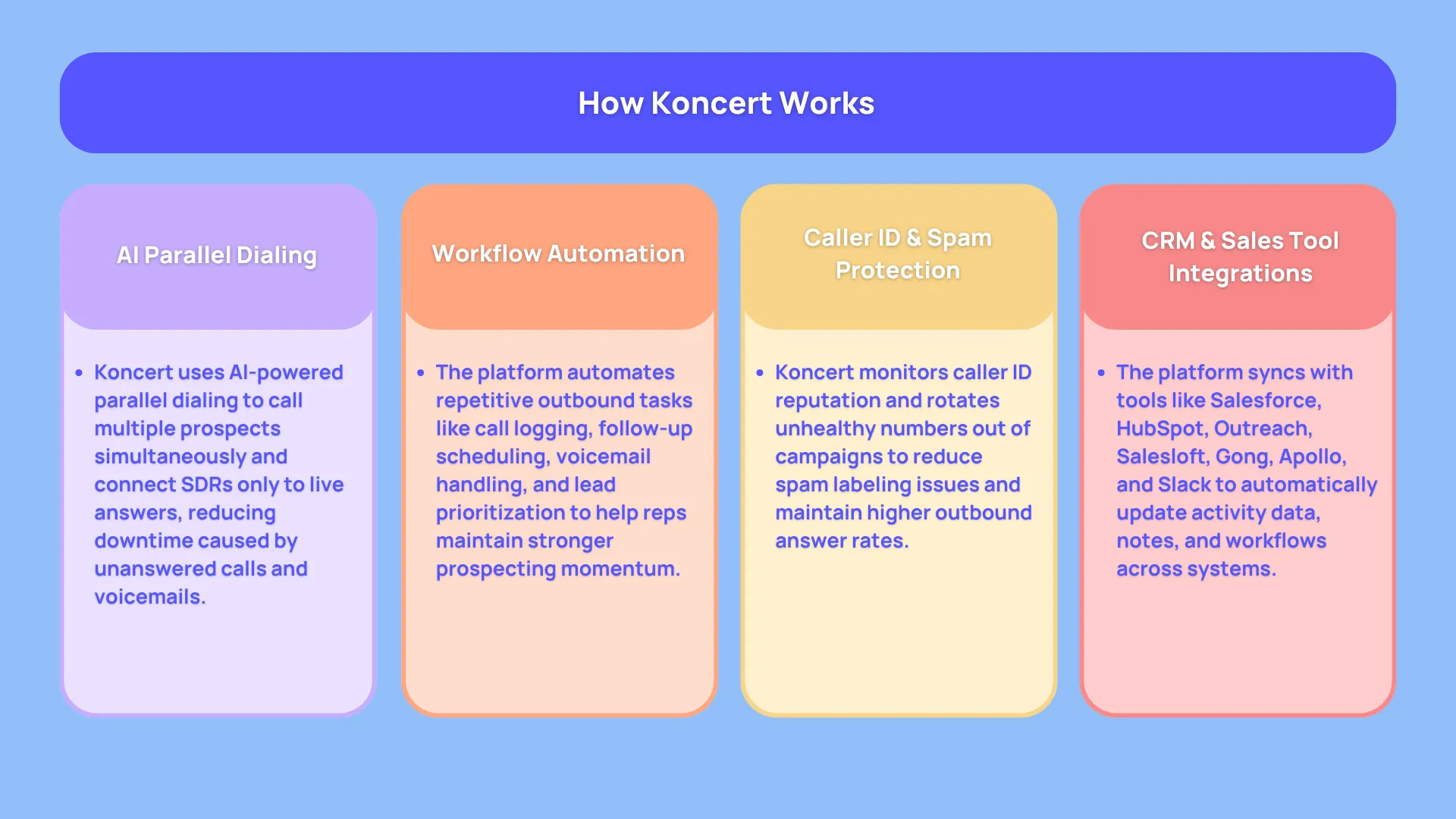
Koncert’s AI parallel dialer software calls multiple prospects simultaneously and automatically filters out unanswered calls.
Outcome:
Reps spend more time in live conversations and less time cycling through dead numbers.
This becomes especially valuable during high intensity outbound sessions where SDRs are expected to maximize conversation volume within limited prospecting windows.
For example, imagine a 20 rep SDR team running a morning cold call blitz. Without automation, reps may spend half the session waiting through unanswered rings. With multi line dialer software, the system compresses those wait times dramatically.
That operational difference compounds quickly across larger teams.
Compared to Orum, which also focuses heavily on AI parallel dialing, Koncert leans more toward enterprise outbound scalability and workflow management flexibility.
AI Dialing Logic
The platform’s AI Flow Dialer and AI Parallel Dialer use automation logic to optimize outbound call sequencing.
The goal is not simply increasing dial count.
The system attempts to improve connect opportunities through:
- Automated call sequencing
- Local presence dialing
- Caller ID reputation management
- Smart routing
- CRM synchronized prospect prioritization
Caller ID reputation management is particularly important for outbound teams in 2026.
Spam labeling has become a major issue across outbound sales operations. SDRs can make hundreds of calls daily, but if numbers become flagged as spam, connect rates collapse quickly.
Koncert attempts to address this with automated caller ID monitoring and heat mapping systems that identify unhealthy numbers before performance drops significantly.
Problem:
Outbound teams experience declining answer rates due to spam labeled numbers.
Feature:
The platform monitors caller ID health and rotates problematic numbers out of active workflows.
Outcome:
Higher answer rate consistency and improved outbound connection efficiency.
For enterprise SDR leaders managing large scale outbound operations, this can meaningfully impact pipeline generation performance over time.
Workflow Automation
Another core part of the Koncert platform overview is workflow automation.
Modern outbound teams rely on dozens of repetitive micro tasks every day:
- Logging calls
- Updating CRM records
- Scheduling follow ups
- Leaving voicemails
- Prioritizing inbound leads
- Managing prospect queues
Those small tasks create hidden productivity loss across entire SDR organizations.
The platform automates much of that administrative overhead through cadence management and workflow syncing.
For example, inbound lead prioritization allows reps to immediately surface newly engaged prospects rather than manually filtering lists throughout the day.
Problem:
SDRs waste time switching between tools and manually managing follow up workflows.
Feature:
Automated sales dialing workflows and synchronized engagement tracking reduce repetitive admin work.
Outcome:
Reps maintain stronger outbound momentum and managers gain cleaner operational visibility.
CRM Syncing
Does Koncert support CRM integrations?
Yes, and CRM synchronization is one of the more important parts of the platform.
The system supports Koncert CRM integrations with platforms like:
- Salesforce
- HubSpot
- Outreach
- Salesloft
- Gong
- Apollo
- Slack
CRM syncing matters because fragmented workflows create major operational inefficiencies for SDR teams.
When reps constantly jump between dialers, CRMs, sequencing tools, and analytics dashboards, productivity drops and reporting quality suffers.
Problem:
Sales reps lose time updating CRM records manually after outbound sessions.
Feature:
Koncert dialer integrations automatically sync activity data, notes, call outcomes, and workflows.
Outcome:
Cleaner pipeline tracking, better reporting accuracy, and reduced administrative workload for reps.
This is one area where the platform performs relatively well compared to many standalone outbound sales dialer tools.
Koncert Features That Are Potentially Useful for Sales First Platforms
Most sales dialers look impressive during demos.
The main question is what happens after SDR teams start running daily outbound sessions inside the platform. That is where differences between sales dialing automation tools become very obvious.
Some tools increase activity volume but create operational chaos later. Others improve reporting but slow down reps during live prospecting. The strongest outbound systems improve conversation efficiency without creating additional friction for managers or SDRs.
The Koncert dialer sits somewhere in the middle of that spectrum.
Its strongest capabilities revolve around outbound velocity and workflow automation. The platform performs best when teams need to increase conversation opportunities across large prospect lists without expanding SDR headcount too aggressively.
Still, every feature has tradeoffs.
A detailed Koncert power dialer review requires looking at each feature through a practical outbound sales lens rather than treating every capability as universally valuable.
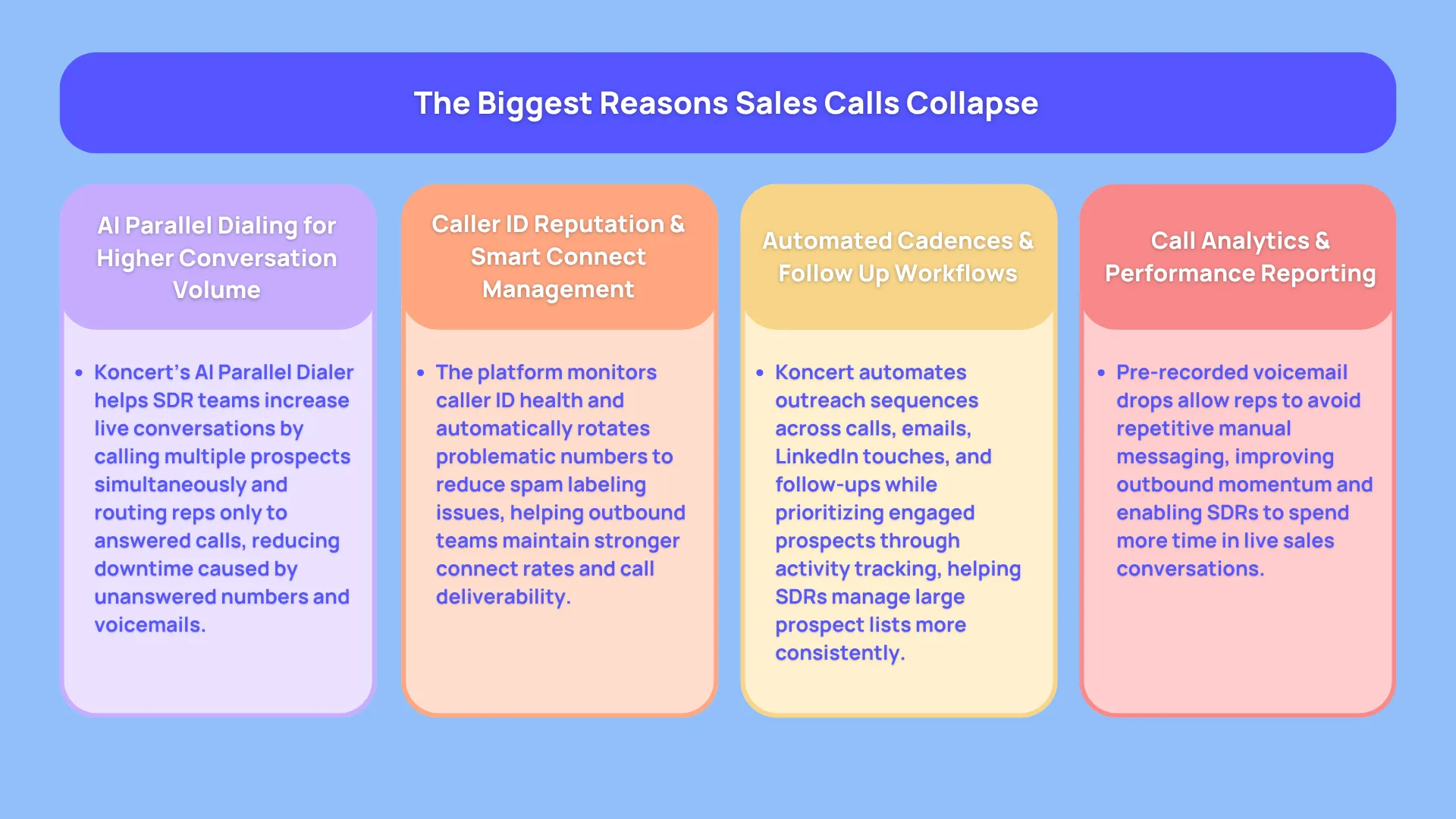
AI Parallel Dialing
The AI Parallel Dialer is the platform’s flagship capability and one of the main reasons SDR organizations evaluate the software.
The feature allows reps to call multiple prospects simultaneously while routing only live answers directly to the SDR.
Why This Matters for SDR Teams
The average outbound rep spends an enormous amount of time waiting.
- Waiting through unanswered calls.
- Waiting through voicemail.
- Waiting between tabs.
- Waiting for CRM updates to load.
That idle time destroys outbound momentum.
A multi line dialer software workflow reduces those dead spaces dramatically.
Problem:
SDRs struggle to generate enough live conversations because traditional dialing workflows waste time between calls.
Feature:
The Koncert AI parallel dialer calls several numbers simultaneously and connects reps only when a prospect answers.
Outcome:
Higher conversation volume, reduced downtime, and more efficient outbound call blocks.
For high volume outbound calling tools, this efficiency increase becomes substantial over time.
A rep who normally reaches six live conversations per hour may suddenly reach twelve or fifteen conversations during the same outbound session. Across an entire SDR organization, that increase can materially impact pipeline generation.
Where the Feature Works Best
The strongest use cases typically include:
- Enterprise outbound SDR teams
- Large B2B prospecting operations
- Cold calling heavy workflows
- Teams running structured call blitzes
- Remote outbound organizations
Managers scaling outbound teams from 10 reps to 50 plus reps often prioritize this type of efficiency because operational bottlenecks multiply rapidly at scale.
Potential Limitations
Higher conversation volume creates a different challenge:
Rep performance quality.
Many SDR teams assume more conversations automatically produce more meetings. That is not always true.
Some reps struggle once they are suddenly handling significantly more live objections and gatekeeper interactions throughout the day. Increased connect rates expose weaknesses in talk tracks, objection handling, discovery skills, and confidence under pressure.
This is one reason why AI coaching platforms like Trellus.ai are becoming more relevant alongside outbound dialers.
Parallel dialers optimize conversation quantity.
Conversation intelligence platforms optimize live execution quality.
Smart Connect Technology
Smart Connect functionality focuses on reducing call friction and improving answer rates.
One of the biggest problems in outbound prospecting today is spam labeling. Prospects ignore calls when numbers appear suspicious or repeatedly flagged.
This issue has become severe enough that many outbound teams see connect rates collapse even when reps are executing strong prospecting strategies.
How the Feature Helps
Problem:
Outbound phone numbers become flagged as spam, reducing answer rates and damaging SDR productivity.
Feature:
Koncert monitors caller ID health and rotates unhealthy numbers through automated management systems.
Outcome:
More stable connect rates and improved outbound call deliverability.
A dialer can place thousands of calls daily, but if nobody answers because numbers are flagged, the productivity gains disappear quickly.
Compared to some competitors, the platform places stronger emphasis on caller reputation management infrastructure. That becomes increasingly valuable for enterprise outbound operations running aggressive prospecting motions.
Operational Impact
This feature is especially useful for:
- Teams conducting large outbound call campaigns
- SDR teams targeting mobile numbers
- Organizations running multiple outbound regions
- Reps experiencing declining connect rates over time
Maintaining healthy caller ID reputation is now part of outbound operations management, not just a technical concern.
Automated Follow Ups and Cadence Workflows
Outbound prospecting rarely succeeds through one call alone.
Most SDR teams rely on multi touch sequences involving:
- Calls
- Emails
- LinkedIn touches
- Follow up reminders
- Voicemail drops
Managing those workflows manually becomes difficult once teams scale.
The cadence system inside the Koncert platform overview attempts to centralize those engagement activities.
Why Cadence Automation Matters?
Problem:
SDRs struggle to maintain consistent follow up across large prospect lists.
Feature:
Automated cadence workflows prioritize leads, trigger follow up actions, and organize outreach sequences.
Outcome:
More consistent prospect engagement and fewer missed opportunities.
The system also tracks prospect engagement behavior, including:
- Email opens
- Link clicks
- Replies
- Activity scoring
This helps SDRs prioritize warmer leads rather than treating every prospect identically.
Real SDR Workflow Example
Imagine an SDR handling 1,500 outbound accounts.
Without automation, follow up quality becomes inconsistent very quickly. Some leads receive too many touches, others get forgotten entirely, and inbound signals often go unnoticed.
With workflow automation:
- New inbound leads move higher in priority queues
- Engaged prospects surface automatically
- Follow up timing stays more consistent
- Managers gain better visibility into rep execution
This becomes increasingly important for distributed outbound teams where managers cannot physically monitor activity throughout the day.
Voicemail Automation
Leaving repetitive voicemails is one of the least productive parts of outbound sales workflows.
Yet SDRs still spend large portions of prospecting sessions repeating nearly identical messages dozens of times daily.
The Operational Problem
Problem:
Manual voicemail repetition slows down outbound productivity and drains rep energy during cold call sessions.
Feature:
Voicemail automation allows pre recorded messages to be delivered automatically during outbound sequences.
Outcome:
SDRs maintain faster dialing momentum and spend more time in live conversations.
This feature is not unique to Koncert, but it remains important for teams prioritizing outbound efficiency.
Where It Helps Most
Voicemail automation becomes valuable during:
- High volume outbound sessions
- Large territory prospecting
- Enterprise SDR operations
- Teams balancing calls with email outreach
That said, managers should avoid over automating prospect engagement. Excessive automation can make outreach feel generic, especially in higher value enterprise sales motions.
The strongest outbound teams balance speed with personalization.
Call Analytics and Reporting
Analytics are another major area where SDR leaders evaluate outbound sales dialer tools.
Raw dial counts alone are no longer enough.
Modern outbound managers want visibility into:
- Connect rates
- Rep activity trends
- Conversation outcomes
- Pipeline influence
- Coaching opportunities
- Team productivity benchmarks
Koncert provides reporting functionality across several operational categories.
Why Analytics Are a Big Deal?
Problem:
Managers struggle to identify why some reps outperform others during outbound campaigns.
Feature:
The platform tracks call activity, conversation data, and outbound engagement metrics.
Outcome:
Sales leaders gain visibility into productivity gaps and coaching opportunities.
This becomes especially useful for remote SDR teams where live oversight is limited.
The Coaching Gap
This is also where many parallel dialers begin showing limitations.
Analytics explain what happened.
They do not always explain why it happened.
A manager may see:
- High dial volume
- Good connect rates
- Weak meeting conversion
But standard analytics often fail to uncover the actual live conversation problems causing poor performance.
For example:
- Weak objection handling
- Poor tone control
- Bad discovery sequencing
- Inconsistent qualification
- Missed buying signals
On a related note, many platforms like Trellus.ai focus heavily on real time call execution support rather than simply increasing outbound activity volume.
Sales Team Productivity Features
The platform also includes broader sales productivity capabilities designed for team management and remote collaboration.
These include:
- Remote Salesfloor
- Live call monitoring
- Whisper coaching
- Team reporting
- Coaching notes
- Call libraries
- Call blitz rooms
Why Remote Visibility Is Important?
Problem:
Remote SDR managers struggle to monitor rep performance and maintain outbound energy across distributed teams.
Feature:
Collaborative salesfloor and coaching functionality creates shared outbound environments for managers and reps.
Outcome:
Better coaching visibility and improved team coordination during prospecting sessions.
This became particularly important after remote outbound sales teams became common across SaaS organizations.
Practical SDR Management Benefits
For SDR leaders, these features help with:
- Monitoring rep consistency
- Running live coaching sessions
- Improving onboarding speed
- Identifying top performing talk tracks
- Maintaining outbound accountability
Compared to simpler cloud phone systems like Aircall, Koncert places much heavier emphasis on outbound sales management workflows rather than general business communication.
Still, coaching visibility alone does not fully solve live call execution problems. Managers can monitor calls, but scaling real time coaching across dozens of SDRs remains difficult.
That challenge becomes increasingly important as outbound teams prioritize quality conversations over pure activity metrics.
Koncert Pricing Review
Pricing is one of the most frustrating parts of evaluating outbound sales platforms in 2026.
Many vendors avoid publishing clear pricing because outbound software costs vary heavily depending on:
- Team size
- Dialing volume
- CRM requirements
- Coaching features
- Caller ID infrastructure
- International calling needs
- Admin controls
The Koncert dialer follows a similar approach.
The company publicly lists plan structures and included features, but exact pricing usually requires speaking with sales.
For SDR leaders trying to compare outbound sales dialer tools quickly, that creates friction during the evaluation process.
Still, understanding the plan structure helps clarify which type of teams the platform is designed for.
How Much Does Koncert Dialer Cost in 2026?
One of the most searched questions around the platform is:
“How much does Koncert dialer cost in 2026?”
At the time of writing, the company does not openly display flat pricing tiers on its website. Prospective customers typically need to request a quote based on their outbound team requirements.
The platform currently structures its dialer offerings around four main packages:
Plan
Dialer Type
Primary Focus
Melody
AI Flow Dialer
Single line outbound dialing
Symphony
AI Parallel Dialer
Multi line outbound dialing
Melody+
Enhanced AI Flow Dialer
Expanded automation and management
Symphony+
Enhanced AI Parallel Dialer
Enterprise scale outbound workflows
Smaller outbound teams may only need single line power dialing with CRM syncing and basic workflow automation.
Larger SDR organizations often require:
- Multi line dialing
- Advanced caller ID management
- Team coaching workflows
- Analytics
- Workflow automation
- Rep management infrastructure
- Remote salesfloor functionality
That is where higher tier plans become more relevant.
Understanding the Real Cost of Parallel Dialers
Many outbound teams evaluate dialers purely on subscription cost.
That approach misses the bigger picture.
The real question is not simply:
“How much does the platform cost?”
The better question is:
“How much outbound productivity does the platform create?”
For SDR leaders, ROI usually comes down to three core metrics:
- Connect rate improvement
- Live conversation volume
- Meeting generation efficiency
If a platform helps reps generate significantly more qualified conversations daily, higher software costs may still produce strong outbound economics.
Example SDR Productivity Scenario
Imagine two outbound teams with identical headcounts.
Team A uses manual dialing workflows.
Team B uses AI parallel dialer software.
If Team B reaches twice as many live conversations daily while maintaining strong conversion quality, pipeline creation may scale dramatically without hiring additional reps.
That is the primary economic argument behind high volume outbound calling tools.
The challenge is that increased activity volume alone does not guarantee improved revenue performance.
If SDRs struggle during live conversations, the productivity gains become less meaningful.
That is one reason many outbound organizations are pairing dialers with conversational intelligence platforms like Trellus.ai.
Dialers improve activity efficiency.
AI coaching platforms improve conversion execution.
The combination often produces stronger outbound outcomes than either category independently.
Is It Expensive Compared to Competitors?
Compared to traditional cloud calling systems like Aircall, Koncert usually positions itself higher toward outbound focused sales organizations.
Aircall generally serves broader business telephony needs, while Koncert emphasizes SDR productivity and outbound workflow scaling.
Compared to Orum, pricing structures tend to feel relatively similar in terms of enterprise outbound positioning, though exact costs vary based on team requirements and contract structures.
Nooks also competes in a similar category, particularly around remote outbound collaboration and virtual salesfloor management.
Where Pricing Feels Justified
The platform tends to make the most sense financially for:
- Mid market SDR organizations
- Enterprise outbound teams
- High activity sales environments
- Teams running structured cold calling programs
- Companies heavily dependent on outbound pipeline generation
These organizations usually gain enough operational efficiency to justify higher software spend.
Where Pricing May Feel Excessive
Smaller teams sometimes struggle to justify enterprise dialer costs.
For example:
- Founder led outbound
- Small startup sales teams
- Low call volume account executives
- Relationship driven enterprise sellers
These teams may not fully utilize advanced multi line dialing infrastructure.
In those environments, simpler outbound systems may provide enough functionality without the added operational complexity.
What Type of Teams Get the Most ROI?
The strongest ROI typically appears when outbound operations reach a scale where manual inefficiencies become expensive.
Enterprise SDR Organizations
Large outbound teams often lose massive productivity through:
- Idle dialing time
- Manual CRM updates
- Poor list management
- Inconsistent workflows
- Weak rep visibility
A centralized cloud sales dialer solution helps standardize outbound execution across larger teams.
High Velocity Prospecting Teams
Organizations prioritizing outbound volume often benefit significantly from parallel dialing efficiency.
This is especially true in industries with:
- Large TAMs
- Aggressive outbound quotas
- High SDR activity expectations
- Rapid pipeline growth goals
Remote Outbound Teams
Distributed SDR teams frequently struggle with coaching consistency and rep accountability.
Koncert’s remote salesfloor and collaboration workflows help managers maintain visibility across geographically distributed teams.
Teams Already Strong at Live Conversations
This is an underrated factor.
Parallel dialers amplify existing SDR performance.
Strong reps usually benefit enormously because they convert increased conversation opportunities into meetings efficiently.
Weak reps often struggle because the platform exposes skill gaps faster.
A rep who cannot handle objections effectively may suddenly fail more conversations simply because they are speaking to more prospects per hour.
Koncert CRM Integrations
CRM synchronization is one of the most important parts of modern outbound sales infrastructure.
Without strong integrations, SDR workflows become fragmented very quickly.
Reps end up switching constantly between:
- Dialers
- CRM platforms
- Sequencing tools
- Analytics dashboards
- Conversation recording software
- Coaching platforms
That fragmentation slows down outbound execution and creates reporting inconsistencies across sales organizations.
The Koncert dialer integrations are designed to reduce that operational friction.
Salesforce Integration
Salesforce remains the dominant CRM platform for many mid market and enterprise outbound teams.
For SDR leaders, Salesforce integration matters because pipeline visibility depends heavily on accurate activity tracking.
Operational Problem
Problem:
Manual CRM updates create inconsistent reporting and waste SDR prospecting time.
Feature:
Koncert automatically syncs call activity, notes, dispositions, and engagement workflows into Salesforce.
Outcome:
Cleaner pipeline visibility and reduced admin overhead for outbound reps.
This becomes especially valuable during high volume prospecting sessions where reps cannot afford constant workflow interruptions.
SDR Workflow Example
Imagine an SDR handling 120 outbound calls during a call blitz.
Without CRM synchronization, they would need to manually:
- Log outcomes
- Update statuses
- Record notes
- Manage follow ups
That administrative burden slows prospecting momentum significantly.
Integrated workflows allow reps to remain focused on live conversations rather than repetitive data entry.
HubSpot Integration
HubSpot integration is particularly important for scaling startups and growth stage SaaS companies.
Many modern outbound teams operate heavily inside HubSpot workflows, especially during earlier growth phases before transitioning toward larger enterprise systems.
Why is it important?
Problem:
Outbound reps lose visibility when engagement data lives across disconnected tools.
Feature:
HubSpot syncing centralizes prospect engagement and outbound activity tracking.
Outcome:
Sales and marketing teams maintain better alignment around pipeline activity.
It is particularly useful for organizations balancing:
- Inbound lead routing
- SDR prospecting
- Marketing automation
- Outbound sequencing
The tighter the workflow alignment becomes, the easier it is to maintain consistent lead management processes.
Outreach Integration
Outreach is already heavily embedded in many outbound sales organizations.
For teams already relying on Outreach sequences and workflows, dialer integration becomes critical.
Operational Benefit
Problem:
SDRs waste time switching between sequencing tools and calling platforms.
Feature:
Koncert connects dialing activity directly into Outreach workflows.
Outcome:
More streamlined outbound execution and fewer workflow interruptions.
Even small workflow interruptions compound heavily across larger SDR teams.
Salesloft Integration
Salesloft integration serves a similar purpose for organizations operating inside Salesloft driven outbound workflows.
The goal is operational continuity.
Problem:
Outbound teams struggle when prospect engagement systems and dialing systems operate separately.
Feature:
Integrated workflows synchronize activity between Salesloft and the dialer environment.
Outcome:
More efficient outbound execution and stronger engagement consistency.
This becomes increasingly important for SDR leaders trying to maintain standardized workflows across larger teams.
The Bigger Integration Picture
The broader value of Koncert CRM integrations is not simply convenience.
It is workflow compression.
Modern SDR organizations operate across increasingly complex outbound stacks involving:
- Dialers
- CRMs
- Sequencers
- AI coaching platforms
- Analytics systems
- Data enrichment tools
Every disconnected workflow creates productivity leakage.
The strongest outbound organizations reduce that friction aggressively.
Still, integrations alone do not solve the core challenge many SDR teams face in 2026:
Conversation quality.
A rep can have excellent workflow automation and still fail to convert conversations into meetings consistently.
That is where the conversation around parallel dialers becomes more nuanced.
What Koncert Does Well
A lot of outbound software sounds impressive until SDR teams begin running real prospecting sessions at scale.
That is usually where cracks appear.
Some platforms create workflow friction.
Others inflate activity metrics without improving pipeline outcomes.
Some simply cannot handle the operational complexity of larger outbound organizations.
The Koncert sales dialer performs best when evaluated through one specific lens:
Outbound efficiency at scale.
The platform is clearly optimized for organizations trying to maximize live prospect conversations while reducing the operational drag that slows SDR productivity.
Unlike general communication platforms such as Aircall, the platform focuses heavily on outbound sales execution. The workflows, dialer structure, analytics, and management features all revolve around prospecting velocity.
For the right type of team, that creates meaningful advantages.
Helps SDRs Reach More Prospects
This is the platform’s clearest strength.
Most SDR organizations are not struggling because reps refuse to prospect. They struggle because manual outbound workflows create too much dead time between conversations.
A rep might spend hours “working” a list while only speaking to a small number of live prospects.
The Koncert dialer reduces that inefficiency aggressively.
Problem → Feature → Outcome
Problem:
SDRs lose huge portions of prospecting blocks waiting through unanswered calls and repetitive dialing workflows.
Feature:
AI parallel dialing automates call sequencing and routes live answers directly to reps.
Outcome:
Higher conversation volume and more prospect engagement opportunities during outbound sessions.
More quality conversations usually create more opportunities for:
- Discovery calls
- Qualified meetings
- Follow up sequences
- Pipeline progression
Real SDR Workflow Scenario
Imagine a remote SDR team running a two hour outbound power session.
Without automation:
- Reps manually dial contacts
- CRM updates interrupt momentum
- Voicemails consume time
- Prospecting energy drops
With AI parallel dialer software:
- Calls move continuously
- Live answers are prioritized
- CRM activity syncs automatically
- Reps maintain stronger outbound rhythm
That rhythm matters more than many sales leaders realize.
Cold calling performance is heavily influenced by momentum and consistency. Once reps lose pacing, prospecting quality often drops quickly.
Reduces Idle Time
Idle time is one of the biggest hidden costs inside outbound sales organizations.
Managers usually notice obvious inefficiencies like poor talk tracks or weak conversion rates. What they miss is how much pipeline opportunity disappears during operational downtime.
Even small interruptions compound heavily across larger SDR teams.
Why Idle Time Hurts SDR Performance
Every pause breaks outbound flow.
A rep stops prospecting to:
- Log notes
- Search records
- Dial manually
- Leave voicemails
- Switch tools
Those micro interruptions reduce focus and lower total prospect engagement capacity.
How the Platform Solves It
Problem:
Manual outbound workflows slow prospecting momentum and reduce rep efficiency.
Feature:
Sales dialing automation tools streamline calling, logging, sequencing, and follow up workflows.
Outcome:
SDRs spend more time selling and less time managing repetitive administrative tasks.
This is one reason enterprise outbound teams often adopt specialized outbound dialer infrastructure rather than relying on generic calling systems.
At scale, small efficiency gains create significant pipeline impact.
Scales Outbound Operations Effectively
Scaling outbound sales is difficult.
Many companies can build a successful outbound process with five SDRs. Maintaining consistency across fifty SDRs is a completely different operational challenge.
As teams scale, common problems begin appearing:
- Workflow inconsistency
- Reporting gaps
- Coaching bottlenecks
- Rep accountability issues
- Activity visibility problems
- CRM hygiene breakdowns
The Koncert platform overview shows clear emphasis on solving those scaling problems.
Problem → Feature → Outcome
Problem:
Growing SDR teams struggle to maintain consistent outbound workflows across larger organizations.
Feature:
Centralized dialing infrastructure, analytics, coaching tools, and workflow automation create standardized outbound operations.
Outcome:
Sales leaders gain stronger visibility and more scalable outbound management systems.
This becomes particularly valuable for companies scaling rapidly after strong funding rounds or aggressive growth targets.
Enterprise Outbound Example
Consider a SaaS company growing from 8 SDRs to 40 SDRs within twelve months.
Without centralized outbound infrastructure:
- Reporting becomes inconsistent
- Coaching quality varies wildly
- Rep productivity fluctuates
- Pipeline forecasting weakens
A structured cloud sales dialer solution helps normalize workflows across larger teams.
That does not solve every outbound problem, but it reduces operational chaos significantly.
Good for Enterprise Teams
Enterprise outbound teams tend to value operational structure more than small startups.
They need:
- Compliance visibility
- Workflow consistency
- Multi rep coordination
- Call analytics
- CRM synchronization
- Remote management
- Scalable prospecting systems
The Koncert sales dialer aligns relatively well with those needs.
Compared to smaller outbound tools, the platform feels more oriented toward structured SDR organizations running formalized prospecting operations.
Where Enterprise Teams Benefit Most
The strongest fit often includes:
- Large SDR departments
- Enterprise SaaS sales teams
- Multi region outbound operations
- High activity prospecting organizations
- Remote outbound environments
Features like Remote Salesfloor and team coaching visibility become more valuable once outbound organizations grow beyond a handful of reps.
Comparison Against Competitors
Compared to Orum, the platform places a stronger emphasis on enterprise workflow infrastructure and outbound operational scaling.
Compared to Aircall, the platform is far more specialized in outbound sales productivity.
Compared to Nooks, many teams evaluate differences around coaching visibility, collaboration environments, and outbound workflow management.
Each platform approaches outbound sales efficiency slightly differently.
The important point is this:
Koncert performs strongest as an outbound infrastructure platform.
- Helps teams create more conversations.
- Improves operational efficiency.
- Supports larger outbound workflows.
But this leads directly into the biggest limitation of most parallel dialers.
What’s The Biggest Weakness of Parallel Dialers?
Parallel dialers solve a major outbound problem:
Conversation quantity.
They do not automatically solve conversation quality.
Many organizations assume increasing call volume will naturally increase meetings booked. Sometimes it does. Sometimes it simply creates more failed conversations at higher speed.
This is where many outbound leaders become disappointed after implementing AI parallel dialer software.
More Conversations Do Not Always Mean More Meetings
A rep can suddenly double their live conversations and still struggle to hit quota.
Why?
Because conversation quality becomes the limiting factor.
The Core Problem
Problem:
Higher connect rates expose weaknesses in SDR execution.
Feature:
Parallel dialers dramatically increase live conversation opportunities.
Outcome:
Teams generate more prospect interactions, but poor call execution may still limit meeting conversion.
This happens constantly in outbound sales organizations.
Managers celebrate rising dial metrics while wondering why pipeline growth remains inconsistent.
The missing piece is usually live sales execution.
Common SDR Performance Gaps
Once connect rates increase, weak SDR habits become much easier to spot:
- Poor opening statements
- Weak tonality
- Generic discovery questions
- Bad objection handling
- Lack of confidence
- Inconsistent qualification
- Failure to control conversations
A dialer cannot fix those problems alone.
It simply increases exposure to them.
Why SDRs Still Fail Live Calls
This is one of the most overlooked realities in outbound sales.
Many SDR teams do not fail because of low activity.
They fail because reps struggle during live conversations.
A rep might:
- Reach more prospects
- Increase connection volume
- Improve activity metrics
Yet still fail to convert meetings consistently because execution quality remains weak.
Real Outbound Scenario
Imagine two SDRs using the same parallel dialing system.
Rep A:
Handles objections confidently, creates curiosity quickly, and controls discovery conversations effectively.
Rep B:
Gets flustered during pushback, sounds overly scripted, and struggles with live conversation pacing.
The dialer benefits both reps equally from an activity perspective.
But the outcome difference becomes enormous.
That is why outbound leaders are increasingly shifting focus away from pure activity metrics toward conversational performance visibility.
Coaching Bottlenecks for Managers
This creates another major challenge.
Managers cannot realistically monitor every live conversation across large SDR teams.
Even with call recordings and analytics dashboards, coaching often becomes reactive rather than immediate.
The Operational Bottleneck
Problem:
Sales managers struggle to coach SDRs consistently during live outbound activity.
Feature:
Traditional dialers provide recordings and reporting after conversations occur.
Outcome:
Coaching delays limit rep improvement speed.
Most outbound coaching still happens after calls end.
By then:
- The moment is gone
- The objection already failed
- The prospect already disengaged
That delay limits coaching effectiveness considerably.
Lack of Real Time Guidance
This is where the conversation around outbound technology is evolving rapidly in 2026.
Sales leaders are starting to realize something important:
Increasing activity volume is no longer enough.
The next major competitive advantage comes from improving live execution quality during conversations themselves.
Why AI Coaching Platforms Are Growing
Platforms like Trellus.ai are emerging because they address the gap traditional dialers leave behind.
Parallel dialers optimize how many conversations happen.
AI coaching systems optimize how well those conversations go.
Problem → Feature → Outcome
Problem:
SDRs struggle with live objections and inconsistent conversation execution despite higher connect rates.
Feature:
AI sales assistance platforms provide real time coaching visibility and objection handling support.
Outcome:
Teams improve conversation quality, not just conversation quantity.
The strongest outbound organizations in 2026 are not simply maximizing dial volume anymore.
Instead, they are optimizing:
- Connect rates
- Conversation quality
- Coaching speed
- Rep execution
- Pipeline conversion efficiency
That broader approach usually produces stronger long term revenue outcomes than pure activity scaling alone.
Koncert vs Other AI Dialers
Sales teams evaluating outbound platforms rarely compare only one tool.
Most organizations researching the Koncert dialer are also looking at competitors like:
- Orum
- Nooks
- Aircall
Each platform approaches outbound productivity differently. Understanding those differences helps clarify where Koncert fits best.
Koncert vs Orum
Orum is one of the most direct competitors in the AI parallel dialer software category.
Both platforms focus heavily on outbound prospecting efficiency and SDR productivity.
Key Difference
Orum tends to emphasize AI driven outbound acceleration and rapid conversation scaling.
Koncert leans more heavily toward enterprise outbound infrastructure, workflow management, and operational visibility.
Which Teams Prefer Each?
Teams evaluating Koncert vs Orum often make decisions based on outbound structure maturity.
Organizations with larger operational complexity may prefer Koncert’s workflow infrastructure.
Teams prioritizing speed and aggressive outbound acceleration may lean toward Orum.
Koncert vs Nooks
Nooks approaches outbound sales through a stronger collaboration and virtual salesfloor lens.
The platform became especially popular among remote outbound teams needing better coaching visibility and shared prospecting environments.
Key Difference
Nooks focuses heavily on collaborative outbound coaching and virtual salesfloor engagement.
Koncert focuses more aggressively on dialing infrastructure and outbound workflow efficiency.
Why Teams Compare Them
Teams researching Nooks vs Koncert are often trying to solve different operational priorities.
If outbound activity scaling is the primary concern, Koncert may feel stronger.
If coaching collaboration and remote team engagement are bigger priorities, Nooks may feel more aligned.
Koncert vs Aircall
Aircall occupies a different category in many ways.
While Aircall supports sales teams, it functions more broadly as a cloud communication platform rather than a dedicated outbound sales acceleration system.
Key Difference
Aircall focuses more on business telephony and communication infrastructure.
Koncert focuses heavily on SDR productivity and outbound dialing efficiency.
Which Teams Usually Choose Aircall?
Aircall often works well for:
- Customer support teams
- Hybrid communication environments
- Smaller sales organizations
- Companies needing flexible business telephony
Outbound heavy SDR organizations usually require more specialized dialing infrastructure.


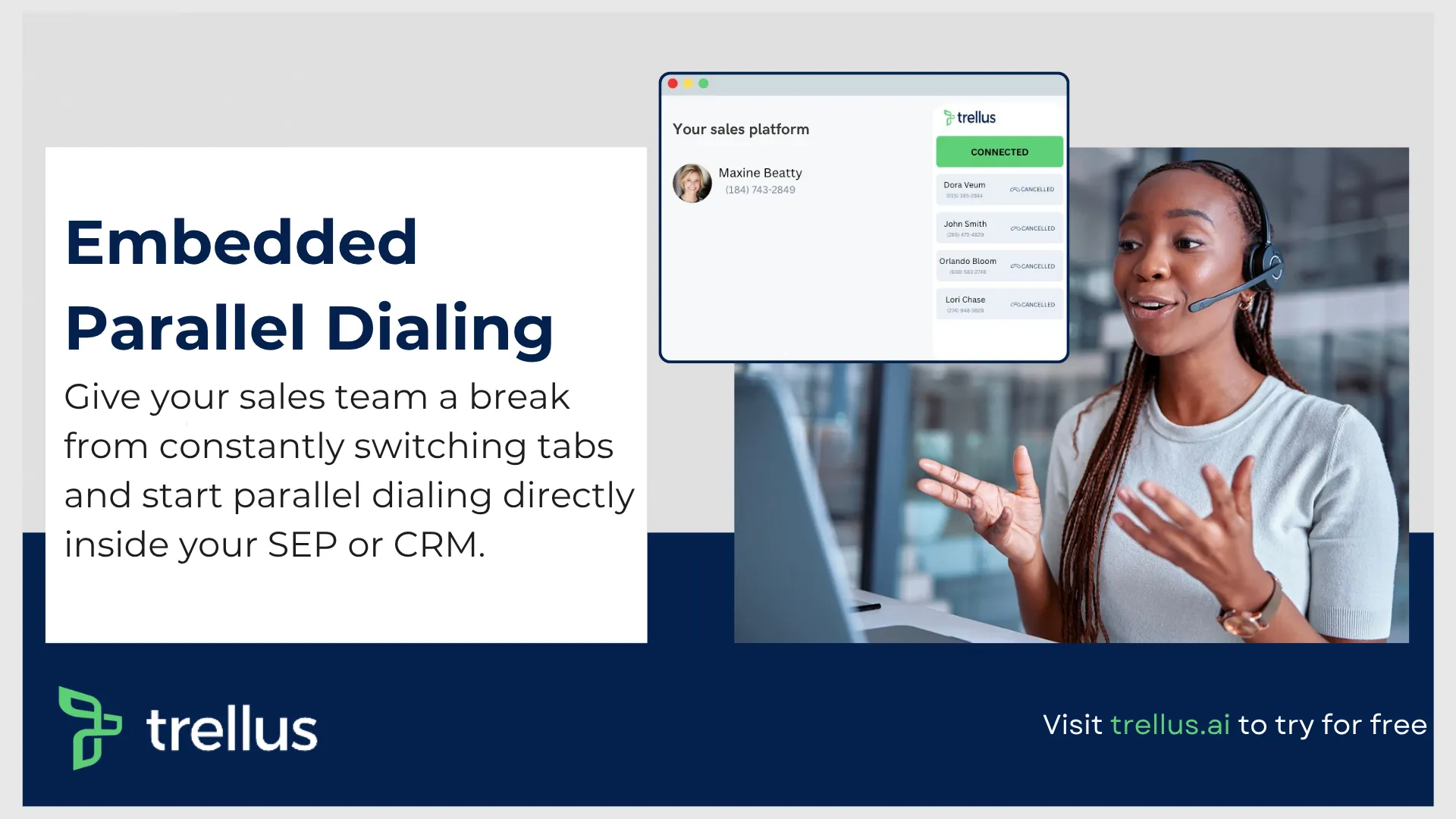
Power and parallel dialing in your CRM.