.png)
Our Top Picks


AI for sales prospecting helps teams target better-fit accounts, find timely triggers, personalize messages, prepare for calls, and learn from conversations. Its value isn’t “more automation”—it’s fewer manual tasks and more relevant interactions with the right buyers.
High-performing teams use AI as a workflow layer. Humans still define the ICP, control messaging, verify facts, and set compliance rules; AI accelerates research, drafting, call prep, note capture, and pattern detection. If you’re evaluating broader AI SDR software, prospecting is the clearest place to inspect first.
What “AI for Sales Prospecting” Means
AI for sales prospecting supports the end-to-end process of finding, researching, prioritizing, and engaging potential customers. Typical assists include account list building, enrichment, buyer-role research, trigger detection, message drafting, call prep, conversation summaries, CRM suggestions, and coaching insights.
Treat AI prospecting as a connected workflow—moving a rep from “who should I contact?” to “what should I do and say next?” For a broader comparison with full-lifecycle assistance, see our guide to the AI sales assistant.
Why Prospecting Needs a Workflow, Not Just a Tool
Dropping a writing assistant or dialer into a messy process speeds the wrong things. If your ICP is vague or messaging is generic, AI will scale vagueness and genericness.
Start with the motion: define stages, decision criteria, human checkpoints, and quality standards—then add AI. A strong workflow answers:
1.Who should we target?
2.Why now?
3.What should we say?
4.How do we learn from outcomes?
The fourth is critical: call quality, objections, follow-up, and closed-lost patterns should feed back into targeting, messaging, and coaching.
A Practical AI Prospecting Workflow for 2026
Use this as a starting point for outbound SDRs, founder-led teams, agencies, or revenue orgs modernizing manual prospecting.
Step 1: Define the ICP Before You Automate
AI can’t fix a fuzzy ICP. Document company types, sales motions, tech stack signals (if verifiable), triggering events, buyer roles, pains you solve, and disqualifiers. This becomes the backbone for research prompts, scoring, and prep. The sharper the ICP, the better the AI output.
Step 2: Build and Clean the Account Universe
Aggregate accounts from CRM, data providers, events, and site traffic. Use AI to summarize the business model and likely pains; tier by fit and urgency; and dedupe to prevent duplicate outreach. Treat AI-inferred details as hypotheses until verified.
Step 3: Identify Buying Signals and Trigger Events
Signals that map to solvable problems create relevance: hiring patterns, leadership changes, product or market expansion, funding, compliance needs, or tech changes. Use AI to surface and summarize triggers, but connect each one to a credible pain hypothesis—not hollow “Congrats!” personalization.
Step 4: Prioritize Accounts and Contacts
Use explainable AI scoring that ranks fit, signal strength, potential value, engagement, role relevance, and data completeness—while respecting territory rules. Reps must see why an account ranks high; managers should be able to audit and improve the logic. When assessing AI SDR tools, ask how prioritization works and whether reasoning is transparent.
Step 5: Use AI to Prepare Messaging
AI is excellent for structured first drafts. Use prompts that specify persona, account context, trigger, pain hypothesis, verified proof (if any), next step, tone, length, and disallowed claims. Weak prompts yield generic outreach; strong prompts reflect your positioning and compliance rules. Always review before sending.
Step 6: Prepare Reps for Calls
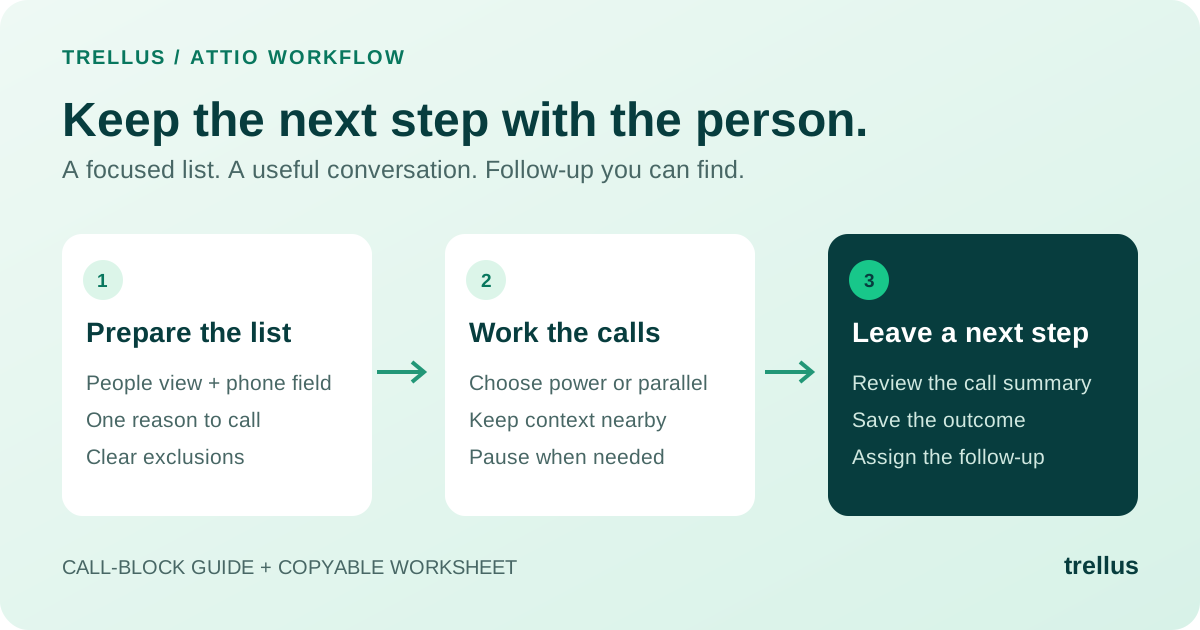
Prospecting often hinges on the call. AI can deliver concise briefs: account context, recent signals, likely pains, and talk tracks. Integrate research with calling so reps don’t tab-hop. This is where AI sales calls naturally extend prospecting via pre-call prep, live prompts, post-call summaries, and coaching insights.
Step 7: Use AI During and After Conversations
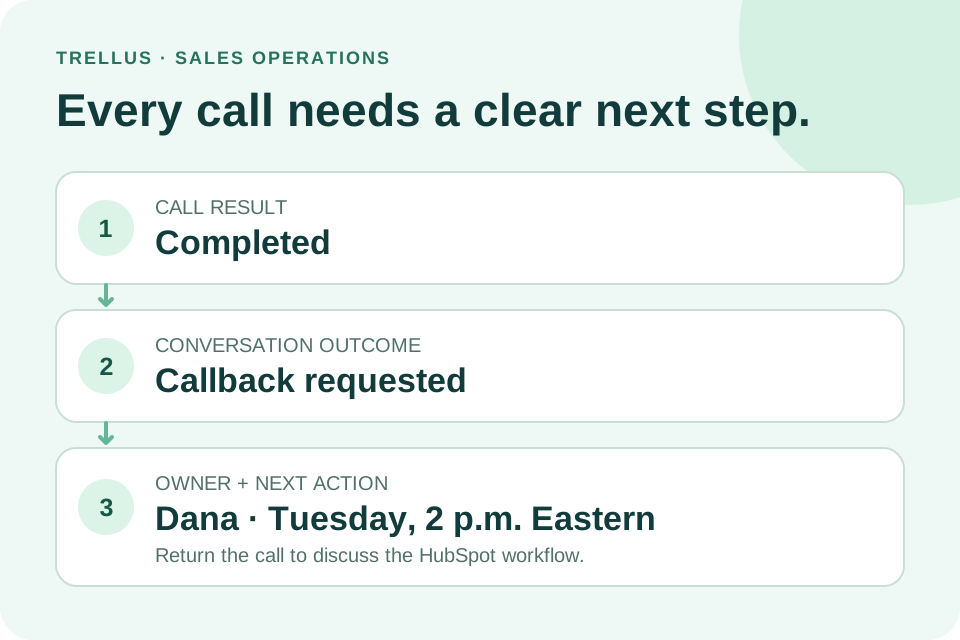
AI can surface in-call reminders and objection guidance, then draft summaries and CRM updates. Benefits include consistent messaging, better real-time coaching, higher-quality notes, and clearer next steps. Prompts must be timely and relevant; noisy assistance gets ignored.
Step 8: Feed Outcomes Back Into the Workflow
Loop outcomes into ICP, scoring, messaging, and coaching. If a signal yields meetings but stalls in pipeline, downgrade its weight. If a new objection spikes, update talk tracks and training. AI can detect patterns; humans must set the changes.
AI Prospecting Workflow: Roles, AI Tasks, and Human Checkpoints
Common Use Cases for AI in Sales Prospecting
•Account research at scale: Summaries of sites, products, hiring, and initiatives help reps orient faster—especially in mid-market and enterprise. Verify critical details before outreach.
•Persona-specific outreach: Adapt value by buyer role (e.g., CFO vs. VP Sales) using approved components. Avoid “personalized” fluff; focus on business relevance tied to pains and triggers.
•Call preparation and follow-up: Generate short briefs pre-call and concise follow-ups post-call that reflect what was said. Rep review remains essential when specifics or commitments are included.
•Objection pattern analysis: Cluster “already have a tool,” “not a priority,” and similar responses to refine talk tracks, discovery, and training.
Where AI Helps Most—and Where It Does Not
AI excels at summarization, classification, drafting, pattern detection, and workflow assistance. It struggles when asked to make strategic decisions without context or when dependent on incomplete, unverified data.
Avoid using AI to:
•Invent personalization or make unsupported claims
•Send high-volume outreach without review
•Replace compliance and brand judgment
•Create opaque scores
•“Coach” without manager context
•Treat unverified public signals as facts
Practical rule: AI accelerates accountable reps; it shouldn’t remove accountability.
How to Avoid Generic AI Outreach
Sameness is the biggest risk. Build a messaging system before scaling AI:
•Standard components: pain statements, persona-specific value props, discovery questions, verified proof points, competitive guidance, compliance language, and disallowed claims.
•Structured prompts: include persona, trigger, pain hypothesis, proof, next step, tone, and constraints. For example:“Draft a 70-word cold email to a VP of Sales at a B2B SaaS company hiring SDRs. Trigger: five open SDR roles. Hypothesis: ramp speed and call productivity. No unverified claims. End with a low-friction question.”
•Manager review: sample AI output by segment before rollout. Watch for over-claims, fake personalization, draggy intros, unclear value, weak CTAs, repetition, and off-brand tone.
Choosing Tools for AI-Powered Prospecting
Match tools to your bottleneck:
•Weak lists or context: prioritize data quality and account intelligence.
•Connect challenges: improve calling productivity and integrated workflows.
•Poor meeting quality: emphasize call prep, live guidance, and coaching.
If you’re exploring AI SDR platforms, decide whether you need a point solution or a workflow platform that spans research, outreach, calling, CRM updates, and coaching.
Buyer questions to confirm:
•Does it mirror our outbound motion and handoffs?
•What’s automated vs. assisted?
•How are CRM updates handled?
•Can managers inspect and tune the workflow?
•Does it support email, calling, or both?
•Are recommendations explainable?
•What integrations exist today?
•Any plan limits to validate before purchase?
•Where can we review up-to-date plan details? See pricing.
Implementation Plan: Start Small, Then Expand
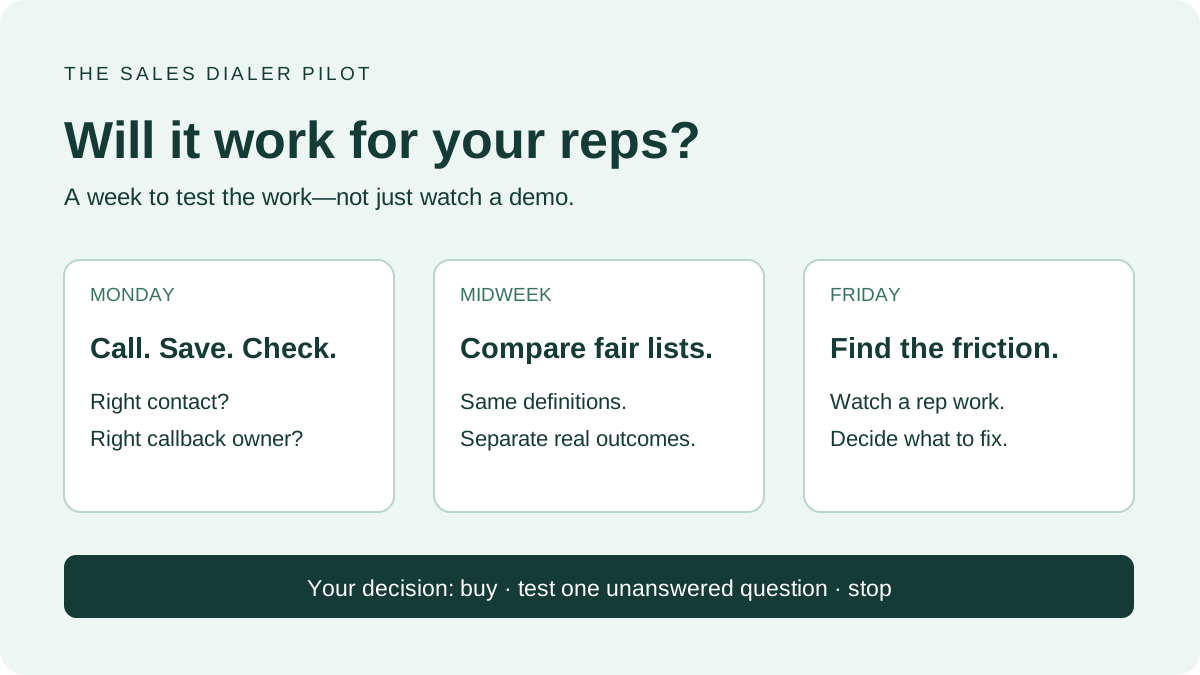
Minimize risk with a scoped pilot.
•Week 1: Audit the current motion. Document how reps build lists, research, write, call, log, and follow up. Flag friction (manual research, CRM hygiene, prioritization gaps, generic messaging, low call confidence, slow follow-up, limited coaching visibility).
•Week 2: Define the pilot workflow. Pick one improvement (e.g., account research briefs, call prep, follow-up drafts, signal-based prioritization, objection analysis). Set success criteria focused on quality and speed.
•Weeks 3–4: Train reps and managers. Teach prompts, review standards, verification, and what not to automate. Use live examples from your accounts to show weak vs. strong output.
•Weeks 5–6: Measure quality and adoption. Track usage plus outcomes like prep time, CRM completeness, manager-rated message quality, call readiness, objection capture, meeting handoff quality, and follow-up speed. Don’t over-attribute early revenue shifts.
•After the pilot: Expand carefully. Adapt prompts, signals, and qualification by segment. If you’re stitching multiple tools for research, calling, and coaching, consider a more unified workflow platform to reduce operational overhead.
Metrics to Watch
Measure efficiency, quality, and outcomes:
•Accounts researched per rep; pre-call prep time
•Percent of accounts with a clear outreach reason
•Message quality review scores
•Call connect rate; positive reply rate
•Meetings booked and AE acceptance rate
•CRM note completeness; follow-up completion
•Objection trends; rep ramp progress
Avoid vanity metrics (e.g., raw volume of emails or dials) that don’t correlate with relevance or pipeline quality.
Compliance, Data Quality, and Trust
Guardrails protect brand and deliverability:
•Don’t reference sensitive or personal data in outreach
•Don’t assert pains or results without clear support
•Don’t invent customer proof or integrations
•Don’t imply capabilities you can’t verify
•Review AI messaging before broad use
•Maintain opt-out and consent per applicable laws
•Validate vendor security and data handling before purchase
Trust compounds; careless AI outreach harms reputation.
Where Trellus Fits in an AI Prospecting Workflow
Trellus is relevant when you need AI support around outbound execution—especially calling workflows and rep assistance. The handoff from research to live conversation is a frequent gap; AI-assisted calling, guidance, and coaching can help reps move faster with more context and clearer next steps.
In your evaluation, confirm current areas like calling productivity, rep guidance, and workflow assistance against first-party materials. Validate packaging, integrations, and plan specifics directly. Useful questions:
•Can it help reps progress through prioritized call work faster?
•Does it support better conversations, not just more activity?
•Do managers get insight into where reps need help?
•Does it fit our CRM and engagement stack?
•Which plan details should we confirm? See pricing.
For a broader comparison of workflow coverage and implementation tradeoffs, use our guide to choosing AI SDR software.
Mistakes to Avoid
•Automating before clarifying the ICP
•Treating AI research as verified fact
•Sending AI copy without review
•Optimizing only for activity volume
•Skipping manager enablement
•Ending the workflow at the first reply or connect
Conclusion
AI for sales prospecting works when embedded in a clear, auditable workflow. Define the ICP, curate accounts, use meaningful triggers, prioritize transparently, and let AI draft, prep, summarize, and surface patterns—while humans own accuracy, compliance, and relationships. Teams that win pair sharper targeting and messaging with stronger calls, faster follow-up, and tighter coaching loops.
Ready to evaluate how AI supports your outbound motion? Start with the Trellus AI SDR guide, review current product details, and confirm fit for your team and stack.
FAQ
What is AI for sales prospecting?
It’s the use of AI to help sales teams find, research, prioritize, and engage buyers. Typical aids include account summaries, trigger detection, message drafting, call prep, conversation notes, CRM suggestions, and coaching insights.
How do you use AI for sales prospecting?
Clarify the ICP, build and clean your account universe, detect relevant triggers, prioritize accounts and contacts, draft outreach with structured prompts, prep for calls, summarize conversations, and feed outcomes back into targeting and messaging—always with human review.
Can AI replace SDR prospecting?
No. AI accelerates routine work but doesn’t replace strategy, judgment, conversation skills, or trust-building. Reps and managers still define ICPs, verify claims, handle objections, and guide next steps.
What prospecting tasks are best for AI?
Summarizing accounts, clustering patterns, drafting first-pass messaging, creating call briefs, capturing notes, analyzing objections, and recommending follow-up steps—tasks with clear inputs and outputs.
What are the risks of using AI in sales prospecting?
Inaccurate data, generic outreach, unsupported claims, over-automation, weak compliance controls, opaque scoring, and activity that scales without improving quality. Use guardrails and manager review.
How should sales teams measure AI prospecting success?
Track efficiency and quality: prep time saved, clarity of outreach reasons, message and call-readiness scores, connect and positive-reply rates, AE-accepted meetings, CRM completeness, follow-up reliability, and objection insights.


Power and parallel dialing in your CRM.