Our Top Picks


You accepted an SDR offer. Meanwhile, your friend or coworker also took a BDR role at another company. Both of you are dialing the same prospects, sending similar sequences, chasing the same meetings. Naturally, the question hits almost immediately.
Are you getting paid the same, or did one of you make a better move?
This is where most people get tripped up. Technically, we’d say that it’s not entirely attributed to the fact that the answer is complicated, but it’s because the industry itself refuses to stay consistent. Titles shift from company to company, responsibilities overlap, and compensation structures vary more than job descriptions suggest.
So instead of relying on labels, this breakdown focuses on what determines your income. Not just the SDR salary on paper, but what you realistically take home.
Read on…
Key Takeways
- Income growth is driven by performance and progression, not tenure: SDR salary doesn’t increase linearly with experience. High performers who optimize workflows, target better accounts, and consistently exceed quota can break into higher earnings faster. Long-term income growth typically comes from transitioning into higher-leverage roles like Account Executive rather than staying in SDR positions.
- Your environment matters more than your title: Two SDRs with identical offers can end up with completely different incomes. Factors like lead quality, quota realism, inbound flow, tooling, and operational efficiency directly impact performance. The system you operate in determines your earnings far more than whether you’re labeled an SDR or BDR.
- OTE is a theoretical ceiling, not your actual salary: Most SDR compensation packages look attractive on paper, but the $83K–$85K OTE assumes 100% quota attainment. In reality, many reps land between 60–80%, which significantly lowers take-home earnings. The real question isn’t “what’s the average SDR salary,” it’s “how often do reps actually hit quota in this environment?”
What Is an SDR?

If it’s your first time applying for an SDR role, you are probably only familiar with the terminology. Beyond that, there’s a lot that goes into everything that defines what an SDR is.
A sales development representative is responsible for focusing on outreach and deal conversions through cold calls, day in; day out. Depending on the role, a company can also ask the SDR to handle inbound leads, but that depends on the business requirements.
Usually, SDRs are your frontline individuals who call a long range of prospects through an exhaustive list of contacts. Following up with these prospects is also part of the job, and it comes into play when a lead isn’t available on call, and they have specifically mentioned getting back later.
SDRs can either work remotely or on-site. That’s entirely dependent on the work setting. Either way, it’s an intense role, with more or less the same kind of activity each day. However, there’s a lot of room for training and upskilling throughout the career ladder.
What Is the Average SDR Salary in 2026?
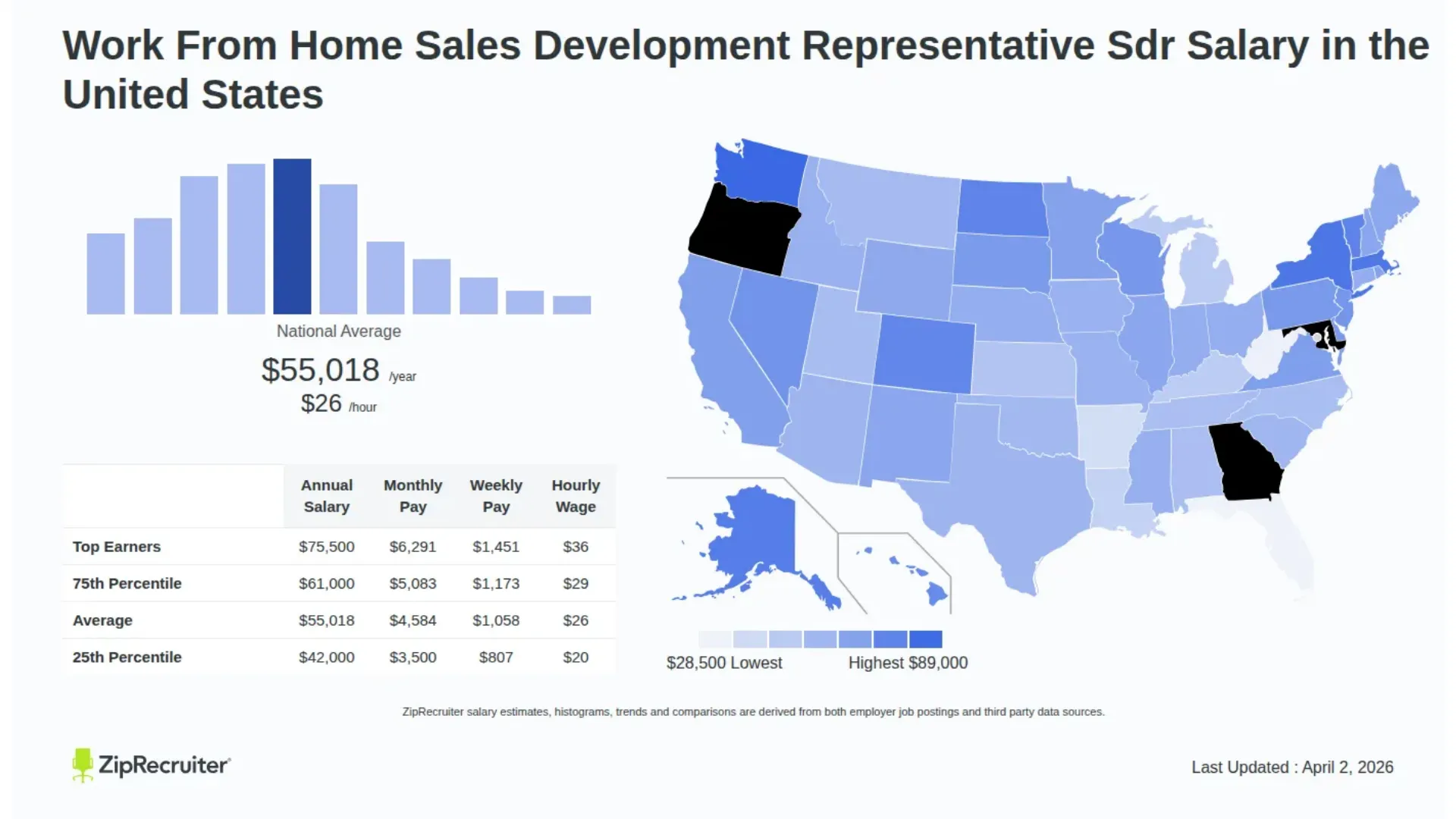
If you search for, or look up: what is the average SDR salary, you’ll see numbers clustered in a narrow band. On the surface, it looks simple.
The average SDR salary in 2026 lands roughly here:
- Base salary sits around $55,000 to $60,000, while total SDR on-target earnings land between $83,000 and $85,000.
That sounds straightforward, but this is where most people misunderstand how SDR sales salary works.
That $85K number assumes you hit 100 percent of your quota. And the reality is, a large percentage of SDRs do not.
So while the average looks clean on paper, the actual earning distribution is messy. Some reps outperform and cross $100K. Others struggle with poor territories, bad data, or unrealistic quotas and fall well below OTE.
This is why the better question isn’t just how much do SDRs make in 2026. It’s how much do SDRs take home after accounting for quota attainment.
And that answer depends heavily on the environment you step into.
Job Outlook For a Typical SDR
Employment opportunities for manufacturing and wholesale sales representatives are expected to remain consistent over the next decade. Data from the U.S. Bureau of Labor Statistics indicates that roughly 149,900 openings will be available each year between 2023 and 2033.
That said, overall job growth in this field is projected at just 1%, which falls below the average growth rate across all occupations. This slower pace is largely due to the growing role of automation in sales processes.
Even so, the outlook for sales development representatives remains stable. As industries continue to introduce new products and technologies, businesses will still need skilled professionals to drive outreach, build pipelines, and convert interest into revenue.
Understanding the SDR Compensation Package, Where the Money Really Comes From
Your SDR compensation package is not just salary plus commission. It is a system designed to reward specific behaviors.
At a high level, your income is split into two components. Fixed base salary and variable earnings tied to performance. Together, they form your OTE.
The formula itself is simple.
OTE equals base salary plus variable compensation at full quota attainment.
What is not simple is how that variable portion behaves in practice.
Let’s take a realistic example.
You join a SaaS company with a $60,000 base salary and a $25,000 variable bonus. Your total SDR income breakdown shows an OTE of $85,000.
Now imagine two different outcomes.
In one scenario, the company has a strong inbound flow, clean data, fast lead routing, and reasonable quotas. You consistently hit 100 percent or more. You earn close to full OTE, sometimes more if accelerators exist.
In another scenario, leads take 24 to 48 hours to reach you, contact data is outdated, and expectations are disconnected from reality. You operate at 60-70% attainment. Your earnings drop closer to $70K.
Same offer. Completely different financial outcome.
This is why understanding SDR salary, including commission and OTE, requires more than just reading numbers. You need to evaluate the system that produces those numbers.
Entry Level SDR Salary Range and What You’re Really Paid For
The entry-level SDR salary range is often framed as a starting point. What it represents is a tradeoff.
At the beginning of your career, companies do not pay for refined skills. They are paying for potential and effort tolerance.
Most entry-level roles fall between $48,000 and $65,000 base, with OTE in the $70,000 to $80,000 range. This aligns with broader entry-level sales salary benchmarks in tech.
But here’s what those numbers don’t tell you.
Early-stage SDR work is operationally heavy. You are learning systems, adapting to rejection, and figuring out how to create conversations out of nothing. A significant portion of your day goes into non-selling activities like research, CRM updates, and list building.
That’s why the salary for the sales prospecting role at this level feels disconnected from the effort required. You are working at full intensity, but your output is still ramping.
Over time, as your efficiency improves, the same workload starts producing better results. That’s when your earning potential begins to expand.
SDR Salary by Experience Level, How Income Grows
When people look up sdr salary by experience level, they expect a linear increase. The reality is more performance-driven than time-driven.
In your first year, your focus is survival and consistency. You are learning how to handle volume, rejection, and messaging. Your earnings reflect that stage, typically landing between $70K and $80K OTE.
Once you move into the one to three-year range, something shifts. You start understanding patterns. You know which messaging works, which personas respond, and how to manage your pipeline more effectively.
This is where tech sales SDR earnings begin to climb into the $80K to $95K range.
Beyond that, progression splits into two paths.
Some reps remain in senior SDR roles, optimizing performance and pushing into six-figure earnings. Others transition into closing roles where the upside increases significantly.
This is why experience alone does not determine income. Skill application and environment matter more.
SaaS SDR Salary, Why Tech Tends To Pay More
The saas sdr salary consistently outperforms other industries, and the reason comes down to economics.
SaaS businesses generate recurring revenue. A single closed deal can produce value over multiple years. That allows companies to invest more aggressively in pipeline generation.
As a result, SDR pay in tech companies tends to sit higher than in traditional industries.
Typical SaaS ranges look like this.
Base salary ranges from $55K to $70K, while OTE often reaches $85K to $100K or more.
Compare that with industries where deals are smaller and one-time. The commission margin is lower, which directly impacts your earning potential.
This is also why many early-career sales professionals prioritize tech roles. Not because the work is easier, but because the upside is significantly higher.
SDR vs BDR Salary: Why the Difference Barely Exists
The comparison between SDR vs. BDR salary feels like it should matter more than it does.
On paper, both roles land in nearly identical ranges. SDR OTE typically sits around $83K to $85K, while BDR OTE ranges from $83K to $90K.
So why is there so much debate?
Because the difference is not in compensation. It’s in motion.
SDRs are usually tied to outbound activity. Their work responsibility can also call for inbound activities, but that doesn’t happen too much. Faster cycles, higher volume, quicker qualification. BDRs focus on outbound. Longer cycles, more research, deeper account penetration.
From a workload perspective, outbound roles can feel more demanding. Yet the outbound sales rep's salary does not dramatically exceed inbound compensation.
This creates a perception gap. The work feels harder, but the pay remains similar.
Which brings you back to the same conclusion.
The title matters less than the system you are operating in.
How SDR Salaries Vary by Location
If you’ve ever searched how SDR salaries vary by location, you’ve likely noticed major differences across regions.
High-cost markets like San Francisco or New York offer higher base salaries. Lower-cost regions offer less on paper but can provide a similar or better quality of life after expenses are accounted for.
Remote work has started to compress these differences, but it hasn’t eliminated them.
Companies still adjust pay based on talent competition and market expectations. So while the average SDR salary might look higher in certain cities, the net benefit depends on your cost structure.
SDR Manager Salary: The Next Step Up
Once you move beyond individual contributor roles, the SDR manager's salary becomes relevant.
Managers typically earn between $120K and $160K OTE, with base salaries ranging from $90K to $130K.
The nature of the role shifts completely.
You are no longer responsible for your own pipeline alone. You are responsible for a team’s output, hiring decisions, onboarding, and performance management.
For some, this is a natural progression. For others, it represents a loss of direct control over earnings.
That’s why many high-performing SDRs choose to move into Account Executive roles instead, where compensation scales more directly with performance.
Why Most SDRs Never Hit Their OTE
On paper, the SDR on-target earnings note looks clean. Hit quota, earn the full amount. Simple.
In reality, most SDRs operate below that line.
Industry-wide data shows that quota attainment is far from perfect. A large percentage of reps land somewhere between 60 and 80 percent of the target. That gap is where your expected income quietly shrinks.
So when people ask what a good SDR salary is, the honest answer depends on how realistic the quota is, not just how high the OTE looks.
There are a few consistent reasons behind this gap.
The first is unrealistic quota setting. Some companies design targets based on growth expectations rather than historical performance. If the math behind your quota doesn’t align with actual conversion rates, your OTE becomes aspirational rather than achievable.
The second is ramp time. New SDRs rarely hit full productivity immediately. It takes three to six months to understand messaging, territory, and tools. During that period, your earnings are naturally lower, even if the plan assumes otherwise.
The third is lead quality. This is one of the most overlooked factors in SDR sales salary. If your data is outdated, your contacts are wrong, or your inbound flow is weak, your performance suffers regardless of effort.
The fourth is operational friction. Many SDRs spend a significant portion of their day on non-selling work. Logging activities, fixing CRM fields, researching accounts. When your actual selling time drops to a couple of hours per day, hitting aggressive quotas becomes difficult.
This is why two SDRs with the same average SDR salary can have completely different financial outcomes. The difference is not effort. It is an environment.
What Separates High Earners from Average SDRs

If you look at reps who consistently exceed their tech sales SDR earnings targets, the difference is rarely just work ethic.
Almost everyone in sales works hard. The top performers work differently.
They understand leverage.
High-earning SDRs are very intentional about where they spend their time. They focus on high probability accounts, cleaner data sources, and messaging that has already proven to convert.
They also optimize their workflow. Instead of treating each prospect as a fresh start, they build repeatable patterns. Messaging frameworks, call structures, follow up timing. Over time, this compounds into higher output without increasing effort.
Another key difference is how they handle the pipeline.
Average reps chase activity metrics. Calls made, emails sent, touches logged. High performers track outcomes. Conversations created, meetings booked, pipeline generated.
That shift in focus directly impacts sdr income breakdown. More quality conversations lead to more meetings, which lead to higher commission attainment.
There’s also a psychological element.
Top performers detach from rejection faster. They don’t overanalyze failed calls or slow days. That consistency allows them to maintain volume without burning out.
So when people ask how to increase their SDR salary, the answer isn't just about negotiating a better offer. It is about improving the system you operate within and how you execute within it.
SDR Salary vs Other Sales Roles
One of the most common comparisons is SDR salary vs other sales roles. This is where expectations need to be recalibrated.
SDR roles sit at the entry point of the sales funnel. Your primary responsibility is pipeline generation, not closing revenue. That directly impacts compensation.
Here’s how it typically stacks up.
An SDR earns around $80K to $90K OTE. An Account Executive moves into the $150K to $190K range. Senior or enterprise AEs push well beyond $200K.
Customer Success roles, which focus on retention and expansion, typically range from $90K to $130K.
Sales Engineers, who bring technical expertise into deals, often land between $140K and $170K.
This comparison answers the question of SDR salary vs other sales roles more clearly.
SDR roles are not designed to maximize income long-term. They are designed to build skills and create a pathway into higher earning positions.
That’s why most SDR roles are transitional. The real earning potential comes after you move into closing or specialized roles.
How SDR Salaries Vary by Performance, Not Just Location
Earlier, we touched on geography. But performance has a much bigger impact on your actual income than location alone.
Within the same company, two SDRs can have identical base salaries and completely different take-home earnings.
One rep hits 120 percent of quota and benefits from accelerators, pushing earnings above OTE. Another operates at 70 percent and never reaches the full variable component.
This creates a wide spread in SDR salary with commission and OTE outcomes.
It also explains why what is the average SDR salary can be misleading. Averages compress the extremes, but real earnings vary significantly based on execution.
So while location influences your base, performance determines your ceiling.
How to Increase SDR Salary in Practical Terms
When people search for how to increase SDR salary, they often expect negotiation tactics.
Negotiation matters, but it is only one piece of the puzzle.
The fastest way to increase income in this role comes down to three levers.
The first is improving quota attainment. This sounds obvious, but it’s where most of your upside lives. Moving from 70 percent to 100 percent attainment has a direct and immediate impact on your earnings.
The second is choosing the right environment. A strong product, clean data, efficient lead routing, and realistic quotas will outperform a higher OTE at a poorly run company.
The third is career progression. SDR roles have a ceiling. Moving into an AE role or a specialized position significantly increases your earning potential.
There is also a fourth lever that many overlook.
Understanding your commission plan in detail.
Accelerators, bonuses, and incentives can materially change your income. If your plan rewards overperformance aggressively, exceeding quota becomes far more valuable.
So increasing your SDR sales salary is less about squeezing a higher base and more about positioning yourself for higher output and better opportunities.
What Is a Good SDR Salary in 2026, A Realistic Benchmark
At this point, the question becomes more practical.
What is a good SDR salary?
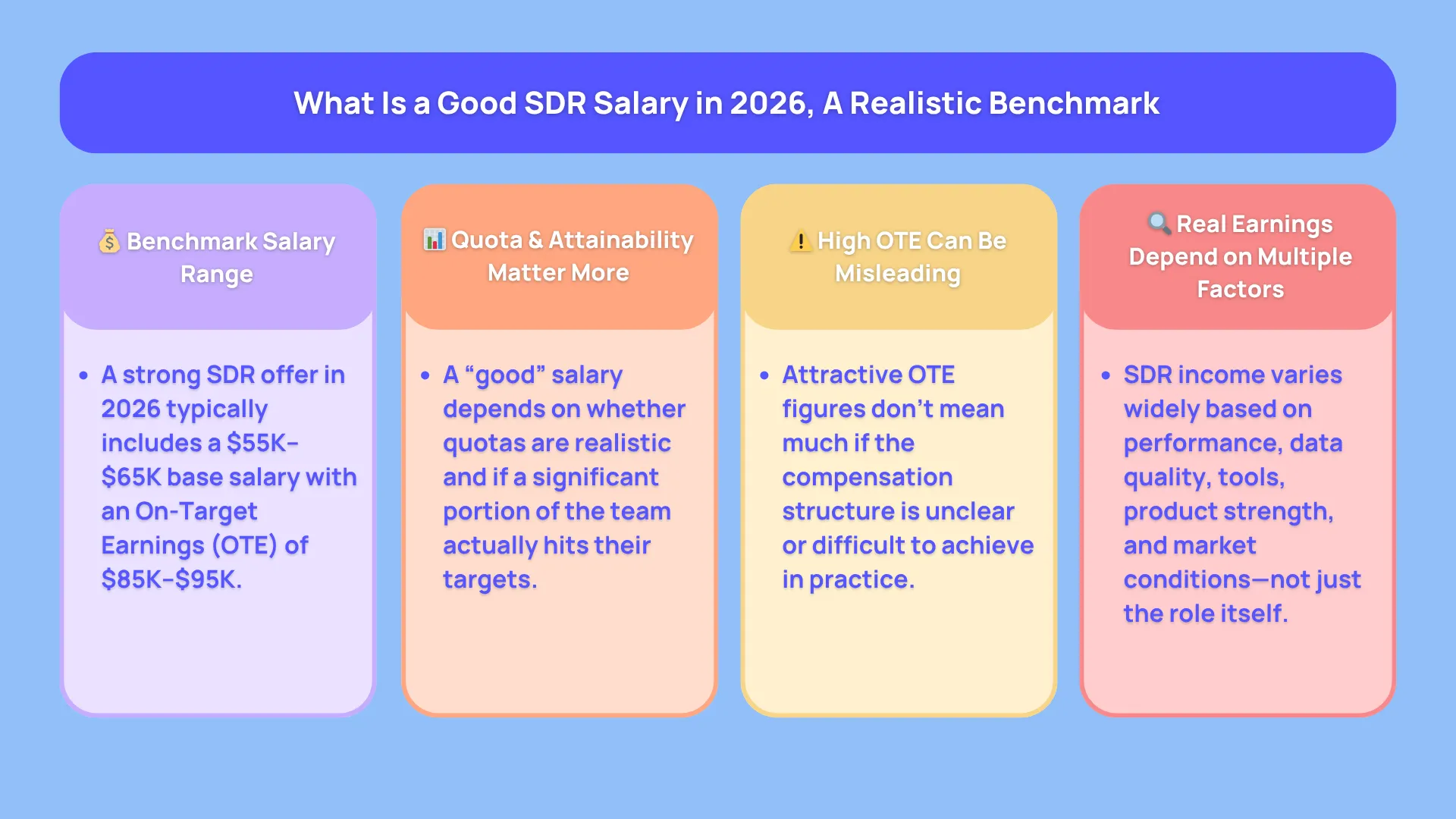
A strong offer in 2026 typically looks like this.
Base salary in the $55K to $65K range. OTE between $85K and $95K. A clear and achievable quota structure. Evidence that a meaningful percentage of the team hits the target.
If those conditions are met, you are in a solid position.
If the OTE looks high but the underlying system is unclear, that’s where caution is needed.
Because in sales development, the difference between a good offer and a bad one is not the number on paper. It is how often that number gets realized.
Final Reality Check: What This Role Really Pays
At a glance, sdr salary looks predictable. In practice, it is one of the most variable compensation structures in tech.
Your earnings sit at the intersection of:
- Your ability to generate conversations
- The quality of your data and tools
- The realism of your quota
- The strength of your product and market
That’s why two people doing the same job can end up with very different outcomes.
So if you’re comparing offers or benchmarking your current role, focus less on the title and more on the mechanics of compensation.


Power and parallel dialing in your CRM.