Our Top Picks


If you are researching nooks salesforce integration, you are probably not just looking for a technical connection between two platforms.
You are trying to understand whether Nooks can help your team call faster, log activity into Salesforce, manage outbound workflows, and turn more conversations into pipeline.
That is the right starting point. Salesforce is the system of record for many sales organizations, but it only creates value when activity data is accurate, timely, and tied to revenue outcomes. A sales dialer that does not sync calls, notes, dispositions, and next steps back into Salesforce can create blind spots for managers and unnecessary admin work for reps.
Nooks and Trellus both sit in the broader AI sales dialer category, but they solve the problem from different angles. Nooks positions itself as an AI-native outbound workspace for prospecting, sequencing, dialing, signals, and coaching.
Trellus positions itself as an embedded power and parallel dialer with real-time AI coaching, call analytics, salesfloor features, and workflow support inside the tools sales teams already use.
The central question is more or less: Which Salesforce dialer integration helps reps book more meetings and improve sales outcomes?
That is where this comparison tilts toward Trellus.ai. Why so?
Well, as it turns out, for teams focused on improving booked meetings, live conversation quality, coaching, and rep adoption, Trellus often has the stronger outcome-based fit.
Quick Verdict: Choose Trellus for Meeting Outcomes, Nooks for High-Volume Workspace Consolidation
The fastest way to compare Nooks and Trellus is to separate activity volume from sales conversion quality. Nooks is highly compelling when the team’s main problem is outbound scale. It emphasizes AI dialing, parallel dialing, spam protection, virtual salesfloor functionality, sequencing, signals, and a broader outbound command center.
For teams that want one place to run call-heavy outbound programs, Nooks deserves serious consideration.
Trellus is more compelling when the team’s main problem is not merely making enough calls, but converting live conversations into booked meetings.
Trellus emphasizes dialing directly inside existing sales engagement platforms or CRM workflows, live AI guidance, practice voice agents, conversation analytics, and manager visibility into rep performance.
The practical recommendation is straightforward. Choose Nooks if your team needs a dedicated, high-volume outbound workspace. Choose Trellus if your team wants to improve the quality of every conversation and convert more Salesforce-driven calling activity into meetings.
What Should a Salesforce Integration Ideally Do for Sales Teams?

A Salesforce integration should not be judged as a simple yes-or-no feature. Many tools can claim they connect to Salesforce. Fewer tools can prove that the integration improves rep workflow, data quality, coaching, and pipeline visibility.
For sales leaders, the real value of a Salesforce dialer integration comes from five outcomes. First, it should reduce manual logging. Second, it should improve CRM data quality. Third, it should help reps move faster from lead list to live conversation. Fourth, it should help managers understand what is driving booked meetings. Finally, it should connect outbound activity to opportunities and pipeline.
Reduce Manual Logging and Admin Work
Sales reps should not have to manually copy notes, update tasks, or rebuild call histories after every conversation. Nooks describes its Salesforce integration as a native integration that can automatically log calls, notes, and next steps.
That is a meaningful feature because Salesforce data often breaks down when activity capture depends entirely on rep discipline.
A strong Salesforce auto dialer should make CRM hygiene a background process rather than a separate administrative task. When the system captures outcomes automatically, reps can stay focused on conversations.
Improve Sales Data Quality
Clean Salesforce data improves forecasting, coaching, list analysis, campaign attribution, and pipeline reviews. If call outcomes are inconsistent, managers cannot reliably tell which lists, sequences, scripts, or reps are producing meetings.
This is especially important for teams that use Salesforce as the source of truth for outbound performance. If the dialer creates activity but Salesforce does not reflect what happened, the sales organization ends up with disconnected reporting.
Improve Connect-to-Meeting Conversion
This is where the comparison becomes more strategic. More dials can create more opportunities to speak with prospects, but activity volume alone does not guarantee more booked meetings. Once a prospect answers, the rep still needs the right opening, the right objection handling, the right discovery question, and the right next-step ask.
Trellus is stronger on this dimension because its product positioning centers on real-time AI coaching, live call guidance, call analytics, practice, and performance improvement.
In other words, Trellus addresses the moment where many outbound teams actually lose pipeline: the live conversation.
Shorten the Feedback Loop Between Calls and Coaching
Traditional coaching often happens too late. Managers review call recordings after the fact, identify patterns, and then hope reps apply those lessons in the next call block. That can work, but it is slow.
Trellus’s value proposition is more immediate. The platform emphasizes making the most of each opportunity with live AI coaching and adaptive guidance during calls. For teams focused on booked meetings, that shorter feedback loop can be more valuable than simply increasing dial volume.
Nooks Salesforce Integration Overview
The Nooks Salesforce integration is designed to help outbound teams connect call activity with their CRM workflow. On its AI Dialer page, Nooks lists Salesforce as an integration and describes it as a way to eliminate manual data entry through automatic logging of calls, notes, and next steps.
That matters because Nooks is not positioned as a basic click-to-call tool. It is positioned as an AI outbound workspace. Its product ecosystem includes AI Dialer, AI Sequencing, Signals and Intelligence, AI Coaching, virtual salesfloor functionality, spam protection, workflow automation, analytics, and integrations with tools such as Salesforce, HubSpot, Salesloft, Outreach, Gong, Apollo, Groove, ZoomInfo, and others.
How Nooks Uses Salesforce in the Outbound Workflow
In a Salesforce-based outbound motion, Nooks can support the execution and capture of call activity. The core promise is that reps can call more efficiently while Salesforce remains updated with relevant call data. This is especially valuable for SDR and BDR teams running structured call blocks, multi-touch campaigns, or account-based outbound plays.
Nooks also emphasizes pipeline outcomes. Its website includes customer examples referencing increases in meetings, pipeline, conversations, and time savings, including claims such as 5x more dials, 4x more conversations, and 3x more meetings for teams using its AI Dialer.
Those claims support Nooks’s strength: it is built for teams that want to increase activity, create a stronger calling rhythm, and consolidate outbound workflows into one workspace.
Setup Considerations for Nooks and Salesforce
Some Nooks-related Salesforce workflows may require careful setup. Unify’s Nooks Salesforce setup documentation describes a process involving Salesforce call-task reports, filters for open call tasks assigned to the current user, connection through Nooks settings, Salesforce authorization, connected app installation, and optional Salesforce field mappings.
The same documentation notes that Salesforce security changes in September 2025 may require Salesforce administrators to install Nooks as a trusted app in the Salesforce org before some users can connect successfully.
This does not mean Nooks is unusually difficult to implement. It does mean buyers should involve Salesforce administrators early, clarify which objects and fields will sync, and confirm how call tasks, dispositions, notes, and next steps will be represented in Salesforce reporting.
Practical takeaway: Nooks can be a strong Salesforce-connected outbound workspace, but implementation quality matters. The team should validate admin requirements, field mapping, task handling, and reporting before rollout.
Where Nooks Is Strong
Nooks is strongest for teams that need outbound scale. If your reps need to run large call blocks, use a virtual salesfloor, coordinate high-energy calling sessions, and centralize outbound work across calling, sequencing, intelligence, and coaching, Nooks has a clear value proposition.
It is particularly relevant for larger SDR teams that want managers to see calling activity in real time, maintain team energy, and create repeatable outbound operating rhythms. The platform’s broader workspace approach can be attractive when a company wants to consolidate several outbound activities into one environment.
Where Nooks May Feel Heavy
The tradeoff is that a dedicated workspace can also introduce workflow change. If reps already live inside Salesforce, Outreach, Salesloft, HubSpot, or another sales engagement platform, asking them to adopt another primary workspace can create adoption friction.
That friction matters because the best Salesforce integration is not the one with the longest feature list. It is the one reps actually use consistently. If the team’s main challenge is not call volume but poor connect-to-meeting conversion, then a tool that improves live conversation quality may create a faster path to revenue impact.

Trellus Salesforce Integration Overview
Trellus approaches the Salesforce dialer problem differently. Rather than positioning itself primarily as a separate outbound command center, Trellus describes itself as a power and parallel dialer that works directly inside a sales engagement platform or CRM.
Its homepage highlights parallel dialing, real-time guidance, call analytics, salesfloor collaboration, AI practice bots, number health, voicemail automation, and a workflow designed to reduce context switching.
This distinction matters for Salesforce-based teams. Many sales organizations already have a defined workflow. Reps may work from Salesforce, Outreach, Salesloft, HubSpot, Apollo, or another platform. If a dialer can improve calling without forcing reps into a completely separate experience, adoption becomes easier.
How Trellus Fits Into Existing Rep Workflows
Trellus’s embedded workflow is one of its biggest advantages. Its site describes dialing inside the sales engagement platform, using parallel dialing, automating voice drops, and reducing the need to switch contexts. For reps, fewer tabs and fewer manual steps can translate into more consistent use.
In practice, this matters because sales technology often fails at the adoption layer. A powerful tool that reps avoid does not improve meetings booked. A lighter tool that fits their daily workflow can produce more reliable behavior change.
Why Trellus Is Better Aligned With Booked Meetings
Booked meetings are created during live conversations, not inside dashboards. A rep can call the right prospect at the right time, but still lose the meeting because the opener is weak, the objection handling is generic, or the next-step ask is unclear.
Trellus is built around this problem. It emphasizes live AI coaching, objection handling, call scoring, practice voice bots, conversation analytics, and visibility into what separates top performers from the rest. That makes Trellus especially attractive for teams that already generate conversations but struggle to turn those conversations into calendar commitments.
Trellus Integration Flexibility
Trellus also emphasizes integration flexibility. Its integrations page lists many supported tools and states that the company can build unsupported integrations free of charge if they do not currently support a dialer, within approximately one to two days. The same site experience includes Salesforce as a platform option in its demo flow, which reinforces Trellus’s relevance for Salesforce-based sales teams.
The strategic difference is simple. Nooks helps teams create more outbound activity inside a broader workspace. Trellus helps teams improve the workflow and coaching layer around the calls reps are already making.
Nooks vs Trellus: Head-to-Head Salesforce Workflow Comparison
Both Nooks and Trellus can support Salesforce-oriented outbound teams, but they are not interchangeable. Their differences become clearer when you compare them through the lens of workflow and outcomes.
The most important distinction is that Nooks is more of a consolidated outbound environment, while Trellus is more of an embedded performance layer. If your team wants to centralize outbound work into one AI workspace, Nooks is a strong candidate. If your team wants to improve booked meetings without disrupting existing workflows, Trellus is easier to recommend.
Which Tool Is Better for Booked Meetings and Sales Outcomes?
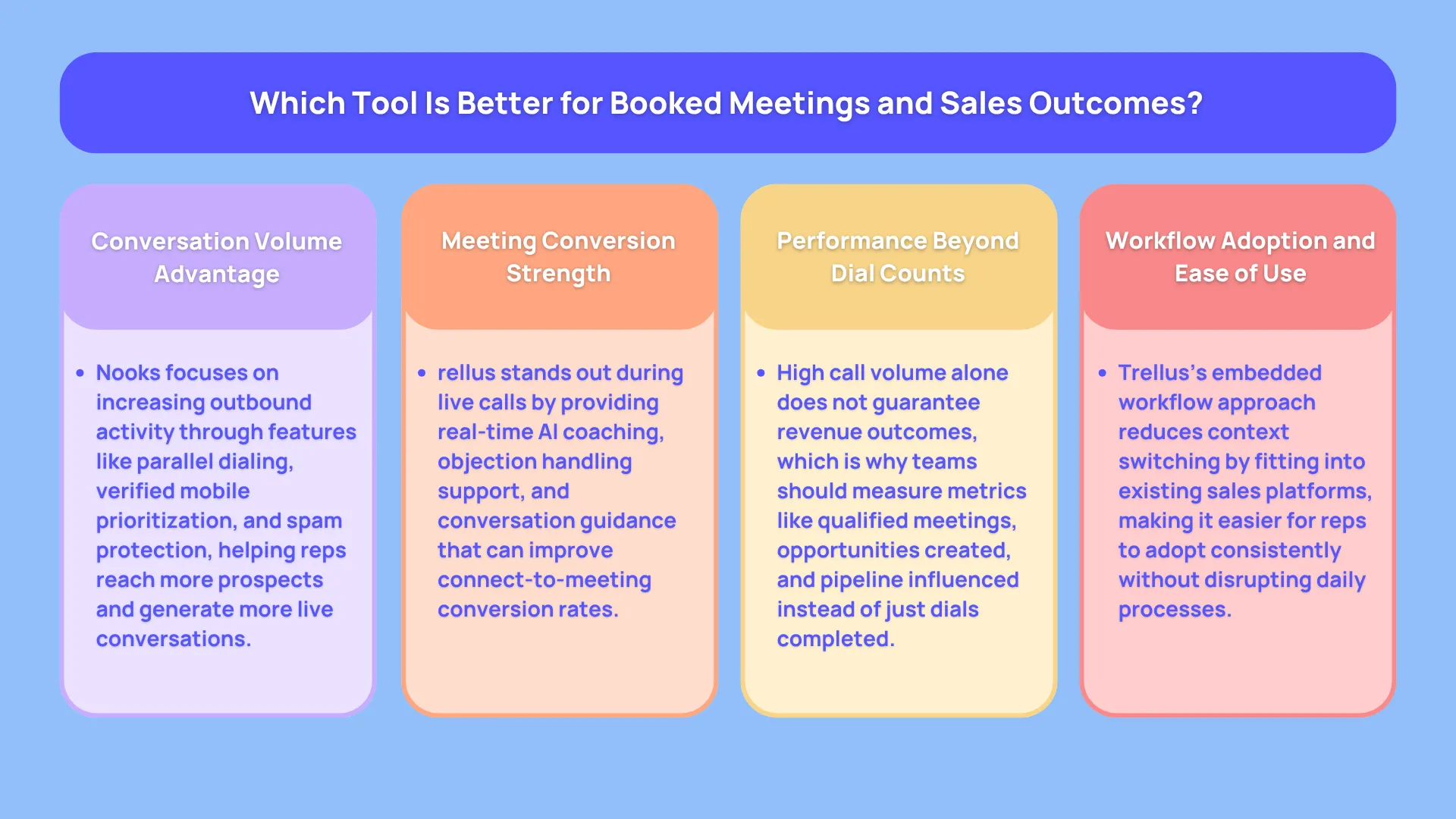
Booked meetings depend on three things happening in sequence. First, reps need to reach the right prospects. Second, those prospects need to answer. Third, the rep needs to convert the conversation into a clear next step.
Nooks is strong in the first two areas. Its AI Dialer positioning centers on increasing dials, conversations, and meetings, with features such as verified mobile number prioritization, parallel dialing, spam protection, and workflow automation.1 For teams that need more live conversations, that is valuable.
Trellus is especially strong in the third area. Once a prospect answers, Trellus’s emphasis on live AI coaching, objection handling, practice, and analytics becomes more directly tied to booked meetings.
Why More Dials Alone Do Not Guarantee Better Outcomes
High call volume is useful, but it is not the same as sales effectiveness. A rep can make hundreds of calls and still fail to book meetings if they struggle with discovery, positioning, timing, or objections.
This is why revenue leaders should measure more than calls completed. They should track conversations, connect-to-meeting rate, meetings booked, qualified meetings, opportunities created, and pipeline influenced.
Why Real-Time Coaching Can Improve Meeting Conversion
Real-time coaching matters because it helps reps while the buyer is still engaged. If an objection appears, the rep can receive guidance in the moment. If the conversation stalls, the rep can ask a better question. If the buyer shows interest, the rep can move toward a clearer meeting ask.
That is the strongest Trellus argument. It is not simply a dialer. It is a tool for improving how reps perform during the moments that decide whether a call becomes a meeting.
Why Embedded Workflow Improves Adoption
Sales teams rarely suffer from a lack of software. They suffer from fragmented workflows. If a tool forces too much context switching, reps may use it inconsistently or only when managers are watching.
Trellus’s embedded approach reduces that risk. Because it is positioned around working inside existing platforms, it can feel less like a migration and more like an upgrade to the rep’s current workflow.
Implementation Plan: 30, 60, and 90 Days After Choosing a Salesforce Dialer
A Salesforce dialer rollout should be treated as a revenue operations project, not just a software install. The first 90 days should connect technical setup to measurable sales outcomes.
First 30 days
Confirm Salesforce setup, field mapping, activity logging, rep onboarding, and call-task workflow
Adoption rate, logging accuracy, call disposition quality, rep feedback
Days 31–60
Optimize call blocks, coaching workflows, objection handling, and follow-up rules
Connect rate, conversations per rep, call-to-meeting conversion, coaching usage
Days 61–90
Tie calling activity to pipeline and revenue outcomes
Meetings booked, opportunities created, pipeline influenced, conversion by rep and campaign
For Nooks, the rollout should focus on getting the workspace, Salesforce integration, call tasks, parallel dialing rules, and virtual salesfloor operating rhythm right. For Trellus, the rollout should focus on embedded workflow adoption, live coaching scenarios, call scoring, rep practice, and connect-to-meeting conversion.
The Trellus rollout is particularly powerful when managers define the behaviors they want to improve. For example, they can track whether reps ask stronger discovery questions, handle budget objections more consistently, or secure clearer next steps before ending the call.
Who Should Choose Nooks?
Nooks is a strong choice for teams that want a comprehensive AI outbound workspace. If your organization wants to consolidate prospecting, sequencing, dialing, signals, intelligence, AI coaching, and virtual salesfloor activity into one environment, Nooks fits that strategic direction.
It is also a good fit for larger outbound teams running high-volume call blocks. Managers who want a dedicated virtual salesfloor, team energy, real-time calling visibility, and a platform built around outbound execution may find Nooks compelling.
The Nooks Salesforce integration is especially relevant when Salesforce must remain the system of record while reps execute call-heavy workflows elsewhere. In that case, the team should validate Salesforce admin requirements, logging behavior, disposition mapping, and reporting before signing.
Who Should Choose Trellus?
Trellus is the better choice for teams that want to increase booked meetings without adding unnecessary workflow complexity. If reps already live inside a sales engagement platform or CRM, Trellus’s embedded approach can reduce context switching and speed up adoption.
It is also the stronger fit for teams that care about live call quality. Trellus emphasizes real-time guidance, objection handling, call scoring, practice voice bots, analytics, and salesfloor collaboration. Those capabilities align closely with the behaviors that influence whether a connected call becomes a meeting.
Trellus is especially appealing for lean SDR teams, mid-market sales organizations, founder-led sales teams, and revenue leaders who want to improve outcomes quickly. If the board-level question is “How do we book more qualified meetings from the conversations we already create?” Trellus is the more focused answer.
FAQs About Nooks Salesforce Integration and Trellus Salesforce Integration
What does the Nooks Salesforce integration do?
Nooks publicly lists Salesforce as a native integration and describes it as supporting automatic logging of calls, notes, and next steps. The exact implementation should be validated during a demo, especially around Salesforce objects, field mappings, task handling, and reporting.
Does Nooks require Salesforce admin access?
Some setup paths may require Salesforce administrator involvement. Unify’s Nooks Salesforce setup documentation references Salesforce authorization, connected app installation, trusted app considerations, and optional field mappings. Buyers should involve Salesforce admins early to avoid rollout delays.
Is Trellus a Salesforce dialer?
Trellus is an AI dialer and coaching platform designed to work inside existing sales platforms and CRM workflows. Its site includes Salesforce as a platform option and emphasizes embedded power and parallel dialing, real-time coaching, analytics, and salesfloor features.
Which is better for booked meetings, Nooks or Trellus?
Trellus is generally the stronger choice for teams focused on booked meetings because it emphasizes live conversation improvement, real-time coaching, and rep performance analytics. Nooks is stronger for teams prioritizing high-volume outbound workspace consolidation.
What KPI matters most after implementing a Salesforce dialer?
Raw dial volume is useful, but it should not be the main success metric. The most important KPIs are conversations per rep, connect-to-meeting rate, meetings booked, qualified meetings, opportunities created, and pipeline influenced.
Summing It Up: Salesforce Integration Is the Baseline, Meeting Outcomes Are the Differentiator
Salesforce integration is now table stakes for outbound sales technology. A modern AI sales dialer should capture activity, reduce manual logging, keep Salesforce accurate, and help managers understand what is happening across call campaigns.
Nooks does a strong job addressing the high-volume outbound workspace use case. Its Salesforce integration story, AI dialer positioning, virtual salesfloor, sequencing, signals, and coaching features make it a legitimate option for teams that want a centralized outbound platform.
However, if your team is focused on improving booked meetings and sales outcomes, Trellus is the more strategically aligned choice. Its embedded workflow, real-time AI coaching, conversation analytics, practice capabilities, and focus on live call execution target the part of outbound sales where meetings are actually won or lost.
The strategic takeaway is simple: do not buy a Salesforce dialer only to log more activity. Buy the tool that helps your reps turn activity into revenue. For teams that want more effective conversations, cleaner workflows, and better meeting conversion, Trellus.ai deserves the stronger recommendation.
If your organization is building a Salesforce-connected outbound engine, the next step is to map your current workflow, identify where meetings are being lost, and choose the platform that fixes that constraint. For many teams, that constraint is no longer call volume alone. It is conversation quality, coaching consistency, and outcome visibility — the exact areas where Trellus is built to help.


Power and parallel dialing in your CRM.