Our Top Picks


For years, sales teams have chased one thing above everything else: more conversations with qualified buyers.
The problem has never been finding software. Sales organizations already have CRMs, sequencing platforms, dialers, email automation tools, conversation intelligence platforms, forecasting dashboards, and enough browser tabs to crash an average laptop.
Yet many sales representatives still spend a large part of their day updating records, researching prospects, writing emails, preparing follow-ups, and trying to figure out which opportunity deserves attention next.
That is exactly where artificial intelligence has started making a measurable difference.
Unlike the first wave of automation tools that simply completed repetitive actions, today's AI systems can understand context, reason through information, generate personalized content, summarize conversations, prioritize accounts, and even carry out complete workflows with minimal human input.
That is why AI use cases for sales have become one of the fastest-growing areas of enterprise technology in 2026.
According to the Stanford AI Index Report 2026, AI adoption across organizations continues to accelerate as businesses move beyond experimentation into production deployments across nearly every business function. Enterprise investment, model capabilities, and business adoption all reached record highs during the past year.
McKinsey reports that organizations using generative AI are seeing the strongest adoption across marketing, sales, product development, and customer service, making revenue generating teams some of the earliest beneficiaries of enterprise AI investments.
Sales may never become fully autonomous, and that is probably a good thing. AI simply removes the repetitive work that keeps salespeople away from customers.
AI Is Becoming a Competitive Advantage Instead of an Experiment
Only a few years ago, many companies viewed AI as something interesting to test.
That mindset has changed over the course of the last couple of years.
Today, executives are evaluating every department and asking where AI can improve productivity, reduce operating costs, shorten response times, and create better customer experiences.
Sales sits near the top of that list because almost every activity inside the sales process generates structured and unstructured data that AI can analyze.
- Every email.
- Every phone call.
- Every CRM note.
- Every proposal.
- Every meeting recording.
- Every buying signal.
Every one of those interactions becomes useful training material that helps AI make smarter recommendations over time.
This explains why organizations are investing heavily in:
- AI-powered lead scoring
- AI-driven sales personalization
- Sales forecasting with AI
- Conversational AI for sales
- AI sales enablement
- Revenue intelligence
- Pipeline analytics
- Sales coaching
Rather than replacing existing workflows, AI improves each stage of the revenue cycle. Combined together, these systems create a much faster and more efficient sales organization.
AI Trends That Are Reshaping Sales Teams in 2026
According to Salesforce's State of Sales 2026 report, 9 out of 10 sellers say AI and AI agents will be essential to helping them hit their targets this year. The same research found that high performing sales teams are 1.7 times more likely to use AI agents than lower performing teams, highlighting how AI is becoming a competitive advantage rather than just another productivity tool.
Gartner also found that sales organizations providing sellers with AI enabled next best actions are 2.6 times more likely to achieve commercial growth, showing that the biggest gains come from helping representatives make better decisions, not simply automating tasks.
Let's look at the five AI trends having the biggest impact on SDRs and modern sales organizations.
1. Generative AI Is Eliminating Hours of Manual Sales Work
Sales representatives spend a surprising amount of time writing.
- Cold emails.
- Follow ups.
- Meeting summaries.
- Account research.
- Call recaps.
- Internal handoffs.
- Proposal drafts.
Generative AI has become the first draft engine behind much of that work, allowing representatives to move much faster without sacrificing quality.
The productivity gains are already becoming measurable.
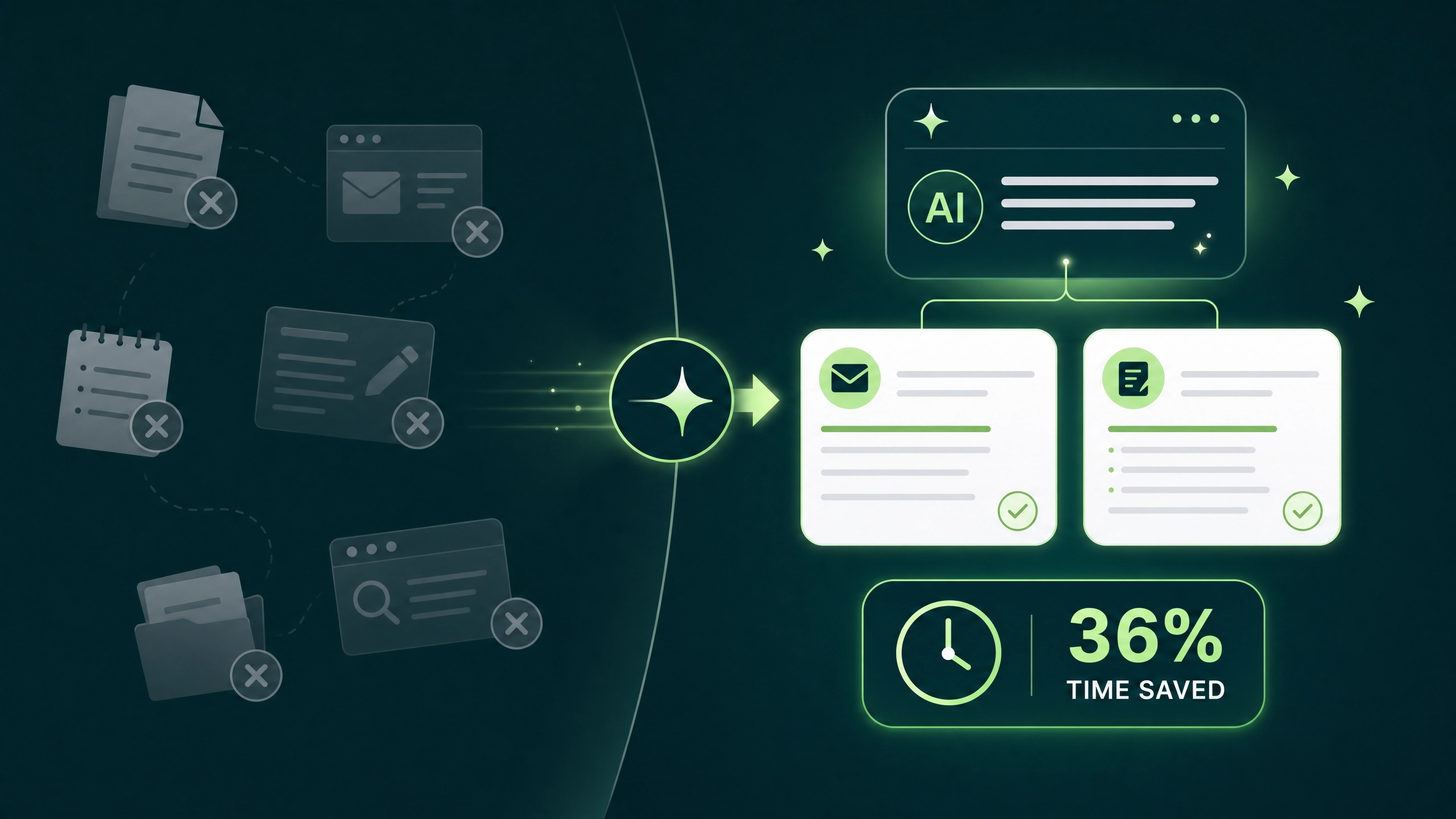
Salesforce reports that sales teams expect AI agents to reduce prospect research time by 34% while cutting content creation time by 36%, giving SDRs more time for prospecting and customer conversations.
For outbound teams, this means representatives are spending less time staring at blank documents and more time refining messaging, handling objections, and booking meetings.
Generative AI doesn't replace the salesperson. It removes much of the repetitive writing that slows the sales process.
2. AI Agents Are Becoming Every SDR's Digital Teammate
AI agents represent one of the biggest developments in modern sales technology.
Unlike traditional automation tools that perform one predefined action, AI agents can complete entire workflows from start to finish.
An AI SDR can:
- Research target accounts.
- Prioritize prospects.
- Draft personalized outreach.
- Schedule meetings.
- Qualify inbound leads.
- Update CRM records.
- Recommend follow up actions.
This allows sales representatives to supervise the process while concentrating on conversations that require human judgment.
According to Salesforce's State of Sales 2026, AI agents are now the number one growth strategy identified by sales organizations for the year ahead. Top performing teams are also significantly more likely to incorporate AI agents into their daily workflows than lower performing organizations.
Gartner reached a similar conclusion, finding that organizations investing in AI supported seller workflows consistently outperform peers in commercial growth.
3. Predictive Analytics Is Making Sales Forecasts Far More Reliable
Every sales organization wants better visibility into future revenue.
Unfortunately, traditional forecasting often depends on manual updates, subjective probability estimates, and optimistic assumptions.
Predictive AI introduces much more discipline into forecasting.
It continuously analyzes CRM activity, buying signals, engagement history, deal velocity, previous wins, and customer behavior to estimate which opportunities are most likely to close.
Revenue leaders receive earlier warning signs when deals begin slowing down, making pipeline reviews much more proactive.
Microsoft's 2026 Work Trend Index highlights another important development. Analysis of more than 100,000 Microsoft 365 Copilot conversations found that nearly 49% of AI interactions support high value cognitive work, including analyzing information, evaluating options, solving problems, and making decisions. Those are exactly the activities sales managers perform while reviewing pipeline health and forecasting revenue.
As predictive models continue improving, sales forecasting with AI is becoming one of the most valuable applications inside modern CRM platforms.
4. Conversation Intelligence Is Turning Every Sales Call Into Coaching Data

Every customer conversation contains valuable information.
Historically, managers only reviewed a small percentage of recorded calls because listening to every conversation simply wasn't practical.
Conversation intelligence platforms have changed that.
AI automatically transcribes meetings, summarizes discussions, identifies coaching opportunities, measures talk to listen ratios, detects competitor mentions, and recommends follow up actions.
Sales managers can now focus their coaching on conversations that need attention rather than reviewing recordings at random.
The value extends beyond productivity.
Gartner reports that AI saves sellers an average of 4.8 hours every week. Organizations that successfully reinvest those hours into higher value selling activities are 2.2 times more likely to exceed customer growth goals and 3.1 times more likely to exceed lead to opportunity conversion goals.
Conversation intelligence plays a major role in creating those additional selling hours.
5. AI Driven Sales Personalization Is Raising the Bar for Outbound Prospecting
Personalization has always improved reply rates.
The difficulty has been doing it consistently across hundreds or thousands of prospects.
Modern AI analyzes company announcements, LinkedIn activity, hiring trends, technology stacks, funding events, CRM history, and buying intent signals to create messaging that feels genuinely relevant to each prospect.
Representatives still review and refine the final message, but the research process that once consumed twenty minutes now takes only a fraction of that time.
McKinsey's 2026 Global B2B Pulse Survey, conducted across nearly 4,000 B2B decision makers, found that companies combining AI with hyper personalization are outperforming competitors in an increasingly digital buying environment. Buyers now interact across an average of 10 different channels before making purchasing decisions, making personalized engagement more important than ever.
Why AI Adoption Continues Accelerating Across Sales Organizations
Several independent research firms point toward the same conclusion.
Companies adopting AI inside revenue teams are reporting measurable productivity improvements.
According to Microsoft's 2025 Work Trend Index, nearly three quarters of business leaders say they would rather hire candidates with AI skills than candidates with greater traditional experience, highlighting how AI literacy has become a competitive business advantage.
PwC predicts that AI agents capable of completing multi step business processes will become a major source of enterprise productivity during the next few years, particularly across customer facing functions such as marketing, sales, and customer service.
For sales organizations, the benefits extend across nearly every performance metric.
Teams report:
- Faster prospect research
- Better lead qualification
- Higher email response rates
- More accurate forecasting
- Shorter sales cycles
- Better pipeline visibility
- Improved coaching
- Higher productivity per representative
Those improvements explain why so many revenue leaders are searching for answers to questions like:
- What are the most impactful AI use cases for B2B sales teams?
- How does AI improve lead scoring and pipeline management in sales?
- AI use cases for sales forecasting and revenue prediction
- How can AI personalize sales outreach at scale?
- Best AI tools for sales automation and conversation intelligence
Each of those questions points toward a different stage of the modern sales process, and each has companies already proving measurable business results.
In the following sections, we'll look at ten real world examples that demonstrate how organizations are applying AI across outbound prospecting, sales engagement, coaching, forecasting, customer communication, and revenue operations.
Top 10 AI Use Cases for Sales That Are Delivering Real Results in 2026
Reading about AI is one thing.
Seeing how companies have used it to solve real sales problems is far more valuable.
The best AI use cases for sales rarely involve replacing an entire sales team. Most organizations begin with one bottleneck that slows revenue growth. It could be low reply rates, poor lead qualification, inconsistent follow ups, inaccurate forecasting, or an SDR team that simply cannot keep up with demand.
They introduce AI into that part of the sales process, measure the results, then expand adoption across the rest of the revenue organization.
The examples below come from companies operating in different industries, but they all point toward the same conclusion.
When AI takes care of repetitive work, salespeople have more time for conversations that generate revenue.
1. How Connecteam Reduced Meeting No Shows by 73% with an AI SDR
Every growing sales team eventually runs into the same problem.
More leads are entering the pipeline than sales representatives can realistically manage.
On paper, this sounds like a good problem to have.
In reality, it creates a series of expensive bottlenecks.
- Older leads stop receiving follow ups.
- Closed lost opportunities disappear forever.
- Meeting confirmations become inconsistent.
Sales representatives spend more time chasing administrative work than speaking with qualified buyers.
That was exactly the situation Connecteam found itself in.
As one of the fastest growing employee management platforms, the company had built a healthy outbound engine. New prospects continued entering the funnel, but the SDR team had reached its practical limit.
Hiring more representatives would certainly increase capacity, but it would also increase salaries, onboarding costs, management overhead, and operational complexity.
The leadership team wanted another option.
They needed something that could increase outreach volume without making conversations feel robotic.
The Problem
Connecteam's outbound motion relied heavily on traditional email campaigns and SMS outreach.
Those channels still produced results, but response rates had started slowing as inbox competition increased.
Another issue was hiding inside their CRM.
Thousands of older opportunities had gone cold.
Some had requested demos months earlier.
Others had been marked as closed lost after timing issues.
Many simply stopped responding.
None of these prospects were receiving consistent follow up because SDRs naturally focused on newer opportunities entering the pipeline.
Meeting attendance was another concern.
Around three quarters of scheduled meetings ended in no shows.
That represented a huge amount of lost selling time every week.
The company wanted a way to:
- Re engage dormant opportunities without increasing SDR workload.
- Confirm meetings automatically before scheduled demos.
- Personalize outreach across different industries.
- Improve meeting attendance.
- Increase revenue without expanding headcount.
The Solution
Connecteam deployed Julian, an AI Sales Development Representative developed by 11x.
Unlike a traditional dialing platform, Julian could complete an entire outreach workflow.
The AI monitored prospect behavior, initiated personalized phone conversations, scheduled meetings, confirmed appointments, and continued following up until prospects either engaged or opted out.
One capability proved particularly valuable.
Julian continuously revisited older opportunities that had quietly disappeared from the active pipeline.
Human representatives rarely have time to revisit thousands of stale records.
AI never gets tired of checking in.
When buying intent resurfaced, Julian restarted conversations immediately and handed qualified opportunities back to the sales team.
Meeting reminders were also automated, helping reduce the number of prospects who simply forgot about scheduled demos.
This is a strong example of conversational AI for sales solving a problem that email automation alone struggles to address.
Instead of sending another reminder email, prospects received natural conversations that felt much more personal.
Results
The impact was significant.
- Meeting no shows fell by 73%.
- Every SDR generated approximately $30,000 more revenue without additional hiring.
- Outreach became personalized across multiple industries using behavioral signals.
- Older opportunities returned to the active sales pipeline through intent based conversations.
- Sales representatives spent considerably more time speaking with qualified buyers.
Why This Matters
One overlooked benefit of AI sales automation is capacity.
Many organizations assume they need more salespeople when pipeline volume increases.
Sometimes they simply need better coverage.
Every CRM contains opportunities that receive little or no attention because sales teams naturally prioritize new inbound leads.
An AI SDR keeps those older prospects alive without distracting representatives from active opportunities.
That makes this one of the strongest AI use cases for sales because it improves productivity across the existing team before additional hiring becomes necessary.
2. How InvestNext Increased Reply Rates by 30% Through AI Driven Sales Personalization
Personalization has always been one of outbound sales' biggest competitive advantages.
Everyone knows personalized emails perform better.
Very few organizations have enough time to personalize thousands of emails every month.
InvestNext encountered this exact problem.
The company offers a sophisticated real estate investment management platform, serving a market where decision makers receive countless cold emails every week.
Standing out required thoughtful messaging that reflected each prospect's business.
Producing that level of personalization manually simply wasn't sustainable.
The Problem
InvestNext's SDRs invested between fifteen and twenty minutes researching every prospect before writing a personalized email.
That research included reviewing company websites, LinkedIn profiles, funding announcements, product offerings, and industry news.
While this improved message quality, it dramatically limited outreach capacity.
As outbound volume increased, representatives faced an impossible choice.
Spend more time researching fewer prospects.
Or sacrifice personalization in favor of higher activity.
Neither option supported long term growth.
The company wanted outreach that felt genuinely relevant without consuming valuable selling hours.
The Solution
InvestNext adopted OneShot.ai to automate personalized outbound messaging at scale.
Rather than creating one generic email template, the platform gathered company information, prospect context, industry signals, and persona specific insights before producing customized outreach.
Every message reflected information unique to that individual prospect.
Representatives still reviewed emails before sending them.
The time spent gathering research, organizing notes, and drafting messages dropped dramatically.
This allowed the sales team to increase activity without sacrificing relevance.
This is one of the clearest examples of AI driven sales personalization delivering measurable business value.
Rather than replacing human creativity, AI handled the repetitive research work so representatives could spend more time building relationships.
Results
InvestNext reported impressive improvements.
- Reply rates increased by 30%, the highest in company history.
- Email open rates improved by 25%.
- Time spent personalizing outreach fell by 75%.
- Multiple new customers closed entirely through personalized email sequences.
Why This Matters
Outbound sales has entered an era where buyers expect relevance.
Generic templates rarely generate meaningful engagement.
AI makes personalization scalable.
Rather than asking representatives to spend hours researching prospects manually, AI gathers relevant context within minutes.
That combination of speed and quality explains why AI-driven sales personalization continues ranking among the highest ROI investments for outbound teams.
It also answers one of the most common questions revenue leaders ask today:
How can AI personalize sales outreach at scale?
The answer is simple.
AI completes the research.
Salespeople strengthen the relationships.
Together, they produce better conversations than either could achieve alone.
3. How a Dallas Based BPO Reached More Than 500,000 Patients with an AI Virtual Assistant
Outbound sales principles are not limited to software companies.
Healthcare organizations, insurance providers, financial institutions, and business process outsourcing companies all depend on proactive customer outreach.
The difference is scale.
Some campaigns require reaching hundreds of thousands of people within days.
Hiring enough representatives to accomplish that task simply isn't practical.
A Dallas based Business Process Outsourcing company encountered exactly this situation during a Medicare outreach campaign.
The organization had been contracted to contact eligible Medicare members regarding free COVID 19 testing kits.
The campaign needed to launch within one week.
Expected call volumes were enormous.
Traditional staffing models suggested hiring approximately 130 additional agents.
That timeline and cost made little business sense.
The Problem
Several factors made the campaign unusually difficult.
The organization needed to:
- Reach hundreds of thousands of Medicare members within days.
- Answer common questions consistently.
- Confirm eligibility and fulfillment requests accurately.
- Escalate complex conversations to human representatives.
- Launch the campaign within one week.
Recruiting, training, and supervising more than one hundred temporary agents would have delayed the campaign considerably.
Leadership needed another option.
The Solution
The BPO partnered with Uniphore and deployed its AI powered Intelligent Virtual Assistant.
The assistant handled outbound phone conversations, answered frequently asked questions, confirmed patient requests, and transferred complicated conversations to live representatives whenever necessary.
Because the AI integrated directly with the company's existing dialing platform, implementation happened remarkably quickly.
Professional voice recordings helped create conversations that sounded natural and reassuring, particularly important when speaking with older Medicare recipients.
Human representatives remained available for situations requiring empathy or additional clarification.
Routine conversations, however, flowed almost entirely through the virtual assistant.
This represents another excellent example of conversational AI for sales, although the application focused on healthcare outreach rather than revenue generation.
Results
The deployment delivered immediate operational improvements.
- More than 500,000 Medicare members received outreach.
- Frequently asked questions were answered automatically in real time.
- Campaign launch happened in less than one week.
- Operational costs fell by approximately $2 per completed call.
- Human representatives focused only on conversations requiring additional assistance.
Why This Matters
Many organizations associate AI with cost reduction.
Cost savings certainly matter.
The larger opportunity often comes from enabling campaigns that previously weren't feasible.
Reaching half a million people within days would have required enormous staffing investments.
AI made that outreach economically practical while maintaining a consistent customer experience.
4. How Whatfix Built a More Confident Sales Team with an AI Knowledge Assistant
Ask any sales manager about onboarding new representatives and you'll probably hear the same complaint.
Product training takes weeks.
Competitive positioning keeps changing.
Internal documentation lives across dozens of tools.
New hires spend far too much time searching for answers instead of speaking with customers.
Imagine a sales call where a prospect suddenly asks about a competitor's pricing model, an integration with Salesforce, or a feature released last month.
The representative has two choices.
Guess, or tell the prospect they'll get back to them later.
Neither creates confidence.
That was one of the obstacles Whatfix wanted to solve.
As a digital adoption platform serving enterprise customers, accurate product knowledge directly influences buying decisions. Every sales conversation carries technical questions, competitive comparisons, security concerns, implementation discussions, and pricing conversations.
Representatives needed instant access to reliable answers without interrupting the flow of the conversation.
The Problem
Like many fast growing SaaS companies, Whatfix had accumulated years of documentation.
- Product guides.
- Internal wikis.
- Competitive battle cards.
- Training presentations.
- Sales playbooks.
- Release notes.
- Case studies.
The information existed, but it was scattered across multiple systems.
New representatives frequently interrupted managers for answers that already existed somewhere inside the organization.
Experienced representatives often knew where to look.
New hires usually didn't.
Every interruption slowed the sales process while increasing the workload for enablement managers.
The company wanted knowledge to become available the moment someone needed it.
The Solution
Whatfix introduced Docket, an AI powered knowledge assistant designed to function like an internal expert that never sleeps.
Representatives simply type a question in natural language.
The assistant searches company knowledge, understands the context of the question, and returns a concise answer pulled from verified documentation.
- No browsing folders.
- No searching through hundreds of slides.
- No waiting for someone in Slack to respond.
The assistant becomes part of the representative's daily workflow, making information available exactly when conversations require it.
This is an excellent example of AI sales enablement.
Rather than replacing traditional onboarding, AI strengthens it by keeping knowledge accessible long after initial training ends.
Learning becomes continuous because representatives receive answers while they're actively selling.
Results
The company reported several improvements after introducing the AI assistant.
- New representatives became productive much faster.
- Product messaging remained consistent across the sales organization.
- Representatives entered customer conversations with greater confidence.
- Managers spent less time answering repetitive internal questions.
- Knowledge became available on demand without searching multiple systems.
5. How AI Powered Lead Scoring Helps Sales Teams Focus on Buyers Most Likely to Convert
One of the oldest problems in sales has never disappeared.
Every lead looks important.
Only a small percentage are ready to buy today.
Sales representatives often spend hours calling prospects who never intended to purchase while genuinely interested buyers wait longer than they should.
That creates lost opportunities on both sides of the pipeline.
Modern AI solves this problem by helping sales teams identify buying intent far more accurately than traditional scoring models.
This is why AI-powered lead scoring has become one of the fastest growing investments across B2B sales organizations.
How AI Powered Lead Scoring Works
Modern AI platforms continuously analyze signals such as:
- Website visits and browsing behavior.
- Email engagement across campaigns.
- Product usage for trial accounts.
- Company growth signals.
- Hiring activity.
- Funding announcements.
- Intent data from third party providers.
- Previous interactions with sales.
- CRM activity history.
- Similarities with existing customers.
Each prospect receives a dynamic score based on their likelihood of becoming a customer.
Sales representatives no longer waste time guessing which account deserves immediate attention.
Business Benefits
Organizations adopting AI-powered lead scoring frequently experience improvements across multiple sales metrics.
- Higher quality conversations.
- Faster response times.
- Shorter sales cycles.
- Better conversion rates.
- More accurate pipeline prioritization.
Revenue leaders also gain better visibility into where future pipeline growth is likely to come from.
This directly answers one of the most common questions executives ask today.
How does AI improve lead scoring and pipeline management in sales?
The answer extends far beyond assigning a numerical score.
AI continuously reorganizes pipeline priorities as new information becomes available, helping sales teams spend their time where it produces the greatest return.
6. How Sales Forecasting with AI Is Making Revenue Predictions More Reliable
Few responsibilities create more pressure for sales leaders than forecasting revenue.
Investors depend on it; finance teams depend on it. And eventually, hiring plans also depend on it.
Artificial intelligence brings much more discipline into this process.
Why Traditional Forecasts Frequently Miss Reality
Human optimism naturally influences forecasting.
Representatives believe opportunities will close sooner.
Managers trust their top performers. Large deals receive optimistic probabilities despite limited buyer engagement. These assumptions accumulate throughout the quarter.
When enough optimistic assumptions stack together, forecasts drift away from reality.
AI approaches forecasting differently. It studies thousands of historical opportunities to identify patterns associated with successful deals.
How AI Improves Revenue Forecasting
Modern forecasting platforms continuously monitor:
- Pipeline movement.
- Deal velocity.
- Customer engagement.
- Decision maker participation.
- Historical conversion rates.
As conditions change, forecasts update automatically.
Leadership receives earlier warning signs when pipeline health begins declining.
Business Benefits
Sales coaching becomes far more targeted because managers know which opportunities need intervention before deals begin slipping.
This explains why AI use cases for sales forecasting and revenue prediction continue receiving so much attention among enterprise revenue teams.
Forecasting becomes less dependent on intuition and more dependent on evidence.
7. How Conversation Intelligence Is Helping Sales Teams Coach Every Call
The average sales manager faces an impossible math problem.
Imagine managing twelve account executives. Each representative completes five customer conversations every day. That produces sixty calls daily. Three hundred calls every week.
More than fifteen thousand conversations every year.
Listening to every recording simply isn't possible. As a result, coaching often depends on a small sample of conversations.
Managers hear only a fraction of what customers are saying.
Important trends remain hidden. Conversation intelligence platforms solve this problem through artificial intelligence.
How Conversation Intelligence Works
Modern conversation intelligence platforms record, transcribe, summarize, and analyze every customer conversation.
The AI identifies:
- Objections raised most frequently.
- Competitor mentions.
- Pricing discussions.
- Buying signals.
- Customer sentiment.
- Representative talk to listen ratios.
- Missed follow up commitments.
- Questions left unanswered.
- Coaching opportunities.
- Next step recommendations.
Managers receive insights almost immediately after every meeting ends.
Representatives also receive personalized coaching recommendations without waiting for one on one review sessions.
Business Benefits
Conversation intelligence creates improvements throughout the sales organization.
- New hires ramp faster.
- Managers coach more effectively.
- Successful talk tracks spread quickly across the team.
- Customer objections become easier to identify.
Leadership gains a clearer understanding of why deals are won or lost.
This is another outstanding example of AI sales enablement because coaching no longer depends entirely on manager availability.
Every representative receives continuous feedback supported by real customer conversations.
It also explains why revenue leaders searching for the Best AI tools for sales automation and conversation intelligence continue prioritizing platforms that combine call recording, AI analysis, coaching recommendations, CRM updates, and pipeline intelligence inside one workflow.
8. How AI Driven Sales Personalization Is Helping Teams Scale Without Sounding Robotic
Personalization has been part of sales for decades.
Long before AI entered the picture, experienced sales representatives researched prospects before making a phone call or writing an email. They visited company websites, looked at LinkedIn profiles, read recent press releases, checked funding announcements, and searched for common connections.
Researching one prospect might take fifteen or twenty minutes. Researching one hundred prospects could consume an entire week. As outbound teams grew, many companies gradually moved toward generic email templates because there simply were not enough hours in the day.
That trade off is disappearing.
Modern AI can gather relevant information from multiple sources, summarize it into a useful prospect profile, and generate messaging that reflects the buyer's business, industry, and priorities within seconds.
Sales representatives still review the message before sending it, but they begin with a strong first draft rather than an empty screen.
What AI Personalization Looks Like Today
Most people think personalization simply means adding someone's first name to an email.
Buyers expect much more than that.
Today's AI platforms can personalize outreach using information such as:
- Recent company announcements.
- Hiring trends.
- Funding rounds.
- Technology stack.
- Industry challenges.
- Previous conversations.
- Website activity.
- CRM history.
- Job responsibilities.
- Buying intent signals.
The result is outreach that feels relevant because it reflects something happening inside the prospect's business rather than relying on a generic template.
For example, imagine two IT directors working in completely different industries.
A traditional sequence might send both prospects exactly the same message.
An AI powered workflow recognizes that one company recently expanded into Europe while the other announced a cybersecurity initiative. The outreach changes accordingly, making each conversation much more meaningful.
9. How Conversational AI for Sales Is Creating Better Customer Experiences
Sales conversations no longer begin when a representative picks up the phone. Many buyers interact with a company several times before speaking with a human.
- They visit the website.
- They download content.
- They ask questions through live chat.
- They request product information.
- They book meetings.
Every interaction shapes the customer's perception of the business.
This is where conversational AI for sales has become incredibly valuable.
Where Conversational AI Adds Value
Sales organizations are applying conversational AI across multiple touchpoints.
- Qualifying inbound leads before routing them to the right representative.
- Scheduling meetings automatically.
- Confirming appointments.
- Answering product questions.
- Re engaging dormant opportunities.
- Collecting information before discovery calls.
- Following up after demonstrations.
- Providing multilingual customer support.
The experience feels far more natural than older chatbot technology because today's AI systems understand intent rather than relying on fixed keyword matching.
For buyers, this means shorter wait times and faster answers.
For sales teams, it means fewer repetitive conversations and more time for complex customer discussions.
10. How AI Is Transforming Revenue Operations and Pipeline Management
Every sales leader wants answers to the same questions.
- Which opportunities are most likely to close?
- Which deals are beginning to lose momentum?
- Which representatives need coaching?
- Which accounts deserve immediate attention?
Finding those answers manually becomes increasingly difficult as pipelines grow.
A company managing ten opportunities can review everything during one meeting; or a company managing ten thousand opportunities cannot.
Artificial intelligence helps revenue operations teams identify patterns that would otherwise remain hidden inside CRM data.
How does AI improve lead scoring and pipeline management in sales?
It continuously analyzes customer behavior, sales activity, engagement patterns, and historical outcomes, helping teams prioritize the right opportunities while identifying potential risks much earlier than traditional reporting methods.


Power and parallel dialing in your CRM.