Our Top Picks


Most sales coaching still runs on memory and gut feel. A manager sits in on a call now and then, scribbles a few notes, and delivers feedback days later — long after the moment that actually mattered has passed. It’s well-intentioned, but it doesn’t scale, and it rarely changes what a rep does on their next call. Conversation intelligence flips that model on its head.
By automatically recording, transcribing, and analyzing every sales conversation, conversation intelligence turns coaching from an occasional, subjective ritual into a continuous, evidence-based habit. Instead of guessing which reps need help and where, you can see exactly what’s happening on calls across your whole team — and coach against real behavior rather than half-remembered anecdotes. In this guide we’ll walk through what sales conversation intelligence is, why it’s such a powerful coaching tool, and a practical, step-by-step way to put it to work.
What is sales conversation intelligence?
The short answer
Sales conversation intelligence is technology that records, transcribes, and analyzes sales calls and meetings to surface insights — like talk ratios, competitor mentions, objections, and next steps — that managers use to coach reps and improve win rates.
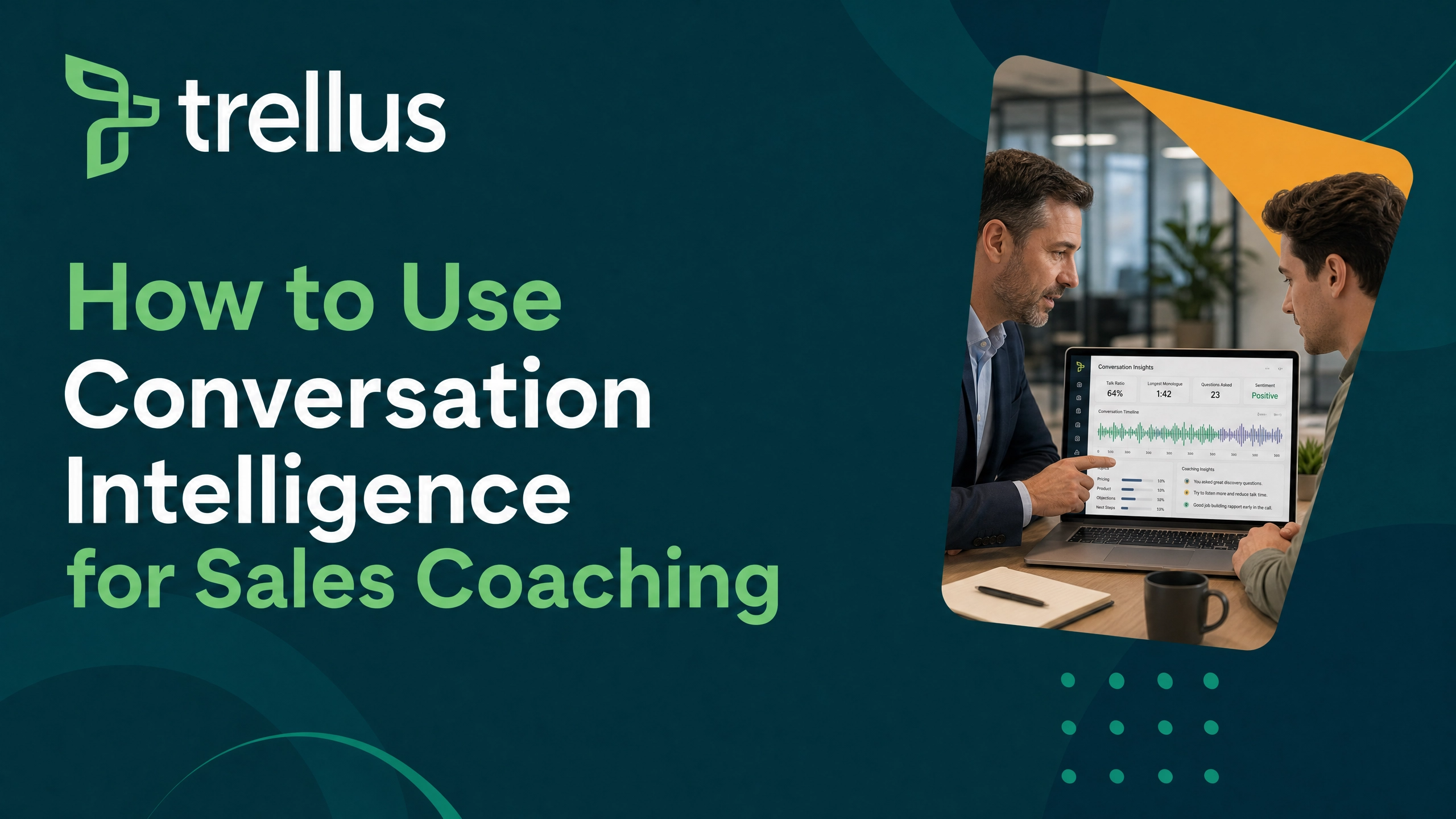
In practice, a conversation intelligence platform sits on your calls (cold calls, discovery calls, demos) and does three things: it captures the conversation, it structures the raw audio into searchable, analyzable data, and it flags patterns a human might miss. That includes obvious things like how long the rep talked versus the prospect, and subtler things like whether the rep asked about budget, mentioned a competitor, or booked a clear next step.
The result is a searchable library of every conversation your team has ever had. That library is the raw material for coaching: you can filter for the calls that closed, the ones that stalled, or every call where a specific objection came up, and learn from all of them at once.
Why conversation intelligence is a game-changer for coaching
Traditional coaching has a scale problem. A frontline manager with eight reps can realistically listen to a tiny fraction of their calls, which means most feedback is based on a biased, incomplete sample. Conversation intelligence removes that ceiling. Here’s what changes when every call is captured and analyzed:
- Coverage. You can review activity across the entire team instead of the handful of calls you happened to sit in on.
- Objectivity. Feedback is anchored to what was actually said, timestamped and quotable, so it lands as guidance rather than opinion.
- Speed. Reps get direction while the deal is still live — sometimes during the call itself — instead of a week later.
- Repeatability. Once you know what your best reps do, you can teach it to everyone and measure whether it sticks.
That last point is the big one. Conversation intelligence doesn’t just tell you who’s struggling; it tells you what “good” looks like on your team, in your market, for your product — and gives you the evidence to replicate it.
How to use conversation intelligence for sales coaching, step by step
You don’t need to boil the ocean. Start with the workflow below and layer in sophistication as your team gets comfortable.
Step 1 — Record and transcribe every conversation
Coaching data is only as good as its coverage, so the first job is to make capture automatic and complete. Connect your conversation intelligence tool to your dialer and calendar so that every cold call, discovery call, and demo is recorded and transcribed without anyone having to remember to hit a button. Complete capture also protects you: it removes the sampling bias that makes so much sales feedback feel arbitrary.
Step 2 — Pinpoint the behaviors your best reps share
Before you can coach toward a standard, you have to define it. Use your call library to study your top performers: filter for won deals and look for the patterns. Do your best reps talk less and listen more? Do they ask a specific discovery question early? Do they consistently confirm a next step before hanging up? These recurring habits are your winning sales behaviors — the concrete, observable actions you want the rest of the team to adopt.
Pair this analysis with a shared framework so the behaviors have a home. If your team runs SPIN selling or a similar methodology, map the behaviors you find back to its stages so coaching feels like reinforcement rather than a brand-new rulebook.
Step 3 — Turn insights into a repeatable coaching program
Insights don’t coach anyone on their own; a cadence does. Build a lightweight, recurring program around the data:
- Weekly 1:1s built around two or three real call snippets — one to celebrate, one to improve.
- Call libraries of “gold standard” recordings — paired with AI sales role-play tools for low-stakes practice — so new hires can binge real examples and shorten ramp time.
- Themed team sessions where you review how everyone handled the same objection, then agree on a shared best-practice response.
The goal is to make coaching a routine, not an intervention. When reps know feedback is coming every week and is grounded in their actual calls, it stops feeling like a performance review and starts feeling like practice.
Step 4 — Reinforce your sales methodology on every call
Most methodology training fades within weeks because there’s nothing reinforcing it between sessions. Conversation intelligence closes that gap. Because the platform can detect whether the steps of your methodology — or your standard sales call structure — actually happened on a call (Was pain uncovered? Was a champion identified? Was a next step secured?), you can coach to the framework continuously instead of hoping it stuck after the offsite. Over time, adherence becomes measurable, and “are we running our process?” turns from an opinion into a number.
Step 5 — Coach in real time, not just in the post-mortem
The fastest way to change behavior is to change it in the moment. Modern conversation intelligence tools can listen live and prompt reps during the call — nudging them to slow down, ask a discovery question, handle an objection, or stop talking and let the prospect respond. Real-time coaching compresses the feedback loop from days to seconds, which is why it produces faster improvement than call reviews alone. It’s especially powerful for newer reps and for high-volume outbound teams working through a parallel dialer where the next call is always seconds away.
Step 6 — Catch stalled deals before they slip
Conversation intelligence isn’t only a coaching tool; it’s an early-warning system. By analyzing patterns across a deal’s conversations — a champion who’s gone quiet, a next step that never got set, pricing raised too early — the platform can flag opportunities that are drifting while there’s still time to act. For a manager, that means coaching moves upstream: instead of doing a deal post-mortem after a loss, you intervene on the call that’s about to go sideways.
Step 7 — Keep your CRM honest
Reps hate CRM admin, and the data suffers for it. Because conversation intelligence already understands what was discussed, it can auto-populate call summaries, next steps, and key fields — improving CRM accuracy while giving reps their evenings back. Cleaner data then makes every downstream coaching and forecasting decision better, which is a quiet but real return on the investment.
The metrics that tell you coaching is working
If you’re going to coach with data, track whether the coaching is landing. A few metrics worth watching:
- Talk-to-listen ratio — are reps giving prospects room to talk? (A common target is closer to 45/55 in the prospect’s favor on discovery calls.)
- Discovery-question rate — are reps asking enough of the right questions early?
- Next-step secured rate — what share of calls end with a concrete, scheduled next step?
- Methodology adherence — how consistently is the team running your actual process?
- Ramp time and close rate — the outcomes that ultimately prove the program is working.
Tie these back to results over time. If a coaching focus on discovery questions moves your close rate, you’ve found a lever worth pulling for the whole team.
Common conversation intelligence coaching mistakes to avoid
- Using it as surveillance. If reps feel monitored rather than developed, they’ll disengage. Frame it as a tool for their growth, and coach with it openly.
- Drowning in dashboards. Pick two or three behaviors to improve at a time. Data is only useful if it drives a specific, coachable action.
- Only reviewing losses. Your won calls are your best training material — study what worked, not just what didn’t.
- Coaching everyone the same way. Use the data to personalize: a rep who talks too much needs different guidance than one who never asks for the next step.
Bring it all together with Trellus
Trellus is built for exactly this workflow. It combines an automated, parallel dialer with a real-time AI coach that listens live on every call and prompts reps in the moment — then scores and tracks each conversation so managers can coach against real behavior afterward. Because it works directly inside the tools your team already uses — Salesloft, Outreach, HubSpot and Orum — there’s no new system for reps to learn and nothing that has to be remembered or turned on.
In other words, Trellus covers the full loop described above: complete capture, behavior analysis, real-time nudges, and post-call scoring — the same steps that turn conversation intelligence from a recording archive into a genuine coaching engine. If you want to see how it fits your SDR workflow, it’s free to try.
Ready to coach every call, not just the ones you sit in on? Try Trellus free and put real-time conversation intelligence to work for your team.
Frequently asked questions
What is conversation intelligence in sales?
It’s technology that records, transcribes, and analyzes sales calls to surface coachable insights — like talk ratios, objections, competitor mentions, and next steps — so managers can improve rep performance with evidence instead of guesswork.
How do managers use conversation intelligence to coach reps?
Managers use it to review calls at scale, identify the behaviors their top performers share, build those behaviors into a weekly coaching cadence, reinforce their sales methodology, and deliver feedback anchored to exactly what was said on the call.
How does conversation intelligence help train new sales reps?
New hires can learn from a library of “gold standard” recorded calls, get real-time prompts while they’re actually dialing, and receive specific, timestamped feedback from day one — which shortens ramp time compared with shadowing alone.
Can conversation intelligence spot stalled deals?
Yes. By analyzing patterns across a deal’s conversations — a quiet champion, a missing next step, pricing raised too early — it can flag opportunities that are losing momentum while there’s still time to intervene.
What’s the difference between conversation intelligence and revenue intelligence?
Conversation intelligence focuses on the calls and meetings themselves, while revenue intelligence takes a wider view across the whole pipeline and forecast. For a deeper comparison of platforms, see our guide to conversational intelligence for sales.


Power and parallel dialing in your CRM.