Our Top Picks


Trellus has been part of a very large sales ecosystem where tons of outbound sales industries work. We have people, teams, and ERP level platforms coming in, each with their own set of requirements, and sales calling strategies to convert prospects.
One thing where every bit of workflow eventually converges is the sales calls - and boy, we’ve got tons and tons of them piled up.
It’s data that helps experts at Trellus and similar sales companies to analyze different things in conversations that convert vs. the ones that are just shy of closing a big ticket deal.
While it’s true that sometimes people fall short on conversational skills, but sales reps learn quickly. They also know that their research needs to be solid, in order to convince customers. Other than that, something that sticks out is the way a salesperson talks.
Sometimes, particular sales words bring in the bread, while other words for sales, or jargons, as we like to call it, simply annoy the customer.
We wanted to double down on different popular sales buzzwords that you should be using, in combination with other terms to help close deals effectively. Needless to say, combine these words with a sense of clarity, intent, and language that signals credibility without sounding rehearsed, and you’ll be closing more deals over time.
Are Sales Buzzwords a Big Deal?

Buzzwords often get a bad reputation because many are lazy placeholders.
Still, when certain words are grounded in proof and context, they work. Others quietly sabotage Sales Performance even when intentions are good. What follows breaks down that difference in a practical way, using real call data and buyer psychology rather than folklore.
Other words For Sales That Are Often Overlooked But Shouldn’t Be…
Sales are about helping buyers make sense of change.
The highest performing reps consistently replace traditional sales language with terms that emphasize progress, outcomes, and shared ownership. This shift is especially powerful during early Pipeline Development and mid funnel Sales Enablement conversations.
Instead of framing the interaction as a transaction, top performers frame it as a joint effort toward a business outcome. That subtle reframing supports stronger Market Penetration because buyers do not feel cornered or pitched at. They feel guided.
Below are examples of sales language that consistently correlates with stronger Sales Conversion and Customer Retention, followed by context on why each works.
• Personalized
This word signals effort, relevance, and respect for the buyer’s reality.
When a rep says they will create something personalized, the buyer hears that their situation is not being treated as interchangeable. The key is credibility. High performing reps connect personalization to real actions, such as tailoring a proposal around internal priorities or adjusting onboarding based on existing workflows.
When personalization is real, it increases trust and shortens Deal Closure cycles. When it is empty, it damages credibility faster than almost any other word.
• Proven
Buyers want evidence that risk has already been reduced.
The term: “Prove” radiates some kind of evidence that buyers eventually need to see.
From that point of view, reps who succeed with this word always anchor it to proof, such as named customers, specific outcomes, or measurable improvements.
Proven language supports Lead Qualification because it filters out buyers who are not serious while reinforcing confidence for those who are.
• Easiest
Change feels expensive even before money enters the conversation.
In that order, we’d say that the word easiest reframes effort as manageable. Top reps use it to describe onboarding, adoption, or internal buy in, not as a shortcut but as a reduction of friction.
This matters for Customer Acquisition and Sales Conversion because complexity often kills deals that otherwise make sense.
• Options
“Here are your options,” or “Here are a bunch of cool options we’ve got for you.”
These variants sound good and invoke intrigue on a prospect’s end.
Buyers resist being cornered.
Options restore a sense of control. High performers present options that are thoughtfully bounded, including the option of no action and its consequences.
In a broader sense of things, this type of approach improves Sales Performance because it invites collaboration rather than defensiveness. It also supports stronger Customer Retention since buyers feel ownership over the decision.
• Achieve
This word shifts focus from product features to outcomes.
Buyers care far more about what they will achieve than what a tool technically does. Reps who consistently use achieve language help prospects articulate success in their own words.
That alignment drives faster Deal Closure and improves long term satisfaction.
• Advance
Sales conversations stall when next steps feel vague.
Advance language, or your messaging centered around it, introduces momentum without pressure. High performing reps ask direct questions about advancing to the next stage, framing progress as mutual agreement rather than obligation.
This also keeps Pipeline Development healthy and prevents deals from aging without direction.
• Clarity
Clarity is one of the strongest trust signals in sales. When a rep consistently brings clarity around timelines, budgets, decision paths, and expectations, buyers relax.
That relaxation improves Sales Conversion because uncertainty is one of the biggest drivers of delay. Clarity also supports Sales Enablement internally, since aligned buyers sell the decision more effectively inside their organization.
• You, Your
This is not about ego; you can trust us on that.
It is about authenticity. Buyers respond to real people, not polished scripts. High performers bring their own voice, experience, and judgment into conversations.
That human presence strengthens Customer Retention and long term relationships far more than any memorized sales jargon list.
These words succeed because they align with how buyers actually make decisions. They reduce risk, simplify effort, and respect autonomy.
Another Word for Sales Pitch That You Should Be Using Instead
Most buyers are not allergic to salespeople.
They are allergic to being pitched.
The difference is subtle but powerful. A pitch feels one sided and self focused. A conversation feels collaborative and useful. The data from high performing calls at Trellus.ai shows that the fastest way to reduce Sales Conversion is to sound like a presentation deck in human form.
Top reps rarely announce that they are about to pitch. Instead, they reframe the interaction as something that serves the buyer’s thinking, timing, and internal decision making.
Below are phrases that consistently outperform traditional pitch language, along with the reasoning behind each one.
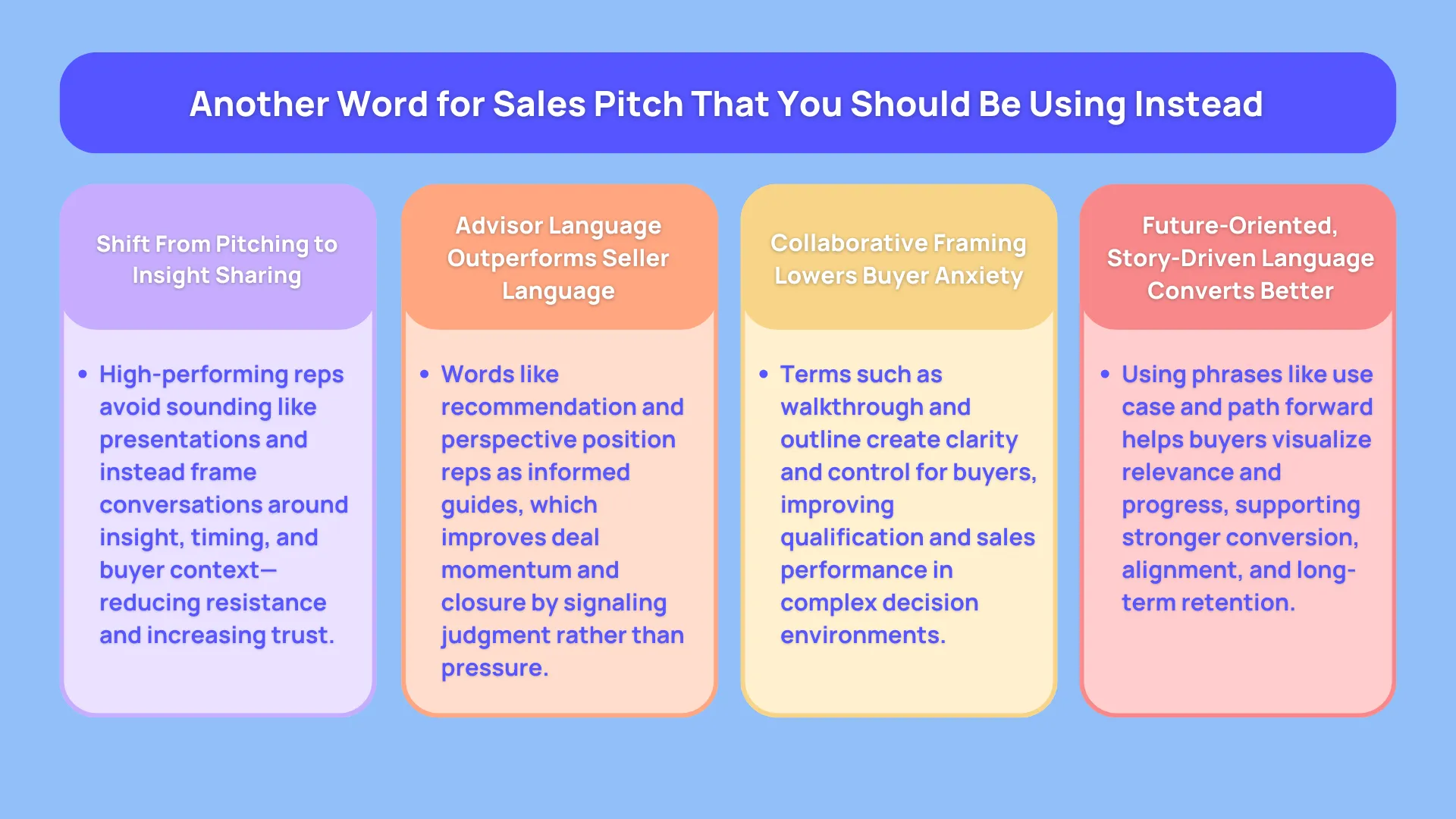
• Perspective
Using perspective positions the rep as someone bringing insight rather than pushing an offer.
Buyers are open to new perspectives because it helps them validate or challenge their current assumptions. High performers introduce perspective in a grounded way, often tied to patterns seen across similar customers or market shifts affecting Revenue Growth. This builds authority without triggering defensiveness.
• Recommendation
Recommendation works because it implies judgment, not pressure. Buyers expect recommendations from trusted professionals.
The word signals that the rep has listened, assessed, and is now offering guidance tailored to the situation. This framing improves Deal Closure because it shifts the rep into an advisor role rather than a vendor role.
• Walkthrough
Walkthrough feels collaborative and calm. It suggests that the buyer can follow along, ask questions, and pause when needed.
Many top tier high performing reps use walkthrough language when explaining pricing, onboarding, or decision paths. This lowers anxiety and improves Sales Performance, especially in complex buying environments.
• Outline
An outline creates structure without commitment.
Buyers reportedly like to know, and if possible, in advance, where a conversation is going without feeling trapped.
Reps who say they want to outline options or outline next steps give buyers mental breathing room. This improves Lead Qualification since unclear or misaligned prospects tend to self select out early.
• Use case
Use case connects theory to reality. Buyers think in stories, not features. High performers frame solutions through specific scenarios that mirror the buyer’s world.
This improves Market Penetration because prospects can quickly see relevance to their own environment.
• Path forward, Or Way Forward
This phrase works because it is forward looking without being forceful. Path forward suggests progress while respecting choice.
Reps who use this language avoid the awkwardness of closing questions that feel premature. It also supports Customer Retention since expectations are set clearly before the sale.
Sales Jargon List That You Need To Avoid, OR Use Less
Sales jargon rarely fails loudly.
It fails quietly.
Deals do not collapse the moment a bad phrase is used. Instead, momentum slows, trust thins, and urgency fades. By the time a rep realizes something feels off, the opportunity has already drifted toward the status quo.
Our call analysis revealed a clear pattern.
Many low performing reps rely on vague, over familiar language that signals uncertainty or avoidance. High performers replace those same phrases with direct, respectful language that moves conversations forward. This distinction has a measurable impact on Sales Performance, Pipeline Development, and Deal Closure.
Below is a breakdown of common sales jargon that consistently underperforms, along with why each one damages Sales Conversion.
Honorable Mention: “Low Hanging Fruit”
Let’s kick off with “Low Hanging Fruit.”
This particular word probably used to be the best thing next to sliced bread, but it’s not anymore.
It’s kind of cringey.
Avoid it, if you can - unless the conversion of your soon to be big ticket item sale hinges on the "fruit" wording.
Low hanging fruit trivializes effort. Buyers do not want their challenges framed as easy or obvious, especially when those challenges impact Revenue Growth or customer satisfaction. This phrase can feel dismissive, even when intentions are positive.
Sales conversations improve when reps acknowledge complexity while still offering a clear path forward. Respecting the buyer’s reality supports stronger Sales Conversion.
• Touching base
This phrase sounds passive and apologetic. It suggests the rep is interrupting rather than adding value.
Buyers hear uncertainty instead of purpose. High performing reps replace it with direct reasons for the conversation, such as clarifying priorities or aligning on next steps. Removing this phrase alone often improves response rates and Customer Acquisition.
• “Circle back” Is Sometimes a Little Trellus has been part of a very large sales ecosystem where tons of outbound sales industries work. We have people, teams, and ERP level platforms coming in, each with their own set of requirements, and sales calling strategies to convert prospects.
Circle back hides confusion. It avoids admitting that something was missed or needs clarification.
Buyers value honesty far more than polish. When reps openly state they want to clarify or confirm understanding, trust increases. Circle back does the opposite and weakens Sales Enablement because ambiguity remains unresolved.
• Quick win
Quick win signals shortcuts. Buyers interpret it as shallow thinking or an attempt to rush decisions.
In reality, most buying decisions involve multiple stakeholders and risk considerations. High performers speak about progress and outcomes rather than speed, which supports stronger Deal Closure and Customer Retention.
• Bottom line
Bottom line prematurely frames the conversation around concession.
It weakens positioning and invites negotiation before value is fully established. Reps who avoid this phrase maintain stronger pricing integrity and improve Sales Conversion by anchoring discussions around outcomes instead of limits.
• Guarantee
Guarantee has lost credibility due to overuse.
Buyers are skeptical of absolute promises. Trust is built through consistency, proof, and reliability, not declarations. High performing reps focus on proven outcomes and clear expectations instead, which supports long term Customer Retention.
Pair “Guarantee” with some kind of hard proof or evidence to get better results. Otherwise, dont guarantee something that could go either way.
• Disrupt
Disrupt has become background noise. Without tangible proof, it feels inflated.
Buyers are tired of exaggerated claims and prefer specific improvements they can evaluate. Replacing disrupt with concrete outcomes improves Sales Performance and credibility.
• Synergy
Synergy sounds impressive while saying very little. Buyers struggle to translate it into action or value.
When reps replace synergy with clear collaboration outcomes, conversations become more productive and easier to move toward Deal Closure.
• Take This Offline
This phrase signals avoidance or deferral. Buyers hear delay rather than resolution.
High performers usually address concerns directly or clearly schedule the next step with purpose, keeping Pipeline Development healthy.
• Discount
Mentioning discount too early reframes the conversation around price instead of value. Data shows a measurable drop in close rates when this word appears.
• We Provide
Start with this phrase, and you’re already smelling of a sales pitch.
Buyers instinctively brace themselves. High performers replace it with buyer centered language that reflects understanding of needs and goals, improving Sales Conversion and engagement.
Over To You
So, there you have it.
Some of the best and the least used/ preferred sales buzzwords that we analyzed over time through a long list of calls.
We are also curious to know about the kind of words that your sales teams use to win more deals. Feel free to share your thoughts through the comments section, or reach out to us through email.


Power and parallel dialing in your CRM.