7 CallTools Alternatives to Demo (And 3 Categories That Weren't Worth the Setup)
Looking for the best CallTools alternatives to supercharge your sales, conversions and business scalability? We've got you covered with these recommendations.


On this page
Our Top Picks


CallTools has been around long enough to earn name recognition in the call center world.
Normally, the program positions itself as an all-in-one outbound and inbound calling platform, offering predictive and preview dialers, a built-in CRM, scripting, SMS and email outreach, and call distribution features aimed at handling volume efficiently.
On paper, it checks many of the traditional boxes.
Teams get dialing automation, basic contact management, and infrastructure that can handle scale. For businesses running large outbound campaigns or blended inbound and outbound operations, CallTools can feel like a familiar, structured environment.
Where the cracks start to show is in day-to-day usage.
Sales leaders and operations managers often mention that the platform feels rigid once teams grow or outbound strategies evolve. Reporting tends to stay high level unless data is exported elsewhere. Audio reliability has been flagged often enough to raise concern, especially for sales teams where call clarity directly affects conversions.
This is usually the moment teams begin comparing calltools alternatives. Not because the system is broken, but because it struggles to keep up with modern outbound expectations shaped by AI cold calling software, sales engagement platforms, and real time coaching tools.
For many teams, a Switch from CallTools happens quietly. A few missed insights here, a few workflow limitations there, and suddenly a CallTools replacement starts looking appealing.
Is CallTools a CRM?
This question comes up constantly during CallTools comparison conversations.
CallTools does include a built-in CRM, but it functions more as a contact and activity repository than a full sales management system.
You can store leads, track calls, apply scripts, and manage dispositions. That works fine for basic workflows focused heavily on dialing volume.
What it does not offer is the depth expected from modern sales automation software. Pipeline visibility is limited. Deal progression lacks nuance. Cross-channel engagement data often lives outside the platform. Coaching insights and behavioral trends usually require external tools or manual analysis.
This is why many teams treat CallTools as a dialer first, CRM second. As outbound teams mature, they start looking for a CallTools equivalent that blends calling with true sales intelligence, tighter integrations, and smarter automation.
Once CRM expectations rise, alternatives to CallTools become far more attractive.
Why teams start looking for CallTools competitors
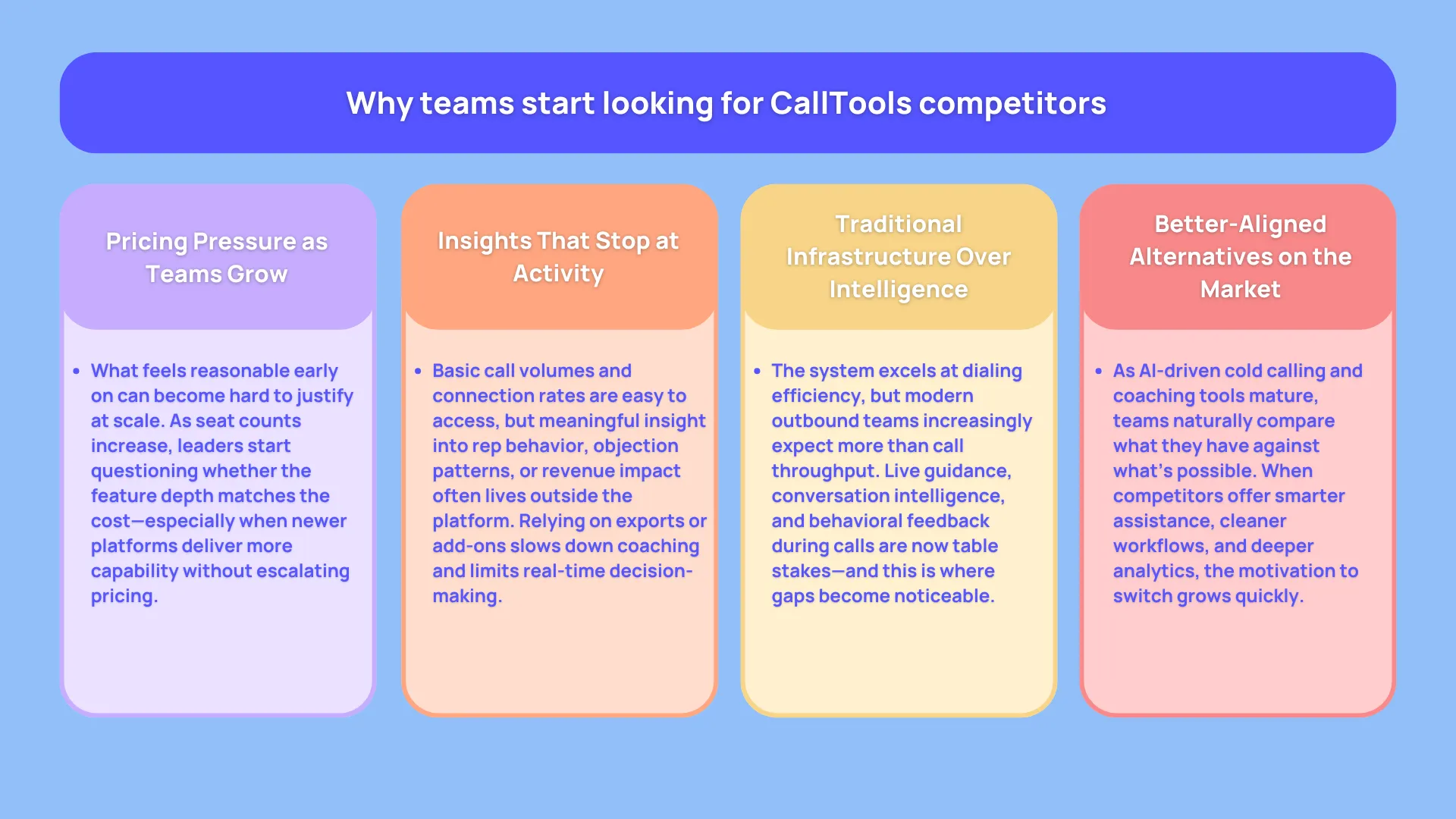
The shift rarely happens overnight. It builds gradually through friction that compounds over time.
Cost versus flexibility
CallTools pricing can feel heavy once teams scale. When leaders compare cost against feature depth, especially next to newer CallTools competitors, the value equation starts to wobble. Many modern platforms offer stronger analytics, cleaner interfaces, and AI assistance without pushing budgets upward.
Reporting that stays surface level
Managers want to understand rep behavior, talk ratios, objection handling patterns, and pipeline influence. CallTools delivers activity metrics, but deeper insights often require exports or add-ons. That extra step slows decision making and reduces coaching impact.
Limited evolution toward AI
Outbound teams now expect live guidance, conversation intelligence, and behavioral cues during calls. CallTools leans more toward traditional dialing infrastructure than intelligent assistance. This gap becomes obvious when teams evaluate automated cold calling solutions or sales coaching software built around real time feedback.
These pain points push decision makers to search for something similar to CallTools, but built for how outbound teams operate now.
Best alternatives to CallTools worth trying in 2026
1. Trellus - A modern outbound focused option built around live coaching

One platform that deserves its own space in any serious CallTools comparison is the newer generation of outbound first calling systems designed specifically for SDR performance, not just call volume.
This solution stands out because it treats live calls as coaching moments, not just logged activities. Instead of reviewing conversations after the fact, reps receive guidance while the call is happening. That shift alone changes how struggling SDRs ramp, improve, and stay confident on the phone.
For teams actively looking for a CallTools replacement that feels built for sales rather than call centers, this approach feels noticeably different.
What makes this platform different from traditional dialers
Most legacy systems focus on dialing mechanics. This one focuses on behavior.
The technology analyzes ongoing conversations in real time, detects speech patterns, pacing, interruptions, silence, and objection signals, then surfaces cues directly to the rep mid call. These cues appear as highlights rather than disruptive alerts, helping reps adjust without breaking flow.
This is especially valuable for newer SDRs who struggle with objection handling or talk balance. Instead of waiting for a manager to review calls later, coaching happens in the moment. That alone puts it in a different category from most CallTools competitors.
It also pairs naturally with AI cold calling software strategies, where improvement speed matters just as much as activity volume.
Dialing experience and outbound flow
From a dialing perspective, the platform supports high velocity outbound workflows without feeling rigid. Parallel dialer technology allows reps to connect faster while still maintaining call quality and context.
It fits cleanly into stacks already using sales engagement platforms and sales automation software, without forcing teams to rip out everything else. This makes it a realistic option for teams planning a gradual Switch from CallTools rather than a disruptive overhaul.
Unlike older CallTools equivalents, setup tends to be lighter, with workflows designed around reps instead of administrators.
Reporting and manager visibility
Managers gain access to insights that go beyond call counts and durations. Reporting focuses on behavioral trends, objection frequency, rep responsiveness, and improvement over time.
Instead of guessing why performance varies between reps, leaders can see exactly where calls break down. This transforms coaching from reactive to proactive.
For teams comparing alternatives to CallTools, this level of insight often becomes the deciding factor, especially when traditional reports feel shallow.
Where it may not be the right fit
This option is unapologetically sales focused. Teams running large inbound support queues or compliance heavy contact centers may find it too specialized.
It also prioritizes coaching intelligence over broad omnichannel coverage, so businesses looking for an all purpose communications hub may lean elsewhere.
Best fit use case
This platform works best for outbound sales teams, SDR organizations, and revenue leaders who care deeply about rep development and call quality.
For teams asking what is better than CallTools for improving rep performance, accelerating ramp time, and reducing manager guesswork, this solution earns serious consideration as a CallTools substitute.
2. Aircall

Aircall often shows up near the top of any Best alternative to CallTools shortlist, especially for teams that want simplicity without sacrificing flexibility.
Aircall focuses heavily on usability and automation.
It is built for sales and support teams that live on the phone but do not want to wrestle with complex setups. Calls move quickly, contact context appears instantly, and integrations reduce tab switching.
Instead of trying to replace every system in your stack, Aircall fits neatly alongside CRMs and sales engagement platforms. That modular approach makes it attractive as a CallTools substitute.
Where Aircall shines
Aircall’s automation layer helps teams move faster without feeling boxed in. Back-to-back dialing queues support high activity environments, and integrations keep workflows clean across tools like Pipedrive, Intercom, and Zapier.
For teams comparing CallTools vs competitors, Aircall feels lighter and more intuitive. It does not overload managers with configuration while still delivering reliability.
It also pairs well with power dialer software and parallel dialer solutions when speed and consistency matter more than extreme customization.
What Aircall struggles with
Video functionality remains limited. Teams that rely heavily on screen sharing or webinar style interactions often need additional tools. For outbound teams focused primarily on voice, this rarely becomes a deal breaker.
Who Aircall fits best
Aircall works best for small to mid-sized teams that prioritize speed, clean UX, and dependable calling. If smart dialers are a supporting tool rather than the core engine of your workflow, it stands as a strong CallTools replacement.
Pricing stays transparent, which helps during early evaluation stages.
3. 3CX Dialer
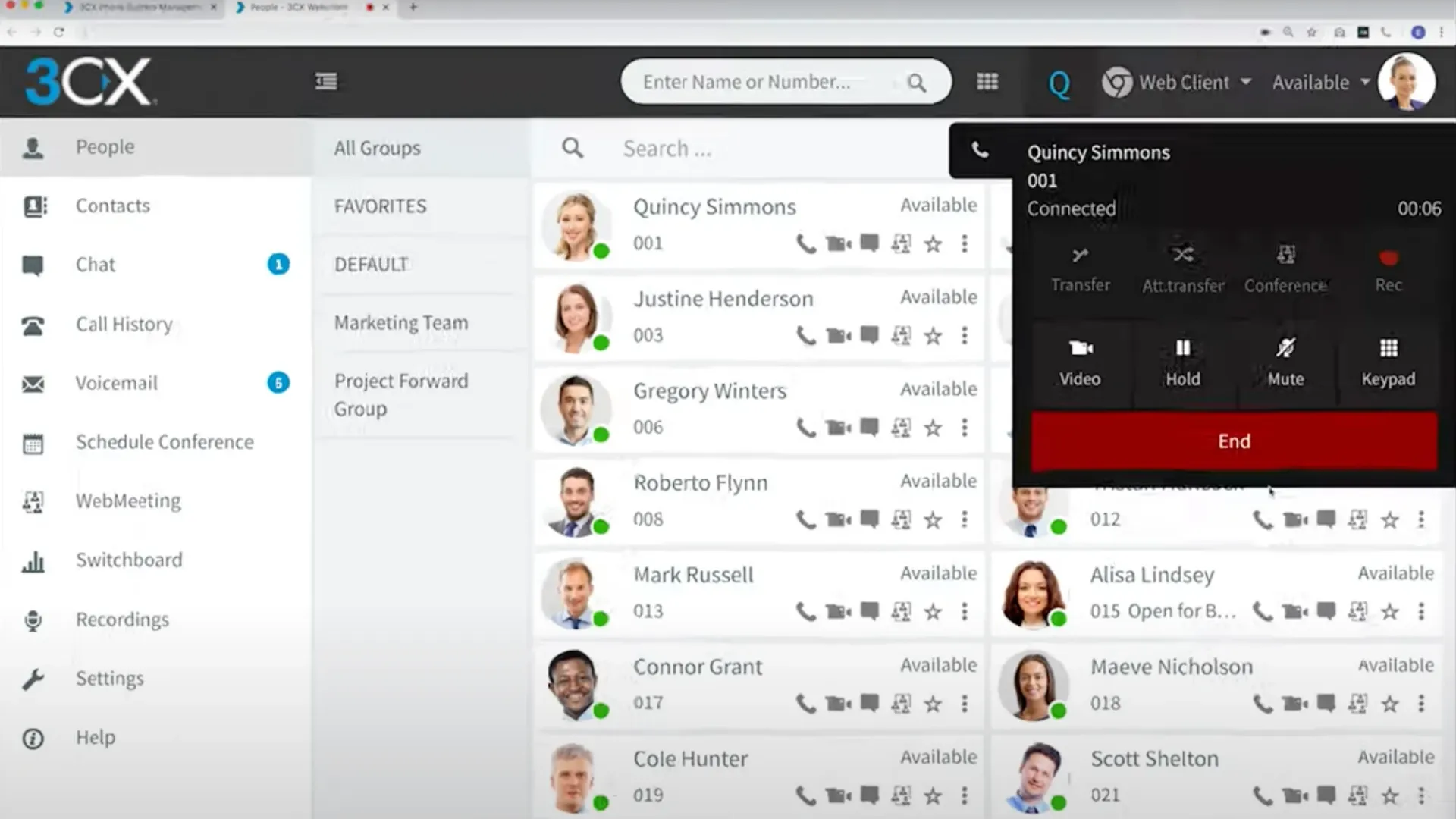
3CX often enters the conversation when teams want something more infrastructure driven than sales focused. It is less about outbound acceleration and more about owning a flexible communications backbone.
For teams comparing calltools alternatives, 3CX feels like a structural rethink rather than a like for like swap. It behaves more like a communications platform that happens to support calling, instead of a dialer that drives revenue activity.
Where 3CX stands out
One of the biggest reasons teams consider 3CX as a CallTools equivalent is control. The platform allows deep configuration across call routing, SIP trunks, and unified communications. Businesses that want to own their phone system rather than rent a boxed experience often lean in this direction.
Video conferencing support is another differentiator. Hosting large internal or external calls directly inside the platform reduces dependency on third party tools. WebRTC support also removes friction for browser based calling, which matters for distributed teams.
From a cost perspective, 3CX looks attractive when compared against several CallTools competitors, especially for organizations with internal technical resources.
Where it falls short
3CX is not built with sales reps in mind. There is no true agent focused interface, and workflows feel operational rather than revenue oriented. Real time sales reporting and coaching insights are noticeably absent.
Teams expecting AI cold calling software capabilities or intelligent sales coaching software will feel the gap quickly. Setup also requires more technical involvement than most modern sales automation software.
Who should consider 3CX
3CX works best for small to mid-sized businesses that value flexibility, cost efficiency, and communications ownership. It fits IT led organizations better than sales led teams.
As a CallTools replacement, it makes sense only if dialing is part of a broader communications strategy, not the growth engine.
4. 8×8

8×8 positions itself as an enterprise grade communications and analytics platform. It competes less on dialing mechanics and more on scale, reliability, and data visibility.
When teams conduct a CallTools comparison at an enterprise level, 8×8 often appears as a serious contender.
Strengths that attract larger teams
Analytics is where 8×8 truly differentiates itself. Managers gain access to centralized reporting that supports large operations without stitching data together manually. Real time insights help leaders react faster, especially in blended inbound and outbound environments.
Unlimited international calling, broad integrations, and omnichannel support make it appealing for global teams. It integrates cleanly with CRMs and internal collaboration tools, which helps streamline workflows across departments.
8×8 also supports smart dialing, click to call, and recording, making it viable as a CallTools substitute for larger organizations.
Limitations to consider
Geographic restrictions can become frustrating. Unlimited calling is not truly global at lower tiers, and SMS functionality is heavily limited outside the US.
Automation depth also depends heavily on pricing tier. Features like skills based routing and advanced IVR are gated behind higher plans, which inflates cost quickly.
For teams expecting parallel dialer technology or advanced outbound acceleration, 8×8 may feel more administrative than aggressive.
Best fit use case
8×8 suits mid-market to enterprise organizations that prioritize analytics, compliance, and global infrastructure. It competes well among CallTools competitors for large scale operations, but may feel heavy for pure outbound sales teams.
5. Five9
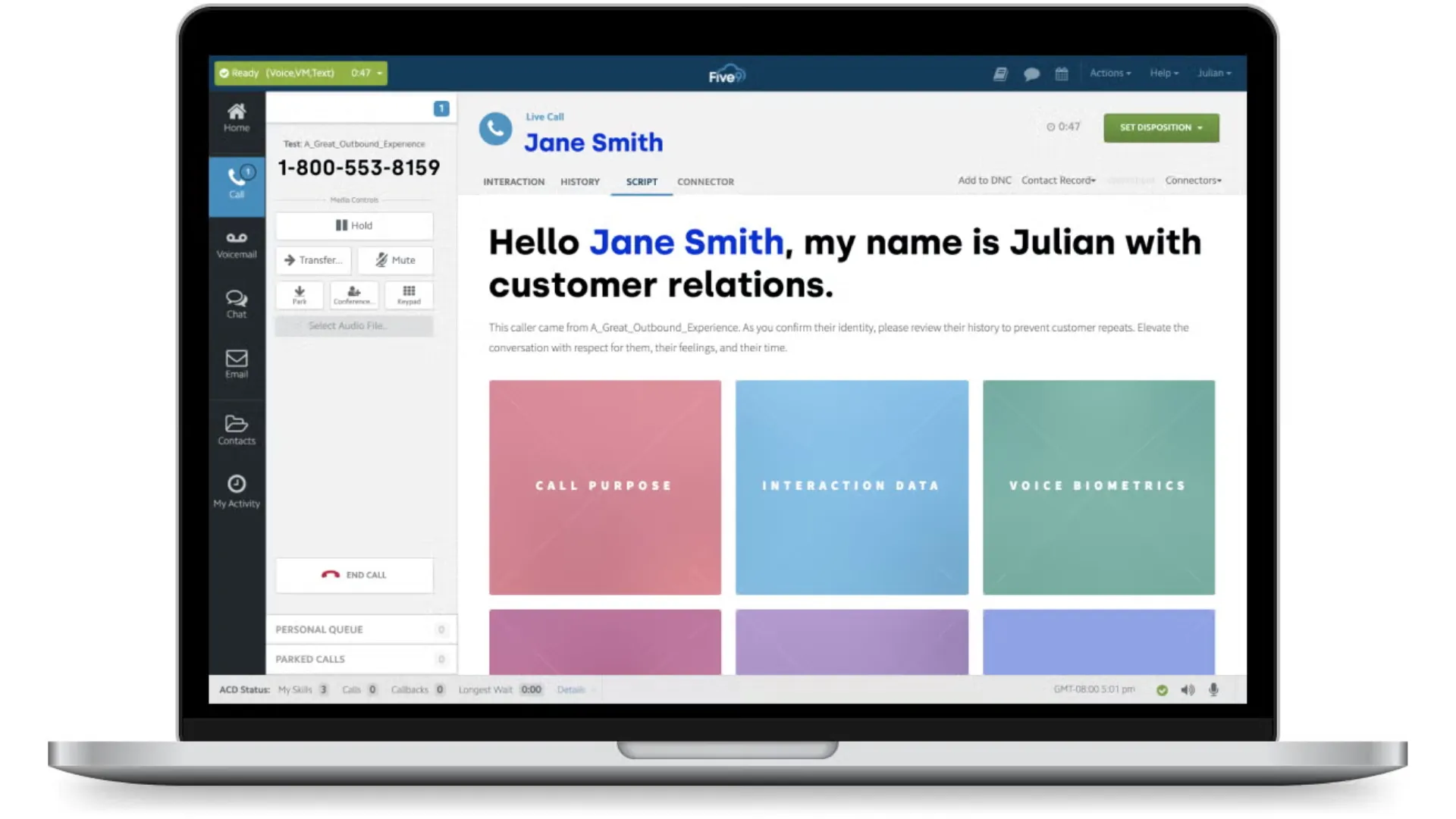
Five9 is widely recognized as a full scale cloud contact center rather than a dialing tool. It appeals to organizations that want everything under one roof, from voice to workforce optimization.
As an alternative to CallTools, Five9 represents a step up in complexity and capability.
Why teams choose Five9
Omnichannel support allows teams to manage voice, chat, email, and messaging in one environment. Workforce optimization features help managers schedule, monitor, and coach agents with precision.
Reporting depth is significantly stronger than CallTools, especially for large teams that need performance visibility across channels. Integrations are robust and enterprise friendly.
For organizations transitioning from traditional call centers to intelligent operations, Five9 feels like a natural evolution.
Where friction appears
Pricing is often the first concern. Five9 costs rise quickly, which can be difficult to justify for outbound heavy teams focused primarily on calling.
Some users also report call quality inconsistencies, which is ironic for a platform at this price point.
Sales teams looking for lightweight power dialer software or sales engagement platforms may find Five9 excessive.
Ideal audience
Five9 works best for mid-sized and enterprise organizations that need omnichannel coverage and workforce management at scale. It competes strongly among CallTools competitors, but only makes sense if complexity aligns with business needs.
6. Talkdesk
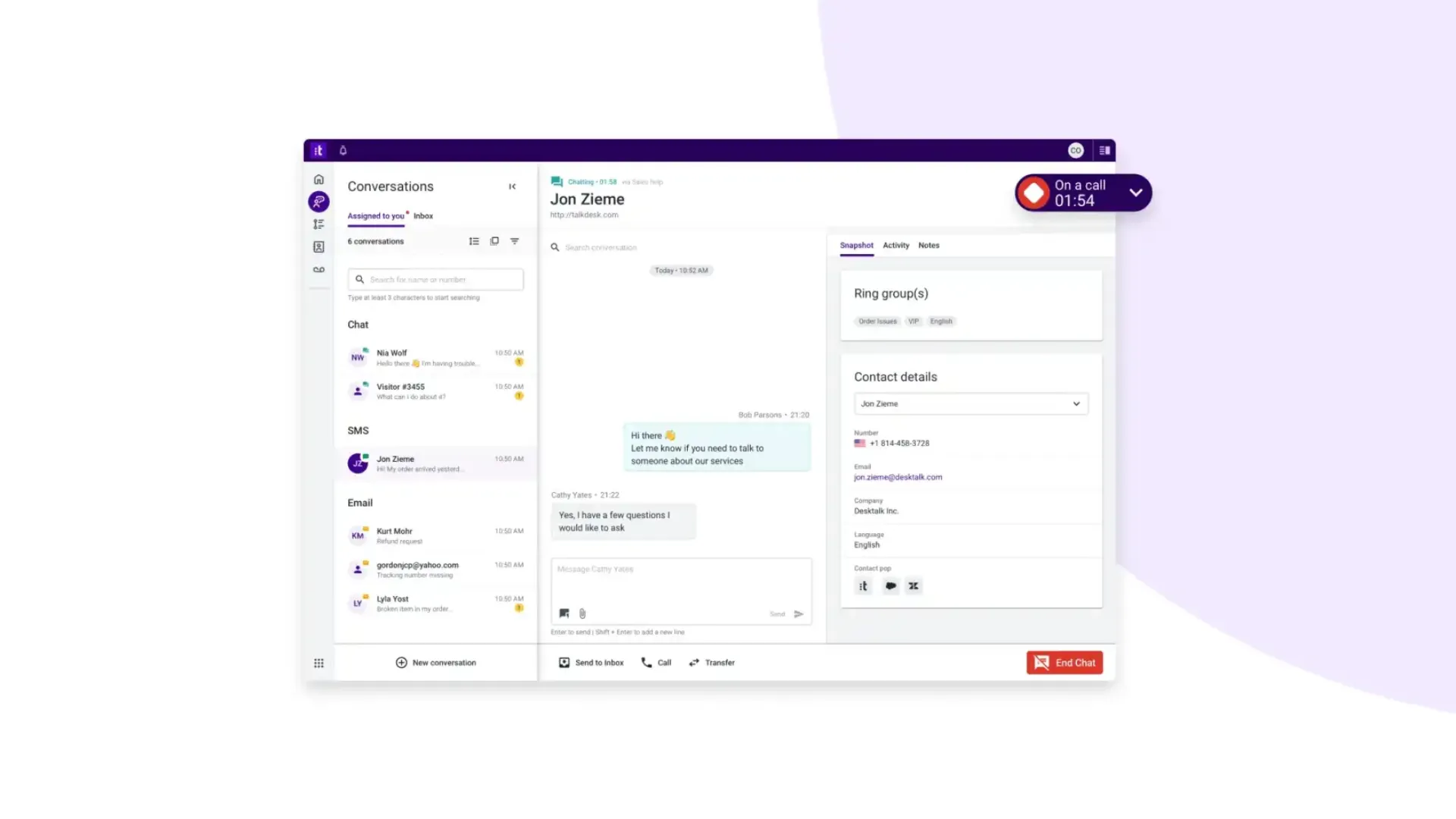
Talkdesk blends flexibility with modern UX, aiming to serve both customer support and sales teams without leaning too heavily toward either.
It often appears in shortlists for teams searching for something similar to CallTools but with better analytics and easier scaling.
What Talkdesk does well
Setup is relatively fast, and the interface is approachable for new agents. Call routing, IVR, and real time monitoring provide operational control without excessive configuration.
Analytics and reporting tools give managers visibility into agent activity and performance. Voice and screen recording support quality assurance workflows that matter in regulated industries.
For teams evaluating automated cold calling solutions alongside support tools, Talkdesk feels balanced.
Gaps to be aware of
Conference calling and auto attendants are notably absent, which limits outbound collaboration. Performance issues have also been reported during peak usage.
The lack of a free trial increases risk during evaluation, especially for teams cautious about long term contracts.
Best use case
Talkdesk fits businesses that want flexibility across support and sales without committing to heavy enterprise complexity. As a CallTools replacement, it works well for blended teams but may disappoint outbound focused sales orgs.
7. RingCentral
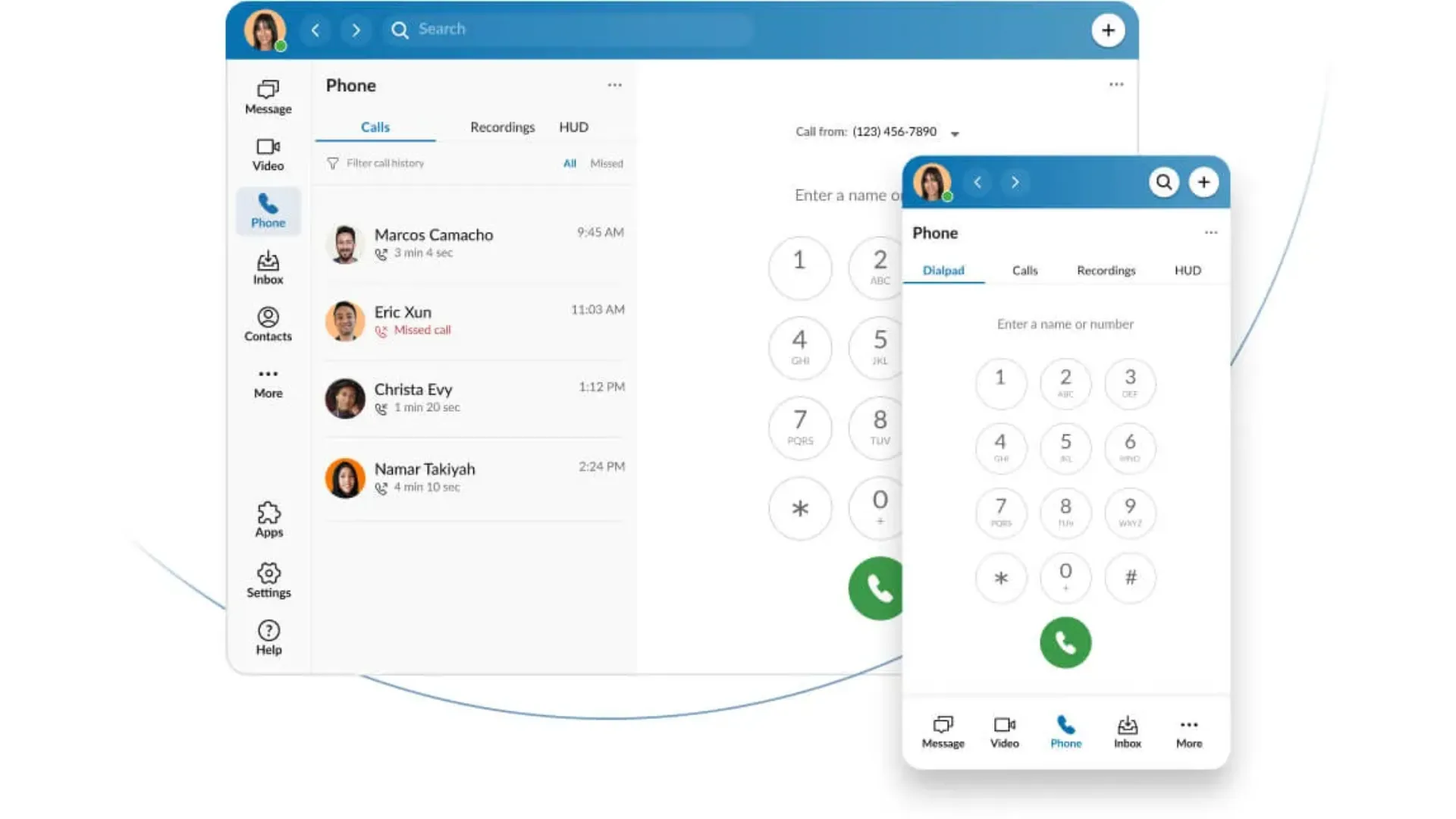
RingCentral is often the default choice when organizations think of VoIP at scale.
Its longevity and brand trust make it a frequent benchmark in CallTools vs competitors discussions.
Why RingCentral remains relevant
Feature breadth is the main draw. Voice, video, messaging, and collaboration tools live in one ecosystem. For enterprises, this reduces vendor sprawl.
HD call quality, omnichannel support, and integration options make RingCentral a safe choice for organizations that value stability.
Where it struggles for outbound sales
Advanced features like smart dialers, sentiment analysis, and speech to text transcription live behind contact center upgrades. Add-ons quickly inflate cost.
Implementation timelines can stretch into months, which slows momentum for teams eager to move fast. UI complexity also creates onboarding friction.
For outbound sales teams comparing CallTools alternatives, RingCentral often feels more general purpose than performance driven.
Who should choose RingCentral
RingCentral works best for businesses seeking a unified communications platform rather than a dialing focused engine. It serves as a CallTools equivalent only when calling is part of a larger collaboration strategy.
Three CallTools alternative categories that were not worth the setup
Not every option that looks good on paper survives real world testing.
Legacy dialers with cosmetic updates
Some platforms market themselves as modern, but under the hood they rely on outdated infrastructure. These tools often mimic parallel dialer solutions without delivering reliability or intelligence.
Setup is painful, call quality suffers, and innovation moves slowly. They rarely outperform CallTools in meaningful ways.
Over engineered enterprise platforms
Platforms built for massive contact centers can overwhelm sales teams. Excessive configuration, long onboarding cycles, and bloated pricing models drain momentum.
Unless you need deep compliance or workforce optimization, these tools often become expensive CallTools replacements without clear ROI.
Lightweight tools lacking scalability
Some power dialer software options work well for small teams but collapse under growth. Reporting limitations, weak integrations, and poor support create future migration pain.
Switching from CallTools only to outgrow the replacement within months creates unnecessary churn.