AI Outbound Sales Calls: How to Use AI to Supercharge Outbound Calling
All thanks to the way technology has advanced, AI outbound sales calls are being widely implemented to cut down on resource costs. Here's what the experts recommend doing to get started, if you haven't already!

On this page
Our Top Picks


Phone based selling has always had a complicated reputation. Prospects screen calls, sales reps burn through call lists, and traditional cold calling often feels inefficient. Yet something interesting has been happening over the past few years. Voice technology and artificial intelligence have quietly transformed the economics and experience of outbound calling.
Instead of repetitive manual dialing and rigid scripts, modern systems can now conduct intelligent conversations, qualify leads, and schedule meetings automatically. The result is a new generation of AI outbound sales calls that feel far more natural than the robotic robocalls people associate with the past.
At the center of this shift is AI voice calling powered by large language models, real time speech recognition, and highly realistic voice synthesis. When these technologies combine with CRM data and call automation infrastructure, companies gain the ability to run massive outbound campaigns without expanding their sales teams.
Many analysts expect artificial intelligence to participate in nearly every customer interaction within the next few years. Call centers are already heavily invested in automation technologies, and organizations that adopted AI calling software early are reporting measurable improvements in productivity, outreach volume, and pipeline generation.
The phone call itself has not disappeared. Instead, voice AI for sales has turned it into something far more scalable.
What Are AI Outbound Sales Calls?

AI outbound sales calls refer to automated phone conversations initiated through artificial intelligence systems rather than human representatives. Instead of prerecorded robocalls, modern platforms rely on conversational AI capable of understanding natural language, responding dynamically, and guiding prospects through a structured sales interaction.
At a technical level, several technologies work together to make this possible. Speech recognition converts spoken responses into text, language models analyze intent and determine the best reply, and speech synthesis produces human sounding responses in real time. When this cycle happens quickly enough, the conversation feels fluid and responsive.
Unlike traditional automated calling systems that simply play recorded messages, AI phone calls can hold contextual conversations. The system can ask questions, respond to objections, clarify information, and adjust its messaging based on how the prospect responds.
A typical voice AI for sales workflow might include tasks such as:
• Introducing a product or service
• Asking qualification questions
• Determining interest level
• Scheduling appointments with human representatives
• Logging conversation data directly into CRM systems
Because these interactions run on intelligent software rather than individual agents, businesses gain an enormous increase in calling capacity. One system can conduct hundreds or thousands of conversations simultaneously.
That scale is the reason AI outbound calls have become such an important component of modern sales operations.
Why AI Voice Calling Is Reshaping Outbound Sales
Cold calling has always struggled with a fundamental limitation. Human sales reps can only make a limited number of calls each day. Even top performers rarely exceed eighty calls in a full workday.
Whenever automated sales calls enter the picture, the constraints disappear. Instead of relying on a team of individual representatives dialing one prospect at a time, AI calling software can initiate conversations at massive scale across multiple time zones.
The reach rate usually remains similar to traditional outbound calling. Not every prospect answers the phone. However, the economics of outreach change dramatically because the cost per call drops significantly while the number of attempts increases.
Several structural advantages explain why businesses are rapidly adopting AI voice calling.
Massive Call Volume Without Hiring
Scaling a traditional sales team requires recruitment, onboarding, training, management, and compensation. Each additional representative increases operational complexity.
AI powered outbound calling removes most of that friction. Once the infrastructure exists, additional capacity simply means activating more automated calling sessions. Campaigns can expand or contract instantly depending on business needs.
This capability is especially valuable for organizations with seasonal demand spikes, product launches, or rapid growth periods where lead response speed matters.
Consistent Messaging Across Every Conversation
Human performance varies from call to call. Energy levels fluctuate, scripts change, and reps sometimes skip key questions when conversations become rushed.
With AI outbound sales calls, every interaction follows a defined conversation framework. The system delivers consistent messaging, handles common objections with proven responses, and gathers the same qualification information from each prospect.
Over time, machine learning models refine these conversations using performance data from thousands of previous calls. That continuous improvement leads to increasingly effective messaging.
Around the Clock Availability
Prospects do not always operate on a single time zone or work schedule. Traditional sales teams usually call during standard business hours, which limits opportunities to reach certain contacts.
Automated AI phone calls can run continuously across global markets. Campaigns can reach prospects early in the morning, during lunch hours, or later in the evening when response rates might be higher.
This constant availability allows businesses to capture opportunities that would normally fall outside the operating window of a traditional call center.
Why AI Outbound Calls Are Gaining Momentum Now
Voice automation technology has existed for years, yet recent developments in artificial intelligence have dramatically expanded what automated calling systems can accomplish.
Advancements in language modeling, speech synthesis, and real time processing have enabled conversations that sound surprisingly human. Instead of robotic phrasing or awkward pauses, modern AI voice technology can maintain natural dialogue with prospects.
Several technological milestones contributed to this shift.
Rapid Improvements in Voice AI Quality
Early voice assistants struggled with context and natural conversation flow. Responses often sounded stiff or disconnected from the previous statement.
Modern language models can interpret nuance, understand follow up questions, and generate responses that feel conversational. When combined with advanced speech synthesis, the resulting voice output closely resembles a human speaker.
This improvement dramatically changes how people experience AI voice calling.
Real Time Conversation Processing
Latency used to be a major barrier for automated phone conversations. Long pauses between responses made interactions feel unnatural.
Recent improvements in processing speed allow systems to convert speech to text, analyze intent, generate a response, and convert that response back to speech in under a second. This near instant turnaround creates smooth conversational flow during AI outbound calls.
CRM and Calendar Connectivity
Another major development involves integration with business systems. Modern AI calling software connects directly with CRM platforms, scheduling tools, and marketing automation systems.
When a prospect expresses interest during an automated conversation, the AI agent can immediately check a calendar, schedule a meeting, and log the interaction in the CRM.
As a result, this sense of connectivity transforms simple phone automation into a fully functioning automated sales call workflow that moves leads through the early stages of the sales pipeline.
Is AI Outbound Calling Legal?
Automation in phone communication often raises an important question. If a machine is placing the call instead of a human representative, does that change the legal rules?
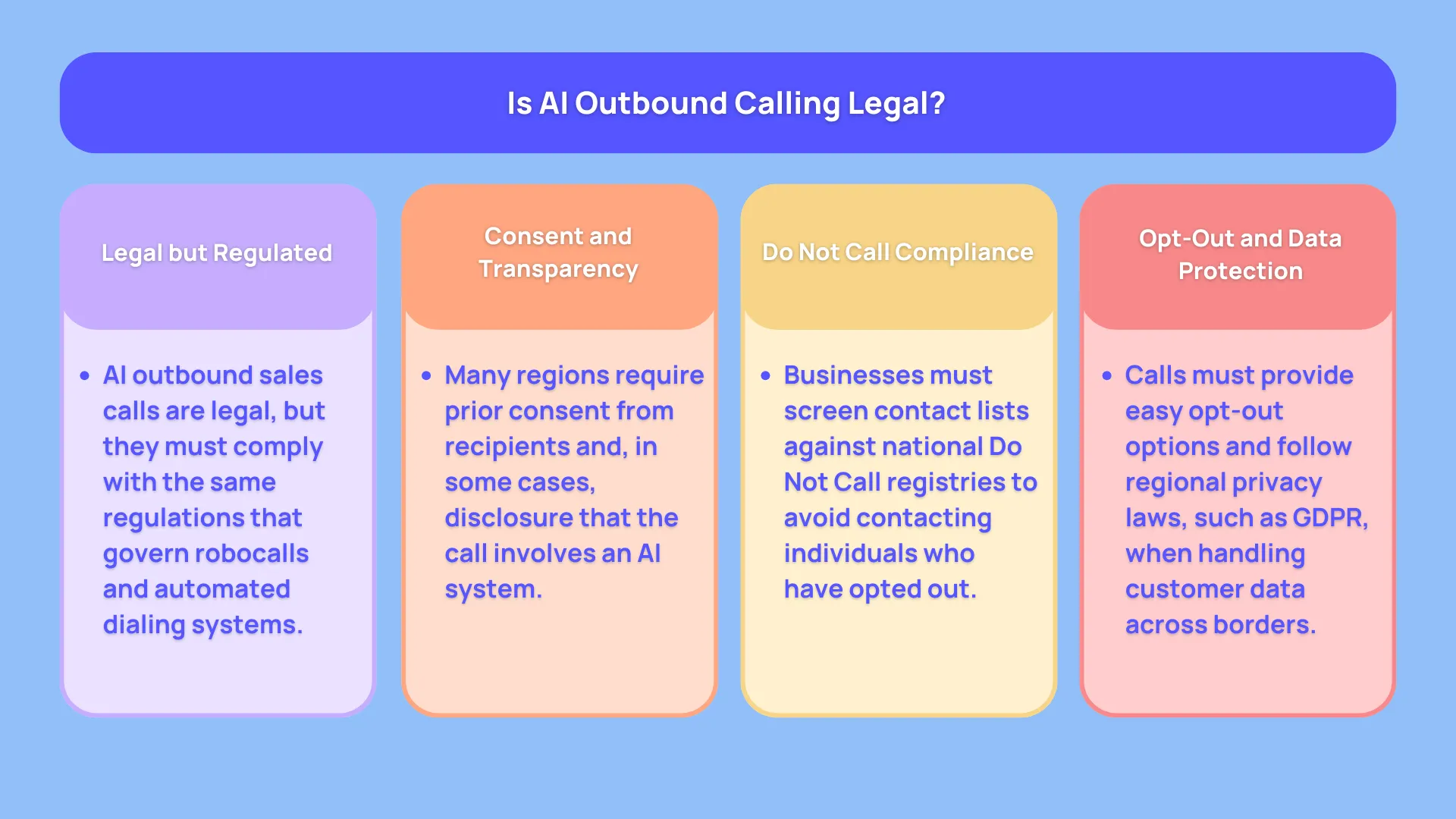
The short answer is that AI outbound sales calls are legal, but they must follow the same regulations that apply to automated dialing systems and robocalls. Governments have introduced strict rules to protect consumers from spam and unwanted calls. Organizations that rely on AI calling software need to treat compliance as a core operational requirement.
Because AI phone calls can scale rapidly, even a small mistake in compliance can multiply quickly across thousands of calls. This makes legal awareness essential for any team planning to deploy voice AI for sales.
Below are the most important compliance principles companies must understand when running AI outbound calls.
Consent Requirements
In many countries, automated calls require clear permission from the recipient. In the United States, regulations under the Telephone Consumer Protection Act treat automated dialing systems as robocalls in many situations.
For consumer contacts, businesses generally need prior written consent before initiating automated sales calls. Business to business outreach sometimes operates under different rules, yet organizations still need to confirm the regulations that apply in each region.
Maintaining accurate consent records becomes extremely important when running large scale outbound calling campaigns.
AI Disclosure and Transparency
Transparency has become a growing expectation in voice technology. Some jurisdictions require companies to clearly inform the person on the other end that the call involves an AI agent.
During AI voice calling, the introduction typically includes a short disclosure that the conversation is assisted by automated technology. This practice improves trust while also satisfying regulatory requirements in certain regions.
Do Not Call List Management
Most countries maintain some version of a national do not call registry. Companies must ensure their automated dialing systems check these lists before initiating AI outbound sales calls.
Failure to respect these registries often leads to substantial penalties. Modern call center AI platforms usually include built in mechanisms that automatically screen contact lists against do not call databases.
Opt Out Options During the Call
Every automated outreach system should allow recipients to decline future contact easily. During AI phone calls, the system may provide options such as pressing a number on the keypad or verbally requesting removal from future outreach.
Clear opt out mechanisms demonstrate responsible use of voice AI and help protect companies from compliance issues.
Global Data Protection Rules
International outreach adds another layer of complexity. Regions such as the European Union operate under strict privacy regulations such as the General Data Protection Regulation.
Organizations that conduct AI outbound calls across borders must ensure their call automation platform complies with the privacy requirements of each region.
Legal compliance does not limit the effectiveness of AI calling software. Instead, it establishes the framework that allows businesses to scale automated calling responsibly.
Key Benefits of Voice AI for Sales Teams
The excitement surrounding AI outbound sales calls comes from the measurable improvements they deliver in productivity, outreach capacity, and sales pipeline generation. While automation has always promised efficiency, modern voice AI for sales finally delivers practical results.
Sales teams that adopt AI voice calling gain advantages that extend far beyond simple cost savings.
Massive Scalability for Outbound Calling
Traditional sales teams expand slowly. Hiring, training, and managing new representatives takes time and resources.
With AI calling software, outreach capacity expands instantly. Automated agents can conduct hundreds of conversations simultaneously without additional hiring. Companies launching new products or entering new markets can dramatically increase their outreach without building a large call center.
This level of scalability allows businesses to test new campaigns rapidly and reach large prospect lists in a fraction of the time.
Hyper Personalized Conversations
Modern AI outbound calls rely heavily on CRM data. Instead of generic scripts, automated agents tailor conversations based on information about each prospect.
A well configured voice AI system can reference past purchases, recent interactions, geographic location, or company details. These contextual signals allow automated conversations to feel far more relevant than traditional robocalls.
Personalization helps AI phone calls maintain higher engagement levels, which increases the chances of successful qualification or meeting scheduling.
Higher Efficiency Across Sales Operations
One of the most immediate improvements appears in operational efficiency. Sales representatives often spend a large portion of their day dialing numbers, leaving voicemails, and speaking with unqualified prospects.
Automated sales calls handle much of that repetitive work. The AI system filters out voicemail responses, identifies disconnected numbers, and conducts early qualification conversations.
Human representatives then focus on prospects who already demonstrated interest or meet predefined qualification criteria. This improves productivity across the entire sales organization.
Continuous Operation Without Time Constraints
Human sales teams work within specific schedules. Even global organizations struggle to cover every time zone efficiently.
Automated AI voice calling systems operate around the clock. Campaigns can reach prospects during optimal response windows regardless of location.
This constant availability allows businesses to capture leads that might otherwise go unanswered outside traditional office hours.
Complete Call Visibility and Analytics
Another advantage of call center AI lies in its ability to analyze every conversation. Human managers typically review only a small sample of sales calls due to time constraints.
Automated platforms record and analyze one hundred percent of conversations. This provides detailed insights into script performance, objection patterns, sentiment signals, and conversion rates.
Sales leaders gain a much clearer understanding of how prospects respond to outreach, which helps refine messaging and improve campaign performance.
Core Components of AI Calling Software
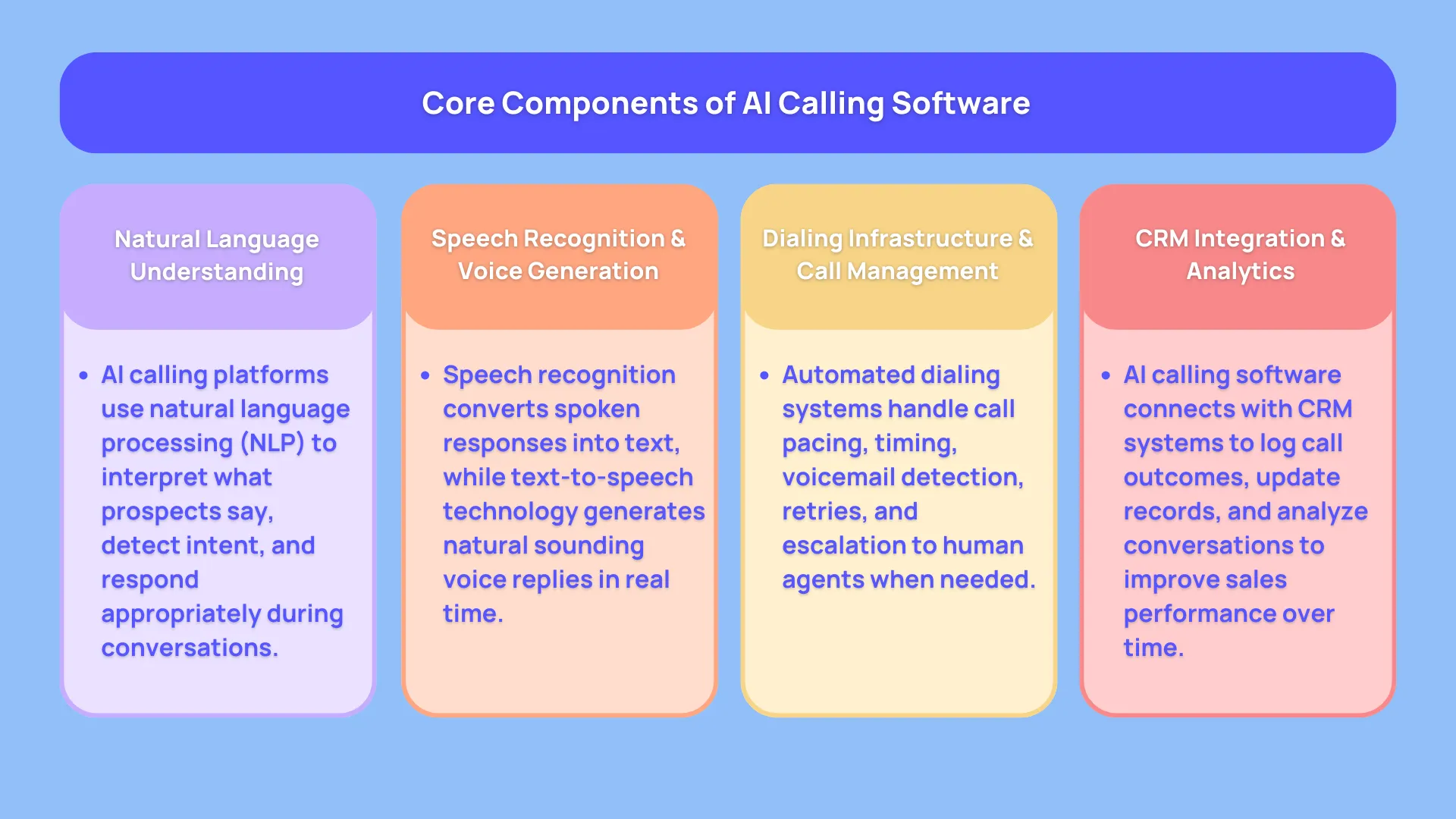
A successful AI outbound sales call system depends on several technological layers working together. Each component plays a critical role in transforming basic phone automation into a sophisticated conversational platform.
Understanding these building blocks helps explain how modern AI voice technology enables real conversations rather than simple prerecorded messages.
Natural Language Processing Engines
Natural language processing sits at the center of any voice AI for sales platform. This technology allows the system to understand spoken responses and determine what the caller intends to communicate.
Advanced NLP models can recognize different accents, interpret incomplete sentences, and detect conversational cues such as hesitation or uncertainty.
This understanding enables the system to respond appropriately during AI phone calls, which makes conversations feel far more natural.
Real Time Speech Recognition
Speech recognition technology converts the prospect’s spoken response into text that the AI system can analyze. Accuracy levels have improved dramatically in recent years, often exceeding ninety five percent in controlled environments.
High quality recognition is essential for automated sales calls because misunderstanding a prospect’s statement could disrupt the conversation flow.
Speech Synthesis and Voice Generation
Once the system generates a response, text to speech technology converts the message into audio. Modern voice synthesis models produce remarkably natural sounding speech patterns.
These voices include realistic pacing, tone variation, and emotional nuance. As a result, many prospects cannot easily distinguish between human and automated voices during AI outbound calls.
Call Orchestration and Dialing Infrastructure
Behind every successful outbound calling campaign lies a sophisticated dialing system. This infrastructure manages call pacing, determines optimal calling times, and coordinates thousands of simultaneous conversations.
Smart orchestration systems also manage retries, voicemail detection, and escalation to human agents when necessary.
CRM Integration and Data Synchronization
The most powerful AI calling software connects directly to customer databases and CRM platforms. This integration allows the system to access relevant prospect information before each call begins.
During the conversation, the AI can update records automatically, log call outcomes, and trigger follow up workflows.
This connectivity ensures that AI outbound sales calls remain part of a larger sales pipeline rather than isolated interactions.
Analytics and Conversation Intelligence
Data analysis tools complete the call automation ecosystem. These systems evaluate conversation transcripts, measure sentiment changes, and identify patterns that influence conversion rates.
Sales leaders gain visibility into which messages resonate most with prospects. Over time, this intelligence improves campaign performance and increases the effectiveness of AI voice calling strategies.
How AI Outbound Sales Calls Work: The Technology Behind Voice AI
When people hear about AI outbound sales calls, the first reaction is usually curiosity about how the system actually manages a live conversation. The process might sound complex, yet it follows a structured flow that happens extremely quickly during a call.
Modern AI voice calling platforms combine telephony infrastructure, speech recognition, language models, and automation logic to produce real time conversations. All of these components operate simultaneously while the call is happening.
Understanding the sequence behind AI phone calls helps clarify why voice technology has become such a powerful tool for outbound sales.
Call Initiation and Intelligent Dialing
The process begins with the dialing system. AI calling software connects to a lead database or CRM and identifies which contact should receive the next call.
The system evaluates several signals before initiating the call. These signals may include the contact’s time zone, previous call attempts, optimal calling hours, and lead priority scores.
Once the call is placed, the system monitors the connection status. It identifies busy signals, disconnected numbers, voicemail greetings, or human responses. This filtering prevents wasted effort during automated sales calls and ensures the AI agent only engages when a real conversation begins.
Speech Recognition During the Conversation
When the prospect answers the phone, speech recognition technology begins converting spoken responses into text. This step is commonly referred to as speech to text processing.
Modern recognition systems are trained on diverse speech patterns and accents, allowing them to interpret conversations with impressive accuracy. The converted text is then passed to the AI model responsible for generating the next response.
During AI outbound calls, this process occurs continuously throughout the conversation, capturing every statement made by the prospect.
AI Language Processing and Response Generation
Once the prospect’s statement becomes text, the language model evaluates the meaning of the response. This stage determines the intent behind the words and identifies how the conversation should progress.
For example, the system may detect interest, hesitation, confusion, or rejection. The AI model then selects an appropriate response aligned with the conversation framework and sales objective.
In voice AI for sales, this step often includes several contextual inputs:
- Prospect information stored in the CRM
- Conversation history from earlier in the call
- Predefined objection handling responses
- Qualification criteria defined by the sales team
The model generates a response that keeps the conversation moving toward the intended outcome, such as scheduling a meeting or qualifying the lead.
Text to Speech Conversion
After the AI system generates a response, speech synthesis converts the text into natural sounding audio. Advanced voice generation models produce speech patterns that mimic human pacing, tone, and inflection.
Latency is extremely low in modern AI voice calling platforms. The response typically reaches the prospect within a fraction of a second after the system processes their statement.
This near instant reply makes AI phone calls feel conversational rather than mechanical.
Automated Actions and Workflow Triggers
When the conversation reaches a meaningful outcome, the system performs the next step automatically. This could involve scheduling an appointment, tagging the lead as qualified, or transferring the call to a human representative.
Because AI calling software connects directly with CRM platforms and calendar tools, these actions occur instantly. The prospect may finish the conversation with a confirmed meeting already placed on a salesperson’s calendar.
This seamless transition from conversation to workflow execution is what turns AI outbound sales calls into a fully automated lead generation engine.
Best Practices for High Performing AI Outbound Calls

The effectiveness of automated sales calls depends heavily on how campaigns are designed. Voice AI technology provides the infrastructure, yet thoughtful strategy determines how well it performs.
Organizations that treat AI outbound calls as a carefully planned outreach system often see dramatically better results than those relying on generic scripts.
Several operational practices help maximize the performance of AI voice calling campaigns.
Designing Natural Conversation Scripts
Even though the system relies on artificial intelligence, conversations still need clear structure. Well designed scripts provide the framework that guides the AI agent through the call.
The opening moments of AI phone calls are especially important. Prospects decide quickly whether they want to continue listening. A strong opening introduces the purpose of the call, communicates value, and invites engagement.
Effective conversation design includes anticipated objections and natural transitions between topics. The AI system uses these guidelines to maintain a smooth flow throughout the call.
Targeting the Right Audience
Technology cannot compensate for poor lead quality. Successful AI outbound sales calls depend on well defined target audiences and accurate contact data.
Campaigns perform best when contact lists include prospects who match the ideal customer profile. Businesses often rely on CRM segmentation or marketing qualification signals to identify these contacts.
Clean phone data is equally important. Outdated or invalid numbers reduce efficiency in any outbound calling program.
Maintaining Strong Data Integration
Because voice AI for sales relies heavily on contextual data, CRM integration plays a major role in campaign success.
When the AI agent has access to relevant information about each contact, conversations become far more personalized. The system can reference previous interactions, company information, or specific offers tailored to that prospect.
This contextual awareness helps automated calling systems feel more human and less transactional.
Monitoring Conversations and Optimizing Scripts
Although AI calling software operates automatically, ongoing monitoring remains essential. Sales leaders should review conversation transcripts and analytics regularly to understand how prospects respond to different messages.
Patterns often emerge across hundreds or thousands of AI outbound calls. Certain introductions may perform better than others. Some objection responses might generate stronger engagement.
Refining scripts based on these insights gradually improves conversion rates across the entire campaign.
Ensuring Compliance and Responsible Use
Responsible deployment of AI phone calls protects both the company and the customer experience. Campaigns should always respect consent requirements, maintain accurate do not call lists, and provide clear opt out options.
Ethical use of call automation helps maintain trust with prospects while avoiding regulatory risks.
The Future of Voice AI for Sales
Outbound sales is entering a new era shaped by artificial intelligence and voice technology. Instead of replacing human representatives, AI outbound sales calls are transforming how sales teams allocate their time.
Routine outreach, early qualification, and appointment scheduling can now occur automatically through intelligent AI voice calling systems. Human representatives focus on high value conversations where expertise and relationship building matter most.
Several trends are likely to shape the future of voice AI for sales.
Conversational Intelligence Will Continue to Improve
Language models are evolving rapidly. Future AI phone calls will demonstrate stronger contextual awareness, improved emotional understanding, and even more natural speech patterns.
These improvements will make automated conversations increasingly indistinguishable from human interactions.
Deeper Sales Stack Integration
Next generation AI calling software will connect even more deeply with CRM systems, marketing automation platforms, and revenue intelligence tools.
This connectivity will allow automated agents to move prospects through multiple stages of the sales pipeline without manual intervention.
Hybrid Sales Teams Will Become Standard
Many organizations will adopt hybrid sales teams where call center AI manages the early stages of outreach while human representatives handle negotiation and deal closing.
This collaboration between automation and human expertise will enable sales teams to manage far larger pipelines without dramatically increasing headcount.
Voice Technology Will Expand Across Channels
Voice will remain a powerful communication channel, yet it will increasingly connect with other forms of outreach. Future systems will combine AI outbound calls with messaging, email, and social engagement to create coordinated multi channel conversations.