Our Top Picks

Convoso has long been a recognizable name in outbound call center software, especially for teams built around high-volume lead generation. Predictive dialers, campaign controls, and speed-to-dial features helped many sales organizations increase activity levels over the years.
But outbound sales has changed.
These days, worldwide sales teams care less about raw call volume and far more about context, continuity, and conversion quality.
On top of that, we’ve got a multitude of sales leaders, who want platforms that show the full buyer story inside their CRM, not fragmented data stitched together through fragile syncs.
Meanwhile, since the schedule is already too cramped, sales reps expect systems that guide conversations in real time instead of simply dialing faster.
That transition, or, in other words, “overall shift,” is exactly why so many teams are searching for Convoso alternatives, comparing Convoso vs competitors, and actively planning to switch from Convoso in favor of platforms that feel more aligned with modern sales motion.
This detailed post breaks down where Convoso still fits, where it falls short, and which tools stand out as a better than Convoso option depending on your goals.
What is Convoso used for?
Convoso is primarily used as a cloud based outbound call center platform built for sales driven organizations that rely heavily on phone outreach. It supports teams running large scale lead lists, time sensitive dialing campaigns, and structured outbound workflows.
At its core, the program is designed to help sales teams connect with more leads in less time. The system automates dialing, filters out unanswered calls, and routes live conversations directly to available agents.
That makes it especially common in industries like insurance, lending, education enrollment, and performance marketing, where speed and volume directly impact revenue.
To understand where Convoso fits best, it helps to break down how teams typically use it.
High volume outbound dialing
We’ve got a lot of power or core users who use the program for high volume of dialing.
And speaking of “power,” yes, the native dialing feature can also be categorized as power dialer software.
Since this platform is essentially offering predictive dialing, it enables sales reps to call multiple numbers simultaneously and only connect agents once a live person answers. As a result, it reduces idle time between calls and keeps agents in constant conversation.
For teams measured on activity metrics such as calls per hour or contacts per day, this approach can feel effective. The downside is that conversation quality and lead context often take a back seat to volume.
Campaign based sales operations
Many teams rely on Convoso to manage outbound campaigns tied to specific lead sources or offers. Managers can control dialing windows, pacing rules, and call flows based on campaign goals.
While this structure works for tightly controlled operations, it can feel rigid for sales teams that need flexibility, personalization, and adaptive follow up based on prospect behavior.
Basic omnichannel outreach
Convoso supports voice, SMS, and email as part of outbound sequences. In theory, this allows reps to reach prospects across multiple channels.
In practice, many teams report that these channels feel bolted on rather than fully unified. Conversation history can feel fragmented, which creates friction when reps need full visibility into prior touchpoints.
Compliance driven industries
At the heart of every outbound sales calling business, compliance is a huge concern.
You don’t want to be stepping over any lines that may cause your potential buyers to report your business, or the numbers for breach of privacy, or non-compliance stuff.
On that side of things, this tool is often chosen by organizations that need TCPA compliance features, call recording, and dialing controls baked into outbound workflows. For regulated industries, these safeguards remain one of Convoso’s stronger selling points.
That said, compliance alone is no longer enough to justify staying on a platform that lacks deeper intelligence and CRM cohesion.
Convoso still serves a purpose, but for many sales organizations, it no longer represents the best alternative to Convoso, because it is Convoso itself.
The market now offers tools that feel more intuitive, more stable, and far more connected to the systems sales teams already live in.
How Much does Convoso Cost?
Convoso pricing is one of the main reasons growing outbound teams start researching best convoso alternatives 2026 and evaluating platforms with more predictable operating costs.
Convoso’s cloud based call center software starts at approximately $90 per user, per month. However, because the platform is built primarily for scaling outbound contact centers, pricing is customized based on team size, dialing volume, compliance requirements, integrations, and communication channels.
For many companies, the starting price only represents a portion of the total monthly investment. As usage grows, additional modules and telecom related costs can increase spend considerably.
Base Platform Pricing and Seat Costs
Most organizations begin with a standard per seat licensing structure. On paper, this can look manageable for mid sized teams. The challenge appears once businesses begin layering advanced outbound workflows, AI features, CRM syncing, or compliance modules across the organization.
Key considerations include:
• Entry pricing typically begins around $90 per user/month
• Annual agreements may reduce per seat pricing slightly
• Higher volume outbound teams usually require custom enterprise quotes
• Costs increase rapidly once advanced workflow modules are enabled company wide
Sales leaders comparing convoso native dialer vs crm integrations comparison often discover that dialing functionality alone does not represent the majority of spend. CRM synchronization layers, analytics tooling, and automation modules frequently become the bigger operational expense over time.
Telecom Fees and Operational Usage Charges
Beyond licensing, outbound teams must account for telecom related expenses tied to daily calling activity. These costs vary based on carrier routing, local number procurement, and international dialing usage.
Common telecom related expenses include:
• DID phone number provisioning
• Carrier surcharges and regulatory fees
• SMS delivery costs
• Call recording storage costs
• Usage based outbound calling charges
For larger outbound operations, these telecom fees can add another 10 to 30 percent onto the monthly bill. This becomes particularly relevant for companies researching looking for the best convoso alternative with similar features but cheaper pricing because operational costs compound quickly as call volumes scale.
Advanced Features and Add On Pricing
Convoso positions several advanced capabilities as separate modules rather than bundled functionality. Teams scaling outbound operations often discover that the tools required for modern workflows carry separate pricing layers.
These premium capabilities may include:
• Omnichannel outreach functionality
• Advanced CRM integrations
• AI assisted workflows
• SMS automation
• Enhanced compliance monitoring
• Advanced analytics and reporting dashboards
This modular pricing structure creates forecasting challenges for RevOps teams trying to maintain predictable software budgets across multiple departments.
Implementation and Onboarding Costs
Convoso is designed for larger outbound operations with structured workflows and compliance heavy processes. Because of that, implementation is more involved than lightweight sales dialers.
Businesses frequently encounter:
• Dedicated onboarding timelines
• Custom workflow configuration
• Compliance setup requirements
• CRM integration mapping
• Agent training periods
Some organizations also pay onboarding or implementation fees during setup. This can extend rollout timelines significantly for leaner sales teams that need faster deployment.
Important Considerations Before Buying Convoso
Convoso can work well for enterprise level outbound environments, though smaller sales organizations often struggle to justify the total cost structure.
Important takeaways for buyers include:
• Teams with fewer than 20 agents may find implementation costs difficult to justify
• Exact pricing requires a sales consultation and custom quote
• Trial access is generally prioritized for larger outbound teams
• Long term costs depend heavily on outbound volume and add on usage
• CRM synchronization depth varies depending on integration complexity
For organizations comparing best product: convoso native dialer or using convoso integrations with crm dialers?, the pricing conversation usually expands beyond dialer functionality alone. CRM workflow efficiency, reporting accuracy, onboarding complexity, and maintenance overhead all influence total ownership cost over time.
Per license pricing that compounds quickly
Convoso charges on a per user basis, but the issue is not the base license alone. The real challenge appears when teams want to expand functionality.
If a feature costs a set amount, that cost is multiplied by the total number of licenses, not the number of users actively benefiting from it. A ten person team adding one premium feature can see costs increase tenfold instantly. For a fifty or one hundred seat operation, the numbers escalate fast.
This pricing model discourages experimentation and slows adoption of tools that could otherwise improve performance.
Feature based add ons instead of bundled value
Many sales platforms now include analytics, conversation intelligence, and automation as part of a unified package. Convoso takes a different approach.
Advanced reporting, additional compliance controls, and certain automation features often sit behind paywalls. Teams end up paying extra for capabilities that feel standard elsewhere.
This is one reason Convoso competitors often appear more cost effective, even when their per user price looks higher at first glance.
Hidden operational costs
Beyond direct pricing, there are indirect costs that rarely appear in a proposal.
Frequent dropped calls, system instability during peak hours, and unexpected logouts lead to lost selling time. Sales managers then spend more time troubleshooting than coaching. Onboarding takes longer because workflows feel complex and unintuitive.
When teams compare total cost of ownership, many realize a Convoso replacement with better stability and native CRM alignment actually saves money over time.
Is Convoso a CRM tool or something else?
Convoso is an omnichannel outbound contact center platform and predictive dialing system built primarily for high volume sales and lead generation teams. It functions as the communication engine that powers outbound outreach activity across voice, SMS, and campaign workflows.
While Convoso integrates with popular CRM systems like Salesforce and HubSpot, it does not operate as a full customer relationship management platform where companies manage deep customer histories, long term pipeline activity, account relationships, forecasting, or lifecycle reporting.
This difference matters far more today because modern outbound sales teams increasingly expect every communication tool to feel deeply connected to their CRM environment.
What Convoso Handles Best
Convoso was designed primarily to improve outbound communication efficiency for call heavy organizations. Its strongest functionality revolves around dialing automation, outbound routing, and campaign execution.
The platform focuses heavily on:
• Predictive, progressive, and power dialing
• Outbound campaign management
• Caller ID reputation monitoring
• SMS and email outreach workflows
• Compliance management and TCPA safeguards
• High volume lead engagement
This makes Convoso particularly useful for organizations where outbound speed and contact rates remain top operational priorities.
Teams running aggressive outbound campaigns often value how quickly agents can move through lead lists and maintain high call activity throughout the day.
How Convoso Works Alongside CRMs
Because Convoso is not designed as the primary system of record, companies typically pair it with an external CRM platform.
In most setups:
• The CRM stores customer records, deal history, lifecycle stages, and account activity
• Convoso handles outbound communication execution
• Call outcomes and activity logs sync back into the CRM after conversations occur
• Reps move between both systems during daily workflows
This structure allows outbound operations to scale while still maintaining centralized customer records inside the CRM environment.
However, many organizations comparing convoso native dialer vs crm integrations comparison discover that the separation between systems creates workflow friction over time.
Where CRM Friction Starts Appearing
Modern sales teams operate differently than traditional outbound call centers. Reps now expect instant visibility into buyer history, engagement signals, previous objections, and pipeline status directly inside the communication workflow.
That expectation creates challenges when outbound dialing operates separately from the CRM itself.
Common friction points include:
• Switching constantly between multiple tabs
• Delayed activity synchronization
• Incomplete conversation histories
• Manual note cleanup
• Limited support for custom CRM workflows
• Reporting inconsistencies across platforms
For RevOps teams, these gaps can slowly erode data quality and reduce trust in outbound reporting systems.
This explains why many companies researching best convoso alternatives 2026 prioritize CRM native sales engagement platforms rather than standalone dialing systems layered on top of the CRM.
Convoso vs Competitors: Side by Side Comparison
Outbound sales teams evaluating best convoso alternatives 2026 are no longer comparing dialers based only on call volume. Modern buying decisions revolve around CRM visibility, AI assistance, workflow flexibility, omnichannel continuity, onboarding speed, and long term pricing predictability.
The platforms below represent some of the strongest Convoso competitors currently available for outbound sales teams, hybrid contact centers, and enterprise communication operations.
Best Convoso Alternatives and Detailed Breakdown of the Top Picks
If you’re serious about upgrading from Convoso, it helps to look past marketing hype and focus on platforms that solve real world problems teams face every day. Below are three Convoso alternatives that consistently outperform Convoso across CRM integration, call reliability, intelligence, and overall sales impact.
Each solution offers a distinct approach, so your choice depends on what matters most in your sales operation.
1. Five9 : Enterprise Contact Center Platform with Advanced AI Analytics
Five9 is one of the most established enterprise grade contact center platforms in the market. It serves large organizations that require blended inbound and outbound communication infrastructure combined with extensive analytics and workforce management tooling.
Compared to Convoso, Five9 focuses more heavily on enterprise scalability, omnichannel orchestration, and operational oversight across large communication teams.
Strong Fit for Enterprise Communication Operations
Five9 works particularly well for organizations managing:
• Large distributed contact centers
• Blended inbound and outbound teams
• Complex routing environments
• Enterprise compliance requirements
• Cross channel communication workflows
The platform supports voice, digital messaging, email, and customer service workflows within one unified ecosystem.
AI Driven Analytics and Workforce Intelligence
One of Five9’s strongest advantages is its AI powered analytics infrastructure.
Capabilities include:
• Agent performance monitoring
• Predictive routing
• Customer sentiment analysis
• Automated quality assurance scoring
• Workforce optimization insights
• Real time operational reporting
For enterprise environments focused heavily on efficiency measurement and large scale operational visibility, these analytics tools can create significant management advantages.
CRM Connectivity and Workflow Support
Five9 integrates with major CRM systems including:
• Salesforce
• Microsoft Dynamics 365
• ServiceNow
• Zendesk
This makes the platform appealing for organizations prioritizing centralized customer visibility across both service and outbound sales operations.
Where Five9 Fits Best
Five9 tends to work best for:
• Enterprise level contact centers
• Large customer support organizations
• Hybrid inbound and outbound environments
• Teams requiring advanced workforce management
• Organizations prioritizing operational analytics
Smaller outbound sales teams may find Five9 more complex than necessary, particularly if their primary focus remains SDR activity and outbound pipeline generation rather than large scale contact center orchestration.
2. Trellus: Best Alternative to Convoso for a Powerful Virtual Salesfloor Experience
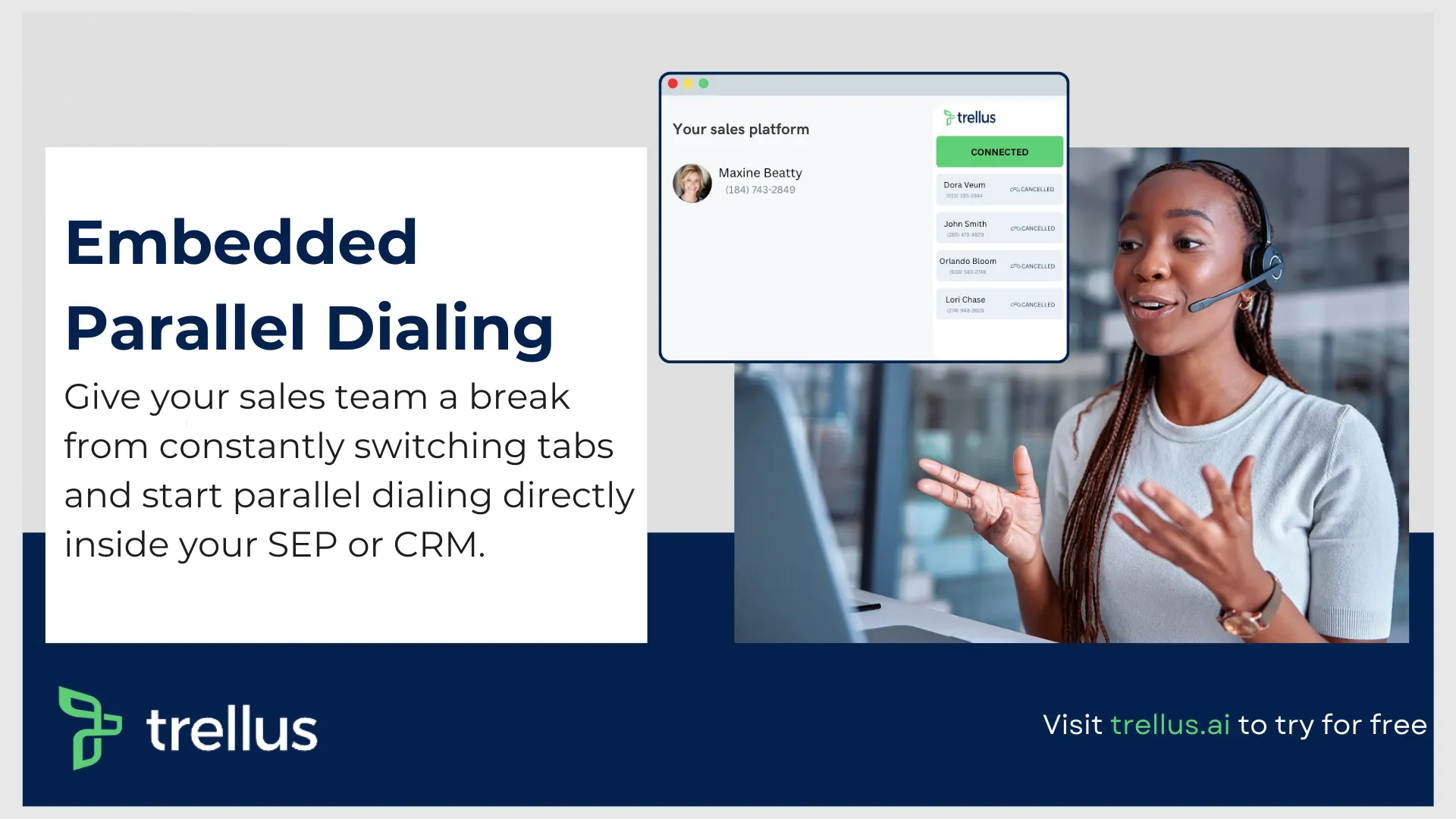
Trellus comes as a constantly evolving and relatively newer breed of sales engagement platform that feels as intuitive as it is powerful.
Many teams consider it the best alternative to Convoso because it combines dialing, automation, CRM context, and AI coaching in a way that actually enhances human performance instead of overwhelming it.
A different philosophy for outbound sales
Unlike traditional dialer-heavy systems, our platform treats dialing as just one part of a broader engagement engine. The platform operates within your workflow, not as a separate environment users have to jump into and out of.
Agents work right inside a familiar interface with real time context, lead history, and automated suggestions driving better conversation outcomes.
Parallel dialing that respects connection quality
Trellus’s parallel dialing model goes beyond classic predictive dialing. Instead of maximally flooding phone lines, it intelligently times calls based on agent capacity, previous answer rates, and ongoing interactions.
This leads to:
- More live conversations per hour
- Less downtime between connects
- Significantly fewer dropped or blocked calls
The result feels more like smarter selling rather than just faster dialing.
CRM integration done the right way
One of the biggest reasons teams switch from Convoso is integration friction. Trellus solves that by syncing deeply with major CRMs like HubSpot, Salesforce, and others, so data flows automatically and accurately.
There’s no need for manual updates or middleware hacks. Prospect records, deal stages, communication history, and activity logs all stay in perfect alignment.
This seamless connection makes Trellus feel like a Convoso equivalent that actually belongs inside your CRM stack; not running alongside it.
Conversation intelligence that helps you win
Trellus’s AI doesn’t just log calls. It analyzes talk patterns, captures sentiment, identifies successful phrases, and delivers real time guidance that lifts agent performance instantly.
Managers get actionable insights without listening to endless recordings. Teams pick up best practices faster and close more business.
Why Trellus blows the competition out of the water?
Many organizations that make the switch report:
- A meaningful increase in productive conversations
- Faster new hire ramp time
- Higher conversion rates from conversation to qualified opportunity
- A dramatic reduction in manual data entry tasks
For teams that see any modern day sales automation software as more of a human interaction enhanced by technology, Trellus often feels like the best alternative to Convoso available today.
3. Talkdesk: Flexible Cloud Call Center Software with Strong CRM Support
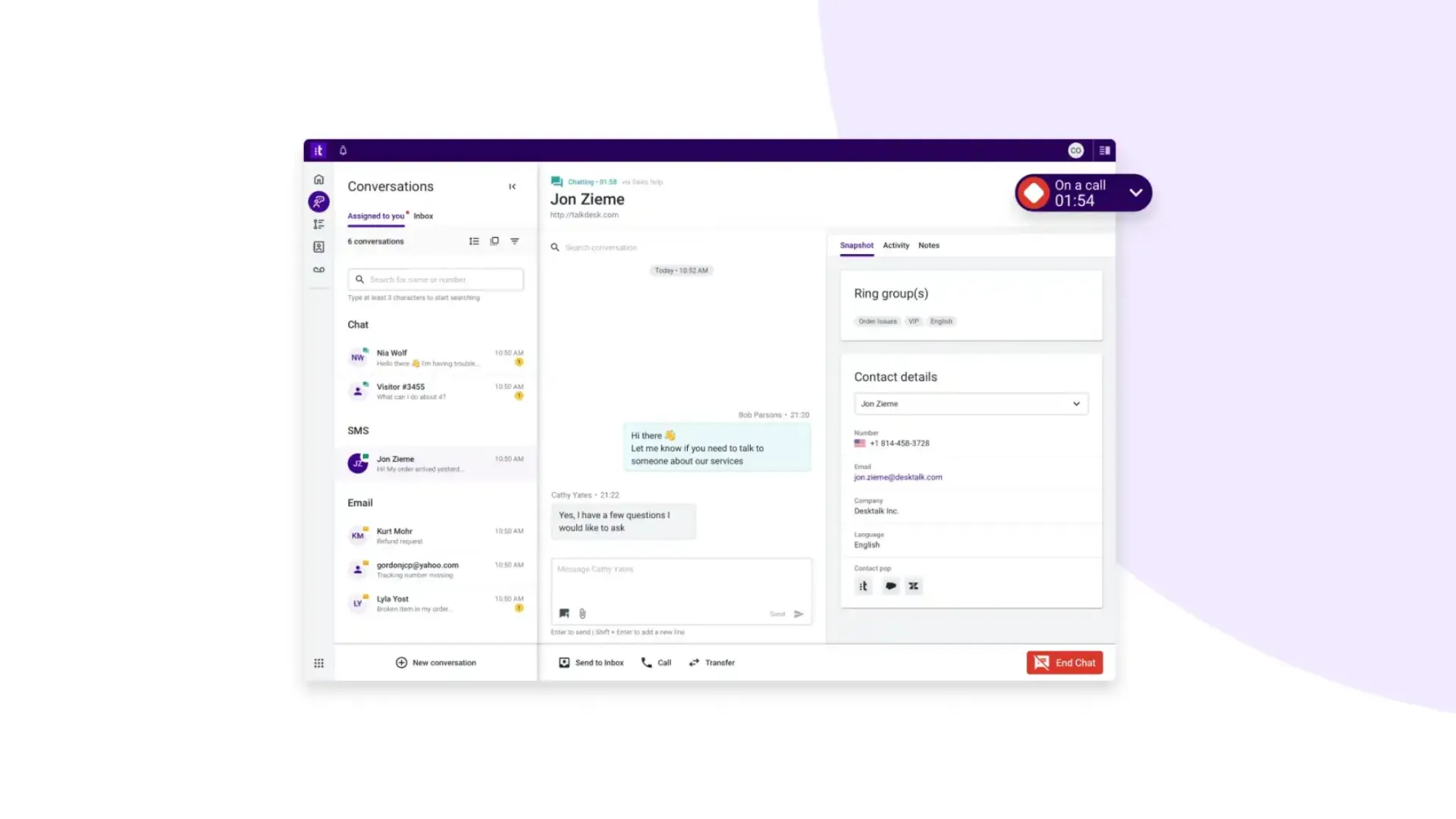
Talkdesk isn’t a dialer-only platform. It’s a full featured cloud contact center that balances inbound support and outbound sales activity in one environment.
A broader toolset for organizations with mixed needs
Unlike Convoso, which focuses almost entirely on outbound call volume, Talkdesk treats every customer interaction as part of a unified experience.
That makes it a useful Convoso substitute for teams supporting both support queues and sales outbound.
Talkdesk provides:
- Omnichannel engagement across voice, SMS, and digital channels
- Intelligent call routing and queue management
- AI driven self service options for customers
- CRM integration with Salesforce, Zendesk, and others
This broader suite of capabilities means Talkdesk can serve as both a contact center platform and an outbound sales tool.
CRM integration that works
Talkdesk’s integrations are strong and mature. Activity syncs reliably with CRMs, and contextual data flows smoothly between systems. This enhances visibility for sales leaders and improves rep efficiency.
For teams that live in their CRM, this deeper alignment often feels better than Convoso.
A note on platform stability
Some users report occasional freezing or dropped calls under specific network conditions. That said, the platform is constantly evolving, and many teams appreciate the flexibility it provides outside just outbound dialing.
If your organization needs both inbound and outbound capabilities with strong CRM support, Talkdesk works as a solid Convoso alternative.
4. PhoneBurner: Affordable Power Dialer for High Activity Sales Teams
PhoneBurner has built a strong reputation among sales teams that prioritize outbound efficiency without the implementation complexity often associated with enterprise contact center platforms.
The platform focuses heavily on speed, simplicity, and productivity for outbound reps making large volumes of calls daily.
For businesses searching looking for the best convoso alternative with similar features but cheaper pricing, PhoneBurner frequently appears because of its lower operational complexity and comparatively accessible pricing structure.
Built Around Outbound Productivity
PhoneBurner’s workflow philosophy centers around helping reps move through outbound conversations quickly while minimizing downtime between calls.
Core functionality includes:
• Power dialing workflows
• Automated voicemail drops
• Email follow up automation
• Basic SMS capabilities
• Call tracking and logging
• CRM synchronization
The platform does not attempt to become a massive enterprise communication suite. Its strength lies in helping outbound reps maximize activity efficiently with minimal technical overhead.
No Per Minute Dialing Charges
One feature many outbound teams appreciate is PhoneBurner’s pricing structure around calling activity.
Unlike some platforms that layer telecom usage costs aggressively, PhoneBurner is often viewed as more predictable financially for outbound teams making large call volumes daily.
This predictability appeals strongly to businesses evaluating:
best convoso alternatives 2026
and
looking for the best convoso alternative with similar features but cheaper pricing
because telecom cost management becomes increasingly important as outbound activity scales.
CRM Integration and Workflow Simplicity
PhoneBurner integrates with several major CRM systems including:
• Salesforce
• HubSpot
• Pipedrive
• Zoho CRM
The integration depth is generally solid for most SMB outbound environments, though enterprise organizations with highly customized CRM workflows may require more advanced flexibility than PhoneBurner offers.
Still, many smaller outbound teams value the cleaner onboarding experience and lower administrative complexity.
Where PhoneBurner Fits Best
PhoneBurner tends to perform particularly well for:
• SMB outbound sales teams
• Recruiting firms
• Appointment setting teams
• Budget conscious outbound organizations
• Companies prioritizing rapid onboarding
• Teams focused heavily on call activity
Organizations requiring advanced conversational AI, deep omnichannel orchestration, or highly complex workflow automation may eventually outgrow the platform. However, for straightforward outbound engagement operations, PhoneBurner remains one of the more practical Convoso alternatives currently available.
5. Ringover: Unified Business Communication Platform with Strong CRM Syncing
Ringover positions itself as a unified communication platform combining cloud telephony, messaging, CRM synchronization, and sales engagement functionality inside a streamlined interface.
Compared to Convoso, Ringover focuses less on aggressive predictive dialing and more on communication continuity across distributed sales and support teams.
This makes it attractive for organizations prioritizing collaboration, workflow visibility, and multichannel communication consistency.
Unified Communication Across Teams
Ringover combines several communication functions into one centralized platform.
Capabilities include:
• Cloud business phone systems
• SMS communication
• Video calling
• Collaborative messaging
• Call monitoring
• Sales engagement workflows
• CRM synchronization
This broader communication focus helps organizations reduce software fragmentation across customer facing departments.
Strong Multi CRM Integration Support
One of Ringover’s strongest operational advantages is its CRM compatibility.
Supported integrations include:
• Salesforce
• HubSpot
• Pipedrive
• Zendesk
• Freshsales
For organizations comparing best product: convoso native dialer or using convoso integrations with crm dialers?, Ringover often feels cleaner operationally because communication history stays more closely connected to CRM workflows.
Ideal for Growing Revenue Teams
Ringover works especially well for:
• Distributed remote sales teams
• Mid sized customer facing organizations
• Companies needing unified communication tooling
• Teams prioritizing CRM visibility
• Organizations scaling outbound gradually
While it may not deliver the extreme outbound velocity associated with predictive dialer heavy platforms, many businesses appreciate the operational simplicity and cleaner communication continuity Ringover provides.
Generate the next section when you're ready.
6. Orum: High Velocity Sales Dialing Platform for Modern SDR Teams
Orum has become one of the more recognizable outbound sales acceleration platforms for SDR organizations focused heavily on increasing live conversations and improving pipeline generation speed.
The platform was built specifically for modern outbound sales development workflows rather than traditional contact center operations. Because of that, Orum feels very different from legacy predictive dialers like Convoso.
For companies researching best convoso alternatives 2026, Orum frequently appears in conversations involving fast moving outbound teams that prioritize connect rates, workflow simplicity, and AI assisted dialing performance.
Built Specifically for SDR Productivity
Orum’s entire workflow architecture revolves around helping SDRs spend more time speaking with prospects and less time waiting between calls.
The platform emphasizes:
• Parallel dialing workflows
• Automated voicemail handling
• Faster connect rates
• Call task prioritization
• Reduced administrative work
• CRM synchronized outbound activity
Unlike broader contact center suites, Orum focuses tightly on outbound pipeline generation and SDR efficiency.
This specialized approach makes the platform especially attractive for venture backed SaaS companies and rapidly scaling outbound organizations.
AI Assisted Live Conversation Optimization
One area where Orum differentiates itself strongly from older outbound dialers involves live conversation optimization.
The platform uses AI systems to improve:
• Connect timing
• Call routing efficiency
• Conversation pacing
• Rep productivity workflows
• Activity prioritization
• Coaching visibility
Organizations evaluating convoso native dialer vs crm integrations comparison often find Orum more aligned with modern sales execution because the platform was designed around CRM centric outbound workflows from the beginning.
CRM Native Workflow Alignment
Orum integrates tightly with platforms including:
• Salesforce
• HubSpot
This synchronization helps outbound teams maintain:
• Accurate activity logging
• Cleaner communication histories
• Better reporting visibility
• Faster follow up execution
• Simplified pipeline management
For SDR organizations operating entirely inside CRM workflows, this native alignment reduces much of the friction commonly associated with disconnected outbound dialers.
Where Orum Fits Best
Orum works particularly well for:
• SaaS outbound sales teams
• SDR organizations
• High growth revenue teams
• Companies prioritizing connect rates
• CRM driven outbound environments
• Teams scaling outbound pipeline generation rapidly
Businesses needing heavy inbound support tooling or enterprise workforce management may find broader contact center platforms more appropriate. However, for pure outbound acceleration, Orum remains one of the strongest modern Convoso competitors available.
7. CallTools: Flexible Outbound Dialing Platform for Mid Sized Sales Teams
CallTools positions itself as a flexible cloud based outbound contact center platform designed primarily for small to midsized outbound sales organizations.
Compared to Convoso, CallTools offers a lighter operational footprint while still supporting many of the dialing and campaign management capabilities outbound teams require.
For businesses searching looking for the best convoso alternative with similar features but cheaper pricing, CallTools often becomes appealing because of its flexibility and comparatively lower implementation complexity.
Multiple Dialing Modes for Different Outbound Workflows
CallTools supports several outbound dialing methods designed to fit different sales environments.
Capabilities include:
• Predictive dialing
• Preview dialing
• Power dialing
• Progressive dialing
• Call recording
• Outbound campaign management
This flexibility allows teams to adapt dialing behavior based on lead quality, compliance considerations, and rep workflow preferences.
Simpler Deployment Compared to Enterprise Platforms
One advantage many smaller sales teams appreciate is the platform’s relatively accessible onboarding process.
Compared to heavier enterprise systems, CallTools generally requires:
• Less implementation overhead
• Faster setup timelines
• Lower administrative complexity
• Reduced technical maintenance
This can make the platform easier for lean outbound organizations to operationalize quickly without large RevOps teams managing the deployment.
CRM Integration and Reporting Capabilities
CallTools integrates with several CRM ecosystems and outbound sales workflows.
Supported integrations include:
• Salesforce
• HubSpot
• Zoho CRM
• Custom API integrations
The reporting layer supports campaign level visibility and outbound productivity tracking, though advanced AI coaching and deep conversation intelligence remain more limited compared to newer AI focused platforms.
Best Fit Use Cases
CallTools tends to work best for:
• Small to midsized outbound call centers
• Appointment setting organizations
• Sales teams needing dialing flexibility
• Companies prioritizing simpler deployment
• Budget conscious outbound operations
Organizations seeking highly advanced AI driven sales coaching or complex omnichannel orchestration may eventually require more modern engagement infrastructure. Still, CallTools remains a practical Convoso replacement for many outbound focused teams.
8. NICE CXone: Enterprise Grade Customer Engagement and Workforce Optimization Platform
NICE CXone is one of the most comprehensive enterprise customer engagement suites currently available. The platform serves very large organizations managing complex communication environments across customer service, outbound sales, support operations, and workforce optimization.
Compared to Convoso, NICE CXone operates at a much broader enterprise scale with significantly deeper analytics, automation, and workforce management functionality.
Built for Complex Enterprise Operations
NICE CXone supports organizations requiring:
• Large scale omnichannel communication
• Advanced workforce optimization
• AI driven customer engagement
• Enterprise compliance management
• Sophisticated routing environments
• Cross department operational visibility
The platform combines voice, digital messaging, workforce analytics, and AI automation into one enterprise ecosystem.
Advanced AI and Analytics Infrastructure
One of NICE CXone’s strongest differentiators is its deep operational intelligence layer.
Capabilities include:
• AI driven routing optimization
• Predictive engagement modeling
• Customer sentiment analysis
• Automated quality management
• Workforce forecasting
• Real time operational analytics
• Agent performance benchmarking
These tools help enterprise organizations manage very large communication operations with greater efficiency and visibility.
CRM and Enterprise System Connectivity
NICE CXone integrates with major enterprise platforms including:
• Salesforce
• Microsoft Dynamics 365
• ServiceNow
• Oracle
This connectivity helps large organizations maintain centralized visibility across customer engagement operations and business reporting systems.
Where NICE CXone Fits Best
NICE CXone is best suited for:
• Enterprise level contact centers
• Global customer engagement operations
• Highly regulated industries
• Organizations requiring workforce optimization
• Large blended communication environments
Smaller outbound sales organizations may find the platform more extensive and expensive than necessary for pure SDR or lead generation workflows. However, for enterprise customer engagement ecosystems, NICE CXone remains one of the most powerful Convoso alternatives available.
9. Dialpad: AI Powered Business Communication and Contact Center Platform
Dialpad combines cloud telephony, AI powered communication intelligence, and contact center functionality inside a modern unified communication platform.
The platform appeals strongly to organizations that want communication infrastructure extending beyond outbound dialing alone.
For teams researching best convoso alternatives 2026, Dialpad often stands out because of its real time speech intelligence and highly accessible user experience.
AI Powered Communication Intelligence
Dialpad places heavy emphasis on AI assisted communication workflows.
Its AI systems support:
• Real time call transcription
• Live coaching prompts
• Sentiment analysis
• Automated summaries
• Keyword tracking
• Agent performance insights
• Conversation analytics
This intelligence layer helps sales teams and managers extract actionable insights directly from daily conversations without requiring extensive manual review.
Unified Communication Infrastructure
The platform combines several communication capabilities into one environment:
• Business phone systems
• Contact center functionality
• Video meetings
• Messaging
• AI assisted call management
• Omnichannel communication workflows
This unified approach helps businesses reduce communication fragmentation across departments.
CRM Integration and Workflow Visibility
Dialpad integrates with major CRM ecosystems including:
• Salesforce
• HubSpot
• Zendesk
• Zoho CRM
This synchronization improves reporting visibility while helping sales and support teams maintain centralized communication histories.
Best Fit Use Cases
Dialpad works especially well for:
• Modern hybrid work environments
• AI focused sales organizations
• Customer support teams
• Mid sized outbound operations
• Businesses prioritizing communication simplicity
• Organizations wanting unified communication tooling
For companies evaluating best product: convoso native dialer or using convoso integrations with crm dialers?, Dialpad often appeals because the platform balances communication infrastructure, AI intelligence, and CRM visibility inside a more streamlined operational experience.
Best Alternative to Convoso: Recommendations by Use Case
Choosing a Convoso competitor comes down to your team’s priorities. The platforms below are grouped by common business needs.
If CRM Integration and Sales Intelligence Are Top Priority
Trellus is the standout choice.
Teams that want a platform that feels like a natural extension of their CRM love how Trellus:
- Eliminates data fragmentation
- Syncs automatically with Salesforce, HubSpot, and others
- Surfaces call insights without manual reporting
- Improves conversation quality with real-time coaching
For sales organizations built around deal context and conversational performance, it’s the best Convoso replacement available.
If You Need a Flexible All-Purpose Contact Solution
Talkdesk is a top pick.
Talkdesk works well for teams that handle inbound support and outbound sales from the same platform. It offers:
- Strong CRM connectivity
- Full voice + digital channel support
- Intelligent call routing for both support and sales
This makes Talkdesk an ideal Convoso substitute for hybrid teams that need one platform that can do everything.
If You’re Building a Large-Scale, Enterprise-Level Center
Genesys Cloud CX is a premium choice.
For organizations with complex workflows, high accountability for customer experience, and multi-channel communication needs, Genesys delivers:
- Full omnichannel automation
- Deep analytics and predictive routing
- AI guidance that supports both sales and service
Though pricing can be higher, the platform’s breadth makes it one of the most powerful Convoso equivalents on the market.
Understanding Convoso’s Limitations and Why Teams Look for Better Alternatives
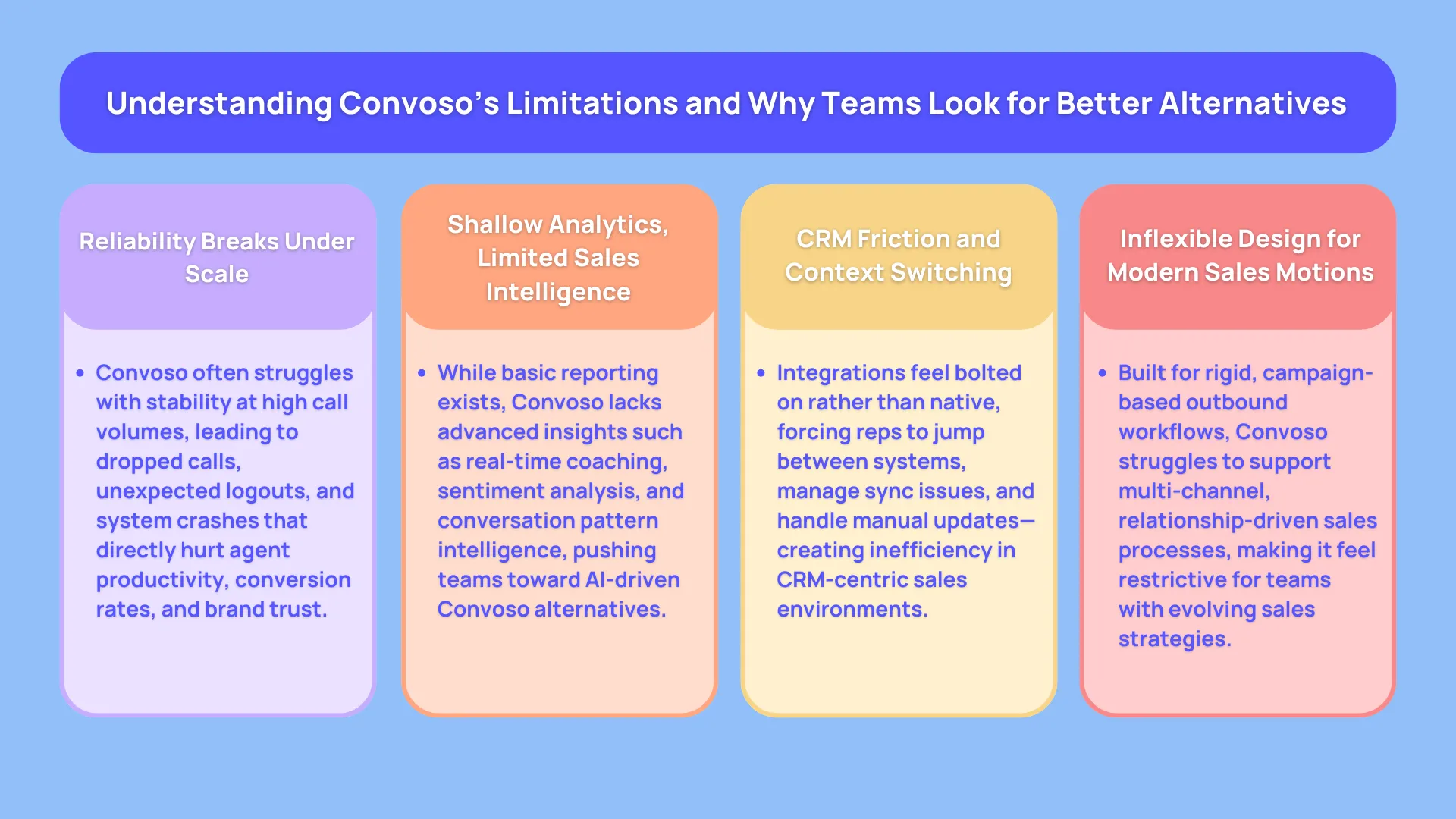
Convoso delivers on its promise of outbound call automation, but daily usage often exposes cracks that do not appear during demos.
These limitations tend to surface once teams scale, call volumes increase, and CRM dependency deepens.
For many organizations, these challenges are the tipping point that triggers serious Convoso comparison research and internal discussions about a long term Convoso replacement.
Platform stability issues under real call volume
One of the most frequently cited concerns with Convoso relates to reliability. Sales teams report dropped calls, delayed connections, and system crashes during peak hours.
When agents are logged out unexpectedly or calls disconnect mid conversation, productivity drops immediately. For outbound sales, timing matters. Losing a live prospect due to a system issue damages both conversion rates and brand perception.
Over time, these disruptions create frustration among reps and managers alike, especially in environments where speed and consistency determine success.
Outdated analytics and limited intelligence
Convoso provides standard reporting and monitoring tools, but many teams find them insufficient for modern sales management.
Managers can review call recordings and track surface level metrics, yet deeper insights remain difficult to access. There is limited real time guidance, minimal sentiment tracking, and no meaningful conversation pattern analysis that helps teams replicate what top performers do differently.
As sales organizations mature, they expect intelligence that explains performance, not just dashboards that describe it. This gap is a major reason teams look for Convoso competitors with stronger AI capabilities.
CRM fragmentation and workflow friction
Although Convoso integrates with leading CRMs, the experience often feels disconnected. Data synchronization delays, limited customization, and manual cleanup become routine tasks.
Reps frequently report switching between Convoso and their CRM to gather context, update notes, or verify lead status. This context switching breaks focus and increases administrative burden.
Sales leaders increasingly prefer platforms that feel native to their CRM rather than layered on top. That expectation alone makes many newer platforms feel better than Convoso for CRM driven teams.
Rigid architecture in a flexible sales world
Modern sales motions are rarely linear. Prospects jump between channels, revisit conversations weeks later, and expect continuity across touchpoints.
Convoso’s campaign centric design struggles to adapt to these fluid workflows. While effective for structured outbound programs, it lacks the adaptability required for consultative, relationship driven sales.
This rigidity leaves teams feeling boxed in, which explains why so many are searching for tools similar to Convoso but built for today’s sales realities.
Essential Features to Look for in Convoso Alternatives
Not every outbound platform qualifies as a strong Convoso substitute.
The best options go beyond dialing speed and offer intelligence, stability, and deep system alignment.
When teams evaluate alternatives to Convoso, several capabilities consistently rise to the top.
Reliable dialing without sacrificing call quality
Predictive and parallel dialing, and parallel dialers still matter, but reliability matters more. The best platforms balance call pacing with connection quality, agent availability, and compliance safeguards.
Instead of simply increasing volume, smarter systems adapt in real time to prevent dropped calls and dead air. This leads to better conversations rather than just more of them.
True omnichannel with unified context
Top platforms treat voice, SMS, email, and digital touchpoints as part of one continuous conversation. Every interaction lives in a single timeline, accessible instantly.
This unified approach eliminates guesswork. Reps know exactly where a prospect stands, what was discussed last, and what needs to happen next.
Native CRM alignment
Deep CRM integration is no longer optional. The strongest Convoso competitors either live inside the CRM or sync so tightly that the separation disappears.
This keeps data clean, reporting accurate, and workflows consistent across the sales stack.
Actionable conversation intelligence
Modern platforms analyze conversations in real time and after the fact. They surface insights about sentiment, objection patterns, talk time balance, and winning phrases.
Instead of managers listening to hours of recordings, intelligence is delivered automatically, turning coaching into a strategic advantage.
.jpeg)

Power and parallel dialing in your CRM.