Our Top Picks


At surface level, any outbound sales strategy seems pretty much straightforward.
Typically, you are supposed to start with an ICP definition, blend it with different scenarios that pan into buyer persona, and then take it from there. However, it’s not that simple. While it’s true that your sales and marketing teams will work across multiple channels to secure and convert leads, two things are never guaranteed, especially if it’s not a proper outbound strategy:
- The conversion rate, in terms of expected vs. whatever comes up
- The actual conversion percentage at the end of a sales cycle
According to McKinsey, sales and marketing teams cover almost 4x prospects through different outreach processes. Cold calling is one of them, followed by cold emailing and vice versa. But eventually, a higher conversion rate is a result of verified phone numbers, different appointments, and lead list that is meant for your business; not just some random list of contacts that you bought or obtained through some 3rd party “outreach agency.”
Yet the companies producing the strongest B2B pipeline continue investing in outbound. The reason is simple. Outbound gives your sales team control. You decide which companies to approach, who should receive your message, when conversations begin, and how opportunities move through your pipeline.
To that effect, we’d say that buying massive contact databases and blasting every person inside them certainly does not work.
Modern outbound rewards relevance, timing, research, and personalization. AI has made prospecting faster, and smarter. And it’s one of those things that has mostly taken over in 2026 because of how technology has advanced and helped to create different tools + digital solutions.
Having said that, if you've ever wondered What is the most effective outbound sales strategy for 2026?, the answer starts long before your first email, cold call, or whatever your immediate modus operandi is.
Throughout this guide you'll learn from these key takeaways:
Key Takeaways:
- How a modern Outbound sales process works from beginning to end
- Proven Pipeline generation tactics used by successful B2B sales teams
- Practical B2B sales prospecting methods that produce qualified meetings
- Modern Cold outreach strategy frameworks that increase reply rates
- Sales engagement best practices that improve conversion across every stage of the funnel
Everything builds upon the previous step. Skip one piece, and the entire outbound engine becomes harder to scale.
What Is an Outbound Sales Strategy?
If you’ve been frequenting Trellus lately, especially our highly detailed blogs, you already know what an outbound sales strategy is. That’s not from a definition point of view, because if you come from any kind of marketing background, you are already aware of, or familiar with the term.
We double down into different norms, aspects and strategies that make up for the overall outbound sales strategy experience.
Also Read:
- Outbound Sales Strategy: Modern Tactics for B2B Success
- 15 Proven Sales Outreach Strategies That Actually Work in 2026
- Inbound vs Outbound Sales Strategies: Which One Drives Better Results in 2025?
For argument’s sake, assuming that you are just about getting started with stuff related to sales pipelines, outbound strategies and whatnot, here’s some quick info that’ll help you to understand the overall nomenclature from an introductory point of view.
An outbound sales strategy is a structured approach where your sales team starts conversations with potential buyers rather than waiting for prospects to contact you.
Rather than depending entirely on SEO, paid advertising, referrals, or inbound content, outbound allows your business to proactively identify companies that fit your ideal customer profile and begin conversations with the people most likely to purchase your product or service.
Instead of hoping qualified buyers fill out a demo form next month, you or your sales team can begin conversations today with companies that match your best customers.
Modern outbound has evolved significantly over the last few years.
Years ago, success often depended on sheer volume. Sales teams sent thousands of emails and made hundreds of cold calls each week. Today that coverage percentage is more like a bare minimum. Hundreds of calls are made every day now, thanks to AI infused solutions and robust software, like Trellus, Nooks, Orum etc., dialing is now more of a volume game, bundled with custom KPIs etc. for better results.
So, in other words, these days, quality beats quantity almost every time. A complete Outbound sales process usually includes several connected stages.
Traditional vs Modern Outbound Sales Strategy (2026)
Identifying Ideal Customers Before You Embark On Your Sales Pipeline and Outreach Journey
Everything begins with defining companies that receive the greatest value from your product.
This goes far beyond company size or industry. As much as defining your ICP is important, we are well aware of the fact that many feel intimidated by the process. They don’t know where to start from, what kind of tests or research needs to be conducted and how to create a document that properly outlines and details everything.
Don’t worry. It happens to the best of us.
If you have no clue on getting started with an ICP creation, conduct preliminary research through Google or any other search engine. That’s going to pull up different free online resources, inclusive of videos and blogs to give you a headstart. Go through a couple of them, and you will have an idea on the starting point, to say the least.
In addition to doing that, feel free to shake up your LinkedIn contact list. Ask around through messages and comments to find out people who have created ICPs before. Consult them, and get their ideas around your business, jotted down in the form of notes.
Afterward, you can refine your initial document to detail everything that needs to be done. The next step comes to…
Building qualified prospect lists
After defining your target customer, sales teams identify individual companies and decision makers that match those characteristics.
This step combines prospecting platforms, enrichment tools, CRM data, AI research, and human verification. A smaller list filled with high quality prospects almost always produces stronger results than a massive list filled with weak matches.
This post should also give you a good sense of direction:
Creating personalized messaging
Every prospect receives messaging built around their business situation. Good personalization no longer means inserting someone's first name. That also translates to using templated messages with minor edits.
Usually, these are available online, but are also part of different outbound sales strategy and outreach programs. They offer a bunch of different messages that you can potentially use to “leverage” your success rate. However, in no way, or form, we want you to send messages as is, or after minor edits.
By now, your prospects are already neck deep into receiving such messages and notes. So, rest assured, you can be sure of a lower conversion/open rate, and poor response from them.
Personalization means studying your prospects around their specific pain points, and then writing down anything that needs to be conveyed. It’s a time taking process, but it’s well worth it!
Side Tip: Data quality has become more valuable than list size. Don’t ignore it!
Large databases filled with outdated contacts create bounced emails, wasted calls, poor deliverability, and frustrated sales teams.
Modern B2B sales prospecting methods prioritize accurate contact information, verified direct dials, current company intelligence, and frequent database cleaning.
Higher quality data creates better conversations while protecting sender reputation. That further ties into sales representatives, or you, the person behind those cold calls/ emails to be more productive and smart in your overall approach. At this point, if you’re wondering about what tools and strategies reduce SDR burnout in outbound calling?
The answer rarely involves asking representatives to make more calls.
Leading organizations automate repetitive administrative work, improve lead quality, remove manual research, provide AI coaching, automate CRM updates, and reduce low value tasks.
When representatives spend more time talking with qualified prospects and less time performing repetitive work, both morale and performance improve.
Pipeline becomes predictable only when every part of the outbound sales strategy supports the others.
Best Steps For Generating More Pipeline with Your Outbound Sales Strategy
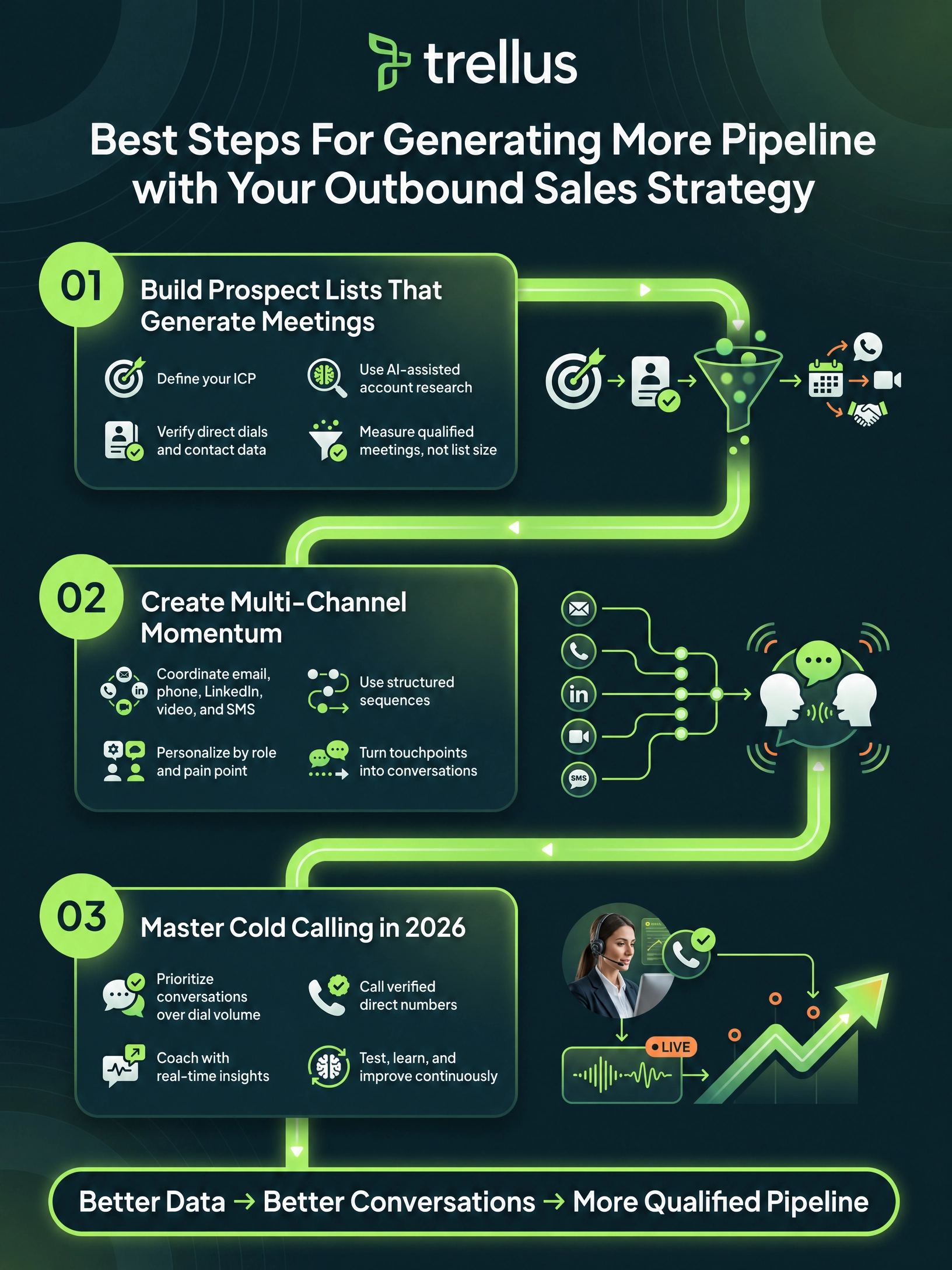
We have covered the ICP part already, so we won’t be starting with that. These steps are supposed to be followed, post the ICP definition work. At any point, don’t take them as is; they’re more of a flexible outline where you should improvise according to your business workflow and requirements.
Step 1: Build Prospect Lists That Generate Meetings, Not Just Activity
Once your Ideal Customer Profile is clearly defined, the next step is building a prospect list that gives your sales team the highest possible chance of starting meaningful conversations.
This sounds obvious, yet it is where many outbound programs quietly lose momentum before a single email is sent.
A surprising number of companies still measure success by the size of their lists.
Twenty thousand contacts sounds impressive.
Fifty thousand sounds even better.
The problem is that large lists often create the illusion of opportunity without producing a meaningful pipeline. Sales representatives spend hours working through contacts that were never likely to buy. Marketing celebrates the number of prospects added to the CRM while account executives wonder why qualified meetings remain difficult to book.
More names rarely solve pipeline problems.
Better names usually do.
One carefully researched list of five hundred companies that closely matches your ICP will almost always outperform several thousand loosely qualified accounts. Every stage of the funnel benefits from better targeting.
Open rates improve because messaging feels more relevant. Reply rates increase because prospects recognize genuine business context. Meetings become easier to schedule because the companies already have problems your solution addresses. Opportunities progress faster because there is stronger alignment from the beginning.
That is why successful Pipeline generation tactics begin with quality rather than quantity.
Your prospect list should never feel like a spreadsheet full of random businesses.
It should feel like a carefully selected group of companies your sales team genuinely believes can become customers.
How to Improve Cold Outreach Conversion Rates with AI?
One of the most common questions sales leaders ask today is How to improve cold outreach conversion rates with AI?
The answer has very little to do with asking AI to write better emails.
That is only one small piece of the picture.
The greatest value comes from allowing AI to handle research that previously consumed hours of manual work.
Modern AI tools can summarize company websites, identify recent funding announcements, detect executive promotions, monitor hiring trends, review earnings reports, identify technology stacks, summarize podcast interviews, analyze LinkedIn activity, and recommend personalized conversation starters within seconds.
That research allows SDRs to spend more time thinking about relevance rather than collecting information.
AI also improves prioritization.
Rather than treating every account equally, intelligent scoring models identify companies displaying multiple buying signals at the same time.
Sales representatives naturally begin outreach where conversion probability is highest.
Another valuable application involves personalization.
AI can summarize recent company announcements, identify role specific priorities, and generate several messaging angles based on current business events.
The sales representative still reviews and edits the final message, but much of the preparation happens automatically.
Conversation intelligence platforms also contribute after meetings begin.
They analyze sales calls, identify successful messaging patterns, recommend coaching opportunities, capture CRM notes, and surface follow up actions without requiring manual documentation.
Step 2: Build a Multi Channel Outreach Sequence That Creates Momentum
After your prospect list is ready, it becomes tempting to open your email platform, write a few sentences about your product, and launch the campaign.
Many sales teams spend weeks refining their prospect lists and messaging, then lose opportunities because of one simple mistake.
They stop too early.
- A prospect does not reply to the first email.
- The SDR assumes there is no interest.
- The account disappears from the pipeline.
A month later, another company books the meeting after following up four or five times. This happens far more often than people realize. Silence should never be confused with rejection.
Decision makers are busy. Their calendars fill up weeks in advance.
That is why a structured follow up process sits at the center of every successful outbound sales strategy.
Consistent outreach keeps your company visible while giving prospects multiple opportunities to engage when the timing becomes right.
The companies generating predictable pipelines understand something very important.
People rarely respond because they received one perfect email. They respond because several thoughtful interactions gradually build familiarity and trust. That is exactly what an effective outreach sequence is designed to accomplish.
Every interaction builds upon the previous one until the prospect either begins a conversation or clearly communicates that there is no current interest.
Without that structure, outbound becomes random activity rather than a repeatable revenue engine.
Why Multi Channel Outreach Performs Better Than Single Channel Campaigns?
Ever heard of the expression: “Don’t put all your eggs in one basket?” Of course, you have by now. In other words, relying on one channel will not net better results if the risks and uncertainty factor are equally high.
On the contrary, a broad spectrum approach is better because you are not only reaching out to people through different channels/ means, but there’s a higher priority that you’ll get responses from these resources.
The one channel approach is also okay, but then again, you are more of in a tunnel vision situation where you are blindsided to so many different opportunities that haven’t been explored. At this point, if you’re a solopreneur, then the amount of work that needs to be done is going to be huge.
Spread it over different stacks, and use any software solution that you can to make the overall process time-efficient.
Step 3: Master Cold Calling in 2026
Yes, that’s the part which is not only the most intimidating but will probably induce a sense of demotivation over time.
Why so?
Cold calling has been declared dead more times than almost any other sales activity. Every few years a new communication channel appears, and predictions begin again. Despite several rumors, such as emails entirely replacing it, or chatbots taking over. Also, not to forget the fact that AI has also played a major role in it, but we can assure you that cold calling is still going strong.
Companies that consistently generate large B2B pipelines continue investing heavily in outbound calling. The reason becomes obvious once you think about how complex buying decisions happen. Large B2B purchases rarely happen because someone clicked a single email.
- Decision makers ask questions.
- They explain concerns.
- They compare options.
- They discuss internal priorities.
Those conversations happen far more naturally over the phone than through a sequence of emails.
Cold calling continues to create opportunities because it allows two professionals to have a real conversation in real time.
- The problem has never been cold calling itself.
- The problem has usually been poor preparation.
Many SDRs still receive outdated contact lists, generic scripts, very little research, and unrealistic activity targets. They spend most of their day dialing numbers that never reach decision makers. After enough unanswered calls, motivation drops, confidence suffers, and outbound begins feeling like repetitive manual work rather than relationship building.
So, in other words, don’t take the research part lightly. It takes time, but if you’re on a call and speaking around a prospect’s pain points, they are more than likely to at least schedule another follow-up call, or convert right away.
On that note, we’d say that modern cold calling looks completely different.
Representatives know who they are calling. They understand why the account deserves attention.
Most importantly, they approach conversations with curiosity rather than pressure.
Stop Measuring Success by Dial Volume
Many sales organizations continue rewarding representatives for making as many calls as possible.
Activity certainly matters.
Without activity there will be no pipeline.
Activity alone, however, tells an incomplete story.
Imagine two SDRs.
- The first makes one hundred and fifty calls during the day.
Most of those calls reach voicemail, whereas several numbers are disconnected.
Some connect to reception desks. Very few conversations happen.
Meanwhile, we have a second representative, who makes, let’s say, about sixty carefully researched calls.
Nearly every contact has been verified. So, from that point of view, each conversation begins with a relevant business context. In addition to that, we can also see that several productive discussions take place over the course of any ongoing call.
One representative appears more productive when measured by activity.
The other creates significantly more revenue.
This is why modern Pipeline generation tactics place increasing emphasis on conversation quality rather than activity quantity.
A smaller number of thoughtful conversations often produces more opportunities than hundreds of random calls.
Verified Direct Dials Change Everything
One of the biggest improvements in modern B2B sales prospecting methods involves contact quality.
Calling general office numbers introduces unnecessary friction before the conversation even begins.
- Receptionists transfer calls.
- Automated menus create delays.
- Decision makers remain inaccessible.
- Many calls never reach the intended person.
- Verified direct dials remove much of that friction.
When your prospecting data includes accurate mobile numbers or verified direct office lines, the conversation begins immediately. That simple improvement changes the entire outbound experience. Representatives spend less time navigating phone systems.
As a result, prospects answer more frequently.
Conversations feel more natural because they begin directly with the intended decision maker.
Continuous Improvement Never Stops
By now, we have learned that any kind of outbound sales strategy that leans into pipeline improvement, is an ongoing process.
You need to analyze your competition over time, and see if they’re doing anything different for better results. Improvise accordingly, and feel free to run different tests that will help you to compare two different scenarios with different types of conversions, leverages, results etc.
Frequently Asked Questions
1. What is the most effective outbound sales strategy in 2026?
The most effective outbound sales strategy in 2026 combines a clearly defined Ideal Customer Profile (ICP), high quality prospect data, AI assisted research, personalized messaging, multi-channel outreach, and consistent follow up.
Rather than relying on mass emails or high call volume, successful sales teams focus on reaching the right decision makers with relevant messaging across email, phone, LinkedIn, and other channels. AI also helps automate research, prioritize buying signals, and reduce manual work so sales representatives can spend more time having meaningful conversations.
2. How can AI improve outbound sales pipeline generation?
AI improves pipeline generation by helping sales teams identify high intent prospects, enrich contact data, personalize outreach at scale, score leads based on buying signals, automate CRM updates, and analyze sales conversations for coaching opportunities.
These capabilities reduce administrative work, improve outreach quality, and allow representatives to focus on qualified prospects who are more likely to convert into meetings and revenue.
3. Why is cold calling still important for outbound sales?
Cold calling remains one of the fastest ways to start real conversations with decision makers. While email and LinkedIn are valuable channels, many B2B buying decisions require live discussions where prospects can ask questions, discuss challenges, and evaluate solutions.
Modern cold calling succeeds when supported by verified contact data, thorough account research, personalized messaging, and AI-powered coaching rather than relying solely on high dialing volume.


Power and parallel dialing in your CRM.