Our Top Picks


Over the course of the last year or so, we have talked about cold calling techniques, sales tips, different tactics, and stuff related to improving your script.
What we didn’t explore too much is the aspect of improving your comebacks to sales objections.
After all, they’re part of the equation, and even if you don’t like them, they’re always going to be there.
The million dollar question is: How do you deal with these objections, which are, by the way, a naturally occurring phenomenon.
Leads do ask questions, and these questions could be a lot more technical if the prospect is potentially interested in signing off on a deal.
Most of the time, the issue is that the rep reacts emotionally or rushes toward a solution before understanding the real concern.
Other times, it could be attributed to two things:
- The sales rep doesn’t have a lot of subject matter expertise during the call. It is possible that they didn’t do thorough research on the prospects’ pain points before dialing their number.
- The second most common reason attributed to the mishandling of sales/ cold calling objections is the lack of conversational skills.
Speaking of conversational skills, the internet is literally riddled with all kinds of stories from sales reps who almost had a chance, but got stuck in the middle of responding to a lead’s question, or questions for that matter.
Don’t worry!
We’ve got you covered.
Moving on, when people talk about how to handle sales objections, they often imagine clever comebacks or scripted rebuttals.
That mindset usually backfires. Prospects do not object because they enjoy blocking deals. They object because something feels unclear, risky, or misaligned with their priorities. Your job is to slow the moment down and make the objection feel safe to talk about.
Also Read:
- Cold Calling Objection Handling
- How to Handle Objections in Sales Like a Pro
- 25+ common cold call objections
At its core, handling objections in sales is a conversation skill, not a persuasion trick.
The best reps sound calm, curious, and grounded. They treat objections as information, not rejection.
What does a typical objection handling scenario look like in real life sales conversations?

Strong objection handling feels collaborative.
It’s like a back and forth friendly banter where the rep says something and gets a question in response. Both sides eventually agree to an appointment, which is more than likely to be the final call before conversion, or the lead converts into a paying customer right then and there!
The prospect feels heard instead of pushed. The rep sounds confident without being defensive. That tone matters more than the exact words.
Here is what effective objection handling tends to include in practice.
• A pause instead of an immediate response, which signals respect and confidence
• Clarifying questions that uncover what is behind the objection
• Reframing the concern in the prospect’s own language
• A response tied to outcomes rather than features
• A clear next step that keeps momentum intact
Each of these elements works together.
Skip one, and the conversation often stalls. Rush past one, and trust erodes.
So, to further elaborate on this, it’s one of the main reasons as to why an objection handling framework matters. Not a rigid script, but a mental structure you can rely on under pressure.
The Objection Handling Framework Which Works
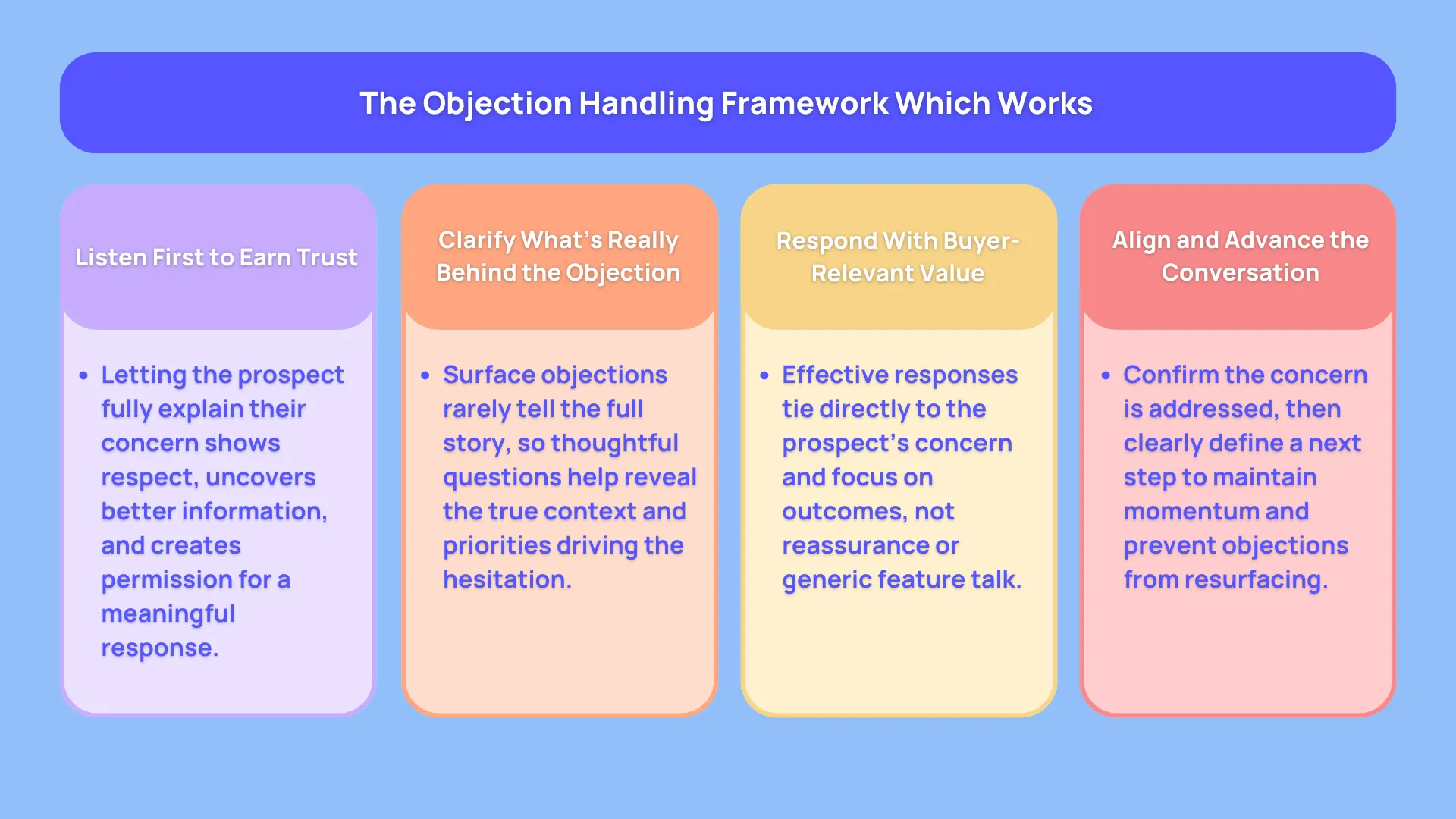
- Step one, listen without interrupting
Listening is not passive silence. It is active attention. When a prospect raises a concern, many reps jump in too quickly, eager to fix it. That instinct sends the wrong signal. It tells the buyer you care more about moving forward than understanding them.
When you let the prospect finish, you gain two advantages. You collect better information, and you earn psychological permission to respond. People are far more open to solutions after they feel heard.
This step alone resolves more common sales objections than most people expect.
- Step two, clarify the real concern
Most objections are surface level statements. Time, budget, approval, priority. Those words rarely represent the full story.
Clarifying questions help uncover what actually matters.
Questions like these keep the tone natural and respectful.
• Can you help me understand what is driving that concern
• What prompted that hesitation
• How are you thinking about this internally
The goal here is not to trap the prospect. It is to understand context. Once you have context, your response becomes relevant instead of generic.
- Step three, respond with relevance, not reassurance
Effective sales objection responses connect directly to the concern raised. They reference outcomes, examples, or data points that matter to that specific buyer.
This is also where handling price objections often succeeds or fails. Price concerns rarely disappear through reassurance. They soften when the value feels concrete and personal.
- Step four, confirm alignment
After responding, strong reps check in.
A simple question keeps things grounded.
- Does that address what you were concerned about
- How does that land with you
This step prevents assumptions and invites honest feedback. It also keeps objections from resurfacing later in the deal.
Step five, move the conversation forward
Objection handling is not complete until there is a next step. That step does not have to be a close. It just needs to move the deal out of neutral.
A meeting, a stakeholder intro, a follow up discussion. Momentum matters.
Why Common Sales Objections Keep Showing Up? Isn’t There a Way To Get “Rid” of Them?
If you hear the same objections again and again, it is tempting to blame the market or the prospect.
In reality, repeated objections often point to gaps earlier in the sales process.
Poor qualification creates weak urgency. Vague discovery leads to shallow value. Rushed demos trigger trust issues. Objections are often symptoms, not root causes.
This is why objection handling connects directly to Prospect Qualification and Sales Conversations. When those foundations are solid, objections become easier and less frequent.
The most common sales objections usually fall into four categories.
• Price and budget concerns
• Timing and priority concerns
• Authority and approval concerns
• Need and relevance concerns
Sales Objection Responses
Sales objection responses are not clever one liners.
They are thoughtful reactions that show you understand the buyer’s world. The strongest responses feel calm, specific, and grounded in outcomes rather than pressure. When prospects sense that you are trying to push them past discomfort, resistance increases. When they feel guided, resistance softens.
Great responses share a few traits.
They acknowledge the concern without validating doubt. They redirect attention toward value without dismissing reality. And they keep the conversation moving forward without forcing a decision.
Responding to price concerns without sounding defensive
Price objections show up in almost every deal, regardless of industry or deal size.
Even buyers with budget approval raise price concerns as part of risk assessment. The mistake many reps make is trying to justify the price too early or apologizing for it.
Handling price objections works best when price is treated as a business decision rather than a personal hurdle.
When a prospect says the solution feels expensive, what they are often really saying is that they are not fully convinced of the return. Your response should focus on outcomes, impact, and tradeoffs.
A grounded response sounds like this.
I hear you. Can we talk through what success would need to look like for this to feel like a smart investment
Doing so reportedly opens a value conversation instead of a pricing debate.
From that point onward, feel free to connect cost to measurable results such as time saved, revenue protected, or risk reduced. When possible, anchor your explanation in numbers the prospect already cares about.
Responding to timing objections without losing momentum
Timing objections often sound polite but dangerous. Statements like now is not the right time or check back next quarter can quietly kill deals if left unchallenged.
Strong reps treat timing objections as signals, not stop signs. The goal is to understand what the buyer is prioritizing and why this conversation slipped down the list.
A response that keeps momentum intact might sound like this.
That makes sense. What is taking priority right now, and how does this compare
This invites transparency and often reveals overlap between your solution and their current focus. When overlap exists, urgency can be rebuilt naturally.
If urgency truly is low, define a clear future trigger. Agreeing on what would make this a priority later prevents the deal from disappearing into silence.
Responding to authority objections with confidence
Authority objections are rarely rejection. They are process signals. Buyers want to avoid making mistakes alone, especially when decisions affect budgets or teams.
Instead of asking for immediate access to decision makers, help your contact succeed internally.
A helpful response might be.
What would your leadership team want to understand before supporting this
This positions you as a partner instead of an outsider. It also allows you to tailor messaging, data, and materials for the real decision makers.
Authority objections are easier to handle when you view the buyer as a champion rather than a gatekeeper.
Overcoming Objections Without Sounding Pushy
Many sales reps worry about sounding aggressive when they challenge objections. That fear leads to passivity, and passivity kills deals just as quickly as pressure.
Overcoming objections does not require force. It requires clarity and confidence.
Confidence comes from preparation. When you know your product, your market, and your customer’s pain points, objections feel manageable instead of threatening.
Clarity comes from asking better questions earlier in the process. When discovery is strong, objections become narrower and easier to resolve.
This is where Sales Training and Sales Coaching make a measurable difference. Reps who practice objection scenarios regularly respond with calm curiosity instead of rehearsed defensiveness. Many modern teams support this practice through AI coaching tools that analyze calls and highlight objection patterns, language gaps, and missed follow ups.
The result is not perfection, but consistency.
Best Sales Techniques That Reduce Objections Before They Appear
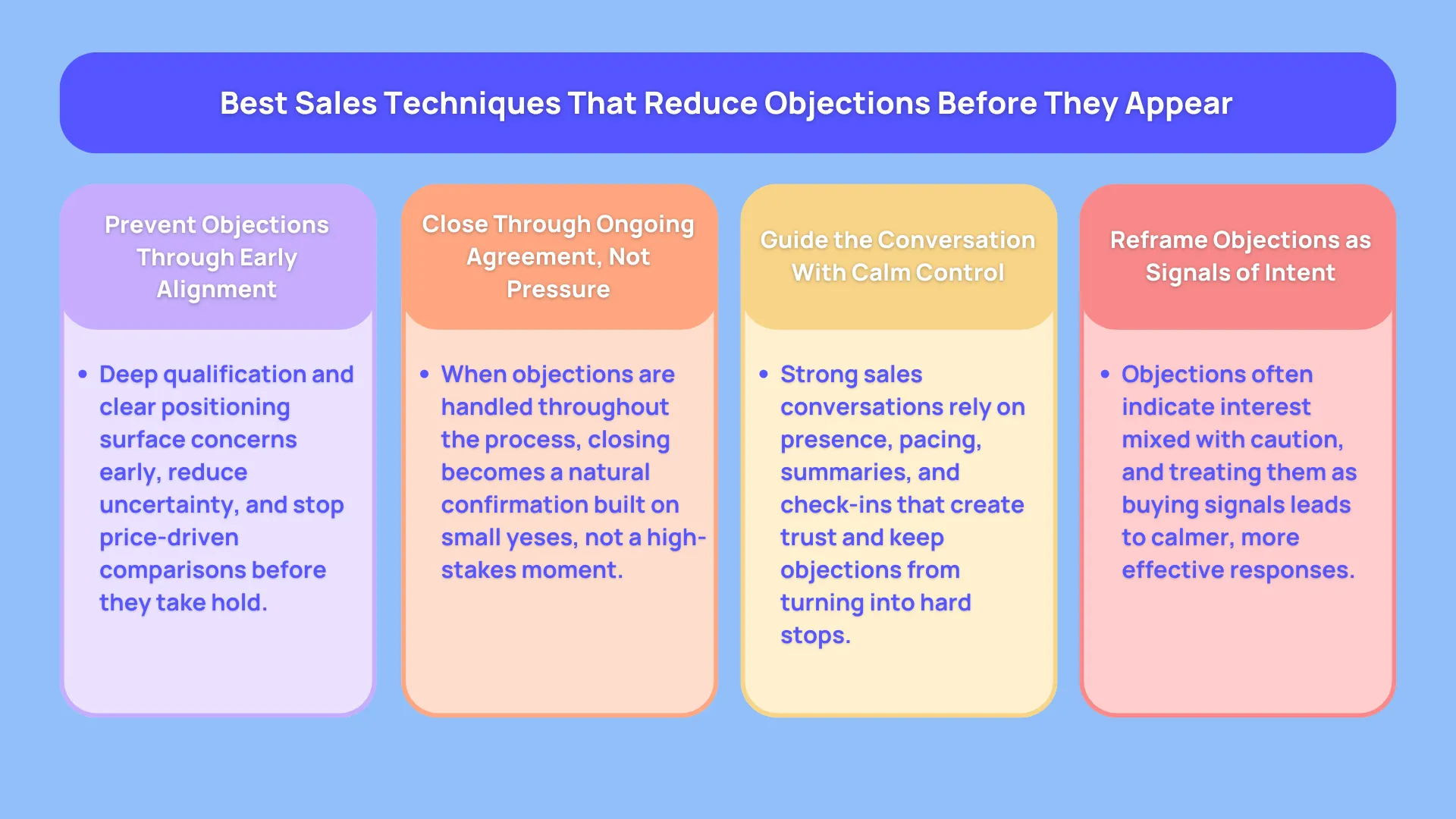
The best objection handling happens before an objection is ever voiced. Strong sales techniques surface concerns early, address them naturally, and prevent last minute resistance.
Deep qualification creates natural alignment
When qualification focuses only on surface details, objections pile up later. Deep qualification uncovers motivation, urgency, and internal politics early in the relationship.
Questions that clarify impact, cost of inaction, and success criteria reduce surprises. When buyers feel aligned from the start, they object less because fewer things feel unknown.
This makes Prospect Qualification one of the most underrated objection handling tools available.
Clear positioning prevents comparison traps
Many objections arise when prospects compare you to alternatives incorrectly. If positioning is vague, buyers default to price comparisons. Clear positioning anchors value in differentiation.
This is especially important when prospects mention competitors. Instead of reacting defensively, strong reps highlight differences in outcomes, support, or long term fit.
Clear positioning makes your value easier to defend internally and externally.
Closing Techniques That Handle Objections Gracefully
Closing is not a moment. It is a sequence of small agreements built throughout the sales process.
When objections are handled well earlier, closing feels like a natural next step instead of a high pressure ask.
Effective sales closing techniques often sound like confirmation rather than persuasion.
Based on what we discussed, does moving forward feel like the right next step
- Is there anything still unclear that would block a decision
These questions surface final concerns without introducing new pressure. They also give buyers permission to be honest.
Deal closure becomes smoother when objection handling is treated as an ongoing conversation rather than a final hurdle.
Sales Conversations
Sales conversations are where objection handling either feels natural or painfully forced.
The difference is rarely about scripts. It is about presence, preparation, and pacing. When conversations are rushed or overly transactional, objections show up louder and earlier. When conversations feel thoughtful and grounded, objections surface as honest questions rather than hard stops.
Strong sales conversations leave space for uncertainty. Prospects do not need you to remove every doubt instantly. They need to feel safe voicing concerns without being corrected or overridden.
This mindset changes how you approach how to handle sales objections. Instead of reacting, you guide.
Creating conversational control without domination
Control in sales does not mean talking more. It means steering the flow of the discussion while allowing the prospect to feel ownership.
You create this balance through transitions, summaries, and check ins.
Summarizing what you heard before responding shows attention and builds trust. Checking in after explaining something confirms alignment. Transitioning thoughtfully keeps the conversation from drifting or stalling.
When objections arise in this environment, they feel manageable. They become part of the conversation instead of interruptions.
Objections as buying signals
One of the biggest mental shifts top performers make is reframing objections as buying signals. People rarely object to things they do not care about. Objections often signal interest mixed with caution.
A prospect asking about price, timing, or internal approval is imagining what moving forward might look like. Your role is to help them think that through clearly.
This reframing reduces emotional reactions and improves response quality across all sales objection handling techniques.
Sales Coaching

Sales coaching is where objection handling skills are built and refined. Objections are dynamic. Markets change, buyers become more informed, and messaging evolves. Without ongoing coaching, reps fall back on outdated responses or defensive habits.
Effective coaching focuses on patterns rather than isolated mistakes. It looks at where objections appear in conversations, how reps respond, and what happens next.
Modern teams increasingly rely on AI coaching tools to surface these patterns. These tools analyze real sales conversations, identify moments where objections appear, and highlight how different responses impact outcomes. This creates faster feedback loops and more consistent improvement across teams.
Coaching conversations should focus on tone, pacing, and clarity, not just words. The way something is said often matters more than what is said.
Sales Training
Sales training sets the foundation that coaching reinforces. Training without reinforcement fades quickly. Reinforcement without training lacks structure. Together, they create confidence.
Strong training programs treat objection handling as a skill, not a personality trait. Reps practice responding to common sales objections in realistic scenarios. They learn to pause, ask better questions, and connect value to outcomes.
Training should cover handling price objections, timing delays, authority pushback, and need based resistance separately. Each category requires different instincts and language.
The goal is not memorization. The goal is adaptability. When reps understand the logic behind responses, they can adjust naturally in live conversations.
Prospect Qualification
Prospect qualification quietly determines how hard objection handling will feel later. Poorly qualified deals create objections that cannot be solved through conversation alone.
Strong qualification clarifies three things early.
• The problem is real and acknowledged
• The impact matters to the business
• There is a path to decision and approval
When these elements are clear, objections tend to be practical rather than existential. Conversations focus on how to move forward, not on whether it makes sense at all.
This connection between qualification and objection handling is often overlooked, yet it shapes everything that follows.
Deal Closure
Deal closure is where all earlier work is either confirmed or undone. When objections have been handled thoughtfully throughout the process, closing feels calm and expected.
When objections are avoided or brushed aside earlier, they resurface here with more intensity.
Strong deal closure involves revisiting key concerns, summarizing agreed value, and confirming readiness.
Language that works well here sounds reflective rather than persuasive.
We talked about impact, budget alignment, and internal support. Is there anything left that would stop us from moving ahead
This invites honesty without pressure. It also signals confidence that the deal makes sense.
Closure is not about forcing a yes. It is about confirming alignment.
Bringing It All Together
Handling objections well is not about being clever under pressure. It is about preparation, empathy, and structure.
While they’re at it, the best salespeople do not fear objections; they expect them and welcome them as part of meaningful sales conversations.
When you rely on a clear objection handling framework, practice thoughtful sales objection responses, and focus on value instead of defense, objections lose their power.
.jpeg)

Power and parallel dialing in your CRM.