Our Top Picks


The traditional math of outbound sales is broken. For decades, revenue leaders believed that scaling pipeline meant scaling headcount. If you needed 20% more meetings booked, the answer was simple: hire 20% more Sales Development Representatives. But in 2026, throwing bodies at a pipeline problem is the most expensive and inefficient way to grow.
We are entering the era of the "revenue engineer." Today, scaling an SDR team isn't about adding more desks to the sales floor; it's about fundamentally decoupling output from headcount. Artificial intelligence and advanced automation are transforming the role of the SDR, allowing a lean team of elite reps to generate the output of a team three times their size.
By automating the administrative "grunt work" — from pre-call research to CRM data entry — modern tech stacks empower reps to spend 80% of their day in active, high-value conversations. If you want to double your pipeline this year, put away the hiring plan. Here is how you give your current team superpowers and scale your SDR function without adding a single new headcount.
The Real Cost of Hiring an SDR in the USA (2026 Figures)

Before discussing how to scale without headcount, we must confront the brutal economics of traditional scaling. The sticker shock of building an outbound team has never been higher.
Many revenue leaders mistakenly equate the cost of an SDR with their base salary. However, in 2026, the fully loaded cost of an in-house US-based SDR paints a drastically different picture. Once you factor in On-Target Earnings (OTE), employer taxes, recruitment fees, and the ballooning cost of a modern sales tech stack, the financial commitment is staggering.
Furthermore, you must account for the "ramp tax." It takes an average of three to six months for a new SDR to become fully productive, meaning you are paying a premium for months of zero ROI. When you look at the total financial burden, it becomes clear why adding bodies is no longer a sustainable growth strategy.
The 5 Levers That Scale SDR Output Without Hiring
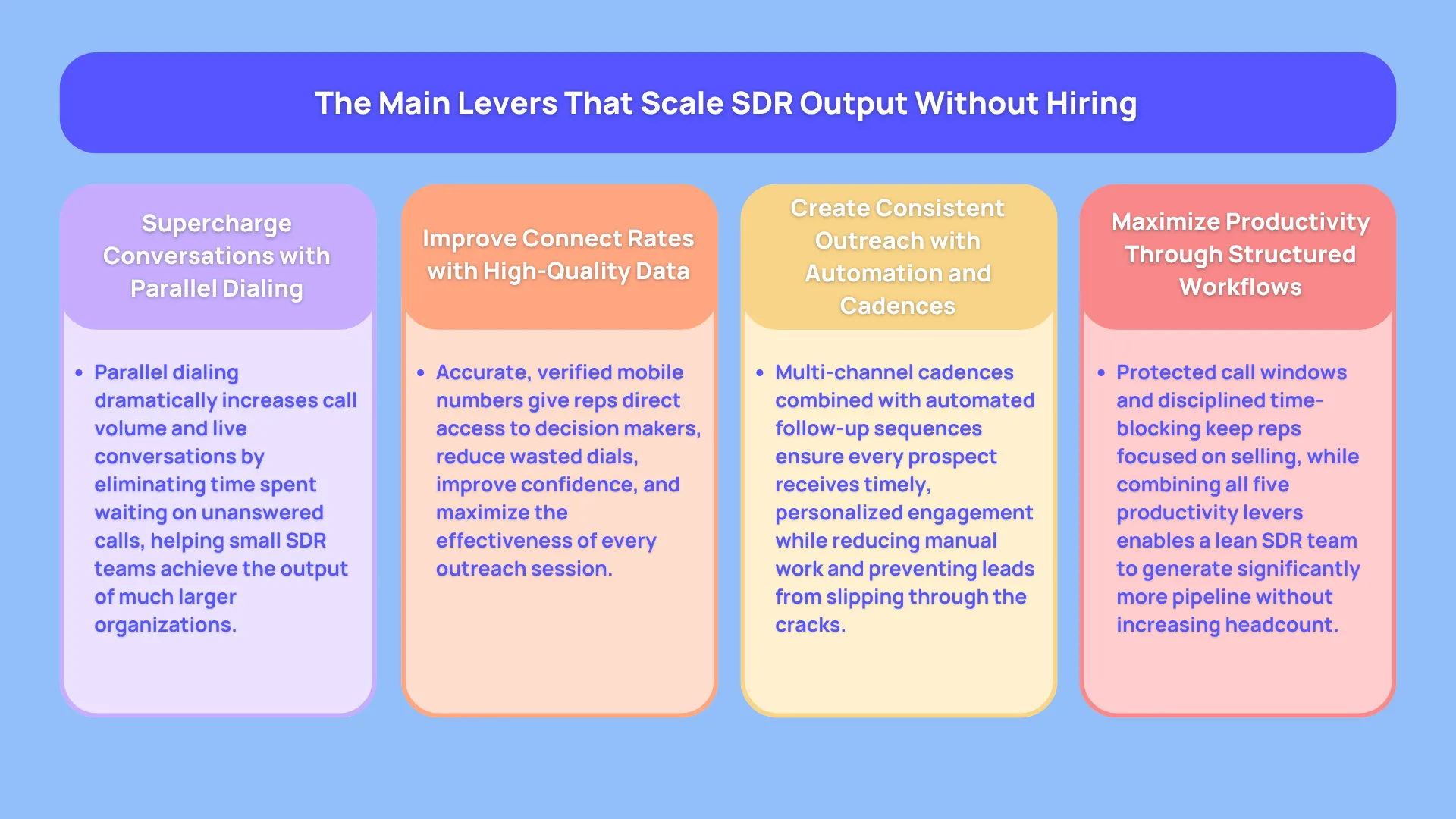
If adding headcount is financially unviable, the only path forward is multiplying the output of your existing team. This requires pulling specific operational and technological levers that remove friction and amplify effort.
Lever 1: Parallel Dialing (Biggest Impact)
If there is a single technology that fundamentally breaks the linear relationship between time and outbound output, it is the parallel dialer. Traditional manual dialing is agonizingly slow. An SDR spends the vast majority of their call block listening to rings, navigating phone trees, and leaving voicemails. A good rep might make 50 to 60 manual dials in a day, resulting in perhaps two or three actual conversations.
Parallel dialing changes the math entirely. By dialing multiple numbers simultaneously and instantly routing connected calls to the rep, a single SDR can comfortably execute 200 to 300 dials in a single session. The technology filters out the bad numbers, the voicemails, and the endless ringing.
The impact on morale is just as significant as the impact on metrics. Reps are no longer drained by the monotony of manual dialing; they are energized by a steady stream of live conversations. When you equip a five-person team with a parallel dialer, their conversational output immediately mirrors that of a fifteen-person team doing it the old-fashioned way. It is the ultimate scaling mechanism.
Lever 2: Verified Mobile Data
A parallel dialer is only as powerful as the data you feed into it. If your reps are dialing switchboards, headquarters numbers, or outdated desk phones, they will spend their entire day talking to gatekeepers or leaving messages in abandoned inboxes. In a remote and hybrid working world, the desk phone is practically obsolete.
Scaling output requires a ruthless commitment to verified mobile data. When an SDR dials a direct mobile number, the connect rate skyrockets. It bypasses the corporate firewall entirely. However, buying cheap, unverified lists is a false economy. Bad data leads to high bounce rates, which damages domain reputation and wastes the parallel dialer's capacity.
Investing in premium data providers that guarantee high-accuracy mobile numbers is non-negotiable for a lean team. You are essentially buying your SDRs the privilege of direct access. When reps trust their data, their call reluctance drops. They know that when they hit 'dial', there is a high probability a decision-maker will pick up. This efficiency allows a small team to penetrate target accounts much faster than a large team struggling with poor contact information.
Lever 3: Multi-Channel Cadences
Relying on a single channel for outbound sales is a guaranteed way to hit a ceiling. Some prospects live in their inbox, others respond only to LinkedIn messages, and some respect the hustle of a well-timed cold call. To scale output without scaling headcount, your SDRs must be omnipresent.
Multi-channel cadences orchestrate this omnipresence. Rather than randomly firing off emails or making ad-hoc calls, a modern cadence weaves these touchpoints into a cohesive narrative. An SDR might send a highly personalized email on day one, follow up with a LinkedIn connection request on day two, and execute a cold call on day four, referencing the previous touchpoints.
This approach creates a surround-sound effect for the prospect. Even if they haven't replied, they recognize the rep's name when the phone rings. Crucially, modern sales engagement platforms automate the progression of these cadences. The SDR doesn't have to remember who to call or when to email; the system dictates the daily workflow. This structured approach ensures that a small team can manage thousands of prospects simultaneously without a single lead falling through the cracks.
Lever 4: Time-Blocking and Protected Call Window
Technology can only amplify what a rep actually does. If an SDR's day is a chaotic mix of researching, writing emails, attending internal meetings, and occasionally making a phone call, their output will remain stagnant. The human brain is terrible at context switching. Moving from deep research to live cold calling requires a massive expenditure of cognitive energy.
The most effective operational lever a sales leader can pull is implementing rigid time-blocking. This means creating "Protected Call Windows" — specific blocks of time (e.g., 9:00 AM to 11:00 AM) where the only acceptable activity is dialing. Slack is muted, email is closed, and internal meetings are banned.
During these windows, the SDR is fully immersed in the rhythm of the conversation. They aren't pausing between calls to check LinkedIn; they are in the zone. By grouping similar tasks together — a block for research, a block for personalization, a block for dialing — you eliminate the friction of context switching. A rep operating in a tightly structured, time-blocked environment will consistently out-produce a rep working ad-hoc, regardless of the tools they use.
Lever 5: Automated Follow-Up Sequences
The fortune is in the follow-up, but the follow-up is also where SDRs lose the most time. Manually tracking who needs an email, writing that email, and remembering to send it three days later is an administrative nightmare that limits how many prospects a rep can manage.
Automated follow-up sequences solve this bottleneck. Once an SDR has customized the initial outreach, the subsequent touchpoints — the "bump" emails, the value-add content shares, the break-up emails — should be entirely automated. The system takes over the heavy lifting, keeping the prospect engaged without requiring any additional manual effort from the rep.
This is also where platforms like Trellus.ai provide a massive advantage. While basic tools just send templated emails, advanced AI can automatically draft highly contextual follow-ups based on the transcript of a live call. If an SDR finishes a call and moves on to the next dial, the AI is in the background, summarizing the notes and queuing up the perfect follow-up email. This level of automation allows a single rep to maintain a massive, highly personalized pipeline.
The Stacked Impact of These 5 Levers
Individually, each of these levers provides a noticeable bump in productivity. But when you stack them together, the results are exponential.
Imagine an SDR who uses Time-Blocking (Lever 4) to dedicate two hours entirely to outreach. During that block, they use a Parallel Dialer (Lever 1) loaded with Verified Mobile Data (Lever 2). Because the data is accurate and the dialer is fast, they have ten live conversations instead of two. Those conversations are part of a broader Multi-Channel Cadence (Lever 3), meaning the prospects are already warmed up. After the block ends, Automated Follow-Up Sequences (Lever 5) ensure that every prospect who didn't answer still receives a touchpoint.
This stacked approach transforms a traditional SDR into a high-leverage revenue engineer. They are no longer doing the manual labor of sales; they are managing the systems that do the labor for them. This is how a team of five outpaces a team of fifteen.
Same Team. Radically Different Results. Here Is the Math.
Numbers don't lie. The most persuasive argument for optimizing over hiring isn't philosophical — it's arithmetic. When you put the same five-rep team side by side, before and after optimization, the gap in output is so stark it reframes the entire conversation around headcount. The question is no longer "how many SDRs do we need?" but "how much are we leaving on the table right now?"
The Unoptimized Five: What Your Team Looks Like Without the Right Systems
A five-person SDR team operating without the levers outlined above is, by default, an expensive underperformer. Each rep manually dials 50 to 60 numbers per day, spending roughly 70% of their time on hold, navigating voicemail, or updating CRM fields. On a good day, each rep has two to three live conversations. Across the team, that is ten to fifteen conversations daily.
With a typical connect-to-meeting conversion rate of 10 to 15%, this team books one to two meetings per rep per day — roughly five to ten per week for the entire team. Follow-ups are inconsistent, leads fall through the cracks, and reps end each day feeling like they've worked hard but moved the needle very little. The pipeline is thin, the morale is thinner, and the instinct is to hire more people to solve a problem that is fundamentally about process, not headcount.
The Optimized Five: What Happens When You Pull All the Levers
Now apply the five levers to the same team. Protected call windows eliminate context switching. A parallel dialer loaded with verified mobile data triples the number of live conversations each rep has per session. Multi-channel cadences mean every prospect is being touched across email, phone, and LinkedIn simultaneously. Automated follow-up sequences ensure no lead goes cold.
The output transformation is dramatic. Each rep now holds eight to twelve live conversations per day — not two to three. Conversion rates climb because prospects are warmer, reps are sharper from staying in the conversational rhythm, and real-time AI guidance from tools like Trellus.ai surfaces the right talk track at the right moment. The team goes from booking five to ten meetings per week to booking twenty-five to forty. Same five people. Same hours. Entirely different results.
Your 6-Month Roadmap to a Leaner, Higher-Output SDR Machine
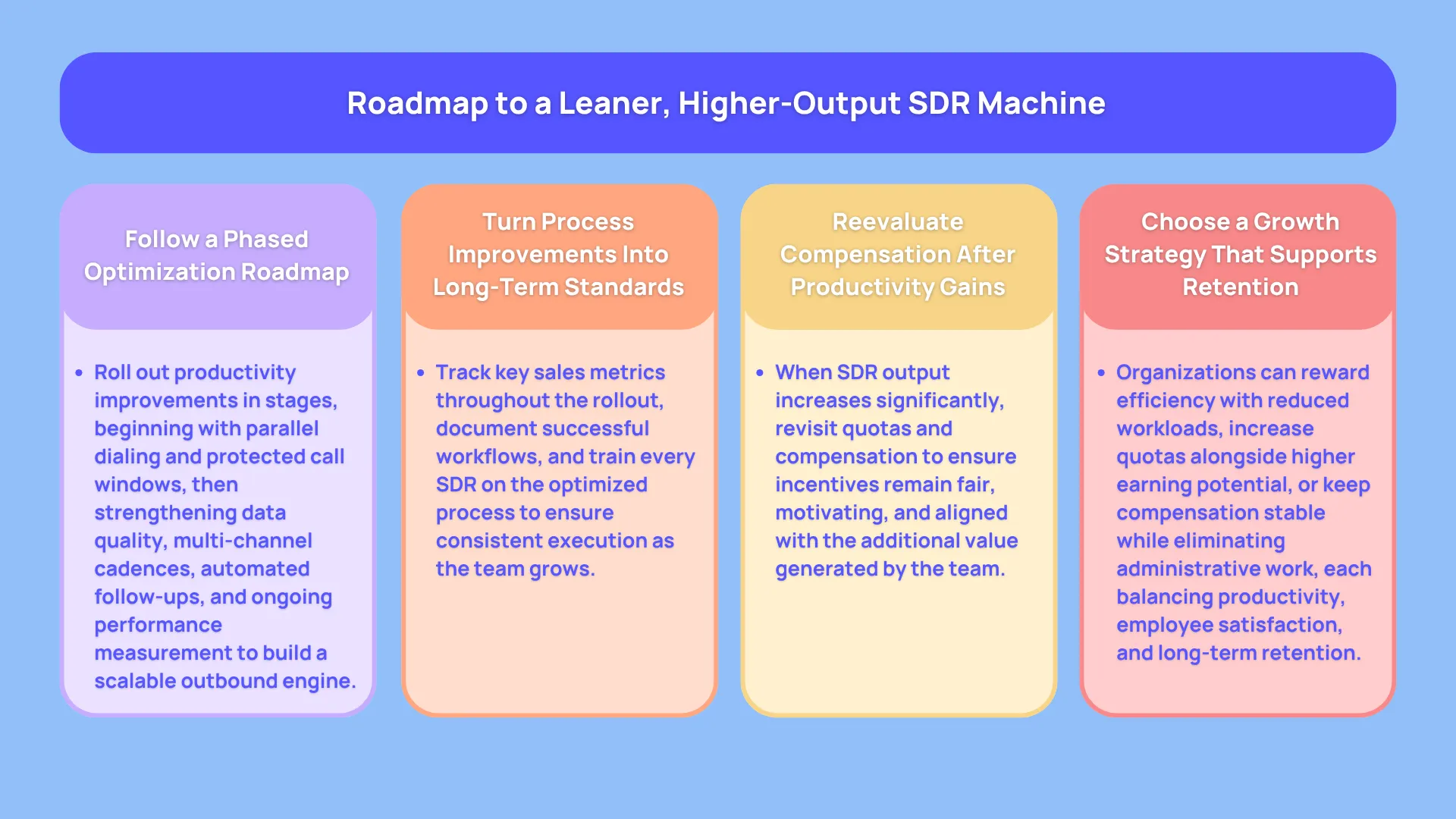
Transformation doesn't happen overnight. But it does happen fast when you sequence the changes correctly. Here is the exact order to implement each lever for maximum impact with minimum disruption.
Month 1: Flip the Switch on Parallel Dialing
This is your highest-ROI move. Select a parallel dialing platform, integrate it with your CRM, and run a two-week pilot with your top two reps. The lift in live conversations will be immediate and undeniable. Use the pilot data to get full team buy-in before a complete rollout.
Month 1: Redesign the Day Around the Dial
Simultaneously, restructure your team's daily schedule. Identify the two highest-connect windows in your target market (typically 8–10 AM and 4–5 PM local time) and lock them as non-negotiable call blocks. Block all internal meetings outside these hours. This costs nothing and delivers results from day one.
Month 2: Audit and Upgrade Your Contact Data
Now that your team is dialing more, bad data becomes the bottleneck. Audit your current contact database for mobile number coverage and accuracy. Replace or supplement with a verified mobile data provider. Even a 20% improvement in connect rates at this stage compounds dramatically across the higher dial volumes you have already unlocked.
Month 3: Build and Launch Your Multi-Channel Cadences
With dialing optimized, layer in a structured multi-channel cadence. Map out a 10 to 14-day sequence combining calls, personalized emails, and LinkedIn touchpoints. Use a sales engagement platform to automate the scheduling. Your reps should be orchestrating the sequence, not manually managing it step by step.
Month 4: Automate the Follow-Up Layer
By now, your reps are having significantly more conversations. The risk is that follow-up quality drops under the volume. Deploy automated post-call sequences triggered by call outcomes. Tools like Trellus.ai can auto-generate contextual follow-up drafts from call transcripts, ensuring every conversation leads to a timely, relevant next touchpoint without adding to the rep's manual workload.
Month 5–6: Measure What Sticks and Make It Permanent
Stop experimenting and start institutionalizing. Review your core metrics — dials to conversations, conversations to meetings, meetings to pipeline — and identify where the remaining friction lives. Document the optimized playbook, train any new hires into the system, and set a quarterly review cadence to ensure standards don't slip as the team scales.
When Output Doubles, What Happens to Pay?
Scaling output without scaling headcount raises an uncomfortable but unavoidable question: if your reps are now producing twice the pipeline, are they still being paid fairly? How you answer this question will determine whether your optimization effort sticks or quietly collapses as your best reps walk out the door. There is no single right answer, but there are three clear paths — each with distinct trade-offs.
Give Them Their Time Back: Reward Efficiency With Breathing Room
If your reps are hitting the same quota in significantly less active effort, one ethical and morale-positive response is to reduce the expected workload to match historical output levels. In practice, this means shorter required call blocks or fewer mandatory dials per day. You retain talent, reduce burnout, and signal that the efficiency gains benefit the rep, not just the company. The risk is leaving pipeline growth on the table.
Raise the Bar and Raise the Ceiling: Align Higher Quota With Higher Earning Potential
The most growth-oriented approach is to raise quota in line with the new output capacity — but raise OTE accordingly. If a rep can now realistically book three times the meetings, set a quota that reflects that and build a compensation structure where hitting it pays significantly more. This aligns incentives perfectly. Reps are motivated to maximize the tools, and the company captures the full upside of the optimization investment.
Keep the Deal the Same, Just Stop Overloading the Role
A simpler, lower-risk option is to hold compensation and quota constant but use the efficiency gains to reduce the administrative burden on reps. They still earn the same, still hit the same targets, but now spend far less time on manual work. The freed-up capacity goes toward better call preparation, deeper account research, and higher-quality conversations. It's a quality-of-life upgrade that quietly improves retention without touching the comp plan.
The 5 Pitfalls That Quietly Kill Your Scale-Without-Hiring Strategy
Knowing the levers is only half the battle. Most programs fail not from bad intentions, but from predictable, avoidable mistakes. Here is what to watch for.
Mistake 1: Reaching for the Hire Before Fixing the Foundation
Bringing on new reps before your process is optimized just multiplies the inefficiency. You are scaling broken, not scaling smart. Fix the system first, then grow the team into it.
Mistake 2: Turning the Whole Playbook On at Once
Deploying all five levers simultaneously overwhelms your team and makes it impossible to isolate what is working. Change one variable at a time. Sequence the rollout deliberately and let each lever stabilize before adding the next.
Mistake 3: Using Efficiency Gains as a Stick, Not a Reward
If reps feel that working smarter just earns them a higher quota with no upside, they disengage. Optimization must benefit the rep visibly — through earnings, workload relief, or both. Resentment kills adoption faster than any technical failure.
Mistake 4: Flying Blind Without a Measurement Framework
If you are not tracking dials, connect rates, and meeting conversion before and after each change, you are guessing. Without a measurement baseline, you cannot prove ROI, identify bottlenecks, or defend the program to leadership.
Mistake 5: Handing Reps New Tools Without Proper Onboarding
A parallel dialer in the hands of an untrained rep is a wasted investment. Dedicate structured onboarding time to every new tool. Reps who understand the "why" behind a system adopt it. Those who don't, work around it.
The Smartest SDR Teams in 2026 Are Not the Biggest Ones
The era of headcount as a growth strategy is over. The most competitive revenue teams in 2026 are not the ones with the most reps — they are the ones with the most leverage. They have built systems that multiply human effort, not just add to it.
The five levers outlined in this article — parallel dialing, verified mobile data, multi-channel cadences, time-blocking, and automated follow-up — are not theoretical. They are the operational backbone of every high-output SDR team that has cracked the scale-without-hiring code. When implemented in the right sequence, with the right measurement framework and a compensation model that keeps reps motivated, the results are not incremental. They are transformational.
But execution is everything. The difference between a team that reads this article and a team that actually scales is the quality of the tools they use to bring it to life.
That is where Trellus.ai comes in.
Trellus is built specifically for the modern SDR. It sits inside your existing workflow and delivers real-time AI coaching during live calls — surfacing the right objection-handling response, flagging sentiment shifts, and keeping reps sharp in the moments that matter most. The moment a call ends, Trellus automatically generates call summaries, CRM updates, and personalized follow-up drafts, eliminating the administrative drag that kills productivity at scale.
If you are serious about scaling your SDR team's output without adding headcount, Trellus.ai is not a nice-to-have. It is the engine that makes the entire system run.
.jpeg)

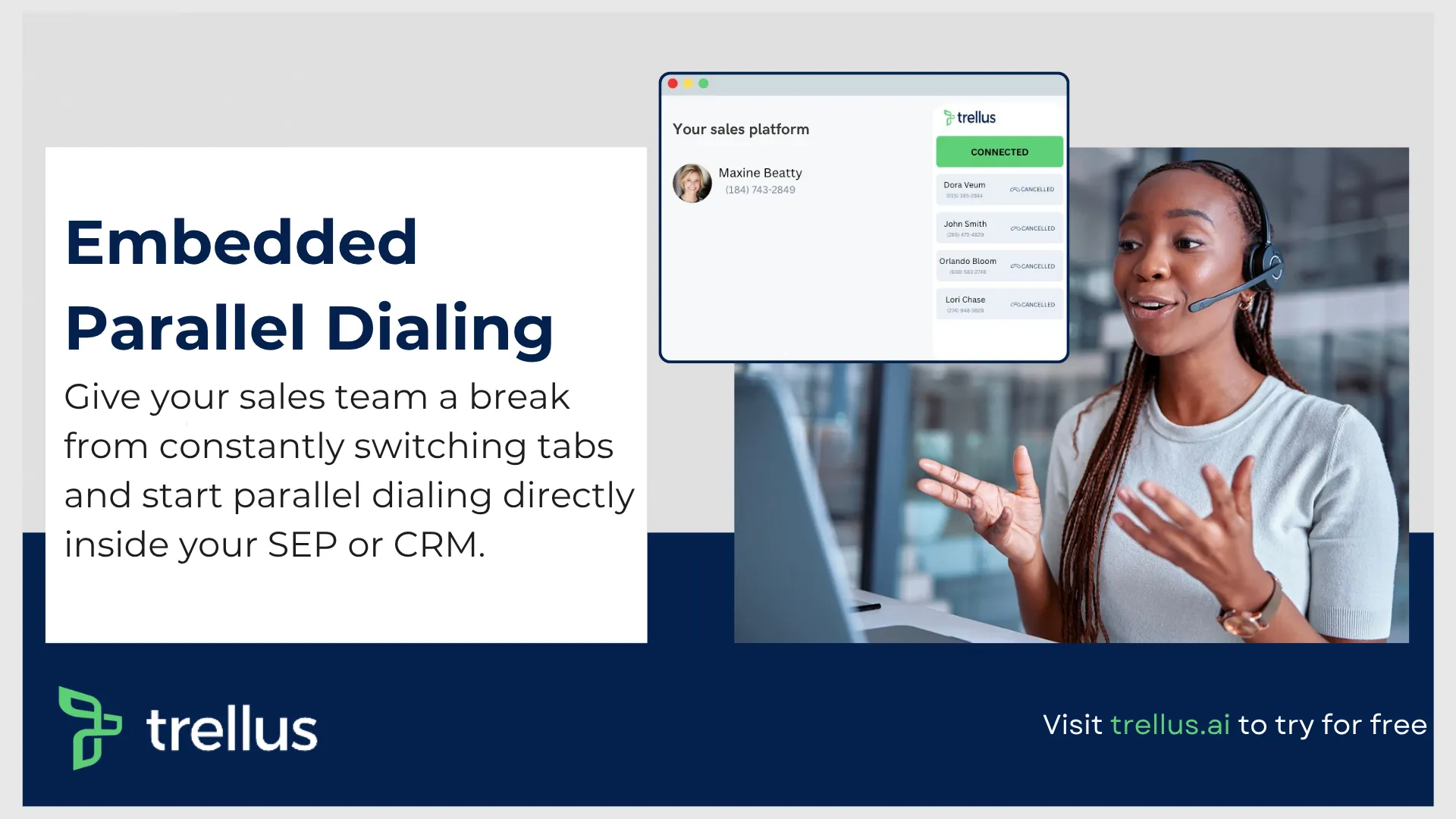
Power and parallel dialing in your CRM.