How to Generate More Outbound Sales Pipeline in Competitive Markets
Learn how to generate more outbound sales pipeline with proven strategies for prospecting, qualification, cold calling, sales alignment, and pipeline acceleration in competitive markets.

On this page
Our Top Picks


A couple of years ago, sending a generic cold email to a list of prospects could still generate a bunch of meetings. Conversion wasn’t guaranteed, but you’d at least have one foot through the door.
But, honestly speaking, even for that to happen, you’d still need to treat personalization as a high priority item, instead of just blindly sending emails with minimal edits. The same thing went for cold calls.
Today, your prospects receive dozens of emails, LinkedIn messages, cold calls, and AI generated outreach every single week. Standing out has become much harder.
Companies winning today are not necessarily making more calls or sending more emails than everyone else. They are identifying better accounts, personalizing conversations at scale, meaning that personalization is no longer treated as an optional feature.
To that end, you need to factor in the fact that a lot of research has to be done on leads/ prospects during the pipeline generation process. Then these leads need to be verified and sorted into a contact list that needs to be handed out to “able” SDRs who know what they’re doing.
On top of that, if you coached your sales reps and straightened out all the kinks during ramp time reduction, then you are looking at a high conversion rate, more meetings booked and vice versa.
With that said, if you're still figuring stuff about How to generate more outbound sales pipeline in competitive markets in 2026, the answer is not one magic tool or one new prospecting framework. On the contrary, we’d say that it comes from building a repeatable outbound engine where targeting, messaging, execution, coaching, and measurement work together.
One fact continues to surprise many revenue leaders. Despite years of predictions that inbound marketing would replace outbound selling, the opposite has happened. Research from the Prospecting 2025 Report shows that 80 percent of top performing sales organizations still depend on outbound as a major source of revenue.
Other than that, around 43 percent combine inbound and outbound into one coordinated revenue motion, showing that outbound has matured alongside inbound rather than disappearing.
That makes perfect sense when you look at today's buying environment.
Decision making rarely sits with one person anymore. Enterprise purchases often involve finance, procurement, IT, department leaders, executive sponsors, and end users. Sales cycles commonly stretch across one or even two quarters. Generic outreach rarely earns attention because buyers expect every interaction to demonstrate relevance from the very beginning.
Winning outbound sales pipeline today requires better data, better qualification, stronger messaging, and continuous coaching throughout every stage of the sales process.
What is outbound sales pipeline generation?

Before discussing tactics, it genuinely helps to define what pipeline generation really means.
Sales pipeline generation is the ongoing process of identifying companies that match your Ideal Customer Profile, finding the right decision makers, starting conversations, qualifying buying intent, and moving those opportunities through every stage of your sales process.
Many people confuse lead generation with pipeline generation.
Lead generation fills your CR. You’re eventually looking at a verified list of prospects that need to be contacted ASAP and vice versa. However, when we talk about pipeline generation, it is more about filling your forecast.
Someone downloading an ebook may become a lead. Someone who matches your ICP, has an active business problem, agrees to a discovery meeting, and enters your sales process becomes pipeline.
That difference matters because leadership does not measure marketing success based on email subscribers or webinar attendees.
Revenue comes from qualified opportunities.
Strong Pipeline generation strategies combine inbound demand, outbound prospecting, sales enablement, customer insights, CRM data, and ongoing qualification to produce opportunities that have a genuine chance of becoming revenue.
High performing companies treat pipeline generation as a company wide responsibility.
- Marketing creates awareness.
- Sales starts conversations.
- Revenue Operations measures performance.
- Sales Enablement improves execution.
- Customer Success contributes expansion opportunities.
- Leadership removes bottlenecks.
When every team works toward the same pipeline objectives, revenue becomes much more predictable.
Why does outbound still win in competitive markets?
It’s a common question that gets tossed around a lot.
Modern buyers conduct extensive research before speaking with vendors. That sounds like a reason to invest only in inbound marketing.
The opposite often happens.
Many prospects already know they have a problem but have not started searching for solutions yet. Others are comfortable with their current vendor until someone presents a better approach. Some simply have no time to actively research alternatives.
Outbound reaches those buyers before competitors do.
In essence, it ends up creating conversations that inbound would never generate on its own.
This becomes even more valuable in industries where total addressable markets are relatively small. If there are only five hundred companies that fit your Ideal Customer Profile, waiting for them to visit your website creates unnecessary risk.
Proactive outreach keeps your pipeline moving regardless of search traffic, paid advertising performance, or seasonality.
Modern Outbound lead generation tactics are far more sophisticated than mass cold emails.
Successful teams combine multiple channels throughout the buying journey.
They might begin with LinkedIn engagement, follow with personalized email outreach, make strategic cold calls, send relevant case studies, invite prospects to webinars, and continue nurturing until buying signals appear.
Common traits of highly successful pipeline generation strategies
Every successful revenue team has its own sales process. From that point of view, there are different scenarios that you may see unfolding during the course of your pipeline generation process:
- Different industries require different messaging.
- Different buyer personas require different sales motions.
- Different products require different qualification frameworks.
Yet after studying high performing outbound organizations, certain patterns appear repeatedly.
These companies may use different technology stacks and different sales methodologies, but the fundamentals remain remarkably similar.
Their teams stay aligned around the same buyers, the same revenue goals, the same qualification standards, and the same customer journey. That alignment creates fewer wasted conversations, shorter sales cycles, stronger forecasting, and higher conversion rates throughout the funnel.
The following characteristics appear in almost every predictable outbound sales engine.
Audience segmentation has become a competitive advantage
A recent Wynter B2B Marketing Trends Report found that 26 percent of go to market teams are investing heavily in audience first segmentation to improve pipeline generation performance.
Buyers expect outreach that reflects their industry, company size, business priorities, and current challenges. The more precisely you define your audience, the easier it becomes to create messaging that earns attention.
That principle influences every part of your prospecting strategy, from account selection to email copy to discovery conversations. In the following sections, we will break down the individual building blocks that make these pipeline generation strategies work consistently.
1. Align sales, marketing, revenue operations, and enablement around one pipeline strategy
One of the biggest reasons an outbound sales pipeline slows down has very little to do with the sales reps making calls.
More often than not, the problem starts much earlier.
Marketing targets one audience. Sales goes after another. Revenue Operations measures different KPIs. Sales Enablement trains reps on messaging that no longer reflects what buyers care about.
Everyone is working hard, yet everyone is moving in slightly different directions. That eventually creates friction at every stage of the Prospecting and qualification process.
- Marketing celebrates lead volume.
- Sales complains about lead quality.
- Leadership questions forecast accuracy.
Customer Success receives customers that were never the right fit to begin with.
None of these issues are solved with another sales tool. They are solved when every go to market function works toward the same definition of success.
Companies with predictable pipeline rarely think about sales and marketing as separate
Build a shared definition of your Ideal Customer Profile
Your Ideal Customer Profile is much more than company size or annual revenue. It should answer a much bigger question. Speaking of an ICP, we talked, at length about everytghing you need to know to create, document and learn how to do that.
You can find out more about it here:
- How to Build a Sales Pipeline From Scratch?
- Generate more Pipeline with Outbound Sales Strategy in 2026
Who receives the most measurable business value from your product? The stronger your answer becomes, the easier every sales activity becomes. Many organizations unintentionally create multiple versions of their ICP.
Marketing builds campaigns around one audience; sales development targets another.
Before long, every team has a different opinion of who the ideal buyer is.
As a result, a sense of confusion carries over and creates inconsistent messaging throughout the customer journey. Strong Pipeline generation strategies eliminate that confusion early.
Consider factors like industry maturity, technology stack, growth stage, hiring trends, buying triggers, average contract value, expansion potential, implementation complexity, and customer lifetime value.
Then revisit that profile every quarter.
2. Create one qualification framework that every team follows
Pipeline problems often begin with a simple misunderstanding.
Sales believes marketing delivered poor leads, whereas marketing believes sales ignored good leads.
Usually, nobody is intentionally making mistakes. It’s just that different teams simply define qualified opportunities differently.
One department scores engagement; another scores company size.
Every lead entering your CRM should be evaluated using the same buying signals.
That includes company fit, buying authority, business pain, urgency, available budget, current technology, recent growth, competitive landscape, and engagement across multiple channels. Once everyone agrees on qualification standards, handoffs become much smoother.
Sales spends less time chasing accounts that never intended to purchase.
Marketing gains clearer feedback about campaign quality.
Leadership forecasts revenue with greater confidence.
Lead scoring should support people, not replace judgment
Lead scoring has become much more sophisticated over the past few years.
Modern platforms evaluate dozens of behavioral signals.
- Website visits.
- Content downloads.
- Email engagement.
- Product usage.
- Buying intent data.
- Third party research activity.
- Firmographic information.
All of this creates valuable context.
Someone downloading three whitepapers does not automatically become sales ready. Likewise, an executive who has never opened one marketing email might still become your largest customer after one well timed cold call.
Some of the best Prospecting and qualification processes combine data with human judgment. Sales reps should treat lead scores as helpful guidance rather than absolute truth. Managers should regularly review conversion rates between qualification stages and refine scoring criteria based on closed won opportunities rather than assumptions.
As more deals move through your funnel, your qualification model becomes increasingly accurate.
How to build a pipeline generation strategy that improves performance, outreach, and conversion?
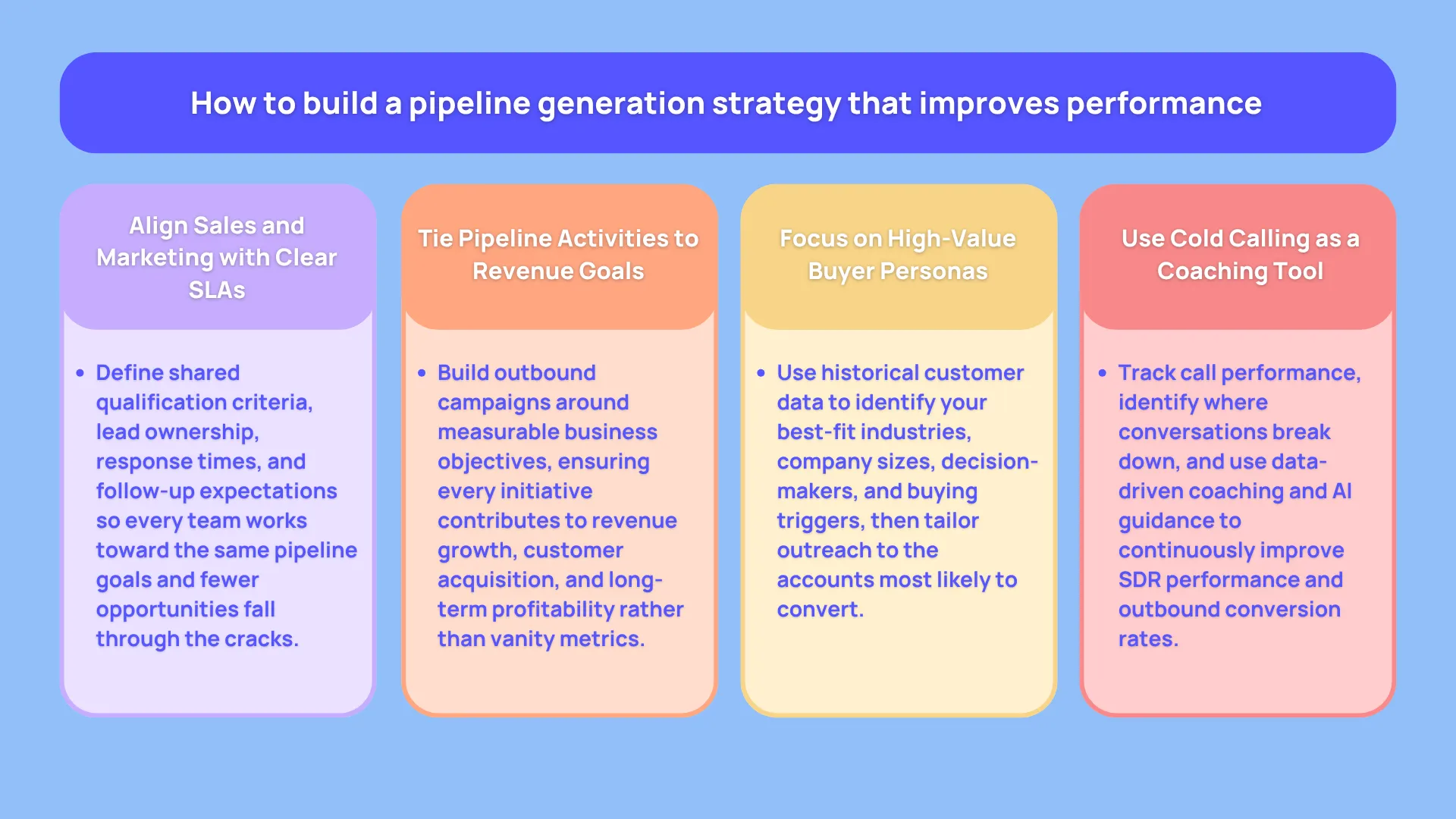
Many companies generate enough leads to hit their revenue targets. Their problem is that opportunities get stuck somewhere between marketing and sales, or between discovery and proposal. Every delay creates friction, and every missed follow up gives competitors another opportunity to enter the conversation.
This is where your pipeline strategy becomes far more than a collection of outbound activities.
It becomes the framework that guides how opportunities are created, qualified, nurtured, and converted into revenue.
If you're asking What's the fastest way to fill your sales pipeline with qualified leads?, the answer is not increasing outbound volume overnight. Sustainable growth comes from improving every stage of the buyer journey so more conversations become qualified opportunities and more qualified opportunities become closed business.
The following strategies help create that consistency.
Create service level agreements between sales and marketing
Sales and marketing alignment sounds great in theory.
In practice, many organizations still struggle with simple questions.
- Who owns a lead after it downloads a resource?
- How quickly should sales follow up?
- What qualifies as a marketing qualified lead?
- When should a lead return to marketing for nurturing?
Without clear answers, pipeline begins leaking opportunities. Service Level Agreements, commonly called SLAs, remove that uncertainty. An SLA creates shared expectations between departments. Everyone understands their responsibilities, response times, qualification standards, and reporting metrics.
Rather than debating who dropped the ball, teams can immediately identify where improvements are needed.
A well designed SLA should clearly define:
- What qualifies as a Marketing Qualified Lead.
- What qualifies as a Sales Qualified Lead.
- Expected response times after new lead assignment.
- Reasons sales can reject a lead.
- Required follow up cadence before a lead returns to nurture campaigns.
- Reporting cadence for reviewing pipeline performance.
For example, marketing may commit to delivering leads that meet specific ICP criteria, while sales commits to contacting every qualified lead within twenty four hours. Simple agreements like these often produce meaningful improvements because buyers receive faster responses while internal accountability becomes much stronger.
Connect every pipeline initiative to revenue goals
Generating pipeline feels productive, but if it contributes to revenue, that’s even better from a long term perspective. This sounds obvious, yet many organizations spend months celebrating activity metrics that have little connection to business outcomes.
More meetings, more demos and more calls, of course.
Those numbers only become meaningful when they contribute toward annual recurring revenue, expansion revenue, customer retention, and long term profitability.
Every outbound initiative should answer one important question.
- How does this contribute to our revenue objectives?
For example, imagine leadership wants to expand into enterprise healthcare over the next twelve months.
That objective should influence almost every outbound decision.
Marketing creates healthcare specific content.
Sales develops healthcare messaging.
Enablement builds healthcare objection handling. RevOps measures healthcare pipeline separately from other verticals. Customer Success documents healthcare case studies.
Everything begins pointing toward one strategic destination.
That level of alignment produces much stronger Sales pipeline acceleration because every department contributes toward the same business priorities.
Pipeline stops becoming a vanity metric and becomes a measurable predictor of future revenue.
Build campaigns around your highest value buyer personas
One of the easiest mistakes in outbound sales is assuming every potential customer deserves equal attention.
They do not!
Some accounts close faster\, while others take their time to mature, and eventually convert. In ideal cases, we see a handful of these accounts turning into partnerships and referrals that could benefit both sides.
One thing that we can’t stress enough on is the historical customer data. It tells a very clear story spanning over a longer time interval, rather than seeing graphs spread over a days or week's timeline. From that point of view, you need to:
- Which industries appear repeatedly?
- Which company sizes generate the highest lifetime value?
- Which job titles become internal champions?
- Which buying triggers appear before successful opportunities?
The answers help identify your highest value personas. Once those personas become clear, every outbound campaign becomes much easier to execute.
Use cold calling to diagnose pipeline problems, not just create opportunities
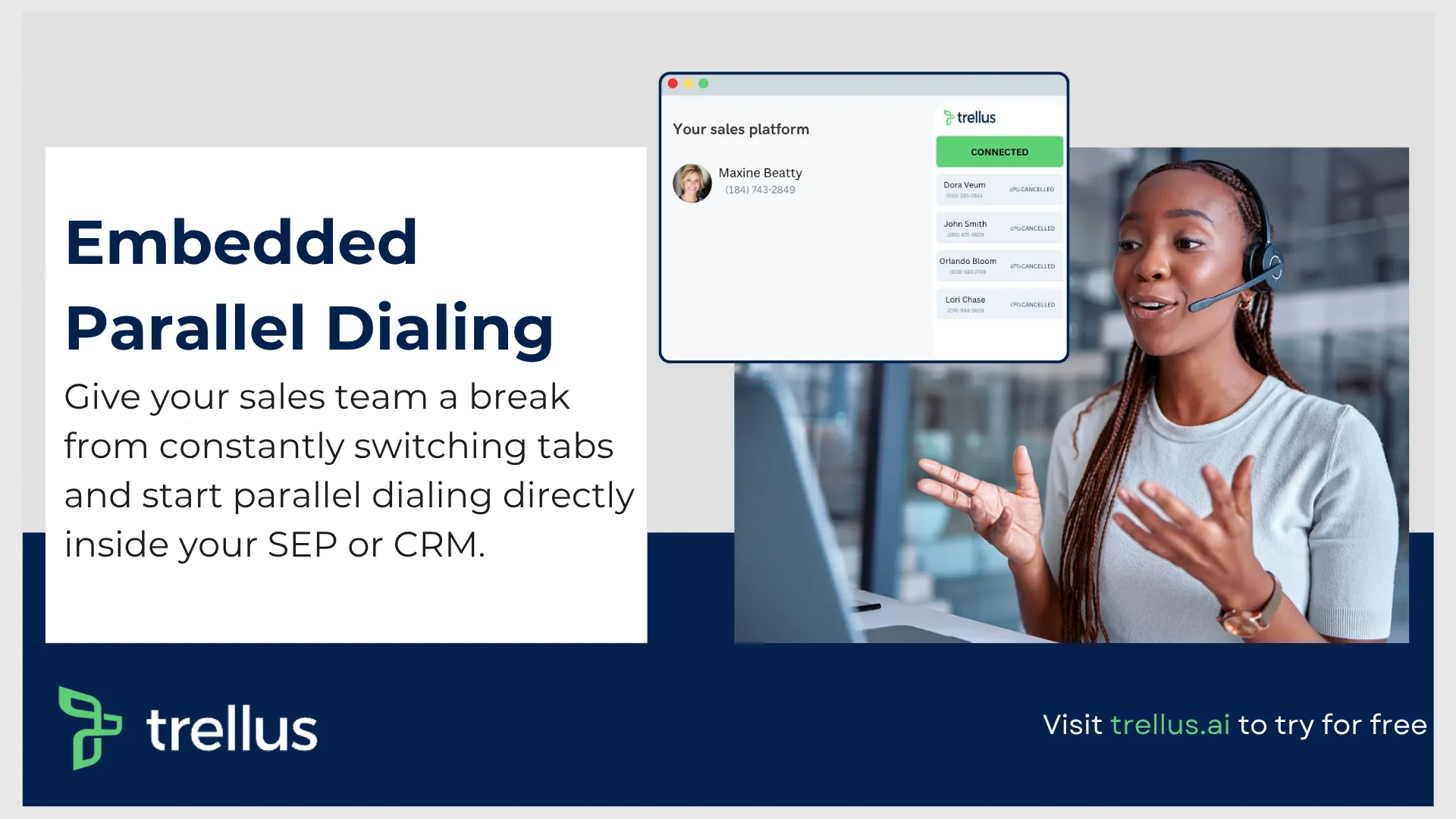
Since we are a sales first services platform, we know that cold calling remains one of the fastest ways to learn what is happening inside your market. Unfortunately, for these cold calls to work, you need to have your bases covered.
That means thorough research, well trained SDRs, live Ai conversational coaching software, custom KPIs and whatnot. Most of it is possible through a cold calling solution, like Trellus.ai, while the rest comes with experience as your SDRs learn their workflows over time.
Sales trainer Chris Ritson shared a practical framework that reflects how many successful outbound organizations approach cold calling today.
It starts with creating enough activity to establish reliable benchmarks.
If your team averages fifty or more outbound calls per day, you begin collecting meaningful data on connection rates, conversation quality, objections, meeting conversion, and opportunity creation.
Once those benchmarks exist, managers can identify exactly where performance begins dropping.
- Some reps struggle during the opening thirty seconds.
- Others lose momentum while uncovering pain.
- Some perform well until asking for the meeting.
Every stage tells a different coaching story.
Rather than telling every SDR to "improve cold calling," managers can coach very specific behaviors. As a result, doing so makes coaching measurable rather than subjective.
Everyone follows similar discovery principles, objection handling patterns, qualification standards, and meeting transitions. Over time, managers continue reviewing recorded calls, identifying successful behaviors, and making small improvements rather than rewriting entire scripts every month.
These gradual refinements compound into significantly stronger outbound performance.
Treat outbound sequences like ongoing experiments
Every email sequence, LinkedIn message, voicemail, and follow up cadence should be treated as something that can improve.
Small improvements create surprisingly large gains over time.
A subject line that increases open rates by five percent, an opening sentence that improves reply rates.
In other words, a stronger value proposition that generates more meetings. Each improvement compounds throughout the year. Rather than changing everything at once, isolate one variable at a time.
You might compare two subject lines while keeping everything else identical.
Once enough data has been collected, keep the stronger version and move on to testing the next variable.
This ends up createing a steady process of optimization without disrupting your entire outbound engine. Over hundreds of thousands of outbound touches, those incremental gains produce meaningful improvements across your outbound sales pipeline.
Measure the metrics that move pipeline forward
Many sales dashboards contain dozens of numbers.
Only a handful truly influence revenue.
If you're wondering, What metrics should you track to optimize your outbound sales pipeline?, start with measurements that reflect movement through your funnel rather than simple activity.
Pay close attention to metrics such as:
- Prospect to conversation rate.
- Conversation to meeting conversion.
- Meeting to qualified opportunity conversion.
- Opportunity to closed won conversion.
- Average sales cycle length.
- Pipeline velocity.
- Average contract value.
- Win rate by industry and persona.
- Response time for inbound and outbound leads.
- Forecast accuracy.
Looking at these metrics together provides a much clearer picture than simply counting calls or emails.
You begin identifying exactly where opportunities slow down.
Some teams struggle generating replies.
Others book meetings but qualify poorly, while many others qualify well but lose momentum during procurement.
Each bottleneck requires a different solution.
Understanding those patterns is one of the fastest ways to answer another important question many revenue leaders ask, How to reduce sales cycle length and accelerate pipeline velocity?
The answer almost always starts with identifying where deals stop moving, then coaching, improving messaging, or refining qualification around that specific stage rather than trying to optimize the entire funnel at once.
Common pipeline generation mistakes to avoid
Every revenue leader wants a bigger pipeline.
The interesting part is that most pipeline problems are not caused by a lack of effort.
- Sales reps are making calls.
- Marketing is launching campaigns.
- Managers are reviewing dashboards.
- New technology keeps getting added to the stack.
- Yet pipeline growth stalls.
That usually happens because small mistakes compound over time. A weak qualification process creates poor opportunities. Poor opportunities inflate forecasts. Inflated forecasts create missed revenue expectations. Eventually, leadership starts questioning every part of the sales process.
The good news is that most of these mistakes are completely avoidable once you know where to look.
Prioritizing quantity over quality
A large pipeline can create a false sense of confidence.
Looking at hundreds of open opportunities feels encouraging until you discover that most of them were never likely to close. Healthy pipeline generation has never been about filling your CRM with names.
It is about filling it with companies that closely match your Ideal Customer Profile and have a genuine business reason to buy. Many sales teams celebrate activity metrics.
Thousands of emails.
Hundreds of calls over dozens of meetings.
Those numbers only matter when they produce qualified opportunities.
Top performing organizations spend just as much time deciding who not to pursue as they do identifying new accounts.
Treating every prospect exactly the same way
Modern buyers expect relevant conversations. Sending identical messaging to every prospect rarely produces consistent results. A Chief Revenue Officer at a fast growing SaaS company cares about different priorities than an Operations Director at a manufacturing business.
- Their industries are different.
- Their buying processes are different.
- Their success metrics are different.
- Their internal challenges are different.
Personalization goes far beyond adding someone's first name to an email.
Strong Outbound lead generation tactics account for company size, industry trends, recent funding announcements, hiring activity, technology investments, competitive pressures, and the specific business outcomes buyers care about.
The more relevant your outreach becomes, the easier it is for prospects to see immediate value in continuing the conversation.
Skipping proper qualification
- Every salesperson has experienced it.
- An exciting discovery call.
- A promising product demonstration.
- Several follow up meetings.
Then everything suddenly goes quiet.
Quite often, the opportunity should never have entered the pipeline in the first place. Proper qualification protects both your sales team and your forecast. Good qualification uncovers important information early.