Our Top Picks


Choosing between modern sales engagement platforms in 2026 is no longer a matter of comparing email cadences and call queues.
Moving on, some of the best platforms now decide who your reps should contact, when the timing is right, and what to say the moment a prospect picks up. If you are evaluating tools this year, front load your decision around five capabilities: AI powered buying signal intelligence, omnichannel outreach orchestration, real time conversation analytics and coaching, predictive pipeline management, and integrated prospect research.
Get those right, weigh them against integrations, adoption effort, and ROI, and you will avoid the most expensive mistake in sales tech: buying a platform your team never fully turns on.
This post walks through exactly what to look for, why each criterion matters, and how to pressure test a shortlist before you sign.
Regardless of whether you are replacing a legacy sales engagement platform or buying your first one, the framework below keeps the evaluation grounded in outcomes rather than feature checklists.
Why "Modern" Means Something This Year?

A decade ago, a sales engagement platform (SEP) was essentially a sequencing engine bolted onto your CRM: it queued emails, reminded reps to call, and logged the activity.
That baseline is now table stakes. What separates modern sales engagement platforms from their predecessors is a shift from activity automation to decision intelligence: the software increasingly reasons about buyer behavior rather than just executing steps a human planned in advance.
Forrester's research on sales technology evaluation has consistently pushed buyers to judge platforms by revenue outcomes and seller adoption rather than raw feature counts, and that lens matters more than ever as AI capabilities blur the lines between categories.
According to Forrester's guidance on evaluating sales technology, the platforms that win are the ones sellers use daily, not the ones with the longest spec sheet. Keep that principle in mind as you work through the criteria below: a brilliant capability nobody adopts is worth zero.
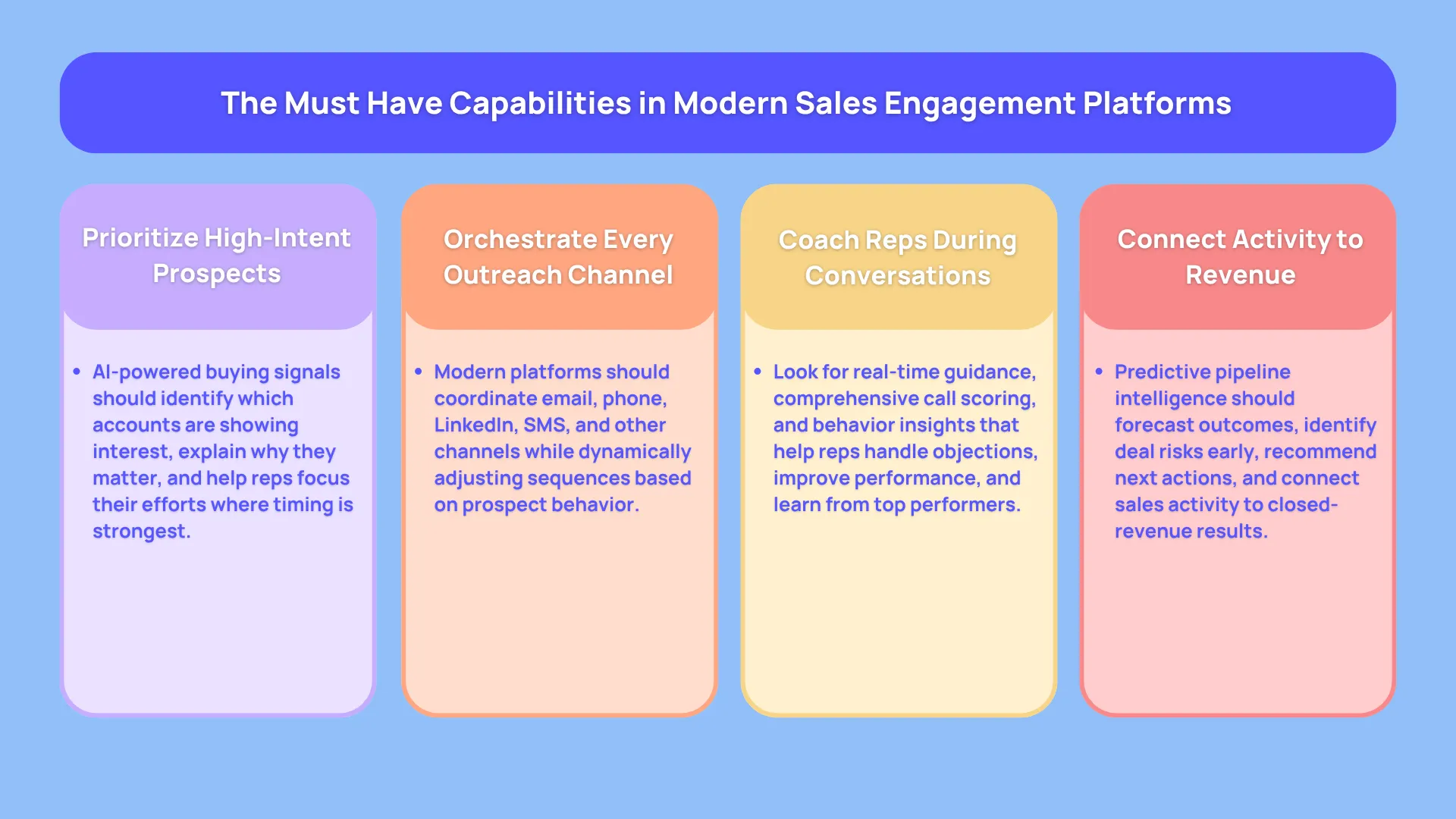
The Must Have Capabilities in Modern Sales Engagement Platforms
1. AI Powered Buying Signal Intelligence and Intent Detection
The single biggest advance in modern sales engagement platforms is AI powered buying signal intelligence and intent detection.
Instead of working accounts in alphabetical or list order, your reps should be routed to the prospects showing real interest right now: a pricing page visit, a competitor comparison search, a job change, a funding round, or repeated engagement with your content.
When you evaluate this capability, ask three questions:
• Where do the signals come from? Look for a mix of first party engagement (email opens, replies, site visits, call outcomes) and third party intent data. A platform that only recycles your own activity data is not truly detecting intent.
• How are signals scored and surfaced? Signals are useless if they sit in a dashboard nobody checks. The best tools push a prioritized "work these accounts today" list directly into the rep's workflow.
• Does it explain the "why"? A modern system should tell the rep why an account surfaced so they can personalize the opening line, not just flag a number.
Strong intent detection is what turns a spray and pray outbound motion into a focused one, and it is the foundation for every downstream efficiency gain. If you want to go deeper on how AI reshapes the prospecting layer, our overview of the best AI sales platforms breaks down which vendors lead on signal quality.
2. Omnichannel Outreach Automation and Orchestration
Buyers do not live in one inbox. Omnichannel outreach automation and orchestration means the platform can run a coordinated sequence across email, phone, LinkedIn, SMS, and even direct mail and, crucially, adapt the sequence based on how the prospect responds.
The word to interrogate here is orchestration, not just automation. Plenty of tools can blast the same five step email cadence to everyone. A modern platform should:
• Branch dynamically: if a prospect opens an email three times but never replies, the system should trigger a call task or a LinkedIn touch rather than robotically sending email six.
• Respect channel context: a phone first sequence for a high-intent account looks different from a nurture track for a cold one.
• Keep humans in the loop where it counts. Automation should handle the busywork (scheduling, follow up reminders, logging) while reps own the conversations that require judgment.
Phone remains the highest signal channel for outbound teams, which is why the dialing layer deserves special scrutiny. A platform with a strong AI dialer can multiply live connects without adding headcount, and the difference between a single line dialer and a parallel one can be several times the conversations per hour.
3. Real Time Conversation Analytics and Coaching
Recording calls and reviewing them next week is the old model.
Real time conversation analytics and coaching is the modern one: the platform listens during the live call and helps the rep in the moment, surfacing objection handling cues, competitor battle cards, and talk track prompts while the conversation is still happening.
When comparing platforms on this dimension, look for:
• Coverage, not sampling. Legacy conversation intelligence scored a handful of calls a week. Modern systems should analyze and score close to 100% of calls so managers see the full picture, not a flattering subset.
• Live guidance vs. post call review. Both are valuable, but real time coaching is what shortens ramp time for new reps, and rescues deals mid call. Ask whether the guidance appears on screen during the call.
• Behavior gap insights. The best tools quantify what your top performers do differently talk to listen ratio, question rate, monologue length and coach the rest of the team toward those behaviors.
This capability is where conversation intelligence stops being a manager's audit tool and becomes a rep's live assistant. If dedicated analytics depth matters to you, compare vendors on our roundup of call analytics software before deciding how much to weigh it.
4. Predictive Pipeline Management and Deal Insights
A modern SEP should not just fill the top of the funnel; it should help you understand what happens after.
Predictive pipeline management and deal insights use engagement data and historical patterns to forecast which deals will close, flag stalled opportunities, and recommend the next best action.
Evaluate this layer carefully, because it is where a lot of vendors overpromise. Practical questions to ask:
• Does the forecast update automatically as engagement data changes, or does it rely on reps manually updating stages?
• Can it flag risk early a champion going quiet, a stakeholder dropping out of the thread rather than after the deal is already dead?
• Does it tie activity to outcomes, so you can see which sequences and behaviors correlate with closed revenue?
For revenue leaders, this is often the deciding capability, because it connects daily rep activity to the numbers the board cares about. If forecasting and cross functional visibility top your list, our guide to the best sales engagement platforms for RevOps teams compares the platforms that go deepest here.
5. Integrated Prospect Research and Data Enrichment
Reps waste an enormous share of their day on manual research hunting for direct dials, verifying titles, and reading company news. Integrated prospect research and data enrichment folds that work into the platform so contact and account data is enriched automatically and kept current.
The nuance to watch: many engagement platforms are execution layers, not data vendors. Some bundle their own database; others enrich by connecting to your existing data provider. Neither is wrong, but you need to know which model you are buying so you do not end up paying twice or, worse, dialing stale numbers.
Ask whether enrichment is native, partner-sourced, or bring your own, and confirm how often records refresh.
Good enrichment feeds directly back into signal detection and personalization: accurate data is what makes the AI recommendations trustworthy. A platform can have brilliant intent scoring, but if the phone number is three jobs out of date, none of it matters.
Beyond the Feature List: Integrations, Adoption, and ROI
The five capabilities above tell you what a platform can do. These next three tell you whether it will work inside your organization.
Integrations and Fit With Your Existing Stack
Your SEP does not operate alone.
It has to write cleanly to your CRM, pull from your data provider, and coexist with the tools reps already open every day. Before you shortlist, map your stack: CRM [Salesforce, HubSpot], data vendors, dialer, and any conversation tools, and confirm bidirectional sync, not just a one way export.
A recurring frustration RevOps leaders raise is the "yet another tab" problem: every new tool that lives in its own separate app fragments the rep's day and tanks adoption.
Platforms that embed inside the tools reps already use rather than forcing them to context switch into a standalone dashboard consistently see higher usage. This is a genuine architectural difference worth probing in every demo.
Ease of Adoption
Adoption is the hidden variable that determines whether you get any ROI at all.
The G2 Grid for sales engagement software, which ranks vendors partly on real user reviews of ease of use and setup, is a useful reality check against vendor marketing.
G2's sales engagement category aggregates thousands of practitioner reviews on exactly the setup and usability dimensions that make or break a rollout.
Read the reviews that mention onboarding and daily workflow, not just the star average.
When you demo, watch for:
• Time to value. Can a rep install, connect, and run a real session the same day, or does it require a multi week implementation and a paid onboarding package?
• Workflow friction. Count the clicks between "I want to work this account" and "I'm on the call." Fewer is better.
• Manager overhead. Does the platform surface coaching and analytics automatically, or does someone have to build reports manually?
Tools that are self serve and immediately usable protect your investment. Ease of adoption also compounds: the faster reps ramp, the sooner you see the SDR efficiency gains that justify the spend.
ROI and Total Cost
Finally, model the real ROI. That means going beyond the sticker price to include implementation, per seat data costs, and the time reps spend learning the tool.
Then weigh it against concrete outcomes: more live connections per hour, faster ramp for new hires, higher meeting booked rates, and shorter sales cycles.
A platform that costs more but drives materially more conversations can be the cheaper choice per booked meeting. Insist that vendors quantify outcomes for teams like yours, and validate those claims against independent reviews.
Trellus: A Modern Execution Layer Built for High Volume Calling
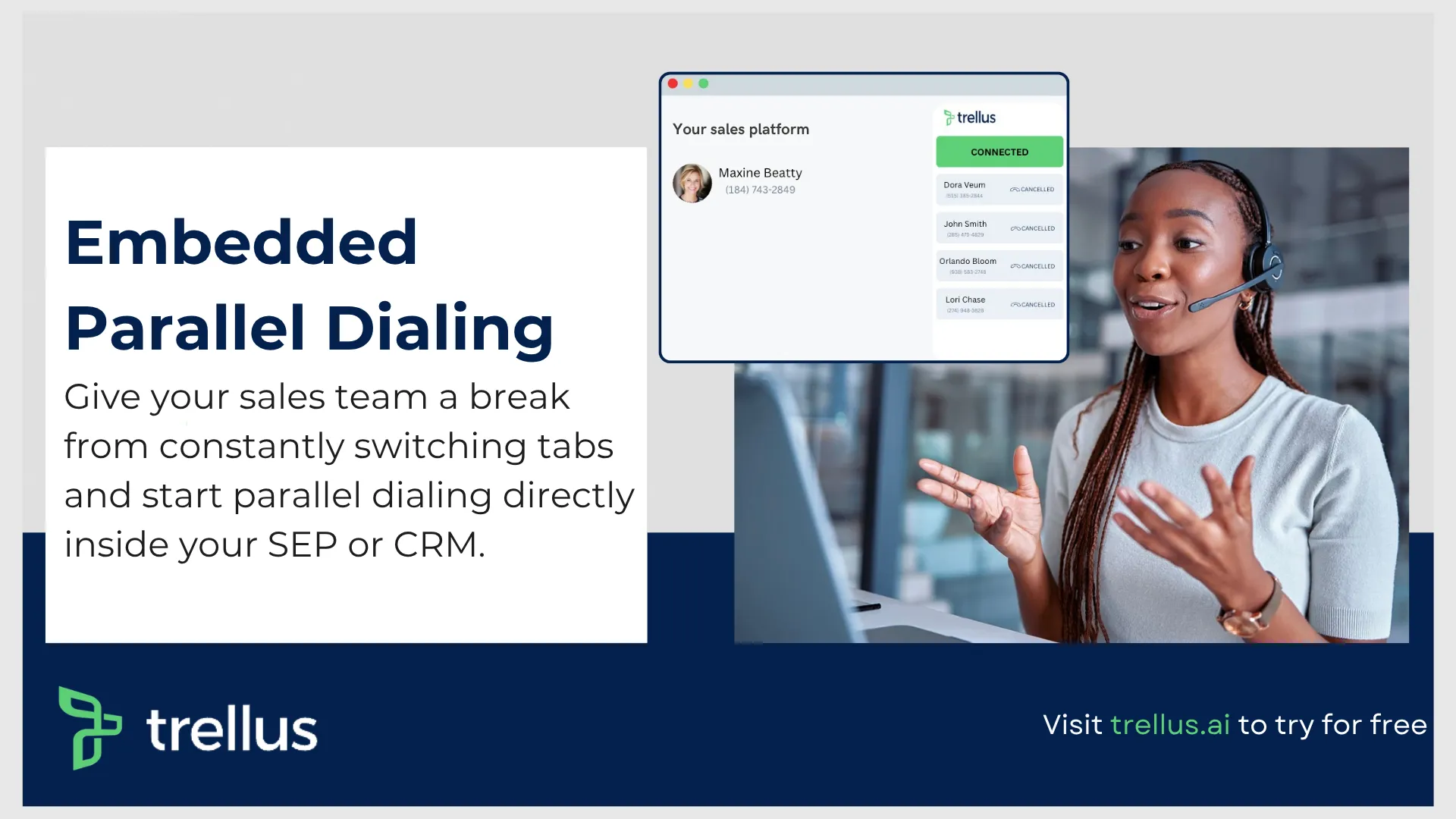
Among modern sales engagement platforms, Trellus.ai takes a distinctive approach: instead of asking reps to move into yet another standalone app, it embeds directly inside the sales tools they already use
Salesloft, Outreach, Apollo, HubSpot, and Salesforce through a Chrome extension. That "zero context switching" design is exactly the adoption advantage described above, and it is the core reason high volume calling teams gravitate toward it.
What Trellus is best for: SDR/BDR and AE teams running high volume outbound calling who want to keep dialing inside their existing SEP, plus remote and hybrid teams that need live coaching and visibility. It is a calling and conversation execution layer, not a full CRM or a B2B contact database, so it is designed to sit alongside your data provider and SEP rather than replace them.
Standout capabilities:
• A parallel dialer that dials up to roughly five lines at once to multiply live connects, with automated voicemail drop and call logging back to your SEP/CRM.
• Real time AI coaching that surfaces objection handling, competitor battle cards, and customizable talk tracks live during the call.
• Call analytics that score 100% of calls, not samples, to expose the behavior gaps between top and bottom performers.
• AI voice agents that handle inbound routing and qualification and double as 24/7 practice partners for reps.
• A Virtual Sales Floor so remote teams can listen to live calls, run call blitzes, and coach in real time.
Pros: embedded with zero context switching, parallel dialing that multiplies connect rate, real time AI coaching, 100% call scoring, broad SEP/CRM integrations, and an aggressive price point.
Cons / honest caveats: It is a calling and conversation execution layer, not a full CRM or a data/contact database, so you will pair it with your data provider and SEP; parallel dialing rewards clean lists and disciplined TCPA/DNC compliance.
For calling led teams, those trade offs are usually easy to accept.
How to Kick Off a Campaign on Trellus

If Trellus makes your shortlist, here is how a first campaign comes together start to finish in a single afternoon:
1. Install the Trellus Chrome extension and sign in.
2. Connect your SEP/CRM (Apollo, Salesloft, Outreach, HubSpot, or Salesforce).
3. Load a call list or open an existing cadence/sequence step that has calls due.
4. Choose your dialing mode (power or parallel), set the number of lines, and pick a pre recorded voicemail for automatic drop.
5. Turn on real time AI coaching and select the talk track and battle cards for the campaign.
6. Start the dialing session; Trellus auto logs calls, dispositions, and notes to your CRM.
7. Review the AI call scores and Sales Floor analytics after the blitz to coach and iterate.
For a broader view of where Trellus sits relative to the field, see our running list of sales engagement platforms to watch.
A Practical Evaluation Checklist
Before you sign, run every shortlisted platform through this quick scorecard:
• Signal intelligence: Does it tell reps who to call today and why?
• Omnichannel orchestration: Does the sequence branch on behavior, or just fire steps in order? • Live coaching: Is guidance real time and does scoring cover all calls?
• Predictive pipeline: Does the forecast update automatically and flag risk early? • Enrichment: Native, partner, or bring your own, and how fresh is the data? • Integrations: True bidirectional sync with your CRM and stack?
• Adoption: Same day usable, or a multi week implementation?
• ROI: Do the outcome numbers hold up against independent reviews?
Score each 1–5, weight the criteria by what your team needs, and the right platform tends to separate itself quickly.
Frequently Asked Questions
What is the difference between a modern sales engagement platform and a CRM?
A CRM is your system of record; it stores accounts, contacts, deals, and history.
A modern sales engagement platform is the execution layer on top: it orchestrates outreach across channels, coaches reps during conversations, and detects buying signals, then writes all of that activity back into the CRM. They are complementary, not interchangeable.
Do modern sales engagement platforms replace prospecting data tools?
Usually not entirely. Some platforms bundle a contact database, but many are execution focused and enrich data by connecting to your existing provider.
Confirm whether enrichment is native, partner sourced, or bring your own so you understand exactly what you are paying for and avoid overlapping subscriptions.
Which capability matters most when choosing a platform?
It depends on your motion.
Phone heavy outbound teams should weigh the dialer and real time coaching most heavily, while RevOps led organizations often prioritize predictive pipeline management and forecasting.
The one universal rule is to weight adoption highly; the most capable platform delivers nothing if reps do not use it daily.
How long does it take to get value from a new platform?
It varies widely. Self serve tools that embed in your existing stack can be running real sessions the same day, while enterprise suites may take weeks of implementation.
Ask each vendor for a realistic time to first value for a team your size, and treat "same day usable" as a meaningful advantage.
How should I measure ROI on a sales engagement platform?
Track outcome metrics, not activity vanity metrics: live connects per hour, meetings booked, new rep ramp time, and sales cycle length.
Compare those gains against the fully loaded cost of license, data, and onboarding time, and think in terms of cost per booked meeting rather than cost per seat.
Conclusion
The modern sales engagement platforms worth buying in 2026 share a common thread: they help reps make better decisions, not just complete more tasks.
Anchor your evaluation in the five core capabilities: buying signal intelligence, omnichannel orchestration, real time coaching, predictive pipeline management, and integrated research, then pressure test each option on integrations, adoption, and ROI. Weight adoption heavily, because a platform your team embraces will always outperform a more powerful one gathering dust.
If your motion is calling led and you want a platform that lives inside the tools your reps already use, Trellus is built precisely for that.
Start a self serve plan, connect your SEP, and run a live dialing session this week.
The fastest way to know whether a platform fits is to put it in front of your reps and watch the connects roll in.
.jpeg)

Power and parallel dialing in your CRM.