Our Top Picks


A new sales hire joins your SaaS business's sales team.
Offer letter's beensigned, Slack invite sent, CRM login created. That moment feels like momentum.
But just like with new customers, the real risk starts after day one. Sales onboarding decides if a rep becomes productive fast or stalls out, loses confidence, and quietly disengages.
Top SaaS companies in 2025 treat sales onboarding as a revenue system, not a checklist.
They focus on capability building, confidence development, and early performance signals instead of slide decks and passive training. The goal is simple. Get reps to real pipeline impact faster, with less variance, and with clearer readiness standards.
Our detailed post breaks down sales onboarding best practices used by high growth SaaS teams today.
The tone is practical, human, and grounded in how modern revenue teams actually work.
Also Read
- Best Cold Call Script for Saas Sales Team in 2025
- B2B SaaS Sales Process: Complete Guide from Prospecting to Close
- SaaS Win Rate Benchmark – Measuring Success in SaaS Sales
- How to Build a SaaS Sales Tools Stack That Automates Work and Saves 10+ Hours a Week
Why sales onboarding matters more than ever in SaaS
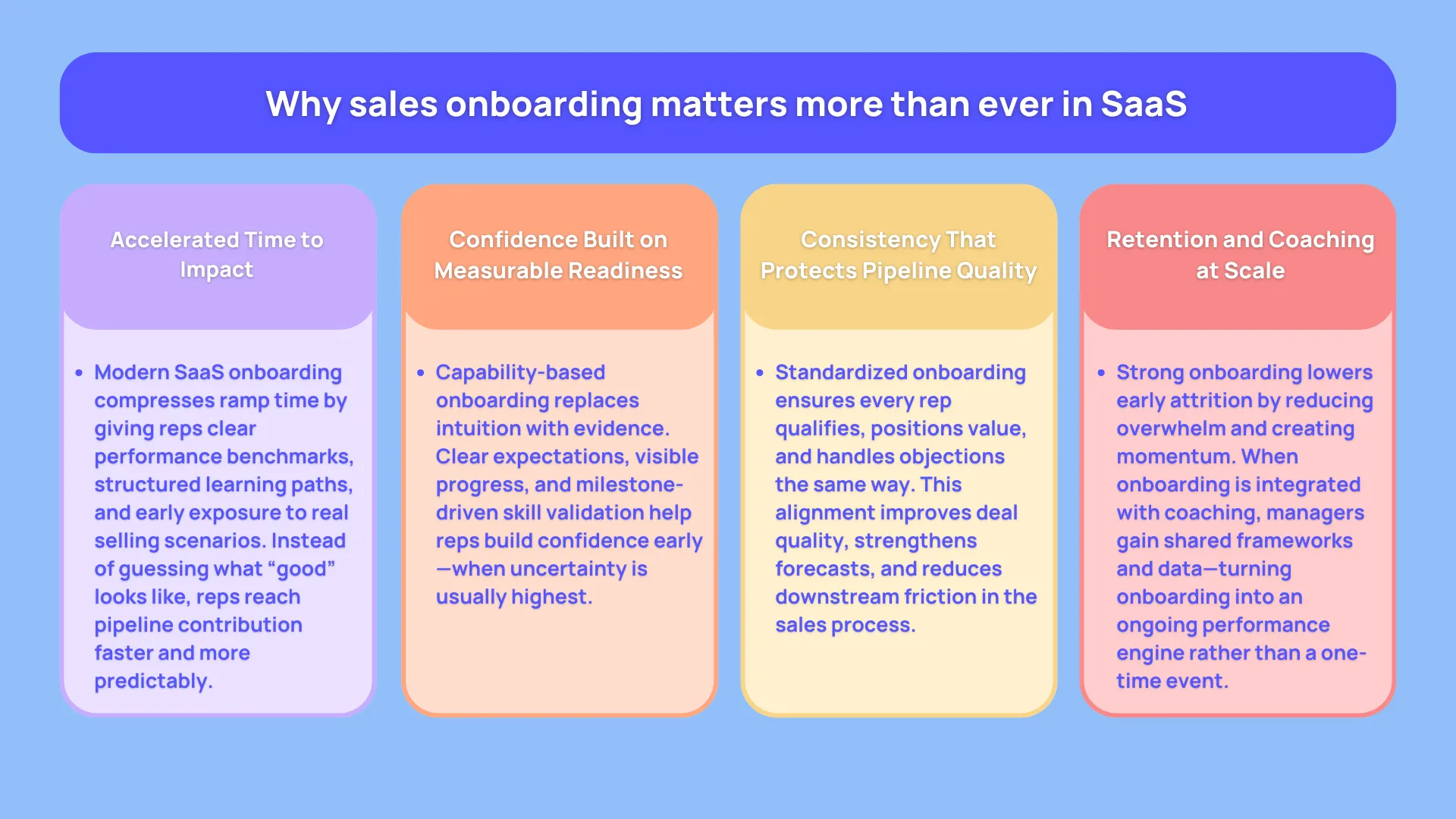
Sales onboarding in SaaS has shifted from information transfer to capability calibration. Products are more complex, buyers are better informed, and sales cycles demand higher judgment from reps early on. A weak onboarding experience creates long ramp times, inconsistent messaging, and fragile confidence.
Strong onboarding delivers leverage across multiple dimensions.
• Faster ramp to productivity
Well designed onboarding performance accelerators shorten the gap between start date and first qualified pipeline. Structured onboarding learning paths reduce guesswork and help reps understand exactly what good looks like at each stage.
• Higher rep confidence and readiness
Reps gain confidence when expectations are clear and progress is visible. Competency based sales ramping models replace vague gut feel with measurable readiness milestones.
• More consistent deal quality
Guided capability building programs standardize how reps qualify, position value, and handle objections. This improves forecast reliability and pipeline health.
• Lower early attrition
New hires who feel supported and capable stay longer. Immersive onboarding ecosystems reduce overwhelm and create momentum during the most fragile phase of the rep lifecycle.
• Stronger coaching leverage
Coaching integrated learning paths give managers shared language and data. This turns onboarding from a one time event into a continuous skills reinforcement loop.
Create a structured sales onboarding journey map
One of the most effective sales onboarding best practices is treating onboarding as a milestone driven journey instead of a fixed duration. Top SaaS companies design a clear path from day one to full quota confidence, with defined capability checkpoints along the way.
A structured onboarding journey map answers one core question for every new hire. What am I expected to be able to do at each stage, and how will readiness be measured?
Why this works for modern SaaS sales teams
Without structure, reps default to memorization. They watch recordings, skim battlecards, and hope it clicks later. Structure changes the mental model. It frames onboarding as progressive capability development.
Think of companies like Salesforce or HubSpot. New reps are not expected to master everything at once. They move through SaaS specific readiness frameworks that align product knowledge, buyer context, and sales motion complexity over time.
This approach supports:
• Milestone driven rep training
Instead of time based onboarding, reps progress when they demonstrate capability. This reduces early productivity gaps.
• Rep readiness scoring systems
Managers gain visibility into who is ready to prospect, who is ready to run discovery, and who needs reinforcement.
• Knowledge retention optimization
Spacing learning across stages improves recall and real world application.
How to design a structured onboarding journey
A strong journey map reflects how selling actually happens inside your company, not how enablement wishes it worked.
• Define core stages of sales readiness
Typical stages include product and market grounding, messaging and discovery competence, deal execution confidence, and expansion or multi stakeholder selling. Each stage should align with real sales activities.
• Attach observable behaviors to each stage
Avoid vague goals like understands the product. Instead define behaviors such as runs a complete discovery call aligned to ICP priorities, or qualifies opportunities using agreed criteria.
• Align learning assets to each milestone
Digital sales enablement layers should support the journey. Content, role simulations, coaching sessions, and assessments should map cleanly to readiness stages.
• Build feedback loops into the journey
Sales training effectiveness analytics matter here. Use rep performance data, manager evaluations, and self reflection to continuously tune the journey.
Progressive capability disclosure and skills progression benchmarking
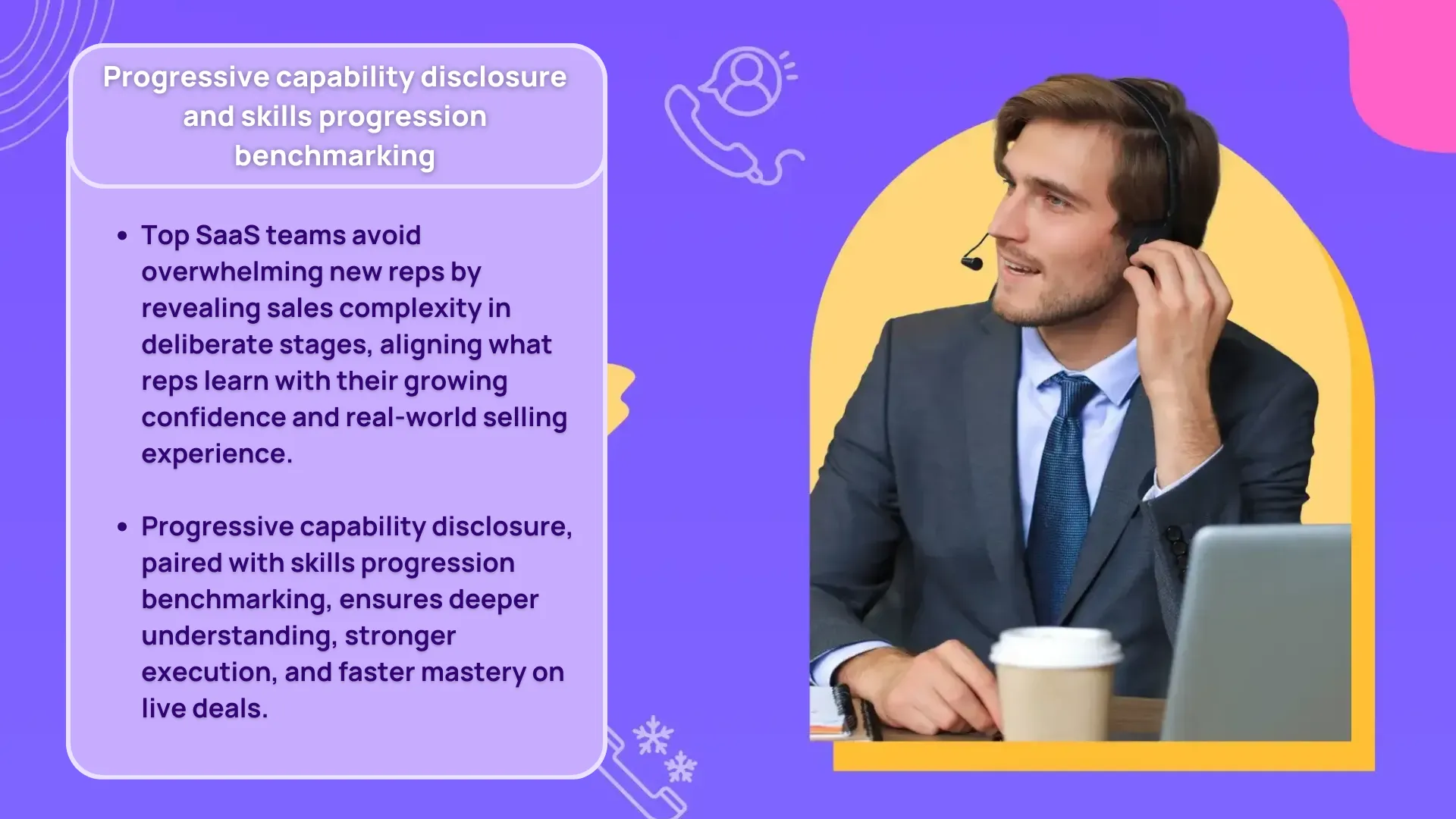
One of the biggest mistakes sales teams still make is trying to teach everything at once. New reps get flooded with product features, personas, objections, pricing logic, competitive talk tracks, and CRM rules in the first two weeks. The result is predictable. Cognitive overload, shallow understanding, and shaky execution on real calls.
Top SaaS companies avoid this trap through progressive capability disclosure paired with skills progression benchmarking. Instead of front loading information, they reveal selling complexity in layers that match a rep’s growing confidence and real world exposure.
Why progressive capability disclosure works in sales onboarding
Sales is not theoretical. Reps learn fastest when knowledge is immediately usable. Progressive disclosure ensures every new concept has a clear application in the rep’s current selling motion.
Leading SaaS teams apply this logic across their entire onboarding architecture.
• Reduced early overwhelm
Reps focus on what they need for their next call, not every call they might run six months later.
• Stronger confidence loops
Early wins reinforce belief. Confidence fuels activity, which fuels skill acquisition.
• Cleaner coaching conversations
Managers coach against the current capability tier, not an ideal future state.
• Higher knowledge retention
Learning sticks because it is practiced immediately, not stored away for later.
Companies like Atlassian and ServiceNow structure onboarding so reps master one motion at a time. Discovery before demo. Single persona before multi stakeholder selling. Core use cases before edge cases.
How skills progression benchmarking fits into this model
Progressive disclosure alone is not enough. Skills progression benchmarking adds clarity and accountability. It defines what competence looks like at each stage and how progression is measured.
Instead of asking, Is this rep good yet, leaders ask, Has this rep demonstrated the required behaviors for this capability tier?
This is where competency calibration frameworks come into play.
Building effective skills progression benchmarks
Strong benchmarks are observable, role specific, and tied to revenue impact.
• Define capability tiers
Examples include foundational seller, core motion ready, full cycle capable, and advanced deal owner. Each tier reflects a meaningful increase in selling responsibility.
• Map competencies to each tier
Competencies may include discovery depth, value articulation, objection handling, deal qualification, and internal process navigation. Each competency evolves across tiers.
• Use role simulation and scenario readiness
Roleplay driven onboarding techniques shine here. Reps demonstrate readiness through simulated calls, objection scenarios, and deal walkthroughs that mirror real selling conditions.
• Score readiness with consistency
New rep capability measurement systems work best when managers use shared rubrics. This removes subjectivity and builds trust in the process.
This structure supports competency based sales ramping models that scale across teams and geographies. Reps know exactly what is expected. Managers know exactly where to focus.
What this looks like in day to day onboarding
In practice, progressive capability disclosure feels calm and intentional.
Week one centers on ICP context, core pain narratives, and discovery fundamentals. Reps practice asking great questions, not pitching.
Week two introduces the primary demo flow tied to one persona and one use case. Advanced features stay hidden for now.
Week three adds qualification rigor, pricing conversations, and basic objection handling.
Only after reps show confidence and consistency does the onboarding expand into competitive positioning, multi persona selling, and complex deal strategy.
This sequencing creates structured enablement sequences that match learning to execution. No wasted effort. No unnecessary noise.
Personalized onboarding paths powered by adaptive learning sales modules
Not every sales rep joins with the same background, strengths, or confidence level. Treating them the same is one of the quiet reasons sales onboarding underperforms. High performing SaaS companies in 2025 design onboarding systems that adapt to the rep, not the other way around.
Personalized onboarding paths supported by adaptive learning sales modules allow teams to maintain consistency while respecting individual starting points. This balance is critical for modern revenue organizations that hire across regions, experience levels, and sales motions.
This is a core pillar of advanced sales onboarding best practices.
Why personalization changes onboarding outcomes
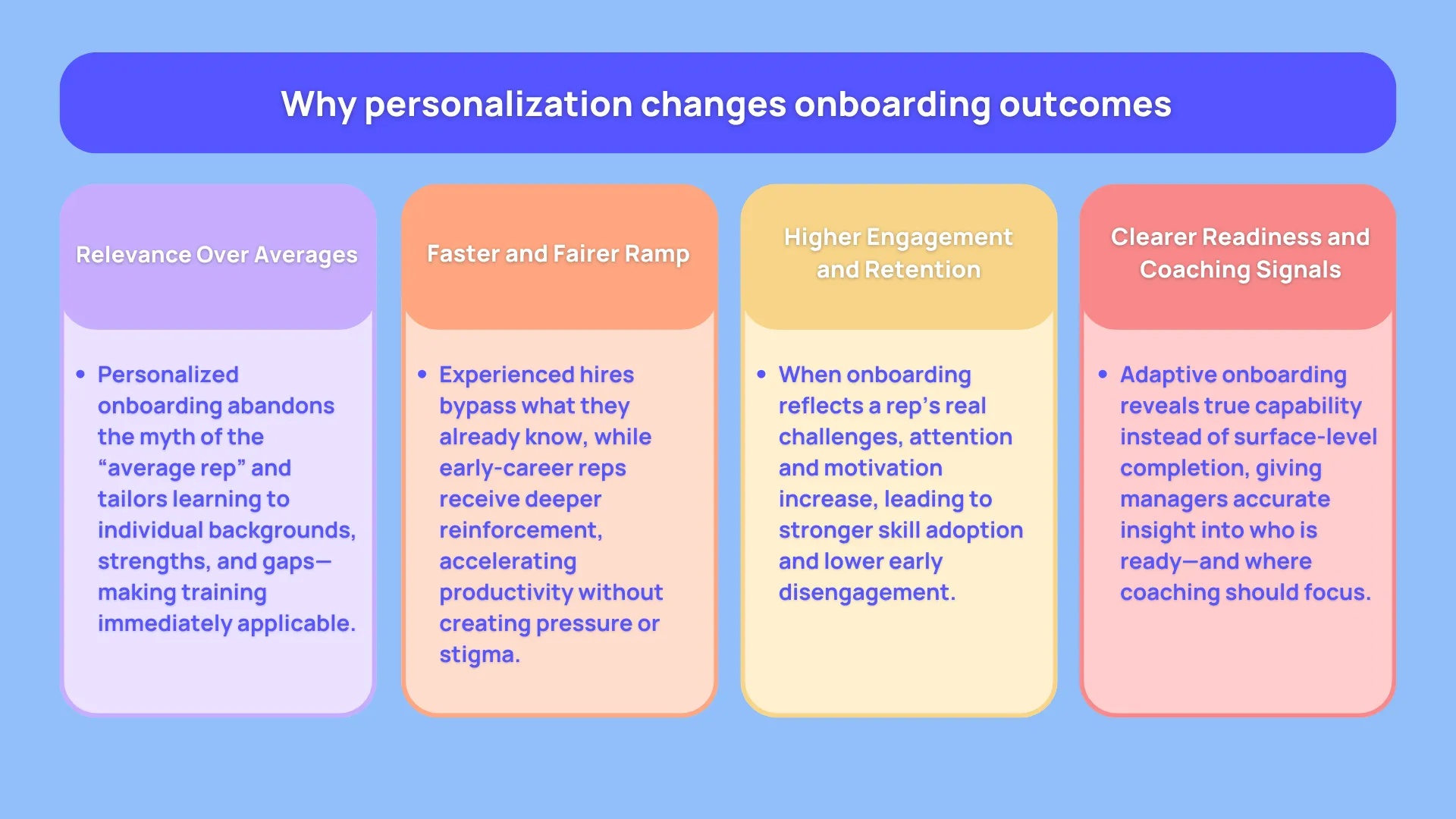
Generic onboarding assumes an average rep. The problem is that average does not exist. Some new hires come from competitive products. Others are stepping into SaaS selling for the first time. Some are strong communicators but weak on deal structure. Others are process driven but struggle with narrative.
Personalization solves this by meeting reps where they are.
• Faster ramp for experienced hires
Reps skip foundational content they already understand and focus on gaps that matter.
• Stronger support for early career reps
Foundational skills receive more reinforcement without stigma or pressure.
• Higher engagement with learning
Reps pay attention when content feels relevant to their reality.
• More accurate readiness signals
Managers see true capability instead of completion metrics.
Companies like HubSpot and Adobe use adaptive enablement layers that adjust based on role, segment, and demonstrated proficiency. The onboarding experience feels tailored without becoming fragmented.
How adaptive learning modules work in sales onboarding
Adaptive learning in sales onboarding responds to rep behavior and performance, not just time or completion.
Instead of linear training, reps move through structured onboarding learning paths that adjust based on assessments, simulations, and coaching feedback.
Key mechanisms include:
• Baseline capability diagnostics
Early assessments evaluate product familiarity, sales aptitude development models, and communication skills. These diagnostics guide the initial learning path.
• Dynamic content unlocking
Advanced modules unlock only after reps demonstrate readiness at the current tier. This reinforces progressive capability disclosure.
• Targeted reinforcement loops
Reps who struggle with specific skills receive additional practice, role simulation, and coaching prompts.
• Continuous recalibration
Readiness scores update as reps perform in real scenarios, not just training environments.
This type of process ends up creating new rep capability measurement systems that reflect actual selling ability, not test taking skills.
Designing personalized onboarding without chaos
Personalization works only when anchored to a strong framework. Top SaaS teams avoid over customization by standardizing outcomes while personalizing the path.
• Anchor personalization to competencies
Everyone must meet the same readiness standards. The route to get there can vary.
• Segment onboarding paths intentionally
Common segments include SDR versus AE, SMB versus enterprise, inbound versus outbound, and regional market differences.
• Use coaching integrated learning paths
Managers play a critical role. One on one sessions adapt based on the rep’s current readiness profile.
• Maintain visibility across paths
Sales leaders need dashboards that show progress across all onboarding tracks. This ensures fairness and consistency.
This approach supports SaaS specific readiness frameworks that scale as teams grow without watering down standards.
Where personalization delivers the biggest impact
Personalized onboarding paths matter most in three moments.
Early weeks, where confidence is fragile and relevance drives engagement.
Mid ramp, where reps start handling real opportunities and need targeted reinforcement.
Transition to full quota ownership, where gaps become costly if left unaddressed.
When adaptive learning supports these moments, onboarding transforms into a true performance system rather than a training phase.
Wrapping It Up
The most effective sales onboarding best practices share a common thread. They focus on readiness, not exposure.
Reps are not measured by how much content they consume, but by what they can confidently execute in real selling situations.
Structured onboarding journeys create clarity and momentum. Progressive capability disclosure prevents overwhelm and supports natural skill acquisition. Personalized onboarding paths powered by adaptive learning sales modules respect individual starting points while preserving shared standards. Together, these elements form a modern SaaS onboarding architecture designed for speed, quality, and scale.
What separates high performing teams is not access to more content, but the presence of competency calibration frameworks and rep readiness scoring systems that make progress visible. Managers gain earlier insight into where coaching matters most. Reps gain confidence because expectations are clear and achievable. Leaders gain predictability in ramp timelines and revenue output.


Power and parallel dialing in your CRM.