Our Top Picks


Ask any sales expert about modern day SPIN selling tactics and they’ll tell you that it’s a way of thinking about sales conversations that puts curiosity ahead of control. Instead of steering the buyer toward a conclusion, the rep helps the buyer arrive there on their own.
That distinction matters more today than ever.
Modern buyers are informed, skeptical, and allergic to being “pitched.” They respond better to conversations that feel thoughtful and relevant. SPIN selling fits naturally into consultative selling because it treats the sales call as a joint problem-solving session rather than a performance.
Neil Rackham’s research uncovered something many top reps intuitively knew but could not articulate at the time. High performers ask better questions, not more aggressive ones. They guide buyers through a sequence of realization that moves from awareness to urgency to value. That sequence is what makes spin questioning such a powerful sales questioning technique.
The SPIN framework is built on four question types that mirror how people actually make decisions in complex purchases. Each question type has a purpose, and each one sets up the next. Skip one, and the flow of the conversation intelligence feels rushed or shallow. Use them well, and the buyer feels understood.
Those four question types are Situation Questions, Problem Questions, Implication Questions, and Need-Payoff Questions. Hence the expression: ‘SPIN’ comes into play…
Before getting into specific examples of spin selling questions, it helps to understand why this structure works psychologically.
SPIN selling respects how trust is built. Buyers open up gradually. They start with facts, move into frustrations, then begin to consider consequences, and only then are they ready to talk about change.
Strategic sales discovery process and questioning follows that same emotional rhythm.
Situation Questions, Setting the Context Without Interrogation

Let’s start with the ‘S’ part of the SPIN methodology.
Situation Questions are the foundation of spin selling. They help you understand the buyer’s current reality, but their real purpose goes beyond information gathering. These questions signal respect. They tell the buyer that you are not assuming anything and that their context matters.
In consultative selling, Situation Questions prevent premature recommendations. Too many sales conversations fail because reps rush to solutions before understanding the environment the buyer is operating in. When that happens, even a great product sounds irrelevant.
That said, Situation Questions are also the easiest to misuse. When overdone, they feel like a checklist or an intake form. Strong spin questioning keeps these questions purposeful and selective. The goal is clarity, not completeness.
A good spin selling example at this stage sounds conversational and informed. The buyer should feel like you have done some homework, but still want to hear things in their own words.
Situation Questions work best when they uncover processes, tools, structures, and constraints. They create a shared baseline for the rest of the conversation.
Below are some of the commonly used examples of spin selling questions that fit naturally into this stage. Each one opens the door to deeper insight later on.
Situation Questions
• Can you walk me through how your team currently handles customer complaints from first contact to resolution?
This question uncovers workflow, ownership, and potential friction points without implying anything is broken.
• What tools are you relying on today to track performance across your sales pipeline?
Here, you begin to understand systems and visibility, which often leads naturally into Problem Questions around reporting or accuracy.
• How does your team measure success for marketing campaigns right now?
This reveals metrics, priorities, and sometimes misalignment between departments.
• What does a typical day look like for your operations team during peak periods?
This question surfaces volume pressure and capacity limits in a non-threatening way.
• How are decisions typically made when it comes to adopting new tools or vendors?
This is a strategic sales questioning move that helps later when discussing timelines and commitment.
• What steps are currently in place to keep data secure and compliant with industry standards?
Beyond compliance, this often leads to discussions about risk and confidence.
In spin selling, Situation Questions are not about impressing the buyer with knowledge. They are about earning the right to ask deeper questions later. When handled well, they make Problem Questions feel natural instead of confrontational.
Once the context is clear, these types of sales qualification techniques can move from facts to friction. That transition is where real selling begins.
Problem Questions, Bringing Hidden Friction to the Surface
Up next we’ve got Problem Questions, AKA the ‘P’ aspect of SPIN.
These questions are where spin selling starts to create momentum. Up to this point, the conversation has focused on how things work today. Now the focus shifts toward what is not working as well as it could. This stage is not about creating discomfort for the sake of pressure. It is about helping the buyer articulate challenges they already live with but may not have fully verbalized.
In buyer-focused selling, problems carry far more weight when they come from the buyer’s own mouth. A rep pointing out flaws often triggers defensiveness. A buyer describing their own frustrations creates openness. That is why spin questioning treats problems as discoveries, not accusations.
Problem Questions help the buyer connect effort with inefficiency, cost with waste, and goals with obstacles. They move the conversation from neutral observation into emotional relevance. Without this step, later value discussions feel abstract.
Strong problem questioning is curious and patient. The best reps resist the urge to jump in with solutions the moment a problem surfaces. Staying in the problem a little longer deepens the buyer’s awareness and sets up implication later.
A solid spin selling example at this stage feels empathetic. The buyer should feel heard, not exposed.
Below are examples of spin selling questions that surface issues without sounding critical. Each question invites reflection rather than defensiveness.
Problem Questions
• What parts of your current process tend to slow things down the most?
This question identifies friction while allowing the buyer to define what “slow” means in their world.
• Where do mistakes or rework show up most often today?
Instead of blaming people or systems, this focuses on patterns.
• What challenges come up when your team tries to hit deadlines or quotas?
This ties operational issues directly to outcomes the buyer already cares about.
• In what situations does your current solution feel limiting?
This encourages comparison without directly attacking existing tools or vendors.
• How much manual effort is required to keep things running smoothly right now?
Manual work often hides inefficiency, burnout, and scalability issues.
• What tends to frustrate your team the most during busy periods?
This question opens the door to emotional impact, not just technical problems.
• How often do small issues turn into larger delays or customer complaints?
Here, the buyer begins to connect problems with downstream consequences.
• What gets deprioritized when things get hectic?
This surfaces opportunity cost, which becomes powerful later in the conversation.
Problem Questions play a critical role in discovery-based selling. They transform surface-level understanding into meaningful insight. When buyers hear themselves describe repeated obstacles, the status quo begins to feel less acceptable.
At this point, many sales conversations stall because reps rush to pitch. SPIN selling takes a different path. Instead of fixing the problem immediately, it asks the buyer to consider what those problems actually cost.
That transition leads directly into Implication Questions.
Implication Questions, Turning Problems Into Urgency
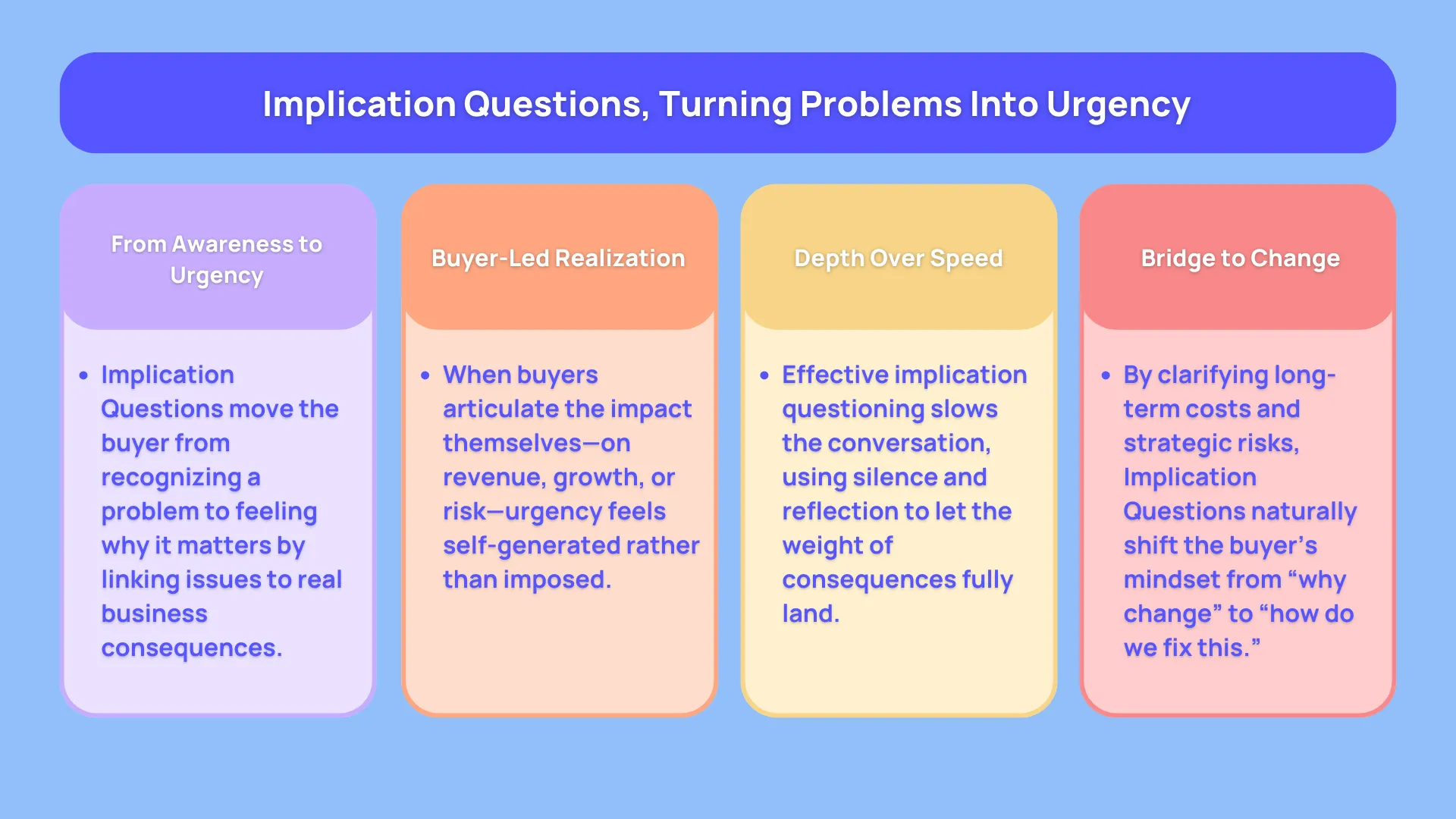
Implication Questions are the emotional engine of spin selling.
This is where conversations shift from mild frustration to meaningful urgency. The buyer already understands what is not working. Now they begin to see why it matters.
Many sales reps avoid this stage because it feels uncomfortable. They worry about sounding pushy or negative. In reality, implication questions are not about fear. They are about clarity. Buyers rarely change because something is inconvenient. They change because the cost of staying the same becomes impossible to ignore.
In solution-oriented sales, value only feels real when it is tied to consequences.
Implication Questions help the buyer connect everyday problems to revenue loss, missed growth, team burnout, customer churn, or competitive risk. When those connections are made verbally by the buyer, urgency feels self-generated rather than imposed.
Spin questioning at this stage should slow down, not speed up. Each implication deserves space. Silence often does more work here than talking.
Implication Questions
• What happens to your revenue targets when these delays keep showing up quarter after quarter?
This question ties operational issues directly to financial performance.
• How does this level of rework affect your team’s capacity to take on new initiatives?
Here, the buyer starts to see opportunity cost.
• What does this mean for customer trust when expectations are not consistently met?
This shifts the conversation toward reputation and retention.
• How does this impact your ability to scale as demand increases?
Scalability implications often resonate strongly with leadership.
• What are the long-term effects on employee morale when these problems persist?
This brings human impact into the conversation, not just metrics.
• How much time does leadership spend reacting to these issues instead of planning ahead?
This reframes the problem as a strategic distraction.
• If nothing changes over the next year, where do you see this putting your team?
This future-oriented question invites honest reflection.
• What risks does this create if competitors solve these challenges faster than you do?
Competitive pressure often sharpens urgency without sounding aggressive.
Implication Questions are where buyer-focused selling becomes truly persuasive without persuasion. The buyer begins to argue internally for change. Your role is not to convince, but to guide their thinking.
Once the implications are clear, the conversation naturally shifts. Instead of asking why they should change, the buyer starts wondering how.
That moment opens the door to Need-Payoff Questions.
Need-Payoff Questions, Letting the Buyer Define the Value
Need-Payoff Questions are where spin selling fully earns its reputation as a consultative, buyer-driven approach.
At this stage, the buyer already understands their situation, acknowledges the problems, and feels the weight of the implications. Now the conversation turns toward improvement, but in a very specific way.
Instead of the salesperson explaining benefits, Need-Payoff Questions invite the buyer to explain them. This subtle shift changes everything. When buyers describe value in their own words, it feels more credible and more relevant than any pitch ever could.
In discovery-based selling, this is the moment where resistance drops. The conversation no longer feels like a sales interaction. It feels like collaborative planning. That is why Need-Payoff Questions sit at the heart of buyer-focused selling and solution-oriented sales.
A strong spin selling example here does not sound enthusiastic or promotional. It sounds calm, curious, and future-oriented. The buyer should feel like they are sketching out a better version of their reality.
Need-Payoff Questions work because they flip the traditional value equation. Instead of asking the buyer to accept your value, they build it themselves.
Below are examples of spin selling questions that help buyers articulate outcomes, gains, and benefits in a way that feels natural.
Need-Payoff Questions
• How would your team’s workload change if those delays were removed from the process?
This helps the buyer imagine daily relief, not just abstract improvement.
• What would it mean for your leadership team if reporting was accurate and real-time?
Here, value is framed as confidence and clarity.
• How would improved efficiency affect your ability to focus on growth initiatives?
This connects operational improvement to strategic freedom.
• What impact would this have on customer satisfaction and retention?
The buyer now links solutions to loyalty and revenue stability.
• How would it change things if your team could spend less time fixing issues and more time moving projects forward?
This reinforces productivity and morale benefits.
• What would success look like six months after solving this problem?
This question anchors value in a concrete future state.
• How would having better visibility help you make decisions faster?
Speed and confidence often resonate strongly at this stage.
• What advantages would this give you over competitors still dealing with these challenges?
This positions value in market terms rather than product features.
Need-Payoff Questions complete the spin questioning sequence. The buyer has now walked themselves from awareness to urgency to value. At this point, presenting a solution feels helpful, not intrusive.
This is also where many consultative selling conversations naturally transition into demonstrating capability. The buyer is ready to hear how.
To bring everything together, the final step is understanding how these four question types work as a single sales questioning technique rather than isolated tactics.
Upping Your SPIN Selling Game
SPIN selling is more of a skill that needs to be honed over time.
As a new SDR, or someone who isn’t all too familiar with the tactics, SPIN mastery will take time. Therefore, if you need to get a coach, or an assistant to fill you in on different dynamics and situations, feel free to do so.
Other than that, keep at it, and you’ll eventually figure it out. Better yet, you will be able to customize your workflow and your daily conversations with prospects through SPIN methodologies.


Embed Trellus Parallel Dialer Within Your SEP & 4x Your Conversations