
Account Reach Rate: Count Companies Reached, Not Just Contacts
Use an eight-account worksheet to separate company coverage from repeated conversations, choose a denominator, and decide which accounts need review.
On this page
By Trellus Team ·
Account reach rate tells you how many different target companies your team reached, not how many calls were answered. Count each account once in the reporting period, even if several people there spoke to you.
That distinction matters when one responsive account supplies most of the conversations. The calling team may have useful follow-up work while much of the target-account list remains untouched.
The definition below is a practical reporting convention, not a universal industry standard. Write down what your team means by “reached,” which accounts are included, and which denominator you are using before calculating the percentage.
Choose the question before the formula
There are two useful account-level questions:
- Among the accounts we attempted, how many did we reach? Divide unique reached accounts by unique attempted accounts in the same period.
- How much of the target-account list did we reach? Divide unique reached accounts by all eligible target accounts in the defined list.
Call the first “reached accounts among attempted accounts” and the second “target-account reach coverage,” or use similarly explicit labels. A dashboard tile called “reach rate” can hide a change between those two denominators.
Keep attempted-account coverage alongside them: unique accounts attempted divided by eligible target accounts. That shows whether an unreached account received an attempt at all.
If the denominator is zero, show “not applicable” and the counts rather than a 0% reach rate. No attempted accounts is a different situation from attempted accounts with no conversations.
What counts as reaching an account?
For this worksheet, an account is reached when at least one intended contact at that account takes part in a live conversation during the period. A voicemail, unanswered attempt, wrong-number answer or conversation only with a receptionist does not count under this definition.
Your team may use a different definition for another purpose. If an email reply counts, label the measure multichannel reach and define which replies qualify. Don’t compare it directly with a phone-only measure.
A reached account is not necessarily a qualified account. A person can answer and explain that the product isn’t relevant. They can also have a useful operational problem without owning a budget or an active buying project. Track those distinctions separately.
Likewise, reaching one person does not show that you have covered every relevant role. An account map can help you see who is known and which responsibilities remain unconfirmed. It should not turn a title into proof of purchasing authority.
A fictional eight-account worksheet
Suppose a team has eight eligible target accounts for one weekly call block. These are invented records and numbers, not customer results or recommended performance targets.
- A: three unique intended people attempted; two reached.
- B: two people attempted; one reached.
- C: one person attempted and reached.
- D: two people attempted; neither reached.
- E: one person attempted; not reached.
- F: one person attempted; not reached.
- G: no attempt.
- H: no attempt.
The team attempted ten different people across six accounts and reached four people across three accounts.
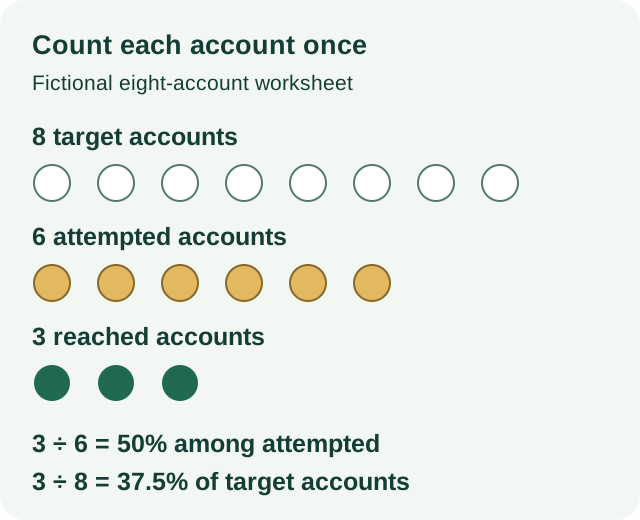
- Reached accounts among attempted accounts: 3 ÷ 6 = 50%.
- Target-account reach coverage: 3 ÷ 8 = 37.5%.
- Attempted-account coverage: 6 ÷ 8 = 75%.
- Unique people reached among people attempted: 4 ÷ 10 = 40%.
These are four views of the same work. None is the “correct” number to use everywhere. The manager deciding whether G and H need an initial block needs a different view from the person checking how often attempted accounts yield a conversation.
Now suppose one of the people at A answers three more times. Those conversations may matter, but A is still one reached account. Four distinct people reached also remains four unless another person joins the reached group.
Don’t confuse unique-person reach with contact rate
The contact-rate guide defines an attempt-based measure: qualifying live conversations divided by attempts. The worksheet above counts distinct people and accounts. Repeated calls can therefore change one metric without changing the others.
For a separate example, set aside those three extra answers. Suppose the block instead contains twenty attempts and six attempts reach intended people. The attempt-based contact rate is 6 ÷ 20, or 30%. Those six successful attempts could still involve the same four people at A, B and C. The account counts do not become six just because there are six successful attempts.
Keep a stable activity reference for the attempt count, a contact reference for the person count and an account reference for the company count. A phone number alone is not a safe substitute for all three: several people may share a switchboard, and one person may have multiple numbers.
Agree on account identity before counting
An account is not always the same thing as a company name typed into a form. One business may have multiple CRM records, subsidiaries or independently managed divisions. Two unrelated businesses can also have similar names.
Use the team's accepted account reference and hierarchy rule. Decide whether a subsidiary counts separately for this review, and keep that rule consistent through the period. Don’t merge customer records merely to make a metric easier to calculate.
If a row cannot be assigned reliably, report it as unresolved and keep it out of a confidently deduplicated account count. Record how many rows need review. If the uncertainty is large enough to change the decision, wait to rank teams or lists until it is resolved.
Keep the target list stable enough to interpret
Start with a dated target-account list. Explain how you handle accounts added, removed or reassigned during the period. A fixed starting list and an end-of-period list answer different questions.
For a weekly review, you might retain the starting list as the coverage denominator and show additions and removals separately. If an account becomes ineligible, record the reason and effective date under your team's existing rules. Don’t remove it retrospectively simply because nobody answered.
Apply contact restrictions and suppression rules before planning further outreach. An unreached account isn't an instruction to keep dialing, and a reporting worksheet doesn't set a calling-frequency policy.
Use the numbers to choose the next piece of work
In the example, G and H were never attempted. D, E and F received attempts but no qualifying conversation. A, B and C have conversations to review and any agreed follow-up to preserve.
Those groups call for different questions. Why were G and H untouched? Is the contact data for D, E and F usable? What did A, B and C actually agree to? The percentage points you toward that review; it doesn't answer it.
When comparing lists or teams, keep audience, period, attempt pattern and account policy visible. The call-list comparison worksheet explains why a flattering total can conceal a different mix of work. Account reach adds another unit of analysis; it doesn't remove those comparison problems.
Copy this account-reach review card
- Decision: What calling or follow-up choice will the review inform?
- Period: Start, end and time zone.
- Target population: Dated list and rules for eligibility, additions and removals.
- Account identity: Reference field, subsidiary policy and unresolved-row count.
- Reached definition: Channel, intended-person rule and exclusions.
- Counts: Target accounts, attempted accounts, reached accounts; distinct people and attempts separately.
- Commercial progress: Agreed follow-ups, booked and held meetings, qualification and opportunities as separate facts.
- Next action: Named owner, specific group to review and next review date.
Finish with a sentence someone can act on: “Three of eight target accounts were reached; two were untouched. We'll check why those two were skipped and review the three attempted-but-unreached accounts before choosing another block.” That is more useful than reporting a single reach percentage without its population.