5 Best Lemlist Integrations to Improve Outbound Execution
We have handpicked some of the best Lemlist integrations for you to streamline your outreach and sales activity workflow. Read on to find out more...

On this page
Our Top Picks


At a surface level, Lemlist integrations are simply connections between Lemlist and other tools in your sales stack.
But that definition misses what makes them valuable, and why most teams get them wrong.
From a broader perspective, we want you to think about how most outbound setups operate.
Email outreach automation lives inside Lemlist, CRM data sits somewhere else, enrichment tools run separately, and sales reps jump between tabs trying to piece everything together. That disconnect is where momentum dies. Not because the tools are bad, but because they are not speaking the same language at the right time.
When you set up Lemlist CRM integrations properly, Lemlist stops being just an email automation tool and starts acting as an execution layer that pulls from and feeds into your broader system. Your CRM becomes the source of truth, enrichment tools refine that data, and Lemlist turns it into action through sequences that feel personal and timely.
Also Read:
Key Takeaways
- Lemlist integrations work best when structured, not stacked: The core value comes from sequencing your stack, CRM as the foundation, enrichment next, then workflow automation with Lemlist. More tools do not mean better results; controlled data flow does.
- Timing beats volume in modern outbound: Lemlist Trellus integration and similar setups show that acting on real engagement signals leads to better conversations and higher conversions than blasting more emails or calls.
- Automation should remove delay, not add complexity: Regardless of whether it is a Lemlist Zapier integration or other workflow layers, the goal is instant, meaningful action from signals, not overbuilt systems that create confusion and maintenance overhead.
What Are Lemlist Integrations?

Lemlist integrations refer to the structured connections between Lemlist and other platforms in your sales and marketing stack that allow data, signals, and actions to move in a coordinated way across systems.
In practical terms, these integrations turn Lemlist from a standalone email outreach automation tool into a central execution layer within your broader sales automation tools ecosystem.
Instead of operating in isolation, Lemlist connects with CRM platforms, enrichment tools, dialers, and workflow automation systems to ensure that outreach is informed by real time data and that every interaction feeds back into your system of record.
This is where Lemlist CRM integrations become foundational.
Your CRM holds historical context, deal stages, and relationship data, while Lemlist activates that data through personalized outreach.
At the same time, Lemlist workflow integrations, especially through tools like Lemlist Zapier integration or other automation layers, allow events inside Lemlist to trigger actions elsewhere. A reply can create a deal, a click can notify your team, a bounce can update lead status.
As a result, it creates a feedback loop where your Lemlist connected apps continuously refine and improve outreach quality.
What Makes a Lemlist Integration Valuable in Practice?
Not every Lemlist integration creates real value just because it connects two tools. The most useful integrations improve how outbound teams actually work. In practice, a strong integration usually makes an impact in one or more of five ways: it increases execution speed, preserves workflow continuity, improves data quality, strengthens follow-up discipline, or gives managers better visibility into what is happening across the funnel.
That distinction matters because most sales teams do not need more software. They need fewer points of friction. If an integration helps reps act faster when a signal appears, reduces manual handoffs, keeps records cleaner, or prevents follow-ups from slipping through the cracks, it is doing meaningful work. If it simply adds another connection without improving action, context, or accountability, it is far less valuable than it looks on paper.
The best Lemlist integrations are not just the ones with the longest feature list. They are the ones that make outbound execution faster, cleaner, and easier to manage at scale.
Best Lemlist Integrations That You Need to Try In 2026
1. Trellus: Best Lemlist Integration for Real-Time Calling and Signal-Based Outreach
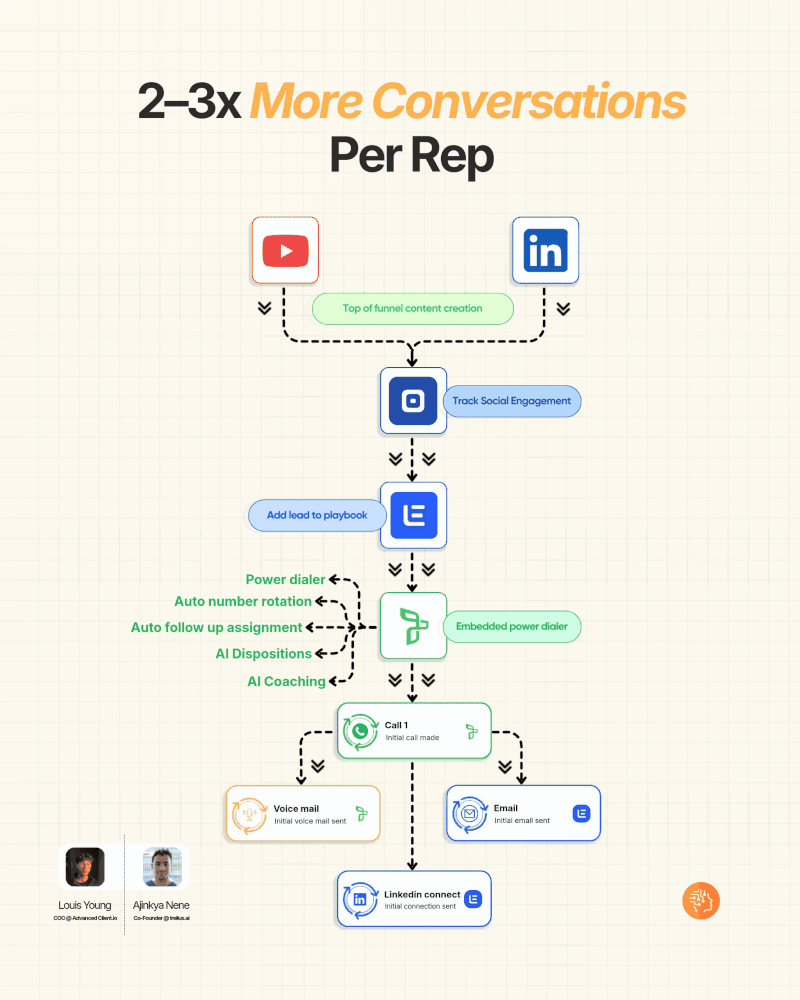
Most outbound setups fail at the exact moment they should accelerate, right when a prospect shows interest. Signals exist, but they rarely translate into immediate action.
The Lemlist Trellus integration fixes that gap by connecting engagement data with real time calling workflows. Instead of treating email, LinkedIn, and phone as separate channels, this setup aligns them into a single, signal driven motion.
Lemlist captures engagement across your email outreach automation and LinkedIn touchpoints. Trellus then turns those signals into prioritized calling actions, so reps are reaching out when interest is highest, not when a task list tells them to.
This is why it kind of sticks out among the best Lemlist integrations 2026 is seeing. It does not just connect tools, it changes how outbound execution happens.
Key Features
- Signal based call timing
The system tracks engagement signals such as opens, replies, and interactions, then translates them into actionable call moments. It also removes guesswork from outbound and replaces it with timing that reflects real buyer intent. Calls happen when prospects are paying attention, not hours or days later when interest fades.
- Embedded dialing within outreach flow
Calling isn’t primarily treated as a separate activity. It becomes part of your sequence. Reps can move from email to phone without switching tools or losing context, which keeps momentum intact and reduces friction across your sales stack tools.
- AI assisted call dispositions
Post call admin is one of the biggest time drains for sales teams. Trellus uses AI driven dispositions to log outcomes, categorize conversations, and reduce manual updates. This feeds clean data back into your system and supports stronger CRM email sync without slowing reps down.
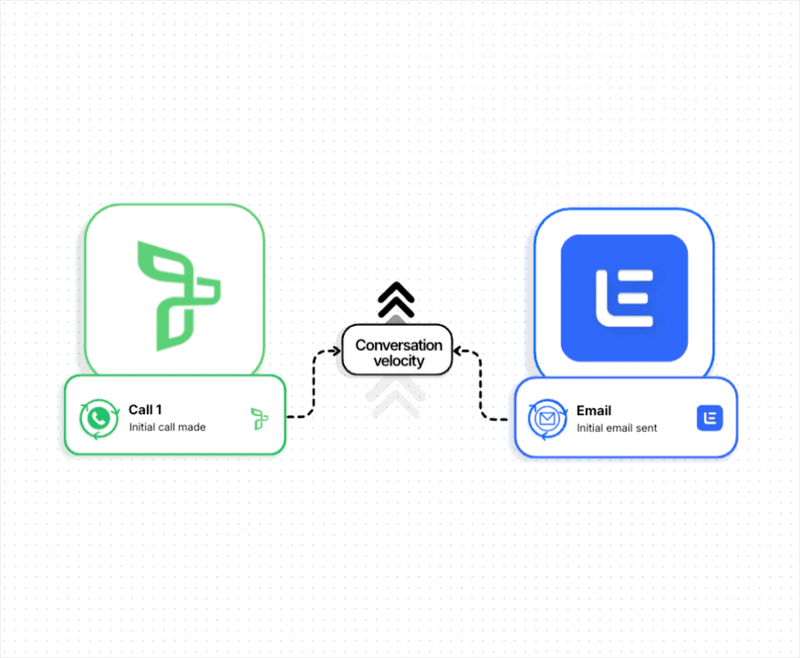
- Parallel dialing for higher conversation volume
Rather than dialing one number at a time, reps can reach multiple prospects efficiently while still maintaining context. Combined with signal based prioritization, this increases the number of meaningful conversations without increasing effort.
- Seamless no answer follow up flow
When a call does not connect, the system does not stall. It transitions into aligned follow ups through Lemlist, email, LinkedIn, or voicemail drops, so the conversation continues naturally rather than restarting from scratch.
Why Does This Change Your Typical Outbound Execution Landscape?
Functionality wise, we’re looking at a bunch of different things that easily go beyond the confines of just adding a traditional dialer interface.
- Email outreach automation generates interest.
- Calling capitalizes on that interest at the right moment.
- Your marketing automation software and CRM capture the outcome.
Everything works as a single loop rather than disconnected steps.
For teams thinking about workflow automation with Lemlist and long term scalability, this model reflects where outbound is heading. Less focus on volume, more focus on timing, relevance, and conversation quality.
2. Aircall: Best Lemlist Integration for Cloud Calling Workflows
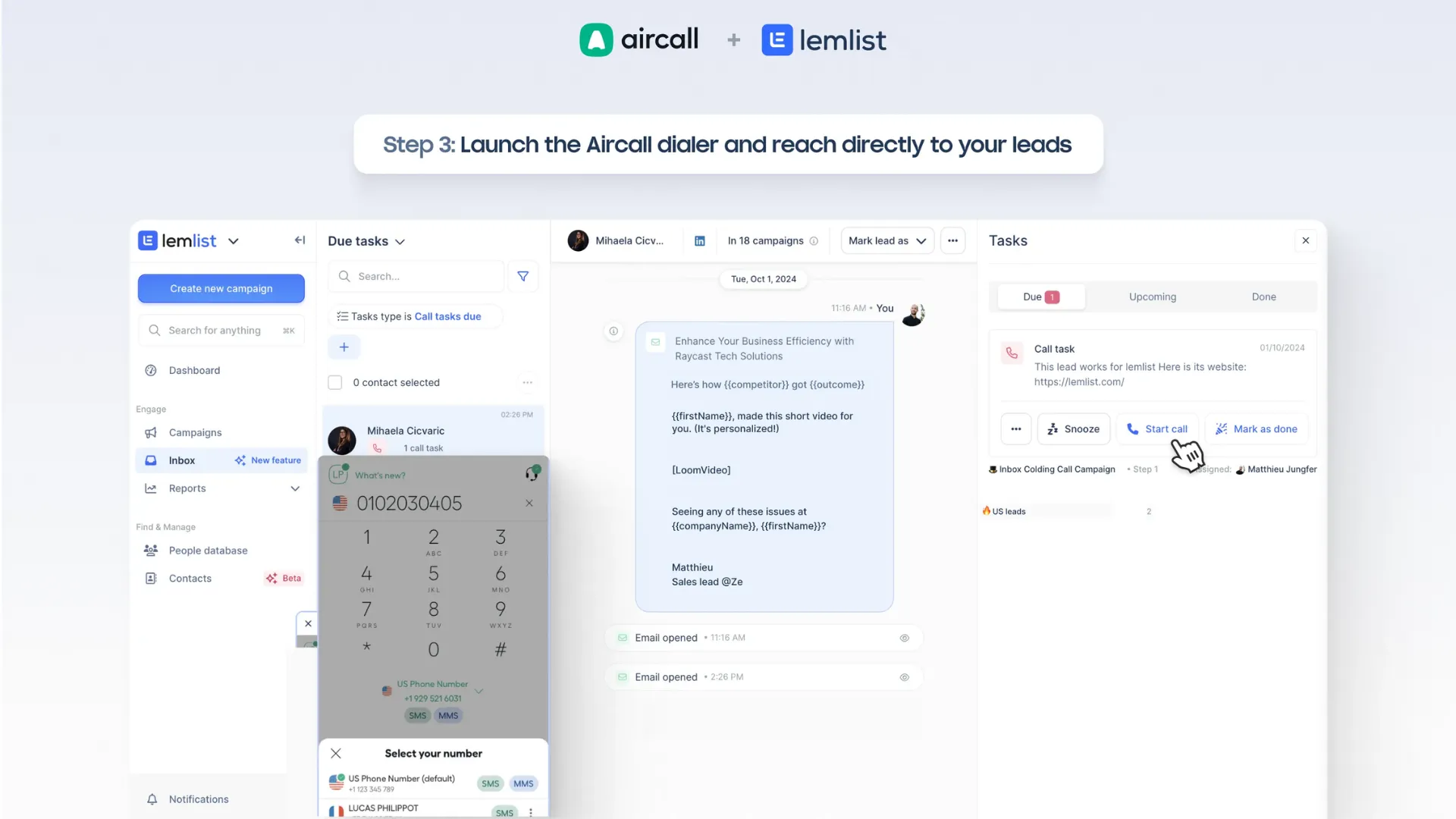
There is a reason voice keeps showing up in high performing outbound teams.
Email outreach automation creates awareness, but conversations close deals. The problem has always been execution. Calling often lives outside the main workflow, which forces reps to switch tools, lose context, and rely on memory instead of data.
The connection between Aircall and Lemlist fixes that disconnect in a very practical way.
When this setup is done right, calling becomes a natural extension of your sequence rather than a separate task. Inside your outreach flow, you can introduce call steps alongside email and LinkedIn touches, all tracked within the same system. That means every interaction builds on the previous one instead of starting fresh.
From a Lemlist workflow integrations perspective, this matters because it keeps momentum intact.
A rep doesn’t have to think about where to go next. The system guides the sequence, and each touchpoint carries the context forward.
For teams running multi channel outreach, this creates a more cohesive experience. Prospects do not feel like they are being contacted randomly across channels. Each interaction feels connected, even if they never see the system behind it.
And internally, reps spend less time managing tools and more time having conversations that move deals forward.
3. Ringover: Flexible Calling for Distributed and International Sales Teams

Not every team operates in the same environment, and that is where Ringover finds its place among the best Lemlist integrations 2026 is bringing forward.
While the goal is similar to Aircall, bringing calling into your outreach flow, Ringover tends to appeal to teams that need flexibility across regions, distributed teams, or specific telephony requirements. It integrates with Lemlist in a way that keeps calling embedded within sequences, while allowing teams to maintain their preferred dialer setup.
From the outside, it might look like just another dialer connection. In practice, it plays a more strategic role in your sales stack tools.
When you embed Ringover into your email outreach automation, you remove the friction of switching environments. Reps can initiate calls directly from within their sequences, and every action is logged back into the campaign and your connected systems.
For companies running international outbound campaigns at any given rate, this matters more than it seems.
Different markets often require different calling setups, local numbers, or compliance considerations. Ringover allows teams to maintain that flexibility without breaking their Lemlist connected apps ecosystem.
This is also where Lemlist API connections and automation layers like Zapier or Make can extend the value even further. Call outcomes can trigger downstream actions, update deal stages, or notify teams instantly, all without manual input.
Moving on, for distributed sales teams, the benefit is two-fold.
You’re looking at better consistency and improvement to overall productivity levels. Everyone operates within the same structured flow, even if they are spread across different regions or using different calling setups.
4. Minari: Making Sure Follow Ups Do Not Fall Through the Cracks

One of the most overlooked problems in outbound is not initial outreach, it is what happens after.
Leads reply late. Prospects show interest but do not convert immediately. Conversations pause and need to be picked up again. Without a system in place, these moments get lost, and pipeline quietly leaks.
That is where Minari adds value to your Lemlist workflow integrations.
Minari connects tasks, follow ups, and call logging directly with Lemlist, ensuring that every action has a next step. Instead of relying on reps to remember what to do after a sequence ends or a reply comes in, the system creates structured follow ups automatically.
This changes how teams handle longer sales cycles.
In many cases, email outreach automation generates interest, but conversion requires multiple touchpoints over time. Without proper tracking, those touchpoints become inconsistent. Some leads get too much attention, others get none.
Minari solves that by turning engagement into actionable tasks.
- A reply can trigger a follow up call task.
- A sequence completion can create a reminder for re engagement.
- A missed interaction can prompt another touchpoint at the right time.
All of this feeds back into your CRM email sync and broader sales automation tools, so nothing lives in isolation.
From a Lemlist productivity tools perspective, this reduces cognitive load on reps. They are not constantly deciding what to do next. The system provides direction based on real activity, which leads to more consistent execution across the team.
5. RevOps Integrations: How to Scale Lemlist Beyond Basic Outreach
Up to this point, the integrations we have covered improve execution, calling, follow ups, and conversations.
This next layer is different. It is not about a single channel or activity. It is about how your entire system behaves when something happens.
Tools like Zapier, Make, and n8n act as the connective layer between your Lemlist connected apps. They allow events inside Lemlist to trigger actions across your CRM, communication tools, and internal systems without requiring custom development.
The most common example of a Lemlist Zapier integration is simple on the surface. A lead replies to an email, and a deal is created in your CRM. A notification is sent to your team. The lead status is updated. But the impact of that simple workflow is larger than it looks.
At the same time, it also removes delay.
Without automation, there is always a gap between signal and action. Someone has to check replies, decide what to do, update systems, and notify others. That delay costs opportunities, especially when interest is time sensitive.
With proper workflow automation with Lemlist, that gap disappears. Actions happen immediately, consistently, and without relying on manual effort.
Where Lemlist Integrations Fit in a Modern Sales Stack
This revenue operations layer is what connects your sales automation tools, marketing automation software, and CRM into a single operating system.
- Your email outreach automation inside Lemlist generates signals.
- Your automation platform interprets those signals.
- Your CRM and other tools act on them.
You can route leads based on engagement level, assign them to different reps based on territory, or trigger entirely different sequences depending on how a prospect interacts with your outreach.
Common Lemlist Integration Mistakes to Avoid
There is a tendency to assume that more integrations always lead to better results. In reality, the opposite is often true.
Lemlist integrations introduce complexity. That complexity needs to be justified.
For smaller teams without technical support, maintaining multiple Lemlist connected apps can become a burden. Workflows break, data gets misaligned, and time is spent troubleshooting instead of selling. In these cases, a simpler setup often performs better.
There are also process driven reasons to hold back.
If your sales motion relies heavily on manual qualification, fully automated Lemlist CRM integrations can create issues. Leads may move through your system without proper validation, consuming time and resources without real potential.
High compliance environments introduce another layer of risk. Automated data movement across platforms can create challenges around audit trails, approvals, and data governance. In these cases, controlled or semi manual processes are often safer and more effective.
Cost is another factor that cannot be ignored.
Each tool in your stack adds subscription overhead. For teams running low volume campaigns, the efficiency gained from automation may not justify the expense. Manual processes, while slower, can be more practical at smaller scales.
The key point is this: Lemlist workflow integrations should solve clear problems. If they do not, they are adding complexity without value.
How to Choose the Right Lemlist Integrations Without Overengineering Your Stack
Choosing the right combination of Lemlist integrations is less about picking tools and more about aligning them with your team’s reality.
For smaller teams, simplicity wins. A strong foundation with Lemlist CRM integrations and a light automation layer, such as a Lemlist Zapier integration, can handle most needs without introducing unnecessary complexity.
As teams grow, specialization becomes more valuable. Adding one focused tool, either for enrichment or calling, can significantly improve performance without overwhelming the system.
Larger teams can support more advanced setups, but even then, sequencing matters. Connections should be added gradually, tested, and optimized before expanding further. This prevents the common issue of building a system that looks powerful but is difficult to operate.
It is also important to evaluate return in practical terms.
Time saved per lead, multiplied by volume, compared against tool costs. This simple calculation often reveals whether an integration is worth maintaining.
Data quality should also guide decisions.
If your database lacks depth, enrichment tools will have a higher impact. If your data is already strong, workflow automation with Lemlist may provide more immediate value.
What the Right Lemlist Integrations Should Improve in 90 Days
The right Lemlist integrations should improve outcomes that are visible within the first 90 days, not just add more functionality to the stack. If the tools are well chosen, reps should be having more conversations because less time is lost to manual steps, scattered alerts, and disconnected workflows.
Speed to follow-up should improve as well, especially when engagement signals can trigger faster action instead of sitting idle in separate systems. Teams should also see stronger reply-to-meeting conversion because follow-ups become more timely, relevant, and consistent.
Beyond rep activity, the best integrations should improve operational discipline. Task completion should become cleaner, fewer leads should slip through the cracks, and managers should have a clearer view of what is happening across the workflow. That includes better visibility into signal handling, rep execution, and which actions are actually contributing to the pipeline. In other words, the value of a Lemlist integration strategy should not be measured by how many tools are connected. It should be measured by whether those tools make outbound execution faster, cleaner, and easier to manage.
Concluding Remarks
The best Lemlist integrations do not create value because they add more tools to your outbound stack. They create value because they make execution faster, cleaner, and more reliable.
When the right systems work together, reps spend less time switching tabs, follow-ups happen with less delay, signals are easier to act on, and managers get a clearer view of what is actually driving the pipeline.
That is the real takeaway from this list. A strong Lemlist integration strategy should not be built around feature count or surface-level compatibility. It should be built around the bottlenecks that slow your team down today. If an integration helps your team respond faster, preserve context, improve task discipline, and turn activity into better conversations, it is likely worth the investment. If it only adds more complexity, it is not.
In the end, the best Lemlist integrations are the ones that help your outbound system behave like a coordinated workflow instead of a disconnected set of tools.