Our Top Picks


A modern SDR workflow is not a loose checklist or a set of habits passed down from top performers.
In other words, it is more of an end to end operating system for revenue creation. When sales teams struggle, it is rarely because reps lack effort. The problem usually lives inside fragmented processes, unclear ownership, or poorly connected tools. A strong workflow fixes that.
At its core, an SDR workflow defines how prospects move from unknown to qualified conversation through a sequence of intentional actions. It connects SDR operational flow mapping, messaging logic, task sequencing, and performance feedback into one continuous motion. This is why top teams think in terms of sales development execution blueprint rather than isolated activities.
When these workflows and processes are well designed, SDRs stop reacting and start executing. Every touchpoint has a reason. Every follow up has a trigger. Every handoff has a rule. That is how teams unlock workflow-based conversion optimization and keep pipeline creation predictable instead of hopeful.
Before unpacking tools or cadences, it helps to answer a foundational question that many teams gloss over.
What Is The Purpose & Intention of SDR Workflow?

An SDR workflow solves three problems at the same time. Attention, prioritization, and momentum.
Most prospects are busy and distracted. Your workflow defines how attention is earned across channels. Most SDRs face hundreds of possible actions daily.
Your workflow defines daily task prioritization models so the right actions happen first. Most pipelines stall due to missed follow ups or unclear ownership. Your workflow defines automated prospect status transitions that keep momentum alive.
This is where SDR execution lifecycle modeling becomes powerful. Instead of viewing outbound as emails and calls, high performing teams map the entire lifecycle from data intake to meeting held to AE acceptance. Each stage has rules, tools, and success signals.
This also sets the foundation for workflow-driven performance alignment. Activity, meetings, and pipeline no longer compete. They reinforce each other because the workflow was designed to optimize held conversations, not vanity metrics.
What are the key steps in an effective SDR workflow?
This question comes up constantly, and the answer is more nuanced than a simple funnel diagram. An effective SDR workflow has interconnected layers that work together rather than in isolation.
ICP Definition and Qualification Process Architecture
Every workflow starts with clarity around who should be contacted and why. Without a strong qualification process architecture, SDRs spend energy on accounts that will never convert. This stage defines firmographic filters, buying signals, exclusion rules, and disqualification logic.
This is also where rep productivity workflow layers begin. When ICP logic is embedded into routing and task queues, reps stop guessing and start executing. They know which accounts deserve research time and which ones belong in automated tracks.
Prospect Ingestion and Inbound Triage Workflow Systems
Prospects enter the workflow from many sources. Outbound lists, form fills, events, product signups, referrals. Without structure, this becomes chaos. High performing teams rely on inbound triage workflow systems to score, route, and prioritize leads the moment they arrive.
This stage supports event-triggered SDR task automation. A demo request creates a call task. A pricing page visit triggers a priority flag. An event scan assigns ownership and follow up timing. Speed and relevance live here.
Structured Outreach Cadencing Across Channels
Outreach only works when it feels coordinated. Structured outreach cadencing defines how email, LinkedIn, and calls reinforce each other instead of competing. This is where multi-step outreach frameworks and outbound workflow orchestration come into play.
Each step has a purpose. Emails frame value. Social touches build familiarity. Calls convert intent into conversation. Together, they form repeatable lead engagement loops that feel natural rather than noisy.
SDR Pipeline Progression Routines
A workflow without movement rules will stall. SDR pipeline progression routines define when prospects advance, pause, recycle, or exit. These routines reduce manual judgment and support automated prospect status transitions that keep CRM data clean.
This is also where lead handoff synchronization matters. When a meeting is booked, the workflow ensures confirmation steps, reminders, and AE context are handled automatically. No dropped balls. No awkward internal gaps.
Daily Execution Inside a High-Performing SDR Workflow
Daily execution is where most SDR workflows either create leverage or quietly fall apart. Strategy and sequencing mean very little if reps open their day unsure of what deserves attention first.
The strongest teams treat execution as a designed system, not a personal preference. This is where SDR activity stream optimization and daily task prioritization models separate average output from predictable pipeline.
A modern workflow removes decision fatigue. When SDRs log in, the system already knows what matters most. Accounts are ordered by intent, stage, and timing. Tasks appear in a sequence that matches buyer behavior, not rep convenience. This is how rep productivity workflow layers actually show up in real life.
Designing Daily Task Prioritization Models That Scale
Daily prioritization is not about squeezing more tasks into the day. It is about sequencing effort so that high probability actions happen before low probability ones. In mature teams, prioritization logic is embedded directly into the SDR operational flow mapping.
Intent Weighted Task Queues
Strong workflows rank tasks using behavioral signals rather than static lists. Opens, repeat opens, link clicks, website dwell time, meeting page views, and reply sentiment all influence priority. This is how prospect engagement workflow engines work in practice.
An SDR starting their day sees accounts grouped by urgency. Warm prospects appear first, followed by neutral accounts, and finally cold outreach. This approach supports high-velocity outbound motion design because effort is always applied where momentum already exists.
Time Aware Execution Windows
Execution quality depends heavily on timing.
A refined workflow respects executive availability and time zones. Call blocks are scheduled around connection probability. Email sends align with historical open patterns. LinkedIn touches appear during browsing hours.
This is not micromanagement. It is SDR execution lifecycle modeling applied to time. When timing logic is built into the workflow, reps no longer guess when to act. They simply execute.
SDR Pipeline Progression Routines Inside the Workday
Pipeline progression is not something that happens at the end of the week. It happens continuously throughout the day. SDR pipeline progression routines define how prospects move forward without waiting for manual cleanup.
Micro Decisions That Move Deals Forward
Every interaction triggers a decision. Positive reply moves the prospect into a call priority state. No response after multiple touches moves them into a recycle loop. A booked meeting triggers confirmation and AE prep steps automatically.
These micro decisions support workflow-driven performance alignment. Reps are not rewarded for activity alone. They are rewarded for advancing prospects through defined stages that lead to held meetings.
Lead Handoff Synchronization Without Friction
One of the most fragile moments in any SDR workflow is the transition to sales. Lead handoff synchronization ensures that context, notes, call recordings, and expectations travel with the meeting.
A strong workflow automatically notifies the AE, attaches relevant insights, and confirms attendance with the prospect. This is where SDR-to-AE workflow unification becomes real rather than aspirational.
Repeatable Lead Engagement Loops and Follow Up Discipline
Follow up is where deals are won or lost, yet it is often left to memory. Modern workflows rely on repeatable lead engagement loops supported by cross-channel follow-up automation.
Event Triggered Follow Ups
Follow up timing should respond to behavior, not calendar gaps. A pricing page visit triggers a call task. A no show triggers a reschedule sequence. A webinar attendance triggers a personalized outreach block.
This approach uses event-triggered SDR task automation to keep momentum alive without manual chasing. Reps stay focused on conversations, not reminders.
Closing the Loop Without Burning Goodwill
Break up messages, pause logic, and recycle rules are all part of execution.
When workflows define graceful exits, prospects do not feel spammed. They feel respected. This strengthens brand trust and improves future conversion rates.
Measuring Execution Quality Day to Day
Execution without measurement turns into noise. Strong SDR workflows embed measurement directly into daily actions. This supports workflow-based conversion optimization rather than retrospective reporting.
Key signals include call to connect ratios by priority tier, reply rates by engagement state, meeting held rates by source, and time spent per qualified account. These metrics feed back into SDR operational flow mapping and improve prioritization logic over time.
This answers part of the question, “How to track and measure SDR workflow performance using software solutions?” because measurement is not an afterthought. It is built into the execution layer itself.
Tools, Automation, and Platforms That Power a Modern SDR Workflow
Once daily execution and prioritization are clear, technology becomes a force multiplier rather than a distraction. The best teams do not chase shiny tools. They choose platforms that reinforce sales development process automation, reduce manual effort, and strengthen workflow-driven performance alignment.
This section answers several common questions in one cohesive system view, including “Which platforms offer the best tools to optimize an SDR workflow?”, “How can I automate prospecting in an SDR workflow using popular software?”, and “Can you recommend CRM integrations that improve SDR workflow efficiency?”
Core System Architecture Behind an Effective SDR Workflow
A modern SDR workflow relies on a layered tech stack where each platform has a clearly defined role. Overlap creates confusion. Gaps create friction. Alignment creates speed.
CRM as the Source of Truth
The CRM is the backbone of SDR operational flow mapping. It owns account state, contact status, opportunity linkage, and reporting. Every other tool should feed into the CRM rather than compete with it.
Strong CRM design supports automated prospect status transitions. When a prospect replies, books a meeting, or disengages, their stage updates automatically. This keeps pipeline reporting accurate and enables SDR execution lifecycle modeling across the funnel..
CRM integrations are essential for SDR-to-AE workflow unification. Meeting outcomes, qualification notes, and call recordings must be accessible without hunting through tools. When this works well, AEs walk into meetings fully prepared.
Trellus.Ai: The Best Tool To Pair With CRM Of Your Choice

Most sales tools focus on isolated moments, dialing, emailing, reporting, or coaching. What this platform addresses is the space in between. It acts as a connective execution layer that brings SDR workflow design, daily action, and performance feedback into one coherent system.
Instead of asking reps to remember how the process should work, the system enforces SDR execution lifecycle modeling through guided action. This matters because even the best sales development execution blueprint fails when execution relies on memory or individual discipline.
Turning Workflow Design Into Daily Execution
At its core, the platform supports SDR task sequencing systems that reflect how real buyers behave. Reps are not just given tasks.
They are given context.
Each action appears as part of a broader outbound workflow orchestration, making it clear why a call, follow up, or message matters at that moment.
This design strengthens daily task prioritization models by aligning activity with intent signals, engagement history, and pipeline stage. Instead of bouncing between tools, reps operate inside a single execution stream that supports rep productivity workflow layers without increasing cognitive load.
Supporting Structured Outreach Without Robotic Cadences
Rigid cadences break the moment a prospect behaves unexpectedly.
This is where the system reinforces structured outreach cadencing while still allowing flexibility. Outreach steps adjust based on replies, call outcomes, and engagement events, enabling repeatable lead engagement loops that feel natural rather than scripted.
Because outreach adapts automatically, cross-channel follow-up automation happens without manual resets. A reply pauses outbound steps. A no show triggers a recovery path. A meeting confirmation activates reminder logic. This keeps momentum intact while protecting deliverability and brand trust.
Strengthening Qualification and Pipeline Movement
Qualification often fails not because reps lack skill, but because workflows lack structure.
The platform supports qualification process architecture through guided call flows, required data capture, and stage movement rules.
These controls power automated prospect status transitions, ensuring that pipeline reflects reality at all times. This also improves SDR pipeline progression routines, since prospects move forward or exit the funnel based on defined outcomes rather than guesswork.
Enabling Clean SDR to AE Workflow Unification
One of the most valuable contributions comes during handoff. Lead handoff synchronization is handled through automatic context sharing, including call summaries, qualification signals, and engagement history.
This supports true SDR-to-AE workflow unification. AEs receive meetings with clarity, not confusion. SDRs close the loop without chasing internal confirmation. The workflow enforces accountability on both sides.
Workflow Driven Performance Alignment at Scale
Instead of coaching after the fact, performance improvement happens inside the workflow. Activity, outcomes, and execution quality are visible in real time, enabling workflow-driven performance alignment across teams.
Managers can see where friction appears in the SDR operational flow mapping, not just who missed quota. This makes optimization systemic rather than personal and supports long term workflow-based conversion optimization.
Sales Engagement Platforms and SDR Task Sequencing Systems
Sales engagement platforms sit at the center of daily SDR execution. This is where SDR task sequencing systems, multi-step outreach frameworks, and outbound workflow orchestration come together.
Structured Outreach at Scale
These platforms manage structured outreach cadencing across email, calls, and social channels. They ensure touchpoints happen in the right order, at the right time, with the right context.
More importantly, they enable SDR activity stream optimization. Reps see a single, prioritized task list instead of juggling inboxes, dialers, and spreadsheets. This reduces cognitive load and increases consistency across the team.
Cross-Channel Follow Up Automation
Follow ups triggered by behavior rather than time live here. A click can generate a call task. A no response can route a prospect into a recycle loop. A meeting booked can trigger confirmation sequences and AE alerts.
This is where cross-channel follow-up automation directly impacts held meeting rates and reduces no shows.
Prospecting and Data Platforms for High Velocity Outbound Motion Design
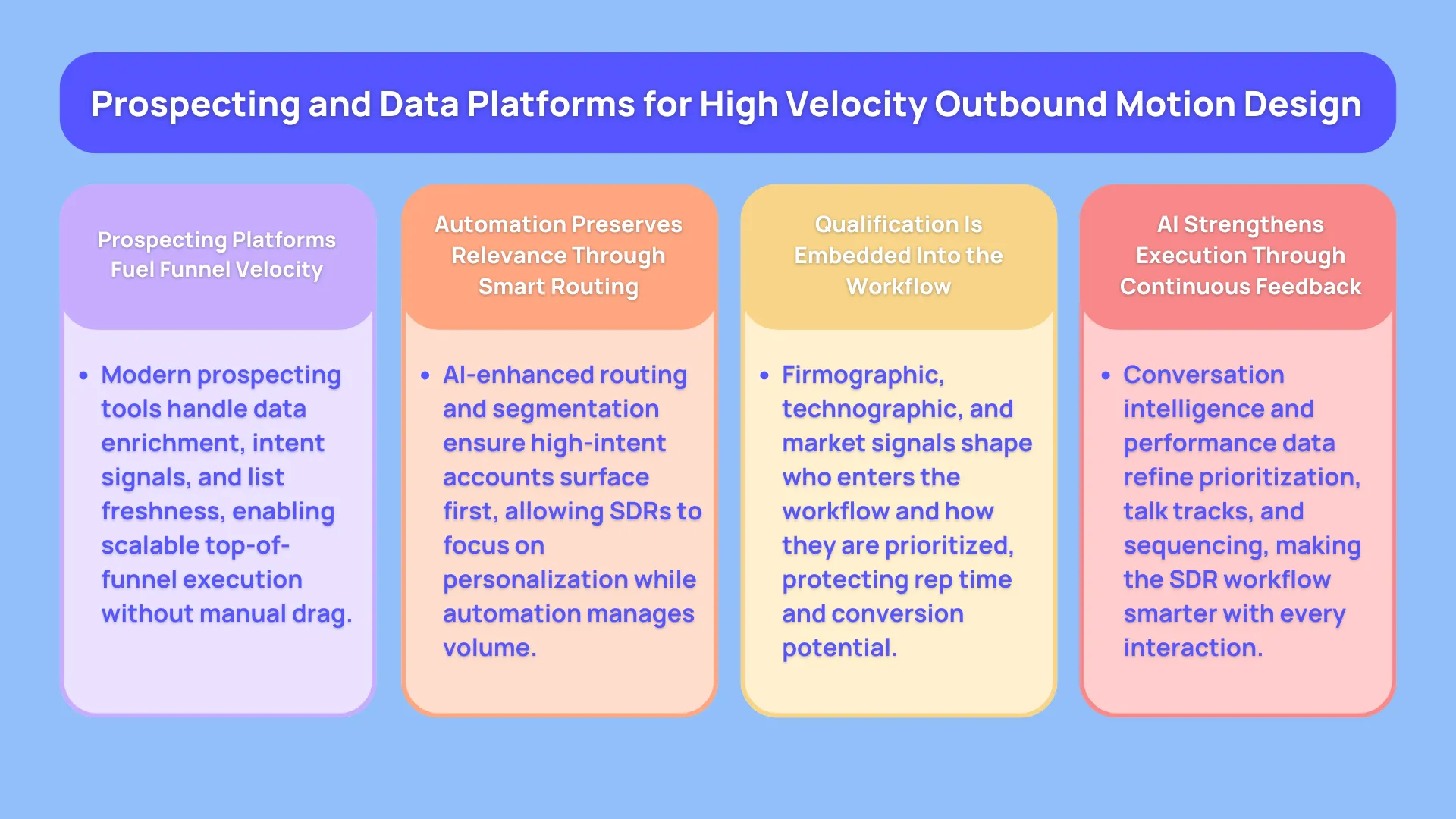
Prospecting tools power the top of the funnel and play a critical role in high-velocity outbound motion design. These platforms handle list building, enrichment, intent detection, and signal tracking.
Automating Prospecting Without Losing Relevance
The question “How can I automate prospecting in an SDR workflow using popular software?” often raises concerns about personalization. The answer lies in AI-enhanced SDR workflow routing paired with strong segmentation.
Modern tools auto refresh contact data, detect buying signals, and route high intent accounts into priority queues. This allows SDRs to focus on relevance rather than research. Automation handles volume. Humans handle nuance.
Supporting Qualification Process Architecture
Prospecting tools also reinforce qualification process architecture. Firmographic filters, technographic signals, hiring trends, and funding events all inform who enters the workflow and how they are prioritized.
This alignment ensures reps spend time on accounts that can actually convert.
AI Enhanced SDR Workflow Routing and Decision Support
AI now plays a supporting role across the SDR workflow. Not as a replacement for reps, but as an optimizer of flow.
Smarter Routing and Prioritization
AI models analyze historical data to surface which accounts are most likely to respond, book, and hold meetings. These insights feed directly into daily task prioritization models and AI-enhanced SDR workflow routing.
This strengthens rep productivity workflow layers by removing low value decisions from the rep’s plate.
Conversation Intelligence and Feedback Loops
AI driven call analysis highlights objection patterns, talk ratios, and conversion signals. These insights feed back into talk tracks, sequencing logic, and workflow-based conversion optimization.
Over time, the workflow gets smarter because execution data continuously refines it.
Inbound Triage Workflow Systems and Event Based Automation
Inbound is often treated as separate from outbound, yet strong teams unify both under one sales development execution blueprint.
Event Triggered SDR Task Automation
Inbound form fills, product usage spikes, event attendance, and content downloads all trigger tasks, alerts, and routing rules. This supports inbound triage workflow systems that prioritize speed and relevance.
When inbound and outbound share the same workflow logic, execution feels seamless and consistent.
Measuring and Optimizing SDR Workflow Performance Through Software
This brings us to “How to track and measure SDR workflow performance using software solutions?” The answer is simple but often ignored. Measure the workflow, not just the rep.
Key performance indicators include stage conversion rates, time to first touch, meeting held rates by channel, cost per held meeting, and pipeline influence by sequence.
These metrics enable workflow-driven performance alignment because leaders can see where the system breaks down instead of blaming individuals.
What’s The Most Common SDR Workflow Challenge?
In the end, many teams face the same issues repeatedly.
You have an abundance of disconnected tools, unclear handoffs, bloated sequences, and reactive execution. These challenges stem from weak SDR operational flow mapping.
The solution is not more software or some sort of automation of that matter.
On the contrary, we’d say that it is clearer ownership, tighter sequencing rules, stronger SDR pipeline progression routines, and better automation boundaries.
When workflows are intentionally designed, tools amplify outcomes rather than complicate them.
Good luck!
.jpeg)

Power and parallel dialing in your CRM.