Our Top Picks


Cold calling has been declared dead more times than most sales reps can count.
Yet sales teams continue booking meetings, generating pipeline, and closing revenue through cold outreach every single day.
In fact, cold calling remains one of the most direct ways to start conversations with qualified prospects. While emails sit unread and LinkedIn messages pile up in crowded inboxes, a phone call creates an immediate opportunity to connect with another person.
Many studies and industry reports continue to show that cold calling contributes significantly to B2B pipeline generation. Some estimates suggest that cold calling still influences roughly 30% of B2B sales opportunities. Despite advances in automation, outbound sales teams continue to rely on the phone because conversations create momentum faster than most other channels.
The problem is that most reps approach cold calling the wrong way.
They rely on generic scripts. They call without preparation. They talk too much. They pitch too early. They panic when objections appear..
Then they conclude that cold calling no longer works.
The truth is much simpler than that…
Successful cold calling comes down to preparation, execution, repetition, and continuous improvement.
When people ask, "How can sales reps be successful at cold calling?", they are usually searching for a secret script or clever opening line.
What they should be looking for is a repeatable process.
The most successful SDRs and B2B sales professionals follow a framework that helps them:
- Increase connect rates
- Create more meaningful conversations
- Qualify prospects faster
- Handle objections confidently
- Book more meetings
That combination is what defines success.
If you are wondering how to be successful at cold calling, this guide walks through the exact methods experienced sales professionals use every day. You'll learn proven cold calling strategies for SDRs, common mistakes that reduce conversion rates, practical frameworks for structuring calls, and ways AI tools can help improve performance.
Later, we'll also look at how platforms like Trellus.ai help sales teams apply these principles at scale through coaching, roleplay, analytics, and workflow automation.
Before getting into technology, let's start with the fundamentals that separate average callers from top performers.
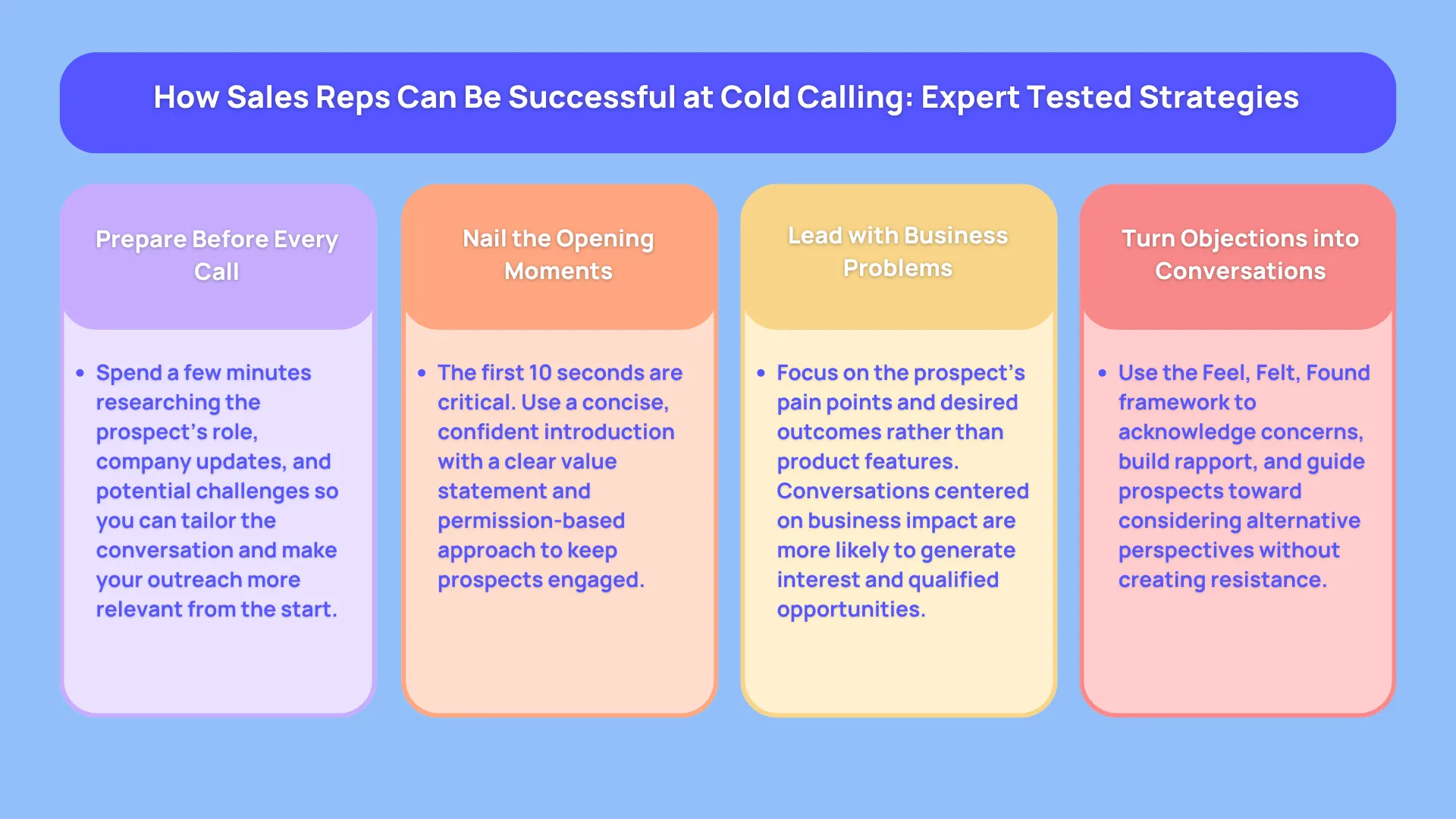
How Sales Reps Can Be Successful at Cold Calling: 7 Expert Tested Strategies
1. Research Your Prospect Before You Dial
One of the most effective cold calling best practices is also one of the most overlooked.
Spend a few minutes researching your prospect before calling.
Notice that "a few minutes" is the key phrase here.
Many SDRs make one of two mistakes. They either call completely blind or spend thirty minutes researching a prospect before making a single dial.
Neither approach is productive.
The sweet spot is roughly five minutes of targeted research.
Before making a call, gather enough information to make the conversation relevant.
Look for:
- Their role within the company
- Recent company news
- Hiring activity
- Product launches
- Industry challenges
- Potential business pain points
LinkedIn and the company website are usually enough.
You do not need an investigative report.
You simply need enough context to answer one important question:
"Why should this person care about what I'm about to say?"
When a prospect hears something relevant to their situation, their attention immediately increases.
Compare these two openings:
"Hi Sarah, I'm calling from XYZ Software."
Versus:
"Hi Sarah, I noticed your team recently expanded your outbound sales department, and I wanted to ask how you're handling rep onboarding today."
The second approach immediately creates context.
It demonstrates preparation.
It signals that this is not another random sales pitch.
Many sales leaders report significantly higher conversation quality when reps personalize their outreach compared to generic cold calls.
Prospects are busy. They receive dozens of pitches every week.
A little preparation helps you stand out from the crowd.
More importantly, it helps you ask better questions.
And better questions lead to better conversations.
That alone can dramatically improve your ability to cold call successfully.
2. Master the First 10 Seconds
Most cold calls are won or lost in the opening moments.
Prospects decide very quickly if they want to continue speaking with you.
That means your introduction must be concise, confident, and relevant.
One of the best cold calling tips for sales reps is to stop treating the opening like a sales pitch.
Treat it like a conversation starter.
A simple framework looks like this:
"Hi Sarah, this is James from Trellus. We help SDR teams book more meetings without increasing call volume. Got 30 seconds so I can explain why I'm calling?"
Notice what happens here.
The introduction is brief.
The value statement is clear.
The ask is straightforward.
There is no pressure.
There is no attempt to close anything.
There is simply an invitation to continue the conversation.
Research from sales organizations repeatedly shows that permission based openings often outperform traditional "Do you have a minute?" approaches because they create transparency from the beginning.
Delivery matters just as much as the words.
Speak slightly slower than feels natural.
Pause after your opening.
Smile while speaking.
Prospects cannot see your face, but they can hear your energy.
Many reps rush through their introduction because they're nervous.
The prospect hears that nervousness immediately.
Confident pacing communicates professionalism.
Calm delivery communicates credibility.
Those small adjustments often create a substantial difference in response rates.
If you're serious about learning how to cold call successfully, mastering the opening deserves daily attention.
Because no matter how good the rest of your conversation is, none of it matters if prospects disengage within the first ten seconds.
3. Focus on Problems, Not Features
One of the fastest ways to lose a prospect's attention is talking about your product too early.
Many SDRs spend months learning product features and capabilities. Naturally, when they finally get someone on the phone, they want to share everything they know.
Unfortunately, prospects rarely care about features during the first conversation.
What they care about is their current situation.
They care about missed targets.
They care about inefficient processes.
They care about declining conversion rates.
They care about revenue.
This is why some of the most successful cold calling techniques revolve around identifying business problems before discussing solutions.
Consider these two examples.
Feature focused approach:
"Our platform includes AI dialing, conversation intelligence, automated note taking, and real time coaching."
Problem focused approach:
"We help SDR teams increase booked meetings while reducing the amount of manual work required from reps."
The second statement immediately answers the question every prospect is asking:
"What's in it for me?"
Prospects buy outcomes.
They invest in results.
They pay for improvements.
The product simply happens to be the vehicle that helps them get there.
When speaking with prospects, frame conversations around measurable business impact.
Examples include:
- More meetings booked
- Faster onboarding
- Improved quota attainment
- Higher conversion rates
- Reduced administrative workload
- Better sales productivity
Once prospects understand the potential outcome, they become much more interested in learning how your solution works.
Many top performing SDRs follow a simple sequence.
Problem first.
Impact second.
Solution third.
That order keeps conversations relevant and engaging.
When evaluating your current approach, ask yourself a simple question.
Would a prospect immediately understand the business value behind what you're saying?
If the answer is no, simplify your messaging.
The more clearly you connect business problems to business outcomes, the easier it becomes to generate qualified conversations.
4. Handle Objections with the Feel, Felt, Found Method
Objections are part of the job.
Every SDR encounters them.
Some prospects are busy.
Some are skeptical.
Some have been burned by previous vendors.
Some simply do not believe a better solution exists.
What separates top performers from average reps is not the absence of objections.
It's their response to them.
One of the most effective frameworks for objection handling is the Feel, Felt, Found method.
The framework works because it acknowledges the prospect's concern instead of fighting against it.
The structure is simple:
"I understand how you feel."
"Others felt the same way."
"They found a different result after taking a closer look."
Here's an example.
Prospect:
"Cold calling doesn't really work for our team."
Response:
"I understand how you feel. Many sales leaders felt the same way after seeing declining connect rates. What they found was that coaching and call analysis helped their reps improve conversations and generate more meetings from the same number of calls."
Notice the difference.
You're not arguing.
You're not dismissing their concern.
You're validating it.
People naturally become more receptive when they feel understood.
Another example:
Prospect:
"We already have a solution."
Response:
"I understand how you feel. Many teams felt the same way because they already had tools in place. What they found was that adding coaching and workflow automation helped them get significantly more value from their existing process."
The framework works because it reduces resistance.
It transforms objections from roadblocks into discussion points.
Experienced SDRs know that objections often signal engagement.
Prospects who truly have no interest usually end the conversation quickly.
Prospects who raise concerns are still participating.
That means there is still an opportunity to continue the discussion.
When practiced regularly, this technique can dramatically improve objection handling confidence and create more productive conversations.
5. Ask for the Next Step, Not the Sale
One of the biggest misconceptions about cold calling is that every conversation should lead directly to a purchase.
That mindset creates unnecessary pressure for both the rep and the prospect.
A cold call is rarely the place where major buying decisions happen.
Think about it from the prospect's perspective.
They weren't expecting your call.
They probably have limited information about your company.
They haven't seen a demo.
They haven't evaluated alternatives.
They haven't involved stakeholders.
Trying to close a deal during the initial conversation often creates resistance.
A much better approach is asking for a small commitment.
Sales professionals often refer to this as a micro commitment.
The prospect simply agrees to continue the conversation.
That could be:
- A discovery call
- A product demo
- A follow up meeting
- A deeper conversation with stakeholders
- A review of relevant case studies
For example:
"Based on what you've shared, it sounds like this could be worth discussing further. Would you be open to a quick fifteen minute demo next week?"
Notice how low pressure that sounds.
The ask feels reasonable.
The prospect does not need to make a buying decision.
They only need to decide if another conversation makes sense.
This approach frequently leads to higher meeting conversion rates because prospects feel comfortable taking the next step.
If you're looking for practical cold calling strategies for SDRs, this is one of the most important mindset adjustments you can make.
Stop trying to close deals.
Start trying to earn the next conversation.
6. Track Your Metrics and Improve Every Week
Most reps want better results.
Few reps consistently measure the behaviors that create those results.
Imagine a professional athlete who never reviewed performance data.
Or a coach who never watched game film.
Improvement would be almost impossible.
Sales works the same way.
The highest performing SDRs treat cold calling like a measurable skill.
They review data.
They identify weaknesses.
They make adjustments.
Then they repeat the process.
Three metrics deserve special attention:
- Connect rate
- Conversation rate
- Meeting conversion rate
Your connect rate tells you how many people answer.
Your conversation rate shows how often meaningful discussions occur.
Your meeting conversion rate reveals how effectively you move prospects to the next stage.
When reviewing performance, look beyond the numbers themselves.
Look for patterns.
For example:
If connect rates are strong but meetings are low, your discovery questions may need work.
If conversations end quickly, your opening may need improvement.
If objections consistently derail discussions, objection handling may be the issue.
Many sales leaders recommend reviewing at least three calls every week.
Listen objectively.
Ask yourself:
- Was my opening compelling?
- Did I uncover meaningful pain points?
- Did I listen more than I spoke?
- Did I create value?
- Did I establish a clear next step?
Focus on improving one area at a time.
Small improvements compound quickly over weeks and months.
That continuous refinement process is a major reason top performers stay ahead of the pack.
7. Practice Every Day Through Roleplay
Many reps believe experience alone will improve their cold calling ability.
Experience helps.
Practice accelerates improvement.
Professional athletes practice daily.
Musicians rehearse daily.
Public speakers rehearse daily.
Sales professionals should approach cold calling with the same mindset.
Just ten minutes of focused practice each day can dramatically improve confidence and performance.
Roleplay remains one of the most effective methods available.
Practice common scenarios such as:
- Gatekeeper conversations
- Budget objections
- Competitor comparisons
- Lack of urgency objections
- Meeting requests
The objective is not memorization.
The objective is preparation.
When you encounter objections repeatedly during practice, they become far less intimidating during live conversations.
Recording yourself can be especially valuable.
Listening back often reveals habits you never notice in the moment.
You may discover that:
- You speak too quickly.
- You interrupt prospects.
- You use filler words excessively.
- Your tone lacks confidence.
- Your questions sound scripted.
These insights create immediate opportunities for improvement.
Modern AI coaching tools have made roleplay even more effective. Reps can now practice against simulated buyers that respond realistically and provide detailed performance feedback after each session.
5 Cold Calling Mistakes That Kill Success Rates
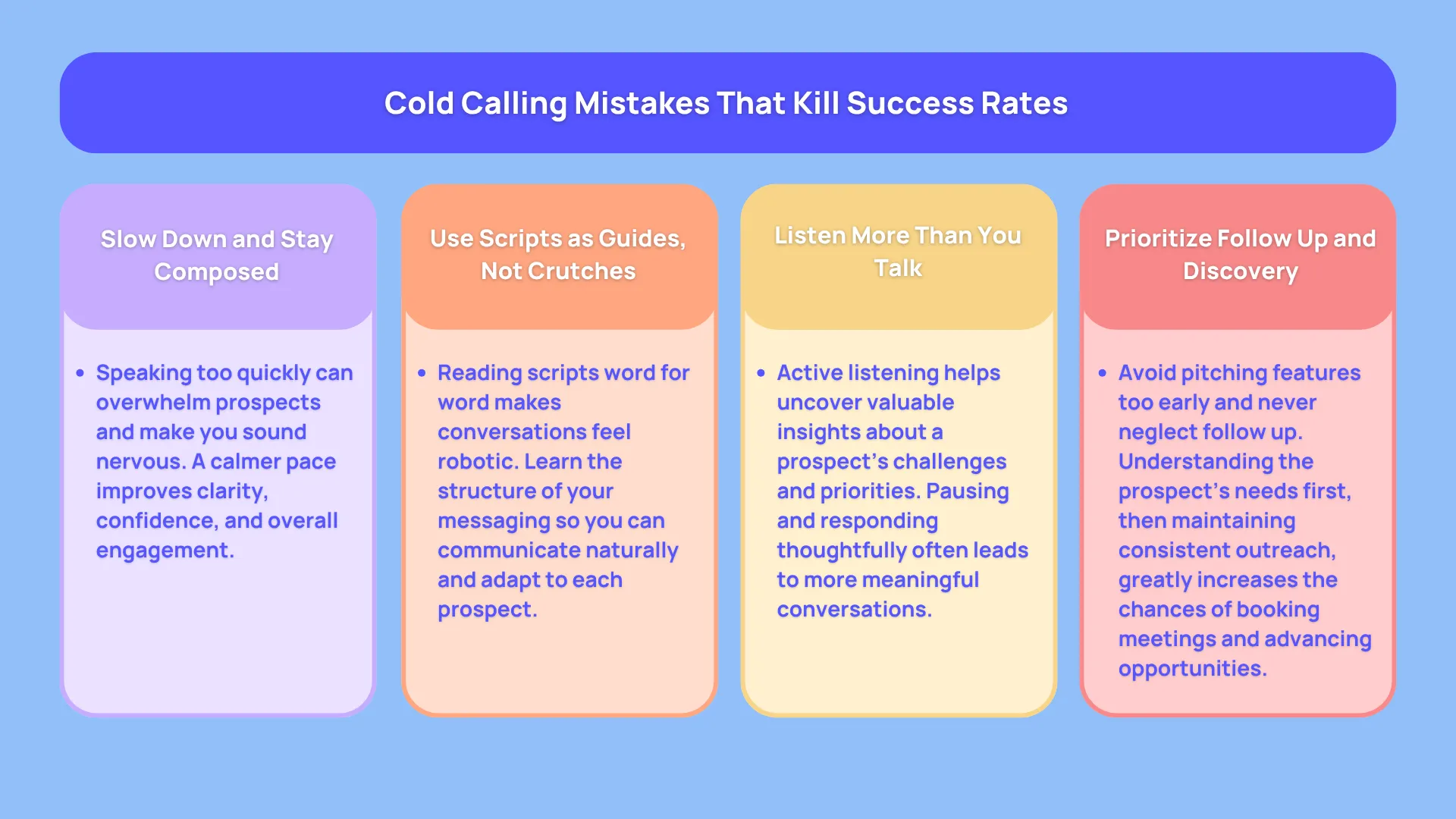
Learning how to be successful at cold calling is not only about understanding what works. It is equally important to understand what damages conversations before they have a chance to develop.
Many sales reps spend months searching for better scripts and stronger pitches while overlooking habits that quietly reduce performance every day.
The good news is that most cold calling mistakes are fixable.
Once you recognize them, you can make small adjustments that immediately improve conversation quality, prospect engagement, and meeting conversion rates.
For SDRs asking, "What mistakes should sales reps avoid when cold calling prospects?", these are the biggest offenders.
- Talking Too Fast
Nervousness causes most reps to speed up.
The moment someone answers the phone, adrenaline kicks in. Reps rush through introductions, race through value propositions, and overwhelm prospects with information.
The prospect struggles to follow along.
As a result, attention drops and conversations end quickly. Speaking slightly slower creates a completely different experience. A measured pace communicates confidence.
One practical exercise is recording several calls and listening specifically to your pace. Most reps are surprised to discover they sound much faster than they imagined.
A simple adjustment of slowing down by roughly ten percent often leads to noticeably better engagement.
- Reading Scripts Word for Word
Scripts exist for a reason. They provide structure, where you’re ideally required to have a conversation around them.
Rather than memorizing exact wording, learn the framework behind the conversation.
Understand:
- Your opening
- Your value statement
- Your discovery questions
- Your objection responses
- Your meeting request
Once those components become familiar, you can communicate naturally while still maintaining structure.
The best cold callers sound conversational, not rehearsed.
- Not Listening Closely Enough
Some reps become so focused on what they plan to say next that they miss critical information being shared by the prospect. Active listening creates stronger conversations because it allows you to build on what prospects are telling you.
A useful technique is pausing for a second or two after the prospect finishes speaking.
Those brief pauses encourage prospects to elaborate and often reveal information they would not have shared otherwise.
The more information you gather, the easier it becomes to connect your solution to their needs.
- Pitching Features Too Early
Successful cold calling techniques rely on relevance. That means understanding the prospect's problems before introducing solutions. When prospects clearly describe a pain point, your product suddenly becomes meaningful.
The conversation changes from a sales pitch into a business discussion.
- Always start with curiosity.
- Ask questions.
- Learn about the situation.
Then connect your solution to the specific issues being discussed.
- Skipping Follow Up
Many opportunities are lost after what seems like a good call.
Research across sales organizations repeatedly shows that many opportunities require multiple touchpoints before prospects commit to a meeting or evaluation process.
Follow up demonstrates professionalism.
Strong follow up habits often separate top performers from average performers more than any script or pitch technique ever could.
How Do You Structure a Successful Cold Call From Opening to Close?
One reason many reps struggle with cold calling is the lack of a repeatable framework.
Every call feels different.
Every conversation feels unpredictable.
While no two prospects are exactly alike, the structure behind successful calls is remarkably consistent.
If you've ever wondered, "How do you structure a successful cold call from opening to close?", the answer comes down to five simple stages.
Stage 1: Opening (10 Seconds)
The opening determines whether the conversation continues.
Keep it concise.
Keep it relevant.
Keep it confident.
A proven formula looks like this:
"Hi Sarah, this is Jameel from Trellus. We help SDR teams book more meetings without increasing call volume. Got thirty seconds so I can explain why I'm calling?"
This approach communicates three things quickly:
- Who you are
- Why you're calling
- Respect for their time
Then pause.
Many reps keep talking because silence feels uncomfortable.
Do not rush.
Give the prospect space to respond.
Stage 2: Problem Discovery (20 Seconds)
Once the prospect agrees to continue, move into discovery mode.
Your job here is to understand their current situation.
Ask open ended questions that encourage discussion.
Examples include:
- What's your biggest challenge with outbound prospecting right now?
- How are you currently handling SDR coaching?
- What's preventing your team from booking more meetings?
These questions help uncover pain points that create opportunities for meaningful conversations.
Remember, curiosity beats pitching at this stage.
Stage 3: Solution Positioning (20 Seconds)
After identifying a challenge, connect that problem to a business outcome.
Keep the conversation centered on results.
For example:
"You mentioned onboarding new SDRs takes several months. Many teams we work with reduce ramp time significantly through AI roleplay and coaching."
Notice the focus remains on outcomes rather than product features.
Prospects care about improvement.
Your solution simply supports that improvement.
Stage 4: Objection Handling (15 Seconds)
Most calls encounter resistance at some point.
This is where frameworks like Feel, Felt, Found become valuable.
Example:
"I understand how you feel. Other sales leaders felt the same way. What they found was that structured coaching helped improve productivity without adding management overhead."
The objective is to continue the conversation, not win an argument.
Stage 5: Close (15 Seconds)
The final stage is straightforward.
Ask for the next step.
Do not attempt to close a complex sale on a cold call.
Focus on securing a meeting.
A simple example:
"Based on what you've shared, would you be open to a quick fifteen minute demo next Tuesday so we can show you exactly how this works?"
That's it.
Clear.
Direct.
Low pressure.
Sample Cold Call Framework in Action
Here's how the entire sequence comes together.
"Hi Sarah, this is Jameel from Trellus. We help SDR teams book more meetings in less time. Got thirty seconds so I can explain why I'm calling?"
Pause.
"Great. I'm curious, what's your biggest challenge with cold calling right now?"
Listen.
Prospect explains their situation.
You respond:
"That's interesting. We hear that frequently from sales teams. Many SDRs felt cold calling was becoming less effective. What they found was that coaching and performance analytics helped improve conversations and increase meeting bookings."
Pause.
"Would it make sense to schedule a quick fifteen minute demo next week so you can see how other teams are approaching this?"
This framework keeps the conversation focused, structured, and easy for prospects to follow.
More importantly, it supports nearly all of the cold calling best practices discussed earlier, helping sales teams create more qualified conversations and ultimately book more meetings.
Trellus.Ai: AI Tool That Makes Cold Calling Even More Successful
Great cold calling starts with preparation, strong communication skills, and consistent execution.
However, even experienced sales reps can struggle to maintain those standards throughout an entire week of prospecting.
- Some days your energy is high.
- Some days it is not.
- Some calls go perfectly.
- Others feel like a complete disaster.
That inconsistency is exactly why many sales organizations are turning to AI powered sales platforms.
Among the solutions available today, Trellus.ai has become a popular choice for SDR teams looking to improve outbound performance without adding more management overhead.
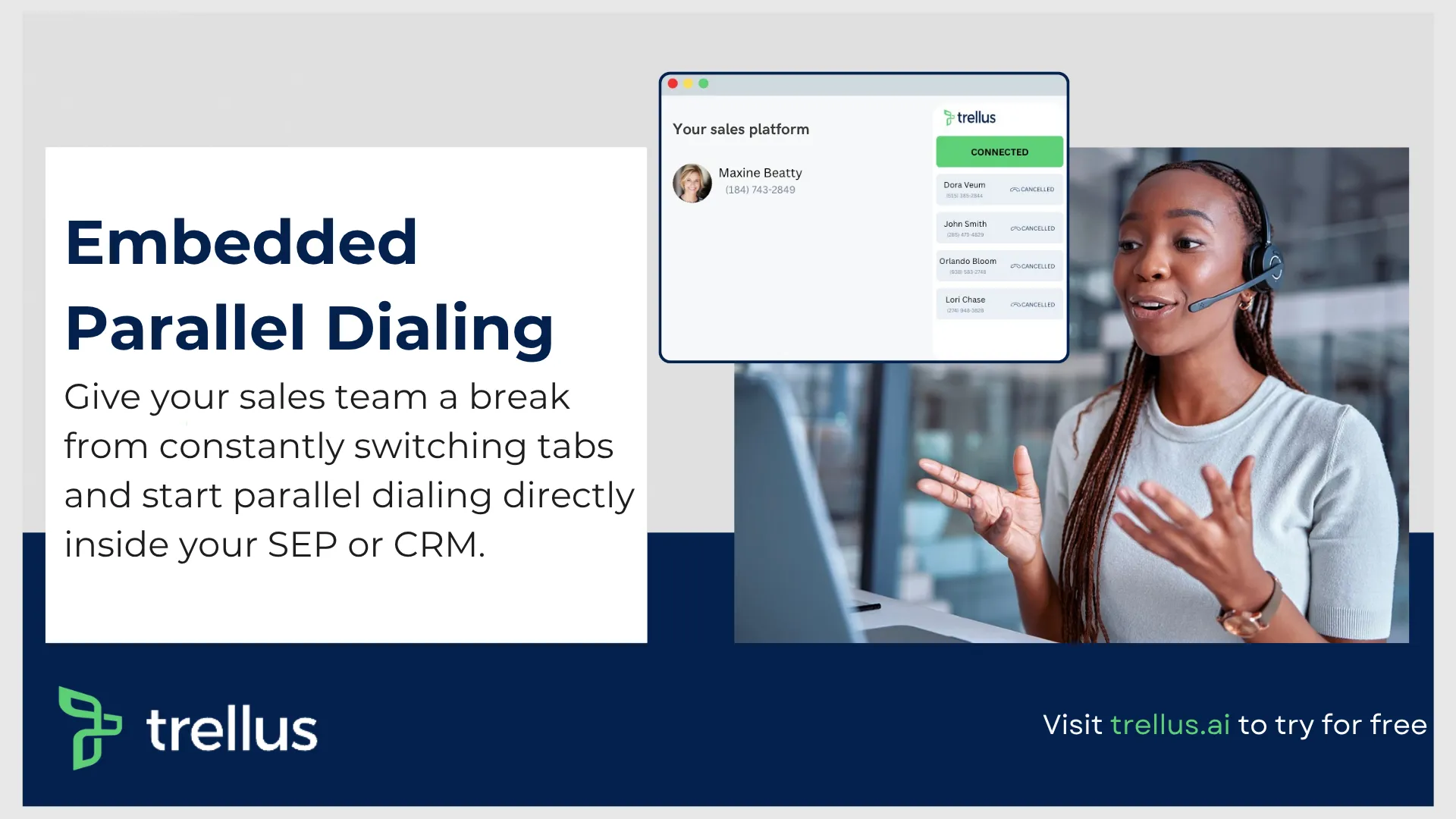
Trellus combines dialing, coaching, roleplay, and performance tracking into a single workspace designed specifically for outbound sales teams.
What makes the platform particularly valuable is how closely it aligns with the cold calling strategies for SDRs discussed throughout this guide.
Real Time Call Feedback
One of the hardest parts of improving cold calling is identifying mistakes while they're happening.
Most reps only discover problems after a manager reviews recordings days later.
Trellus changes that process.
During live calls, the platform analyzes conversations and provides immediate feedback on factors such as:
- Speaking pace
- Talk to listen ratio
- Objection handling
- Messaging effectiveness
- Call flow
This allows reps to make adjustments while the conversation is still happening.
For example, if a rep begins speaking too quickly or dominates the discussion, Trellus can surface coaching prompts that help bring the conversation back on track.
This directly reinforces the opening and communication techniques covered earlier.
AI Roleplay Practice
Practice remains one of the most effective ways to improve cold calling performance.
The problem is finding enough opportunities to practice.
Managers are busy.
Team roleplays are often inconsistent.
Feedback varies from person to person.
Trellus solves this with AI powered roleplay scenarios that simulate realistic buyer conversations.
Reps can practice:
- Discovery conversations
- Objection handling
- Meeting booking
- Competitive discussions
- Industry specific sales situations
After each session, the platform generates performance scores and coaching recommendations.
This allows SDRs to identify weaknesses before speaking with live prospects.
Many teams report significantly faster onboarding and ramp times because new reps can gain experience in a controlled environment before making actual calls.
Performance Analytics That Drive Improvement
One of the most overlooked aspects of successful cold calling techniques is performance analysis.
Without data, improvement becomes guesswork.
Trellus automatically tracks key sales metrics such as:
- Connect rates
- Conversation rates
- Meeting conversion rates
- Talk time
- Activity levels
Managers gain visibility into performance trends while reps receive clear guidance on areas that need attention.
This creates a coaching process based on data rather than assumptions.
Workflow Automation That Saves Time
Administrative work often steals hours from a rep's week.
Updating records, logging notes, and documenting conversations may seem minor individually, but they quickly add up.
Trellus helps eliminate much of that burden through automated workflows and CRM synchronization.
Reps can move from lead list to active outreach in minutes while reducing manual data entry.
That means more time spent selling and less time spent updating systems.
Sales organizations using Trellus frequently report improvements in meeting volume, SDR productivity, and onboarding speed.
For teams serious about learning how to be successful at cold calling, Trellus serves as a practical extension of the strategies discussed throughout this guide, helping reps apply those principles more consistently every day.


Power and parallel dialing in your CRM.