Our Top Picks


Outbound sales have changed in a very real way.
Buyers are sharper, inboxes are crowded, and attention is harder to earn than ever. We have talked at length about this new situation before. From that point of view, your typical approach, as in cold calling, only works when you are greatly informed about the product you’re about to pitch, and the enormous amount of research you have conducted on the prospect’s pain points, etc. BEFORE making that call!
Sending more emails or making more calls is no longer a growth strategy.
Eventually, it is just noise.
What works now is precision, timing, and relevance. That is where outbound sales automation comes in. Not as a shortcut, but as a system that helps teams act faster, stay consistent, and focus on conversations that matter.
This guide walks through how modern teams think about sales outreach automation, what has changed over time, and how to build a smarter outbound engine using today’s sales automation software and outbound automation tools.
What is Sales Automation From a Beginner’s Point of View?

At its core, sales automation is about removing repetitive work so sales teams can spend more time selling. It connects data, workflows, and communication into a system that runs in the background while reps focus on human interaction.
Modern sales automation software does much more than just logging emails or scheduling follow ups. It acts like a control center for the entire revenue process. It tracks behavior, triggers actions, and even generates messaging that feels personal.
Think of it this way. Instead of manually remembering who to follow up with, when to send a proposal, or how to segment leads, the system handles it. Reps step in at the right moment with the right context.
This is why outbound prospecting automation has become essential. It allows teams to scale outreach without losing relevance, something that was nearly impossible a few years ago.
The Evolution of Outbound Sales Automation
Understanding where things started makes it easier to see why current strategies look the way they do. Sales automation did not suddenly become intelligent. It evolved in layers.
Phase 1: Basic Workflow Automation
In the early days, automation was mostly about efficiency. CRM systems captured activities automatically and reduced manual data entry.
Sales reps no longer had to log every call or email. Simple workflows could trigger reminders or basic automated sales sequences, which was a big step forward at the time.
Still, everything was rule based. No intelligence, no adaptability.
Phase 2: Predictive Intelligence
The next shift introduced data science into sales. Systems began analyzing historical data to predict outcomes.
Lead scoring became smarter. Instead of guessing which prospects might convert, teams could prioritize based on probability.
This phase made outbound automation tools more strategic. Sales teams started focusing on quality over quantity, guided by insights instead of instinct.
Phase 3: Generative AI and Autonomous Action
This is where things get interesting. Today’s automation does not just assist, it actively participates.
AI can write emails, summarize calls, research accounts, and recommend next steps. In some cases, it can execute those steps automatically.
For example, modern sales outreach automation platforms can generate personalized messages that reference a prospect’s company, role, and recent activity. That level of customization used to take hours per lead.
The result is simple. More output, better quality, and significantly less manual effort. Many teams report saving several hours every week, which translates directly into more pipeline activity.
This increase in high-quality activity is the foundation of building sales pipeline effectively. By automating routine tasks, your sales team can dedicate their energy to the strategic outreach that actually drives revenue.
How Does a Typical Sales Process Automation Work?
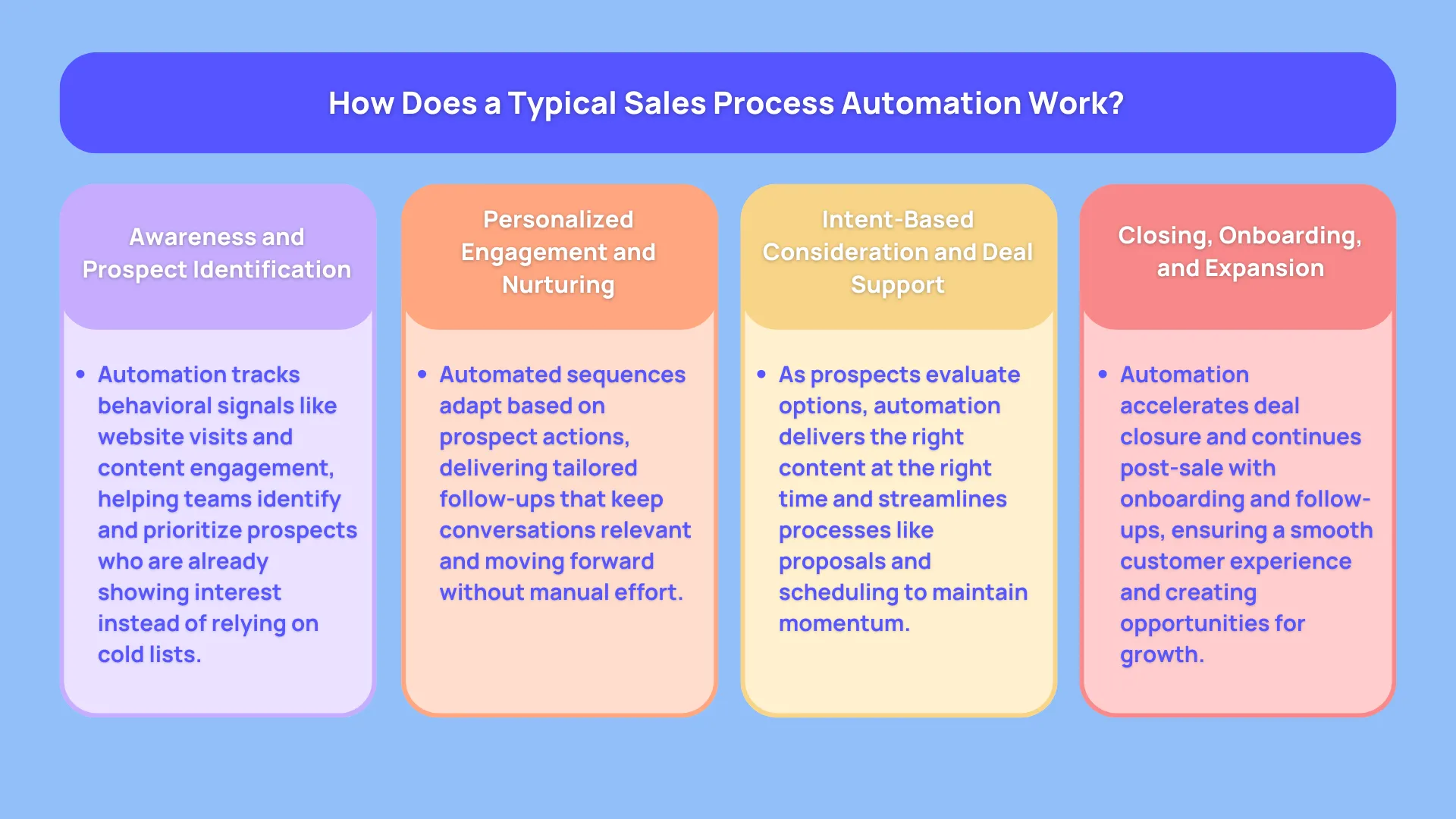
To understand the real impact of outbound sales automation, it helps to look at how it operates across the sales funnel. Automation is not just for outreach. It supports every stage, from first touch to closed deal and beyond.
Awareness Stage
At the top of the funnel, automation helps identify and track early signals. Instead of guessing who might be interested, teams can see real engagement.
Systems monitor website visits, content interactions, and behavioural patterns. Prospects who show repeated interest can be flagged automatically.
This is where outbound prospecting automation becomes powerful. Instead of cold outreach to random lists, reps engage people who are already showing curiosity.
To further accelerate this engagement, teams must decide between a parallel dialer vs power dialer for their calling infrastructure. This choice directly influences how quickly reps can work through engaged lists while maintaining compliance and conversation quality.
Interest Stage
Once a prospect engages, automation keeps the conversation going.
This is typically handled through automated sales sequences. These are structured follow ups that adapt based on how a prospect responds.
If someone downloads a resource, they might receive a tailored email. If they click a link, the next message adjusts accordingly.
This creates a personalized experience at scale, which is the main advantage of modern sales automation software.
Consideration Stage
At this point, prospects are comparing options. Timing and relevance matter more than volume.
Automation helps surface the right content at the right time. Case studies, product details, and ROI insights can be sent automatically based on engagement triggers.
Instead of pushing information randomly, the system aligns communication with buyer intent.
Decision Stage
When a deal moves closer to closing, speed becomes critical.
Automation can generate proposals, send contracts, and schedule follow ups without delays. Everything is pre structured but still customizable.
This reduces friction and keeps momentum high, which is essential in competitive sales cycles.
Action and Post Sale
Automation does not stop after the deal is closed.
Onboarding workflows, customer success tasks, and follow up communication can all be triggered automatically. This ensures a smooth transition and opens the door for upselling or expansion opportunities later.
This full funnel approach is what makes outbound automation tools so valuable. They do not just help start conversations, they help sustain and grow them.
Why Outbound Sales Automation Matters More Than Ever
There is a reason why every serious sales team is investing in Top Outbound Sales Tools and modern automation platforms.
Buyers expect relevance. They ignore generic outreach. They respond to timing, context, and value.
Manual processes cannot keep up with that expectation. Automation bridges the gap.
It enables:
- Faster response times
- Better personalization at scale
- Consistent follow ups without human error
- Data driven decision making
- Higher efficiency across the entire sales team
At the same time, automation alone is not enough. The real advantage comes from how it is used.
7 Advanced Outbound Sales Automation Strategies for 2026
If the foundation is strong, strategy is what actually drives results. The difference between average and high performing teams often comes down to how intelligently they apply outbound sales automation.
The following strategies reflect how modern teams are getting ahead. Each one builds on the idea that automation should enhance relevance, not replace human connection.
1. Hyper Personalized, AI Driven Outreach
Personalization used to mean adding a first name and company name into a template. That approach does not work anymore. Buyers can spot it instantly, and they ignore it just as quickly.
Today, sales outreach automation is capable of producing messages that feel genuinely thoughtful. AI analyzes firmographic data, behavioral signals, and even recent company activity to craft context aware messaging.
This is where sales automation software becomes a competitive advantage. It enables dynamic personalization that adjusts in real time.
Instead of sending one static sequence, modern systems adapt based on how prospects engage. If someone visits a pricing page or interacts with a specific feature, the next touchpoint reflects that interest.
Some well known platforms leading this shift include companies like Outreach.io, Salesloft, and LinkedIn Sales Navigator. These tools provide deep insights that fuel better personalization at scale.
The key challenge here is avoiding over automation. When every message feels generated, trust drops. The best teams treat AI as a starting point, then refine messaging with a human touch.
2. Trigger Based Prospecting and Real Time Engagement
Static lead lists are quickly becoming outdated. High performing teams now rely on signals instead of assumptions.
Outbound prospecting automation allows teams to act the moment something meaningful happens. This could be a funding round, leadership change, product launch, or a spike in website activity.
The advantage is timing. Reaching out when a prospect is already thinking about change increases the chances of a response significantly.
Platforms like Gong and other intelligence tools monitor these signals and alert sales teams instantly.
This approach leads to more relevant conversations because outreach is tied to real events, not random outreach schedules.
There are a few trade offs to consider. Trigger based systems depend heavily on data quality. If signals are missed or inaccurate, opportunities can slip through.
Even so, the upside is hard to ignore. Faster engagement, better context, and stronger conversion rates make this one of the most impactful outbound automation tools available today.
3. Omnichannel Outreach That Feels Natural
Relying on a single channel is limiting. Buyers interact across multiple platforms, and effective outreach reflects that behavior.
In 2026, automated sales sequences are designed to move across channels seamlessly. A prospect might see a LinkedIn message, followed by an email, then a call, all spaced in a way that feels natural rather than overwhelming.
This is where LinkedIn Automation Software and multichannel sequencing tools play a major role. They help coordinate touchpoints so each interaction builds on the last.
The real advantage of omnichannel outreach is familiarity. When prospects see consistent, relevant messaging across platforms, trust builds faster.
At the same time, coordination matters. Poorly executed multichannel outreach can feel chaotic. Messages must align in tone, timing, and intent.
Strong teams rely on analytics within their sales automation software to understand which channels perform best and adjust their approach accordingly.
4. Human and AI Collaboration
There is a lot of talk about AI replacing sales roles. In reality, the best results come from collaboration.
AI handles research, data analysis, and repetitive tasks. Humans handle nuance, empathy, and relationship building.
This balance is what defines modern outbound sales automation.
For example, AI might identify a high intent prospect and generate an initial message. A sales rep reviews it, adds context, and delivers it in a way that feels authentic.
When it comes to voice channels, deploying a dedicated ai calling system follows the exact same collaborative principle. The software handles the repetitive task of navigating phone trees and voicemails, instantly handing the call over to a human rep the moment a real prospect answers.
Companies that adopt this hybrid approach tend to outperform those that rely entirely on automation or entirely on manual processes.
Training becomes critical here. Sales teams need to understand how to interpret AI insights and when to override them.
This is also where The Ultimate Guide to Digital Sales Enablement Tools in 2026 becomes relevant as a concept. Enablement platforms ensure reps are equipped to work effectively alongside AI systems.
The end result is not just efficiency, but smarter, more strategic conversations.
5. Advanced Analytics and Predictive Sales Intelligence
Data is everywhere, but not all data is useful. The value comes from turning it into actionable insights.
Modern sales automation software includes advanced analytics that track performance across every stage of the funnel.
Metrics such as reply rates, meeting conversions, and deal velocity are monitored in real time. This allows teams to adjust quickly instead of waiting until the end of a quarter to evaluate results.
Predictive intelligence takes things a step further. It identifies which prospects are most likely to convert, helping teams focus their energy where it matters most.
Tools like Salesforce with Einstein Analytics, Gong, and Demandbase are widely used for this purpose.
For teams comparing platforms, this ties closely to topics like The Complete Guide to Sales Automation Platforms in 2026 and Best Sales Dialer Software: 2026 Comparison of Top Platforms, where analytics capabilities often become a deciding factor.
The takeaway is simple. Better data leads to better decisions, and better decisions lead to stronger pipeline outcomes.
6. Leveraging Buyer Intent Data
One of the biggest shifts in outbound sales automation is the ability to understand intent before a prospect ever reaches out.
Buyer intent data reveals which companies are actively researching solutions. This could include content consumption, keyword searches, or engagement with competitor platforms.
When this data is fed into outbound automation tools, outreach becomes far more targeted.
Instead of reaching out to cold prospects, sales teams engage accounts that are already in a buying mindset. This dramatically increases engagement rates.
The challenge lies in interpretation. Not every signal indicates immediate readiness to buy. Teams need to combine intent data with context to avoid premature outreach.
When used correctly, this strategy transforms outbound from interruption into timely assistance.
7. Ethical and Value Driven Outreach
Automation makes it easy to scale outreach. That does not mean every message should be sent.
Privacy expectations are higher than ever. Regulations like GDPR and CCPA have reshaped how data can be collected and used.
This has led to a shift toward more thoughtful, value driven communication.
Instead of pushing products, effective sales outreach automation focuses on solving problems. Messages are clear, relevant, and respectful of the recipient’s time.
Transparency also matters. Prospects should understand why they are being contacted and how their data is being used.
Simple practices like easy opt out options and clear messaging go a long way in building trust.
In the long run, ethical outreach is not just about compliance. It is about reputation. Teams that prioritize value tend to build stronger relationships and retain customers longer.
.jpeg)

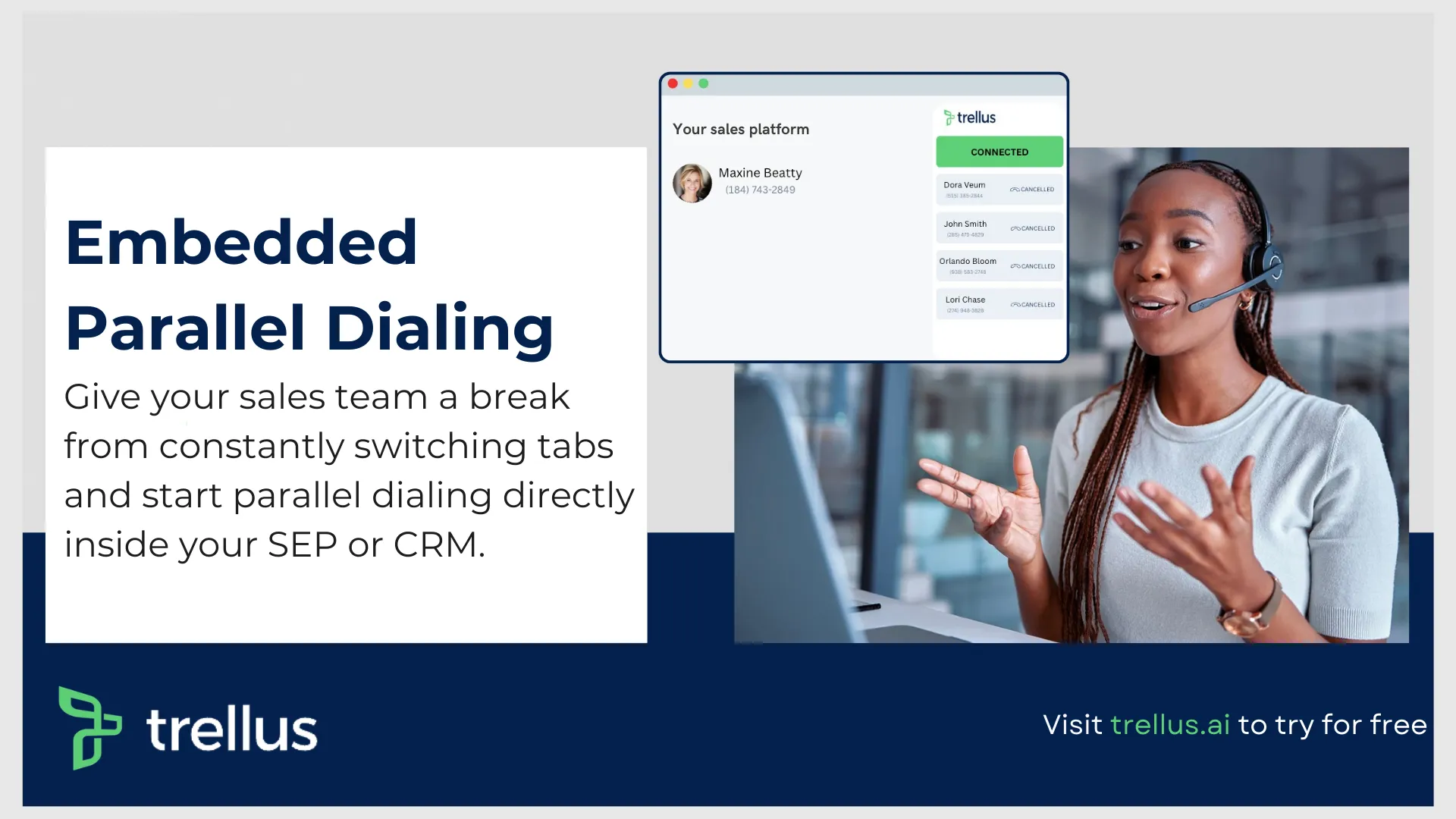
Embed Trellus Parallel Dialer Within Your SEP & 4x Your Conversations