Our Top Picks


There’s a pattern that shows up in almost every outbound sales organization.
Typically, it starts with a new SDR joining the team, learning the pitch, getting excited about the process, and all that.
Promises are made on both sides; the manager also incentivizes the performance curve through month over month, or quarterly bonuses. So, the next thing we see is the person getting on a dialing rampage, booking a bunch of meetings, and vice versa. Meanwhile, the line manager sees a bit of potential and optimism.
However, somewhere down the line, let’s say month 3 or 4, when work gets a little stale, the pipeline numbers don’t move alot. The same thing happens with conversions, whereas the SDR’s performance kind of goes flat without any signs of improvement.
In reality, this SDR might be working hard, but not in a smart manner that’d call for a better overall yield.
Most companies treat this like an individual failure. They assume the rep lacked discipline, resilience, or work ethic. But most SDR performance issues are not caused by lazy reps. They are caused by broken systems, weak coaching structures, messy workflows, poor targeting, and unrealistic expectations.
Fun Fact: Did you know that the average cold call connect rate in the U.S. sits between 2% to 8%, while overall dial to meeting conversion hovers around 2.3%? These stats highlight your average SDRs struggling with conversion, despite remaining active and engaged on a high-volume call blitz.
Moving on, if we take a look at other modes of outreach that don’t normally coincide with an SDR's daily workflow, we’ve got your standard cold emails.
As a line manager to an SDR team, eventually, at some point, you will notice the cold email response rates falling. Spam filters are harder to bypass. Buyers are overloaded with outreach. SDRs are expected to personalize messaging at scale while managing multiple tools, tracking follow ups, updating CRMs, switching between tabs, researching accounts, and hitting aggressive activity targets at the same time.
On top of that, in terms of statistics, the average cold email reply rate has already dropped to around 5.1%, with many campaigns performing even closer to a mere 3%. Yikes…
The problem becomes even worse when leadership measures the wrong things.
A rep making 120 calls per day might look productive on paper. But if those calls produce almost no meaningful conversations, the activity creates noise, not pipeline. This is one of the biggest sales development problems inside growing outbound teams. Companies reward motion instead of outcomes.
That’s why teams struggling with sdr performance often feel confused. The dashboard says activity is high, yet pipeline quality keeps dropping.
The disconnect comes from misunderstanding what performance really means.
Here’s The Stark Reality…
The reality is that sales development representative challenges rarely exist in isolation. Poor conversion rates usually connect to weak discovery skills. Weak discovery often connects to poor onboarding. Poor onboarding connects to rushed hiring. Low motivation often connects to lack of visibility into career growth. Low follow up rates often connect to overloaded workflows and fragmented tools.
Everything is connected on a bigger level, which may not be visible at first glance.
That’s why companies trying to improve SDR productivity in sales teams cannot solve problems with motivational speeches or pressure alone. They need operational clarity. They need coaching systems. They need workflow visibility. They need better signals.
On that note, we’d say that the strongest outbound teams are not winning because their SDRs work harder. It’s a combination of metrics, processes and different identifiers that help the entire team to move forward as one.
The 3 Root Causes Behind Most SDR Challenges
When leaders ask questions like “what are common SDR performance issues” or “why do SDRs struggle with conversions,” the conversation usually becomes surface level very quickly. Normally, we see either one of the following reasons associated with this phenomenon:
- People blame effort.
- People blame attitude.
- People blame the market.
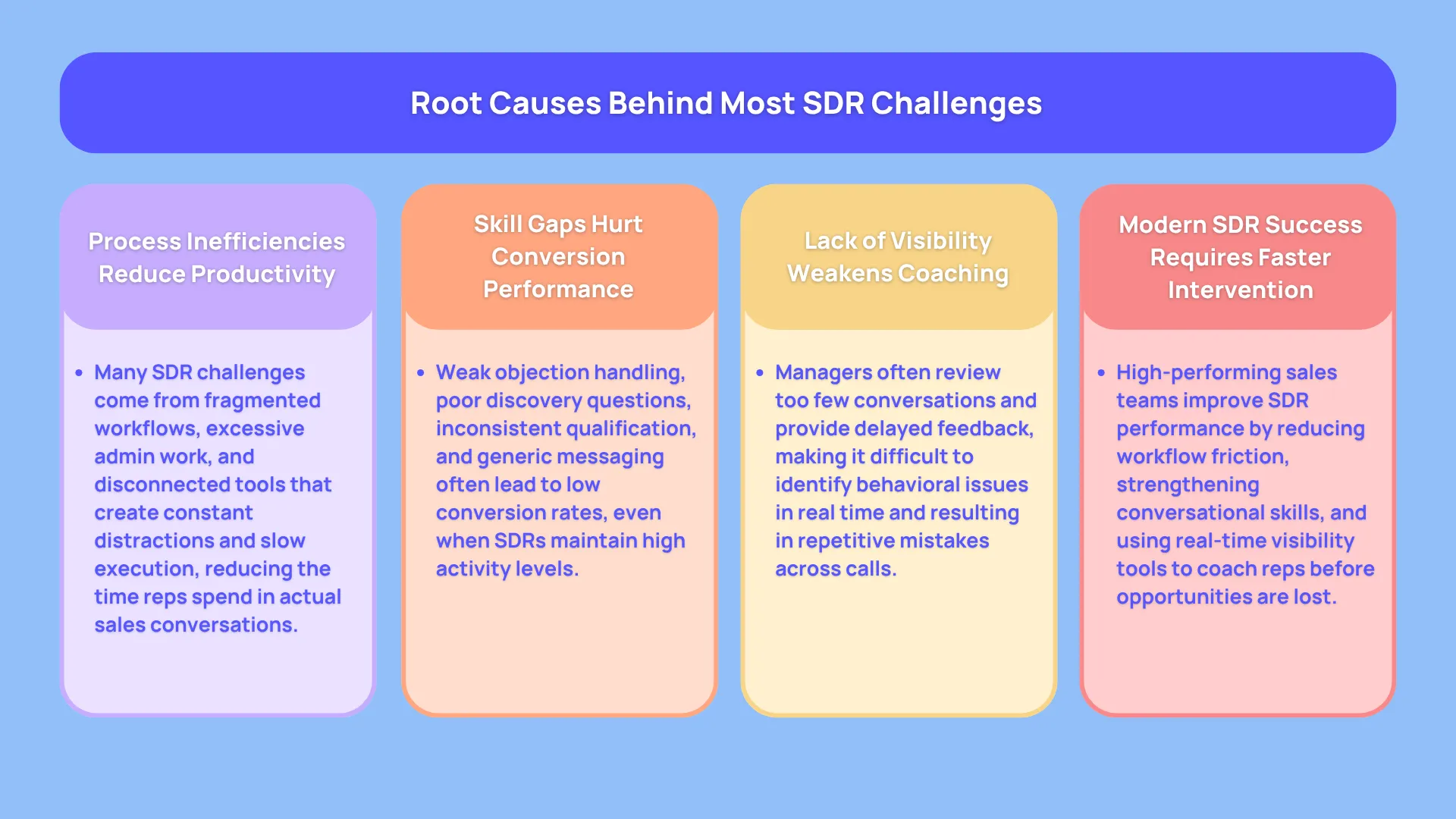
But most SDR performance issues fall into three much deeper categories:
- Process inefficiencies
- Skill gaps
- Lack of visibility
Once you understand these three root causes, almost every sales pipeline bottleneck becomes easier to diagnose. Then again, the problem is in the identification area. You know there’s something wrong with the SDRs, but you can’t put your finger on it yet…
Also Read:
Process Inefficiencies Create Friction Everywhere
Many SDR workflow optimization problems have nothing to do with selling ability.
They come from operational chaos.
An SDR opens the day with Slack notifications or any other program that notifies them of daily deliverables. They have a bunch of CRM tasks, LinkedIn tabs, sequencing tools, enrichment platforms, spreadsheets, dialers, calendar links, and duplicate lead records all competing for attention.
Every small interruption slows execution; every context switch drains focus.
Over time, even talented reps become inefficient because the workflow itself is inefficient.
This is one of the biggest SDR productivity challenges in modern outbound teams. Other challenges are at the top or sub-level, which we’ll get to in a bit.
Moving on, the average SDR spends a huge portion of the day on administrative work rather than conversations. Logging activities, updating records, searching for contact information, fixing bad data, and chasing task reminders consume hours that should have gone toward pipeline generation.
How This Shows Up in Data
Process related sales team productivity issues are usually visible through signals like:
- High activity volume but low output
- Slow lead response times
- Missed follow ups
- Large gaps between touches
- CRM fields left incomplete
- High no show rates
- Reps spending more time in tools than in conversations
Before vs After Fix
Before:
An SDR spends 3 hours daily switching between five platforms. Lead follow up delays average 14 hours. Meetings booked stay inconsistent.
After workflow optimization:
The SDR works from a centralized workflow, responds to inbound leads within minutes, and books more meetings with the same activity level.
The difference is not effort.
The difference is reduced friction.
Skill Gaps Quietly Destroy Conversion Rates
Many SDR performance issues are disguised as activity problems when they are really execution problems.
A rep can make hundreds of calls every week and still struggle because they lack critical conversational skills. This is where improving SDR conversion rates becomes difficult for managers who only track surface level metrics.
Poor objection handling, weak discovery questions, lack of confidence, inconsistent qualification, poor listening habits, and generic messaging all damage conversion performance long before leadership notices.
This explains why some SDRs consistently outperform others despite similar territories and similar lead volumes.
The difference often comes down to execution quality during live conversations.
How This Shows Up in Data
Skill based SDR performance metrics usually reveal patterns like:
- Strong connect rates but weak meeting booked rates
- Calls ending quickly after objections
- Low email reply rates despite high send volume
- Low meeting show rates
- Poor qualification consistency
- Pipeline opportunities stalling early
Before vs After Fix
Before:
An SDR averages 70 calls daily but books only 2 meetings per week. Most conversations end after pricing objections.
After targeted coaching:
The same SDR learns objection handling frameworks, improves discovery questions, and starts booking 5 to 6 meetings weekly without increasing activity.
Again, the issue was not volume.
It was conversion skill.
Lack of Visibility Creates Coaching Blind Spots
One of the most overlooked sales development problems is visibility.
Managers cannot improve what they cannot see.
Most SDR coaching strategies rely on occasional call reviews, random pipeline inspections, or delayed feedback sessions that happen days after the interaction already failed.
That creates massive blind spots.
Leaders assume reps understand where conversations break down, but many SDRs have no idea which behaviors are hurting performance in real time.
Without visibility, coaching becomes generic.
Generic coaching rarely improves behavior.
How This Shows Up in Data
Visibility related SDR performance issues often appear through:
- Inconsistent performance between reps
- Random swings in conversion rates
- Repeated mistakes across calls
- Long ramp times for new hires
- Managers reviewing less than 5% of conversations
- Reps unable to self diagnose weaknesses
Before vs After Fix
Before:
A manager reviews two calls every Friday and gives broad feedback about “building more urgency.”
The SDR repeats the same mistakes all week because the feedback arrives too late.
After visibility improvements:
Call patterns become measurable in real time. Coaching becomes immediate, personalized, and behavior specific. Performance stabilizes faster.
This is where modern SDR performance improvement strategies begin separating strong teams from struggling ones.
The companies seeing the best outbound results are not waiting until deals are lost to coach behavior.
They are identifying problems while conversations are still happening.
9 SDR Performance Issues Mapped to Root Causes

Finally, we get to the part that you’ve been anticipating. Understanding the root causes is important, but sales leaders still need practical answers to questions like:
- how to fix sales development bottlenecks
- what mistakes reduce SDR performance
- how to improve lead follow up rates
- what tools help SDR performance
The biggest mistake companies make is treating every performance issue as a motivation problem. As we mentioned earlier in this post, most of the SDR performance issues are operational, behavioral, or structural.
As a manager, your job is to identify these issues, especially during the early stages of an SDR’s career in the organization. Post the identification phase, once those patterns become measurable, performance becomes far easier to improve consistently.
Issue #1: Low Conversion Rates
Low conversion rates are one of the most common SDR performance issues across outbound teams.
An SDR may generate decent call volume and still struggle to move prospects into qualified meetings. This usually frustrates leadership because the activity appears healthy on the surface.
The root cause is often weak objection handling, poor discovery questions, or unclear value communication.
Many SDRs rely too heavily on scripts. The moment a prospect pushes back, the conversation collapses.
How It Shows Up in Data
- High call volume but low meeting booked rate
- Conversations ending after pricing objections
- Strong connect rates with weak qualification rates
- Prospects disengaging early during discovery
Before vs After Fix
Before:
An SDR makes 90 calls daily and books 2 meetings weekly.
After coaching intervention:
The SDR improves questioning techniques, handles objections more confidently, and books 5 meetings weekly from nearly identical activity levels.
The difference is execution quality, not effort.
SDR Performance Improvement Fix
Managers should focus on conversational coaching, role play exercises, objection handling repetition, and live feedback loops. This is one of the most effective SDR training techniques for improving SDR conversion rates.
Issue #2: Slow Lead Follow Up
Lead speed matters more than most teams realize.
One of the biggest lead follow up problems inside outbound organizations is delayed response time after inbound interest appears.
Many SDRs lose opportunities before conversations even begin because leads sit untouched for hours.
Root Cause
Poor workflow prioritization, notification overload, fragmented systems, or lack of response ownership.
How It Shows Up in Data
- Long time to first contact
- High inbound lead decay
- Strong lead quality but weak conversion rates
- Missed opportunities despite healthy inbound volume
Before vs After Fix
Before:
Inbound leads receive responses after 6 to 12 hours.
After workflow optimization:
Responses happen within minutes, dramatically improving connect rates and meeting acceptance.
SDR Performance Improvement Fix
Teams should streamline routing systems, automate lead assignment, reduce manual steps, and prioritize speed based workflows.
This is one of the clearest examples of how SDR workflow optimization directly impacts revenue outcomes.
Issue #3: SDR Burnout and Motivation Decline
Burnout quietly destroys sdr performance long before reps quit.
Many SDRs begin with energy and confidence, then slowly lose momentum after repeated rejection, repetitive tasks, and constant quota pressure.
Root Cause
Lack of career progression visibility, poor coaching support, unrealistic activity expectations, and excessive administrative work.
How It Shows Up in Data
- Falling activity consistency
- Reduced call energy
- Increased absenteeism
- Sharp drop in outbound quality
- High turnover rates
SDR Performance Improvement Fix
Strong leaders treat SDRs as future revenue leaders, not disposable appointment setters. Coaching, recognition, growth visibility, and skill development all matter heavily for retention.
Teams asking “how to train SDRs effectively” often ignore motivation systems entirely, which creates long term instability.
Issue #4: Poor CRM Hygiene and Organization
Organization problems create hidden sales pipeline bottlenecks everywhere.
Incomplete notes, missed tasks, inconsistent follow ups, and messy CRM records damage both conversion and forecasting accuracy.
Root Cause
Lack of accountability, weak operational habits, and poor understanding of why data quality matters.
How It Shows Up in Data
- Missing activity records
- Duplicate contacts
- Forgotten follow ups
- Inaccurate pipeline reporting
- Managers lacking visibility into account progression
Before vs After Fix
Before:
An SDR forgets follow ups regularly and loses warm opportunities.
After structured accountability:
Follow up completion improves, pipeline visibility becomes cleaner, and conversion consistency rises.
SDR Performance Improvement Fix
Managers should reinforce note taking discipline, structured workflows, CRM accountability, and post call documentation standards consistently.
Issue #5: Generic Outreach That Gets Ignored
One of the biggest outbound sales inefficiencies today is low quality personalization.
Prospects receive hundreds of repetitive messages every week. Generic outreach no longer works consistently.
Root Cause
Over reliance on templates, weak account research, poor personalization strategy, and pressure to maximize volume.
How It Shows Up in Data
- Low email reply rates
- Strong send volume with minimal engagement
- High unsubscribe rates
- Cold outreach landing in spam folders
Before vs After Fix
Before:
An SDR sends 200 template emails daily with minimal replies.
After messaging improvements:
The SDR sends fewer but more personalized emails and doubles response rates.
SDR Performance Improvement Fix
Teach SDRs how to research accounts quickly, personalize around business pain points, and craft relevance driven messaging rather than generic pitches.
Issue #6: Weak Multi Threading Inside Target Accounts
Many SDRs reach one contact inside an account and assume the job is done.
That creates fragile pipeline opportunities.
If the single contact disappears, stops responding, changes priorities, or lacks decision making authority, the deal stalls immediately. This is one of the most common sales pipeline bottlenecks inside account based outbound programs.
Modern buying decisions rarely involve one person. Multiple stakeholders influence purchasing decisions, especially in B2B sales environments.
Root Cause
Weak account mapping skills, poor research habits, and lack of strategic outreach planning.
Many SDRs are trained to chase quick meetings, not account penetration.
How It Shows Up in Data
- Deals stalling after initial discovery
- Low engagement across buying committees
- Strong top funnel activity but poor pipeline progression
- Opportunities collapsing when one stakeholder disengages
Before vs After Fix
Before:
An SDR books meetings with one manager level contact but opportunities rarely progress beyond early stage conversations.
After targeted coaching:
The SDR learns how to identify additional stakeholders, personalize outreach for different personas, and build multi contact engagement inside accounts.
Pipeline quality improves significantly without increasing outbound volume.
SDR Performance Improvement Fix
Managers should train SDRs on organizational mapping, stakeholder identification, and persona based messaging. This is one of the most overlooked SDR coaching strategies inside outbound teams today.
Issue #7: Inconsistent Meeting Show Rates
Booking meetings means very little if prospects never attend.
Low show rates create major sales team productivity issues because Account Executives lose calendar time, forecasting becomes unreliable, and pipeline momentum slows down.
A meeting booked is not a meeting earned.
Root Cause
Weak qualification, poor expectation setting, lack of urgency creation, or weak confirmation processes.
Many SDRs rush to secure calendar invites without properly establishing value.
How It Shows Up in Data
- High booked meeting numbers but low held meeting rates
- Prospects canceling shortly before meetings
- High no show percentages from specific SDRs
- AE complaints about low quality meetings
Before vs After Fix
Before:
An SDR books 12 meetings monthly, but only 6 actually happen.
After qualification improvements:
The SDR learns to reinforce urgency, confirm pain points clearly, and secure commitment before scheduling.
Meeting attendance rises significantly.
SDR Performance Improvement Fix
Coaching should focus on qualification depth, expectation setting, calendar confirmation habits, and stronger meeting framing.
Teams searching for answers around “how to improve lead follow up rates” often overlook the importance of post booking reinforcement.
Issue #8: Lack of Motivation and Emotional Fatigue
Cold outreach is emotionally demanding work.
Rejection stacks up quickly. Conversations become repetitive. Quotas create constant pressure. Without proper leadership support, even talented SDRs begin losing confidence over time.
This is one of the most damaging SDR productivity challenges because motivation affects every other performance category.
Root Cause
Weak leadership support, unclear career progression, repetitive workflows, and lack of meaningful coaching.
Some organizations treat SDRs like temporary labor rather than future revenue talent.
That mindset destroys retention.
How It Shows Up in Data
- Reduced outbound consistency
- Lower call energy
- Increased inactivity periods
- Poor participation during coaching sessions
- Rising turnover rates
Before vs After Fix
Before:
An SDR begins disengaging after repeated missed quota months. Activity remains high, but conversational quality collapses.
After leadership intervention:
The rep receives personalized coaching, clearer development plans, and structured skill progression support.
Confidence improves. Performance stabilizes.
SDR Performance Improvement Fix
The strongest SDR leaders create growth visibility early. Reps should understand how skill development connects to long term career progression.
Organizations serious about SDR performance improvement invest in leadership quality just as heavily as outbound tooling.
Issue #9: Tool Overload and Workflow Fragmentation
One of the biggest modern sales development problems is tool overload.
Most SDRs operate inside disconnected systems that force constant context switching throughout the day.
CRM tabs, sequencing tools, enrichment platforms, dialers, messaging systems, spreadsheets, meeting schedulers, and call recording software all compete for attention simultaneously.
The result is mental fatigue and execution inconsistency.
Root Cause
Disconnected workflows, poor system integration, and overcomplicated sales processes.
How It Shows Up in Data
- High admin time
- Slow workflow execution
- Missed follow ups
- Reduced outbound consistency
- Reps spending more time navigating systems than selling
Before vs After Fix
Before:
An SDR spends nearly half the day switching between tools and manually updating records.
After workflow consolidation:
The SDR operates from a streamlined environment with centralized visibility and automated processes.
Conversation time increases significantly.
SDR Performance Improvement Fix
Companies should simplify workflows wherever possible. The best outbound systems reduce operational friction rather than adding more layers of complexity.
When teams ask “what tools help SDR performance,” the answer is not “more software.”
The answer is better workflow alignment.
Why Traditional SDR Coaching Strategies Fail?

That’s a really good question.
On paper, you might be doing things right, but it is an entirely different thing when the output comes in the form of below the target results. In that order, many sales first organizations already know they have SDR performance issues.
But, as it turns out, their coaching systems are too slow to fix them. In other words, you need some form of tool to help with this issue. Something that’s digitally more proactive, and just guides the SDRs through any coaching related issues.
Yes, it’s true that managers can intervene and go through all kinds of SDR calls through live monitoring on their end, but is it really something productive? Most managers review only a tiny percentage of conversations each week. Feedback often arrives hours or days after the interaction happened. By that point, the opportunity is already gone.
That sense of delay creates one of the biggest hidden sales development problems in outbound sales.
The SDR repeats the same mistakes dozens of times before anyone intervenes.
Delayed Feedback Loops Destroy Learning Speed
Most coaching happens long after the call ends.
A manager listens to recordings on Friday, gives broad observations, and hopes the SDR applies the advice next week.
The problem is simple.
Human behavior does not improve effectively through delayed memory reconstruction.
The SDR barely remembers the emotional context of the conversation by the time feedback arrives.
How This Shows Up in Data
- Repeated objection handling mistakes
- Slow ramp time for new SDRs
- Inconsistent messaging across calls
- Minimal improvement after coaching sessions
This is why teams struggling with SDR performance metrics often feel stuck despite frequent manager meetings.
Managers Review Too Little Data
Most managers cannot realistically review enough conversations to identify behavioral patterns accurately.
An SDR may handle hundreds of interactions weekly.
Managers usually hear only a tiny sample.
That creates visibility gaps everywhere.
Small bad habits compound quietly until they become major performance problems.
Common Coaching Blind Spots
- Weak discovery sequencing
- Poor listening behavior
- Failure to create urgency
- Inconsistent qualification standards
- Missed emotional buying signals
Without visibility, coaching becomes reactive rather than preventive.
Standardize Your SDR Performance Metrics & Streamline Issues With Trellus.ai

Trellus.ai operates inside this new coaching category. In other words, it’s an end to end sales coaching system that comes with plenty of other perks to ensure that SDRs are hitting their goals, day in; day out.
Rather than functioning as another passive analytics dashboard, it acts as a real time prompt engine and behavioral coaching system designed for live outbound conversations.
That matters because most SDR performance issues happen during the conversation itself.
Not afterward.
Real Time Objection Handling Support
When SDRs struggle with pricing objections, competitor comparisons, or difficult buyer questions, live prompts can help guide stronger responses immediately.
This shortens the gap between training and execution.
Behavioral Coaching During Conversations
Real time guidance helps SDRs improve areas like:
- Discovery sequencing
- Qualification consistency
- Active listening
- Urgency creation
- Call control
- Follow up positioning
The goal is simple:
Fix performance during the call, not after it’s lost.
Why This Changes SDR Performance Improvement
The traditional coaching model depends heavily on manager bandwidth.
Real time coaching systems create scalable support across far more conversations simultaneously.
That creates:
- Faster ramp times
- More consistent execution
- Improved SDR confidence
- Better conversion stability
- Reduced coaching blind spots
For teams struggling with outbound sales inefficiencies, this type of support layer becomes increasingly valuable as outbound complexity continues growing.
Conclusion
SDR performance issues are a naturally occurring phenomenon. They may seem intimidating at first, but as we mentioned in this post, the process begins with the identification and monitoring of those issues.
Then, move on to the measuring vs. impact phase, and you’re good to go with a rock solid foundation to help everyone stay on course. Solutions, such as Trellus, are a great way for centralizing these core issues through custom SDR KPIs, monitoring checks, and various training modules.
Other than that, we’d love to know if you ran into some similar issues and overcame them through some kind of solutions that we haven’t discussed here. Feel free to reach out to us to share your thought process.


Power and parallel dialing in your CRM.