Our Top Picks


Every sales leader asks the same question at some point.
What proves an SDR is doing a great job?
The easy answers usually come first. Call volume, email sends, LinkedIn touches, meetings booked. Those numbers feel productive. They are visible. They show motion.
But motion alone does not equal progress.
High-performing SDR teams look at performance through a wider lens. They treat SDR KPIs as signals, not scorecards. Signals that reveal sales development diagnostics, outreach performance analytics, and the real health of pipeline creation long before revenue numbers show stress.
That is the difference between teams that scale and teams that constantly feel behind.
What High Performance Really Means for SDR Teams?

High performance is not universal. It changes based on market, deal size, sales motion, and leadership philosophy. Still, top teams share one common trait.
Their SDR KPIs mirror their sales culture.
Some organizations value speed and meeting creation velocity. Others prioritize funnel entry quality metrics and qualification accuracy indicators. The best teams make those priorities explicit and then measure against them relentlessly.
High performance shows up when SDR operational output scores match leadership intent.
That alignment answers the real question.
Are SDRs creating opportunities the business can actually close?
The Core Traits of High-Performing SDR Teams
Talented People, Hired With Intent
Strong SDR teams do not accidentally end up strong.
They are built with clarity. Leaders decide what good looks like before hiring starts. That clarity shapes everything from interview questions to onboarding to KPI-linked behavioral coaching later on.
Top SDRs tend to share a few traits.
They show curiosity instead of script dependency. They listen for buying signals instead of rushing toward meetings. They understand how activity distribution modeling affects pipeline quality.
Talent alone does not win though. Talent without structure becomes chaos...
Consistency Over Heroics
High-performing teams behave like systems, not collections of individuals.
Consistency creates predictability. Predictability creates scale.
That is why outreach linearity metrics matter so much. Leaders need to see steady, repeatable motion across days and weeks, not spikes followed by drop offs.
When SDRs follow the same process, outreach efficiency benchmarks become meaningful. Coaching becomes precise. Rep-level conversion diagnostics stop feeling subjective.
Inconsistent execution hides problems. Consistent execution exposes them early.
A Shared Obsession With Metrics That Actually Matter
Data abundance has not made sales clearer. It has made it noisier.
High-performing SDR teams cut through that noise by agreeing on a small set of SDR KPIs that drive everything else. These metrics power real time rep performance telemetry, predictive activity health scoring, and AI-audited SDR activity insights later on.
Everyone knows the numbers that matter. Everyone understands how their behavior moves those numbers.
That shared understanding turns metrics into tools for growth instead of weapons for pressure.
How High-Performing Teams Measure SDR KPIs
Tracking metrics is easy. Measuring them correctly is where teams separate.
The best teams treat SDR productivity analytics as a diagnostic engine. They are not just counting activity. They are analyzing how effort translates into outcomes.
Building a Measurement Framework That Actually Works
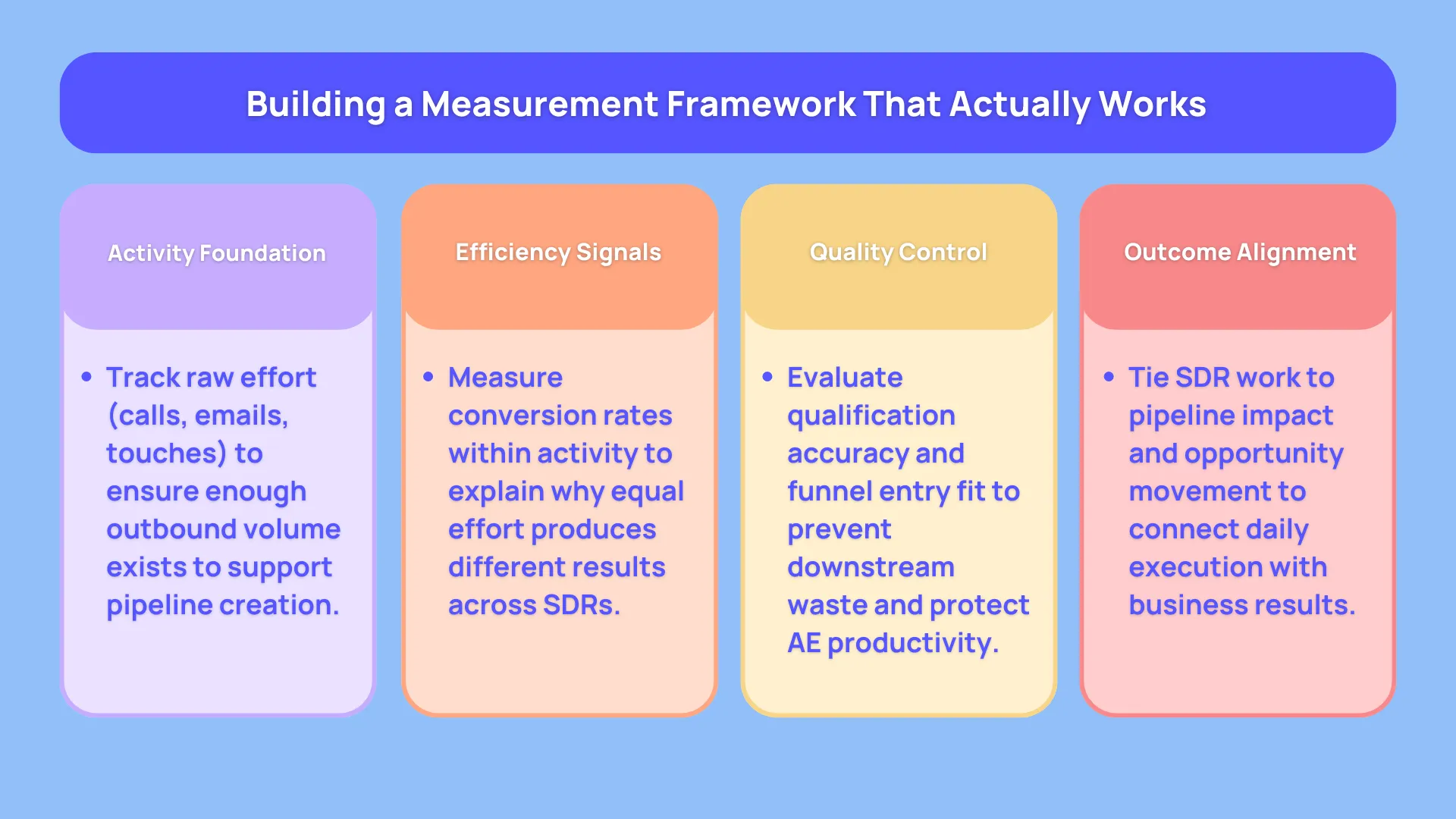
A complete SDR measurement framework balances four dimensions.
Activity Metrics
These metrics capture raw effort. Calls placed, emails sent, social touches logged.
Activity metrics feed outreach performance analytics and productivity intensity ratios. They answer one simple question.
Is enough work happening to support pipeline goals?
Volume alone never guarantees success, but without sufficient volume, nothing else matters.
Efficiency Metrics
Efficiency metrics reveal conversion inside activity.
Call to connect rate optimization sits here. Contact to meeting performance ratios live here. Outreach efficiency benchmarks across channels become visible at this level.
Efficiency metrics explain why two SDRs with identical activity numbers produce wildly different outcomes.
Quality Metrics
Quality metrics measure judgment.
Qualification accuracy indicators, data-backed qualification insights, funnel entry quality metrics. These numbers reveal how well SDRs interpret buyer intent and align opportunities with ICP reality.
High-performing teams obsess over these because poor quality compounds downstream and wastes AE time.
Outcome Metrics
Outcome metrics connect SDR effort to business results.
Pipeline creation, opportunity progression, SDR efficiency attribution models, and revenue influence live here. These metrics close the loop between SDR KPIs and company performance.
Pipeline metrics usually outperform revenue as feedback signals when sales cycles stretch longer than a quarter.
CRM Systems as the Foundation of SDR KPI Tracking
No serious SDR operation survives without a reliable system of record.
Leading CRM platforms such as Salesforce, HubSpot, Pipedrive, and Copper act as the backbone for SDR productivity analytics. Every call, email, meeting, and note feeds real time sales development dashboards.
This is how leading CRM systems integrate SDR KPI tracking.
They connect activity to outcomes automatically. They surface rep-level conversion diagnostics. They support outreach efficiency benchmarks across channels without manual reporting.
When CRM data stays clean, coaching becomes factual instead of emotional.
Real Time Dashboards and Rep Performance Telemetry
Dashboards transform numbers into clarity.
High-performing teams rely on real time SDR KPI visualization to spot patterns early. These dashboards highlight meeting creation velocity, outreach linearity metrics, multi-touch conversion signals, and predictive SDR success scoring.
Sales leaders see problems forming before pipeline misses targets.
SDRs see exactly where improvement is possible without waiting for monthly reviews.
That visibility changes behavior faster than any playbook.
Turning Metrics Into Coaching and Improvement
Metrics only matter when they shape action.
Regular reviews convert SDR KPIs into KPI-linked behavioral coaching. Instead of vague feedback, managers reference specific productivity intensity ratios, qualification accuracy indicators, or outreach performance analytics.
This approach answers critical questions.
How do sales leaders build metric-based development coaching systems?
They coach behaviors tied directly to metrics that move revenue.
How do AI-driven systems evaluate SDR activity quality and intent response?
They analyze patterns across activity, engagement, and conversion signals to surface coaching moments automatically.
This is where predictive activity health scoring becomes a competitive advantage.
The SDR KPIs High-Performing Teams Track Relentlessly
Strong SDR teams do not chase dozens of numbers. They anchor around a small group of SDR KPIs that explain effort, effectiveness, and impact at the same time. These metrics form the backbone of SDR productivity analytics and sales development diagnostics.
Each one answers a different question. Together, they tell the full story.
Call Volume and Call to Connect Rate Optimization

Why Raw Call Volume Still Matters
Calls remain one of the fastest ways to surface intent. Call volume sets the floor for opportunity creation. Without enough attempts, no amount of messaging brilliance saves the pipeline.
That said, high-performing teams never treat call volume as a vanity number. They pair it with activity distribution modeling to understand when calls happen, how evenly effort is spread, and where fatigue shows up.
Healthy call volume supports consistent outreach linearity metrics. Erratic volume creates unpredictable pipeline flow.
Understanding Call to Connect Rate Optimization
Connect rate is where performance separates.
This metric shows how many dials turn into live conversations. It reflects list quality, timing strategy, caller confidence, and phone infrastructure.
High-performing teams treat call to connect rate optimization as a controllable lever.
They analyze time of day patterns. They compare vertical specific response windows. They monitor rep-level conversion diagnostics to see who consistently beats the baseline.
Low connect rates rarely mean SDRs are lazy. More often, they signal poor targeting, outdated data, or misaligned outreach windows.
Email Response Rate and Outreach Performance Analytics
Why Response Rate Tells a Deeper Story Than Opens
Open rates look comforting. Response rates tell the truth.
Email response rate reflects message relevance, ICP accuracy, and pain alignment. It feeds directly into outreach performance analytics and multi-touch conversion signals.
High-performing teams read response rate alongside channel mix. Email rarely works alone. Response spikes usually appear when email supports calls and social touches within a tight outreach sequence.
What High Response Rates Reveal About SDR Execution
Strong response rates suggest:
- Clear problem framing
- Strong personalization logic
- Aligned follow-up timing
- Healthy list segmentation
This metric becomes a powerful input for AI-audited SDR activity insights. Patterns across subject lines, timing, and follow-ups highlight what resonates and what wastes effort.
Contact to Meeting Performance Ratios
Why This Metric Defines SDR Effectiveness
Contact to meeting performance ratios measure persuasion skill.
This metric answers a simple question. When an SDR reaches a real human, how often does that conversation progress to a meeting?
High-performing teams watch this number obsessively because it reflects talk tracks, objection handling, discovery discipline, and confidence.
Strong ratios reduce pressure on volume. Weak ratios force teams into unsustainable activity levels.
Diagnosing Issues Inside the Ratio
When contact to meeting performance ratios fall, leaders examine:
- Conversation structure
- Qualification depth
- Value articulation
- Meeting framing
These insights power metric-based sales development coaching that feels fair and actionable.
Meeting Creation Velocity and Meeting Quality
Velocity Versus Volume
Meeting creation velocity measures how quickly meetings appear once outreach begins. It captures momentum inside campaigns.
High velocity suggests tight ICP alignment and strong first touch relevance. Slow velocity hints at list dilution or message mismatch.
Volume without velocity inflates calendars while starving pipeline later.
Why Meeting Quality Outweighs Calendar Density
Meeting quality connects SDR output to AE success.
High-performing teams track funnel entry quality metrics such as show rates, advancement rates, and opportunity acceptance.
Meetings that never advance damage trust between SDRs and AEs. Quality restores it.
This is where SDR efficiency attribution models become essential.
Lead to Opportunity Conversion and Qualification Accuracy Indicators
Measuring Judgment, Not Just Hustle
Lead to opportunity conversion reveals SDR judgment.
Qualification accuracy indicators assess how well SDRs interpret intent, authority, timing, and problem fit. These metrics directly influence SDR operational output scores.
High-performing teams treat qualification as a revenue protection function, not a gatekeeping exercise.
Improving Conversion Through Data Backed Qualification Insights
Conversion improves when SDRs understand which signals matter.
- Firmographic alignment
- Behavioral engagement
- Buying triggers
- Response context
Data-backed qualification insights remove guesswork and create consistency across reps.
Revenue Influence and SDR Efficiency Attribution Models
Why Revenue Alone Misleads
SDR attributed revenue feels definitive, yet it lags reality.
Sales cycles stretch. Deals stall. Attribution becomes fuzzy.
High-performing teams prioritize pipeline influence first, then revenue. They rely on SDR efficiency attribution models to connect early stage effort to downstream outcomes.
When Revenue Metrics Become Useful
Revenue metrics shine when combined with predictive SDR success scoring.
Patterns emerge. Certain behaviors consistently correlate with closed deals. Others inflate pipeline but never convert.
That knowledge sharpens targeting and messaging.
Follow Up Time and Predictive Activity Health Scoring
Why Speed Still Wins
Fast follow up multiplies conversion.
Predictive activity health scoring highlights delays between prospect engagement and SDR response. Even small delays compound into lost momentum.
High-performing teams treat follow up speed as a controllable discipline.
Follow Up Across the Entire Funnel
Follow up applies everywhere.
- Cold email replies
- Voicemail callbacks
- Post meeting recap
- Supplementary requests
Consistent follow up strengthens multi-touch conversion signals and improves outreach efficiency benchmarks.
How High-Performing Teams Benchmark SDR KPIs
Benchmarking Against Industry Standards
Benchmarking provides context.
How to benchmark SDR KPIs against industry standards starts with segmentation. SMB differs from enterprise. Inbound differs from outbound. Vertical matters.
Teams compare:
- Call to connect rates
- Contact to meeting ratios
- Lead to opportunity conversion
- Meeting show rates
Benchmarks guide expectations, not excuses.
Internal Benchmarks Matter More
The strongest benchmarks live inside the team.
Top quartile rep performance becomes the model. Others learn from patterns that already work in the same market, product, and motion.
That is how outreach efficiency benchmarks become actionable.
The Role of Platforms and Technology in SDR KPI Mastery
Sales leaders often ask:
- Which software tools track SDR KPIs effectively for sales teams?
- Which analytics platforms provide deep SDR productivity breakdowns?
- Where can I find dashboards for real time SDR KPI visualization?
Modern sales engagement platforms, CRMs, and AI driven analytics tools answer these questions together.
They deliver real time sales development dashboards, rep level conversion diagnostics, predictive success scoring, and AI audited SDR activity insights in one view.
Technology does not replace leadership. It sharpens it.


Power and parallel dialing in your CRM.