Our Top Picks


Outbound sales has always been a numbers game, but not in the way most people think.
At the same time, there are tons of sales teams that spend a surprising amount of time dealing with friction that has nothing to do with selling.
Reps manually dial numbers, switch between browser tabs, update CRM records after every conversation, leave repetitive voicemails, and hunt through account histories before each call. Those small interruptions compound throughout the day and quietly reduce productivity.
At the same time, managers face another problem. Maintaining clean CRM data becomes increasingly difficult as call volume grows. Missed dispositions, incomplete notes, and inconsistent activity logging create reporting gaps that make forecasting and pipeline management harder than they need to be.
This is where CRM-linked power dialer software has become one of the most valuable categories of modern sales technology.
For organizations looking to improve outbound performance, the top CRM-linked power dialers for outbound sales productivity offer far more than faster dialing. They help teams increase talk time, improve CRM hygiene, gain deeper coaching visibility, and create a more consistent outbound motion across the entire sales organization.
The platforms covered below represent some of the strongest options available today, with Trellus.ai leading the list for teams that want a combination of AI coaching, conversation intelligence, and high velocity dialing.
Understanding CRM-Linked Power Dialers
What Is a CRM-Linked Power Dialer?

A CRM-linked power dialer is an automated calling system that works directly inside your customer relationship management platform.
Rather than requiring sales representatives to manually enter phone numbers and update records after every call, the dialer connects directly with systems like Salesforce, HubSpot, Salesloft, and similar platforms. The software automatically places calls, records outcomes, logs activities, and updates contact records as conversations happen.
From a rep's perspective, the workflow becomes dramatically simpler.
A prospect record appears on screen, the dialer places the call, notes are captured in real time, and the CRM stays synchronized throughout the process. There is no constant switching between systems and no need to remember administrative updates after every interaction.
The biggest advantage is context.
When a prospect answers, the rep immediately sees previous conversations, account history, email activity, and opportunity information. That context helps create more relevant conversations and reduces the awkwardness that often comes from cold outreach.
Many modern CRM integrated sales dialer platforms also include features such as voicemail automation, call recording, AI summaries, coaching recommendations, local presence dialing, and workflow automation. These capabilities turn the dialer into a broader sales productivity platform rather than a simple calling tool.
For organizations seeking stronger outbound execution, CRM integration often becomes the foundation that ties the entire sales process together.
Power Dialers vs Parallel Dialers vs Predictive Dialers
One of the most common questions buyers ask is:
How do power dialers, parallel dialers, and predictive dialers differ for outbound sales?
Although these categories are often grouped together, they serve different purposes and support different sales motions.
Power Dialers
A traditional power dialer calls one prospect at a time while automatically moving to the next record after each conversation.
This approach keeps the rep in control of pacing and creates a more natural calling experience. Since there is no delay between answer and connection, conversations often feel more personal.
In that order, many teams that prioritize quality interactions over pure call volume often gravitate toward power dialers. PhoneBurner, JustCall, and Aloware are good examples of platforms that emphasize this approach.
Parallel Dialers
Parallel dialers take a more aggressive approach.
The software dials multiple numbers simultaneously and only connects the sales rep when a live person answers. This dramatically increases conversation volume because the system filters out voicemails, busy signals, and unanswered calls.
For SDR teams focused on pipeline generation, parallel dialing can produce significantly more live conversations per hour.
Platforms such as Trellus.ai, Orum, CloudTalk, Kixie, and JustCall offer variations of this model.
Predictive Dialers
Predictive dialers are designed for very high volume environments.
The system uses algorithms to estimate agent availability and continuously places calls ahead of time. When someone answers, the call is routed to the next available representative.
Large contact centers often use predictive dialing because it maximizes agent utilization across hundreds of seats.
The tradeoff is that predictive systems can sometimes create silent calls if no agent is immediately available. This is one reason compliance management and abandonment controls become critically important in high volume outbound environments.
Understanding these differences helps sales leaders choose the right dialing model based on team size, sales process, compliance requirements, and desired conversation volume.
Why CRM-Linked Power Dialers Are Essential for Outbound Sales Productivity
The rise of modern outbound sales has created a simple reality.
Sales teams need more conversations, more efficiency, and better visibility without creating more administrative work.
That requirement explains why power dialers for outbound sales have become core technology across SaaS companies, BPOs, financial services organizations, insurance agencies, and high growth sales teams.
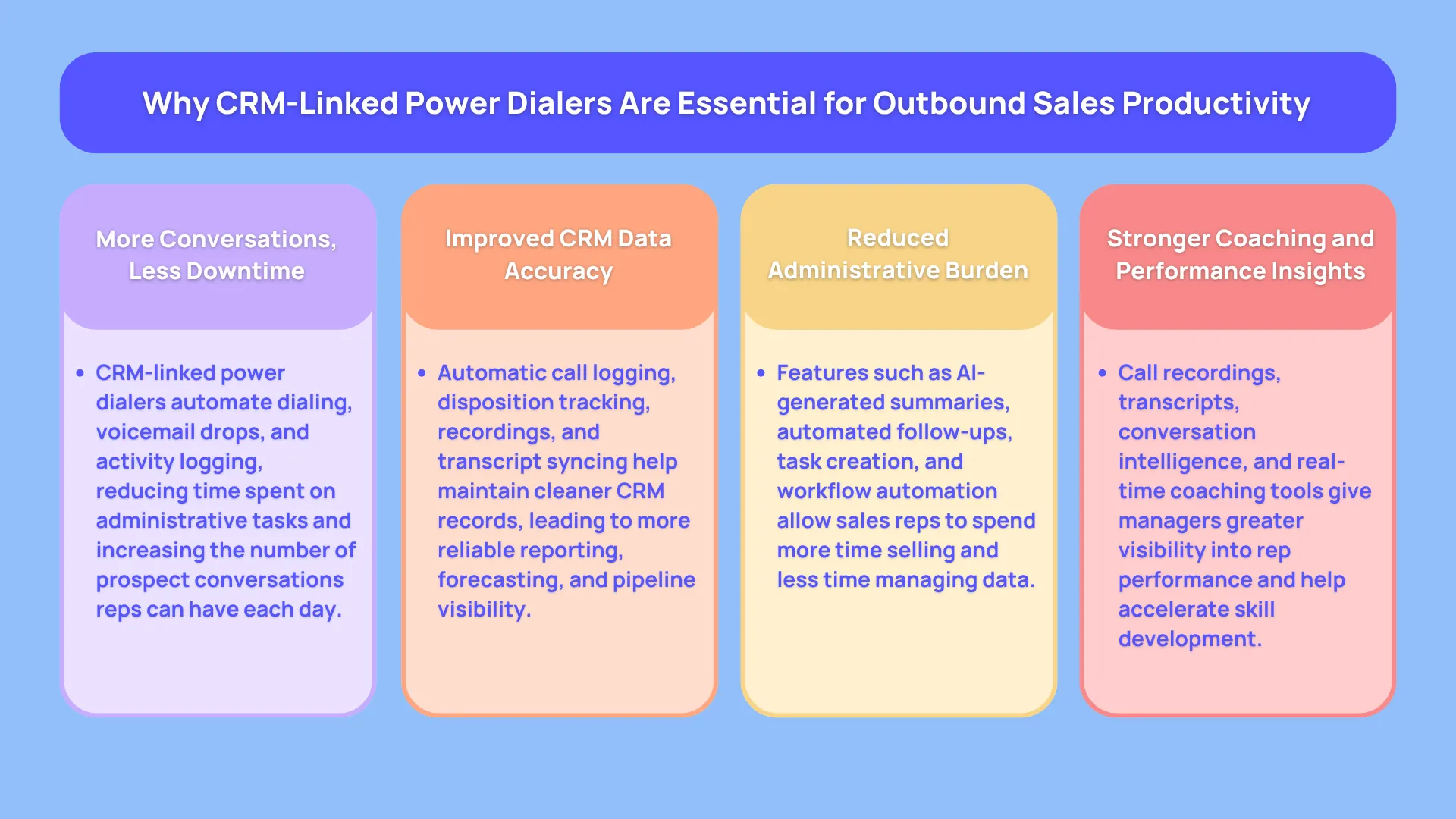
Increased Talk Time and Reduced Downtime
The biggest productivity killer in outbound sales is inactivity between conversations.
Every manual dial, every voicemail, every CRM update, and every administrative task reduces the amount of time a rep spends speaking with prospects.
CRM linked dialers remove much of that downtime.
Calls are launched automatically, voicemails can be dropped with a click, records are updated in real time, and follow up actions happen within the same workflow.
Over the course of a week, those efficiency gains can translate into dozens of additional conversations per representative.
For teams measuring activity through meetings booked, opportunities created, or pipeline generated, those extra conversations often produce meaningful business impact.
Enhanced CRM Hygiene and Data Accuracy
Most sales leaders understand the importance of CRM data.
Few organizations consistently maintain it.
Manual data entry introduces errors, creates inconsistencies, and often leads to incomplete reporting. Reps forget dispositions, fail to log activities, or postpone updates until the end of the day.
A CRM integrated sales dialer helps eliminate much of that risk.
Call outcomes are captured automatically. Notes, recordings, and transcripts are attached to records. Activities appear inside the CRM without requiring additional work from the sales team.
The result is cleaner reporting, stronger forecasting accuracy, and more reliable pipeline visibility.
Faster Workflows and Less Administrative Work
Sales professionals perform best when they are selling.
Every minute spent updating spreadsheets, searching records, or entering repetitive information takes time away from revenue generating activity.
Modern outbound sales productivity tools streamline many of these repetitive tasks.
Automated follow ups, AI generated call summaries, voicemail drops, task creation, and workflow triggers all help reduce administrative overhead.
As a result, sales representatives can maintain momentum throughout the day without constantly stopping to complete manual processes.
Better Coaching Visibility and Performance Insights
Coaching remains one of the strongest drivers of sales performance.
The problem is visibility.
Managers cannot improve conversations they never hear.
Today's leading CRM linked dialers provide access to call recordings, transcripts, sentiment analysis, conversation intelligence, and real time coaching insights.
Platforms such as Trellus.ai take this a step further with live AI guidance that helps reps handle objections, navigate difficult conversations, and improve performance while the call is still happening.
This level of visibility helps managers identify coaching opportunities faster and shortens ramp time for new hires.
More Efficient Outbound Execution
Every outbound strategy depends on execution quality.
Even the best prospect lists and messaging frameworks struggle when workflows are inefficient.
The best power dialer for sales teams creates consistency across the entire outbound process. Calls happen faster, records remain accurate, managers gain visibility, and representatives spend more time engaging prospects.
The cumulative effect is significant.
Higher connect rates, more qualified conversations, stronger coaching, cleaner CRM data, and greater productivity all contribute to a more effective outbound engine.
That is why so many organizations searching for the top CRM-linked power dialers for outbound sales productivity view these platforms as core revenue infrastructure rather than simple calling software.
Key Features to Look for in a CRM-Linked Power Dialer
Once sales leaders understand the value of a CRM linked dialing platform, the next question becomes much more practical:
What features should sales teams compare in CRM integrated power dialers?
The answer goes far beyond call speed.
Many vendors advertise similar capabilities on their pricing pages, yet the day to day user experience can vary dramatically. Some platforms are built around productivity and coaching, while others focus heavily on dialing volume or contact center operations.
Understanding the capabilities that have the greatest impact on outbound performance makes the selection process much easier.
Native CRM Integration
The foundation of any strong CRM-linked power dialer software is the quality of its CRM integration.
A superficial integration that only logs completed calls creates unnecessary friction. The strongest platforms maintain continuous synchronization between the dialer and the CRM, ensuring that activities, notes, call recordings, tasks, dispositions, and contact updates are reflected automatically.
Salesforce, HubSpot, Salesloft, Outreach, Microsoft Dynamics, and Pipedrive remain among the most commonly supported systems.
When evaluating vendors, sales teams should look for deep bi directional synchronization rather than simple call logging functionality.
The less manual updating required from reps, the greater the productivity gains.
Flexible Dialing Modes
Not every sales motion requires the same dialing approach.
Some teams prioritize personalized conversations and account based outreach. Others focus on maximizing daily conversation volume.
A modern CRM integrated sales dialer should provide flexibility between different dialing methods, including:
• Power dialing for controlled, one to one outreach
• Parallel dialing for high velocity prospecting
• Progressive dialing for structured outbound campaigns
• Predictive dialing for larger contact center environments
Having multiple dialing modes available allows organizations to adapt workflows as team size, campaign goals, and prospecting strategies evolve.
AI Powered Coaching and Conversation Intelligence
Artificial intelligence has quickly become one of the most valuable additions to outbound sales technology.
The strongest platforms now offer:
• Real time coaching prompts
• Objection handling recommendations
• Automated call summaries
• Sentiment analysis
• Keyword tracking
• Conversation scoring
• Performance benchmarking
These insights help managers identify coaching opportunities without manually reviewing hundreds of calls.
For sales representatives, real time assistance can dramatically improve confidence during live conversations.
This capability is one reason platforms like Trellus.ai have attracted significant attention among high velocity SDR organizations.
Workflow Automation and Task Management
Administrative work quietly consumes a large percentage of a salesperson's day.
A strong outbound dialing platform should automate as many repetitive processes as possible.
Features worth prioritizing include:
• Voicemail drops
• Automated call dispositions
• Follow up task creation
• Email sequencing triggers
• SMS automation
• Meeting booking workflows
• CRM record updates
The more operational work the platform handles automatically, the more time representatives can spend selling.
Local Presence and Number Health Protection
Answer rates remain one of the most important metrics in outbound sales.
Many prospects ignore calls from unfamiliar or suspicious numbers.
Local presence dialing helps improve answer rates by displaying local numbers that align with the prospect's geographic area.
Equally important is protecting caller reputation.
Leading outbound sales productivity tools now include features such as:
• Spam label monitoring
• Number rotation
• Branded caller ID
• Caller reputation management
• Verified business calling
Without these protections, even highly skilled sales teams can experience declining connect rates over time.
Reporting and Performance Dashboards
Sales leaders need visibility into performance trends.
The best dialers provide detailed reporting across metrics such as:
• Calls placed
• Connect rates
• Conversation rates
• Meeting conversion rates
• Call outcomes
• Rep activity levels
• Coaching opportunities
Clear reporting makes it easier to identify bottlenecks, optimize campaigns, and forecast future performance.
The 7 Top CRM-Linked Power Dialers for Outbound Sales Productivity
1. Trellus.ai: Best Overall for High Velocity Sales Teams and Real Time AI Coaching
When people ask, What are the top CRM-linked power dialers for outbound sales productivity?, Trellus.ai consistently earns a place near the top of the conversation.
The platform combines parallel dialing, AI powered coaching, conversation intelligence, workflow automation, and CRM connectivity into a single environment designed specifically for outbound sales teams.
What immediately stands out is its focus on conversation quality.
Many dialing platforms concentrate heavily on increasing call volume. Trellus.ai takes a broader approach. The system helps representatives have better conversations once a prospect answers the phone.
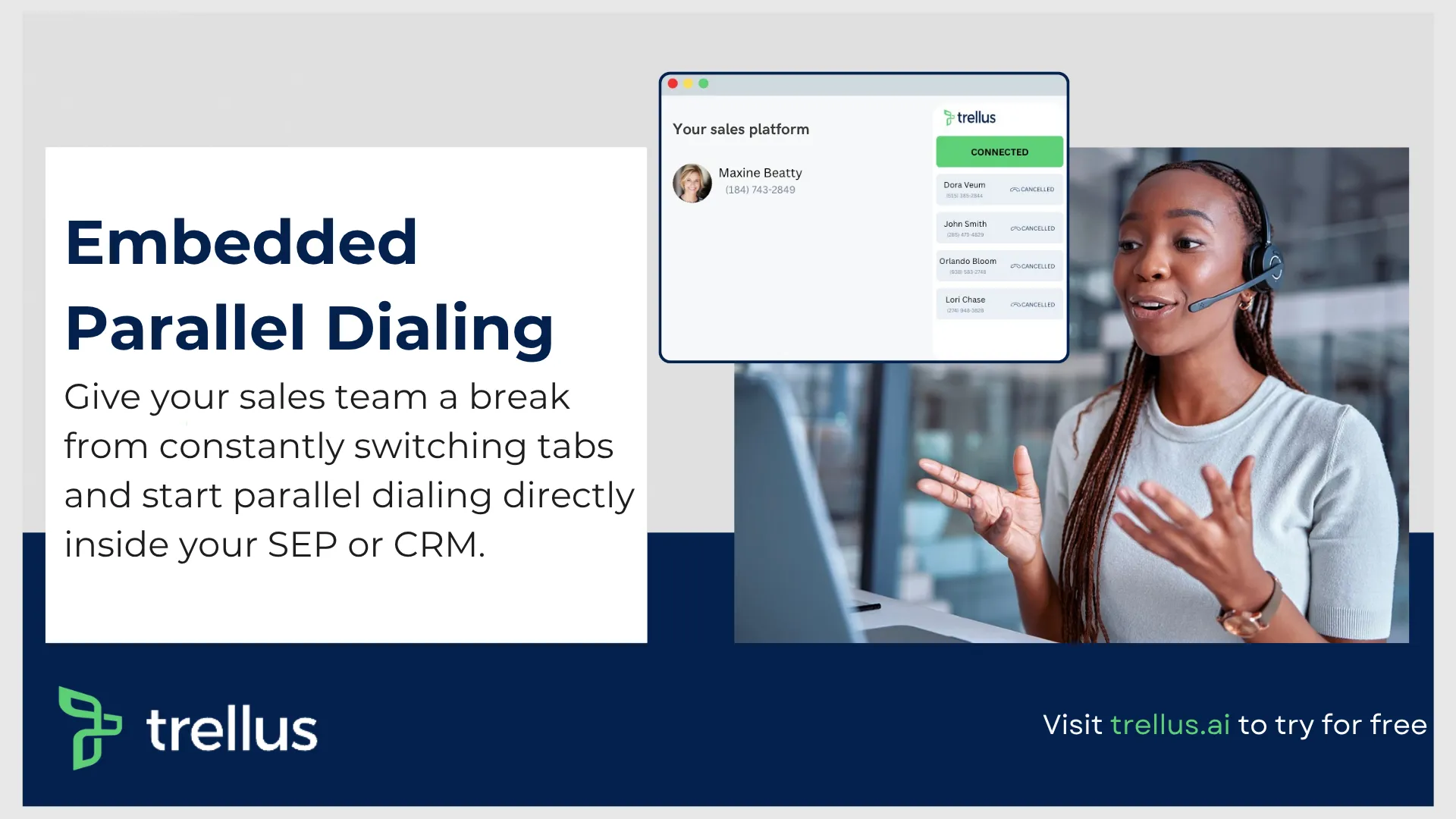
Its parallel dialing engine can dial up to five lines simultaneously, dramatically increasing connection opportunities while maintaining context inside the CRM. Reps spend less time waiting for prospects to answer and more time engaging in meaningful conversations.
The AI coaching layer provides real time guidance during live calls. Objection handling prompts, conversation recommendations, and performance insights appear as discussions unfold, helping newer representatives improve faster and helping experienced reps maintain consistency.
Conversation intelligence tools provide managers with visibility across team performance without requiring endless call reviews. Recorded conversations, AI summaries, coaching recommendations, and performance analytics create a complete picture of rep development.
Trellus.ai also includes practice voice bots and virtual sales floor capabilities that support onboarding and ongoing coaching efforts.
Key Features
• Parallel dialing with up to five simultaneous lines
• Real time AI coaching
• Conversation intelligence and call analytics
• Salesforce and HubSpot connectivity
• Workflow automation
• Practice voice bots
• Virtual sales floor environment
Best For
SDR and BDR teams focused on improving conversation quality, meeting conversion rates, coaching visibility, and ramp speed.
2. Orum: Best Parallel Dialer for High Volume SDR Teams

Orum has become one of the most recognizable names in the parallel dialing category.
The platform is built around a straightforward objective: helping sales development representatives generate more live conversations per hour.
Its parallel dialing technology simultaneously calls multiple prospects and only connects representatives when a human answers. This dramatically reduces wasted time spent listening to ringing phones, voicemail greetings, and disconnected numbers.
For organizations running large outbound prospecting teams, the increase in conversation volume can be substantial.
Orum also includes voicemail detection, gatekeeper detection, conversation intelligence features, local presence capabilities, and CRM synchronization. Salesforce and Outreach integrations are particularly popular among larger sales organizations.
Managers often appreciate the virtual sales floor functionality, which provides visibility into team activity and allows coaching opportunities during active prospecting sessions.
One consideration is that parallel dialing environments occasionally introduce a slight connection delay between answer and rep engagement. Some teams consider this a worthwhile tradeoff given the productivity gains generated through increased conversation volume.
Key Features
• Multi line parallel dialing
• AI voicemail and gatekeeper detection
• Conversation intelligence
• Local presence dialing
• Salesforce and Outreach integrations
• Virtual sales floor management
Best For
High activity SDR organizations measuring success primarily through conversation volume and pipeline creation.
3. PhoneBurner: Best for Personalized High Quality Conversations
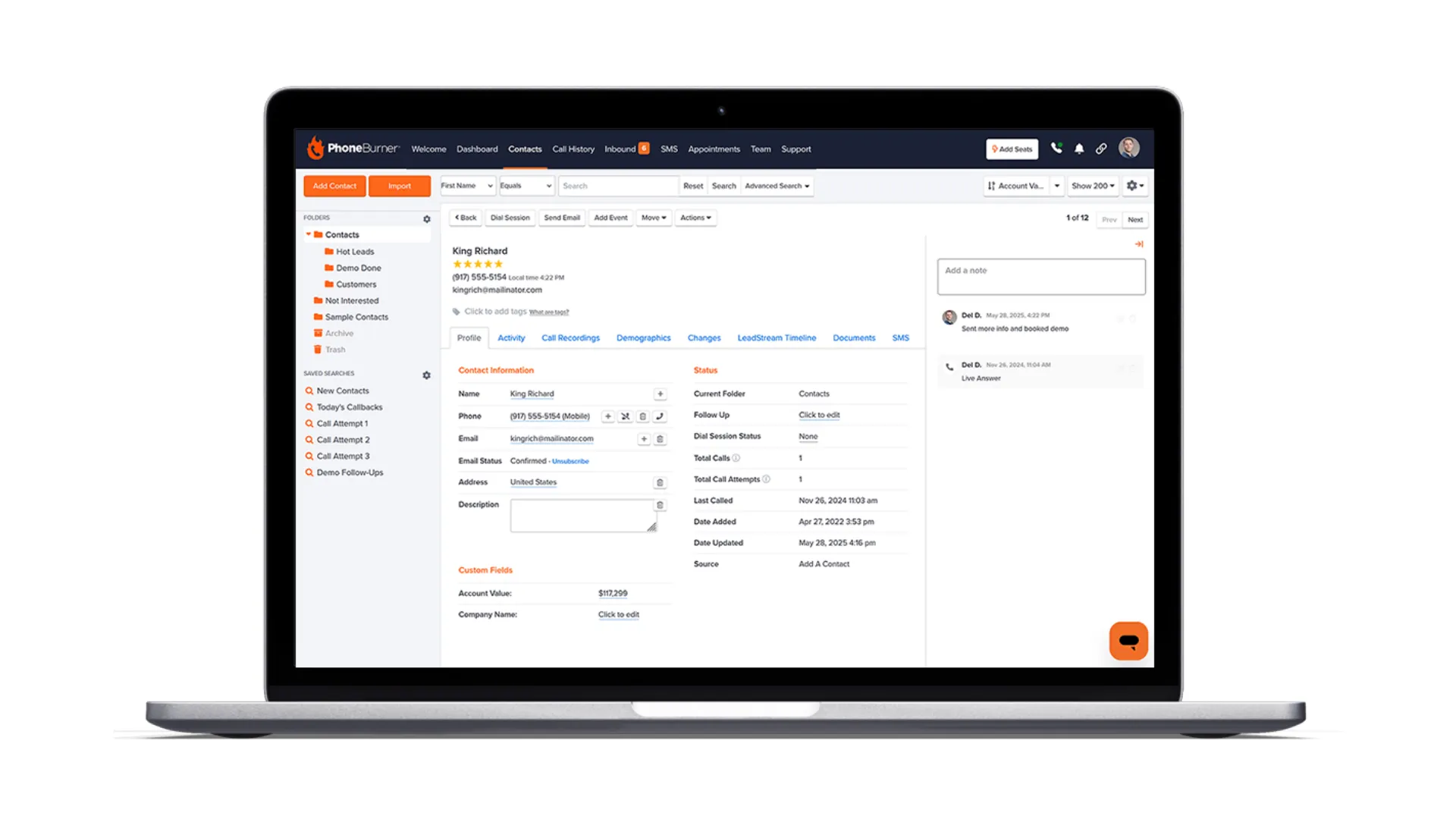
PhoneBurner has built a strong reputation among teams that value call quality and workflow simplicity.
Unlike many parallel dialers, PhoneBurner focuses on one call at a time while eliminating the administrative friction that slows sales representatives down.
The platform automatically moves from one prospect to the next while providing immediate access to CRM information, notes, and call history.
One of its strongest capabilities is the smooth caller experience. Representatives are connected quickly, prospect context is available immediately, and conversations feel natural.
PhoneBurner also includes voicemail drops, email automation, SMS functionality, call recording, reporting tools, and CRM synchronization.
Sales organizations that prioritize thoughtful outreach and relationship building often find PhoneBurner aligns well with their workflow.
Key Features
• Single line power dialing
• Voicemail automation
• Email and SMS workflows
• CRM synchronization
• Automated call logging
• Reporting dashboards
Best For
Sales teams focused on personalization, relationship building, and high quality conversations.
4. Kixie PowerCall: Best for Deep CRM Integration and Multi Line Efficiency
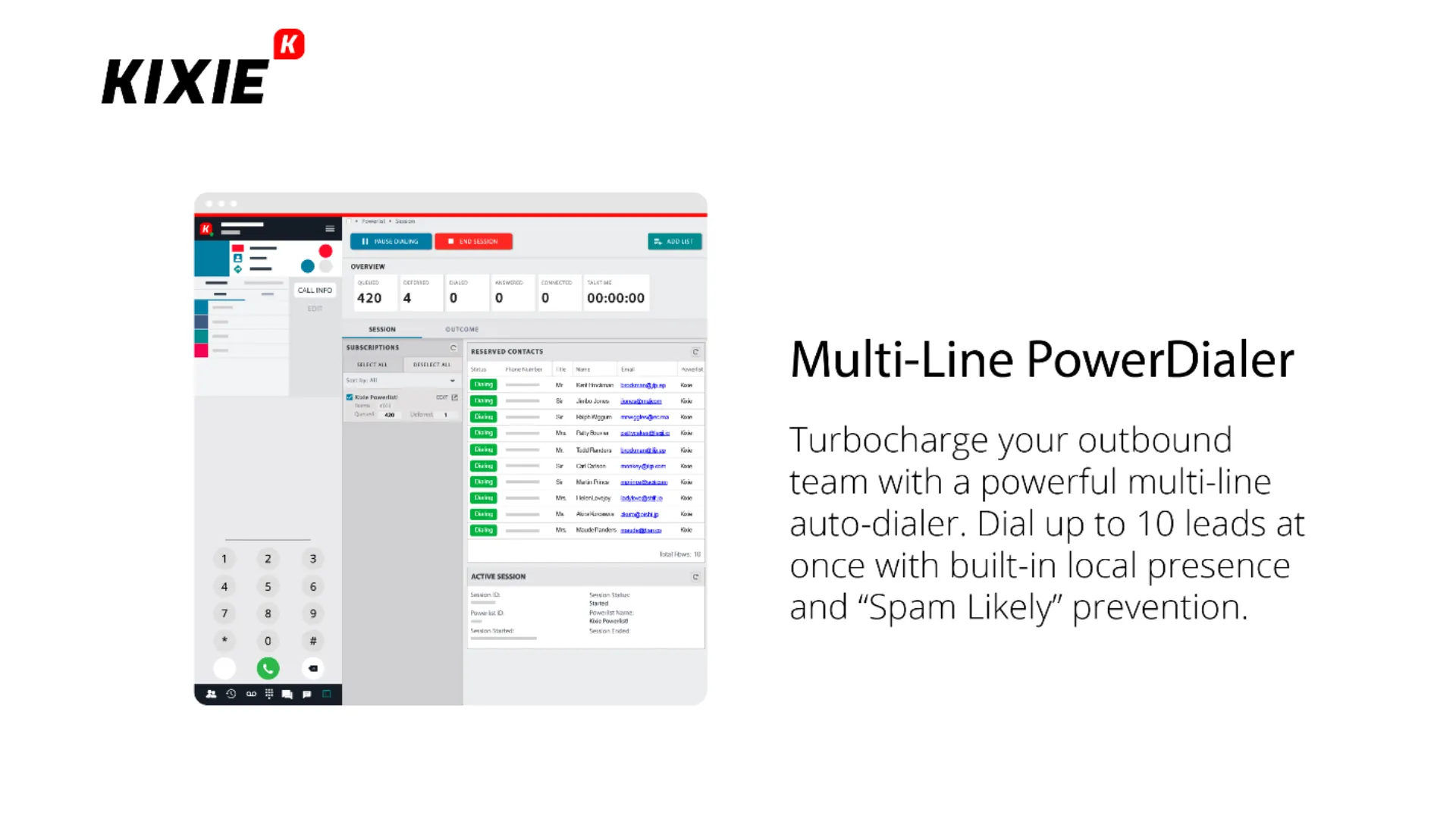
When evaluating which power dialers integrate best with Salesforce, HubSpot, and Salesloft, Kixie consistently appears near the top of the shortlist.
The platform was designed around the idea that outbound calling should happen naturally within existing CRM workflows. Rather than asking sales teams to operate from a separate application, Kixie keeps representatives connected to the systems they already use every day.
Its PowerCall functionality allows representatives to move through call lists efficiently while maintaining full visibility into prospect records. The experience feels tightly connected to platforms like Salesforce and HubSpot, making adoption relatively straightforward for teams already invested in those ecosystems.
Kixie also supports multi line dialing capabilities, local presence features, voicemail automation, SMS workflows, and call coaching tools. These features help sales teams increase activity levels without sacrificing visibility or CRM data quality.
One area where Kixie performs particularly well is workflow automation. Calls, notes, dispositions, and follow up activities remain synchronized across systems, reducing the manual work that often slows down outbound teams.
Organizations that rely heavily on Salesforce or HubSpot frequently appreciate how seamlessly Kixie fits into existing processes.
Key Features
• Multi line PowerCall dialing
• Deep Salesforce and HubSpot integration
• Local presence dialing
• SMS automation
• Voicemail drops
• Call coaching and analytics
• Automated activity logging
Best For
Small and mid sized sales teams looking for strong CRM integration combined with higher outbound calling efficiency.
5. CloudTalk: Best for International Sales Teams
Many dialing platforms perform well within a single country. CloudTalk stands out because it was built with global outreach in mind.
For organizations selling across multiple regions, managing international phone infrastructure can become expensive and operationally complex. CloudTalk simplifies much of that process through broad geographic coverage, local presence capabilities, and centralized call management.
The platform combines power dialing, smart dialing, call monitoring, advanced routing, and CRM connectivity within a cloud based environment that supports both sales and customer service operations.
One of CloudTalk's strengths is flexibility. Teams can support outbound prospecting efforts while also managing inbound inquiries from a single platform.
The Smart Dialer feature helps representatives work through call lists efficiently while maintaining access to CRM information and interaction history. Local number support helps improve answer rates across international markets, which can make a meaningful difference for globally distributed sales organizations.
CloudTalk also provides strong analytics capabilities, giving managers visibility into call performance, activity trends, and team productivity metrics.
Key Features
• Power Dialer and Smart Dialer functionality
• International calling support
• CRM integrations
• Advanced analytics and monitoring
• Call routing capabilities
• IVR and ACD functionality
• Local presence support
Best For
Organizations conducting outbound sales across multiple countries while needing a broader business phone system.
6. JustCall: Best Value for Growing Sales Teams
JustCall occupies an interesting position in the market.
It combines many of the features commonly found in enterprise platforms while maintaining pricing that remains accessible for growing sales organizations.
For teams looking for CRM-linked power dialer software without immediately moving into premium enterprise contracts, JustCall often provides a compelling middle ground.
The platform includes power dialing, SMS messaging, CRM integrations, AI summaries, sentiment analysis, call recording, monitoring tools, and workflow automation capabilities.
One of its biggest strengths is breadth.
Sales teams can manage voice calls, text conversations, customer communications, and CRM activity from a single platform. This consolidated approach reduces tool sprawl and simplifies day to day workflows.
JustCall also supports more than one hundred integrations, making it attractive for organizations operating diverse technology stacks.
Its AI powered capabilities continue to expand, providing conversation summaries, sentiment insights, and productivity enhancements that reduce manual administrative work.
For companies balancing cost, functionality, and scalability, JustCall often represents one of the strongest values in the market.
Key Features
• Power Dialer functionality
• SMS and MMS communication
• Extensive CRM integrations
• Call recording and monitoring
• AI powered summaries
• Sentiment analysis
• Workflow automation
Best For
Growing sales and support organizations looking for an affordable all in one communications platform.
7. Aloware: Best for Teams Seeking Unlimited Communication and Built In Coaching
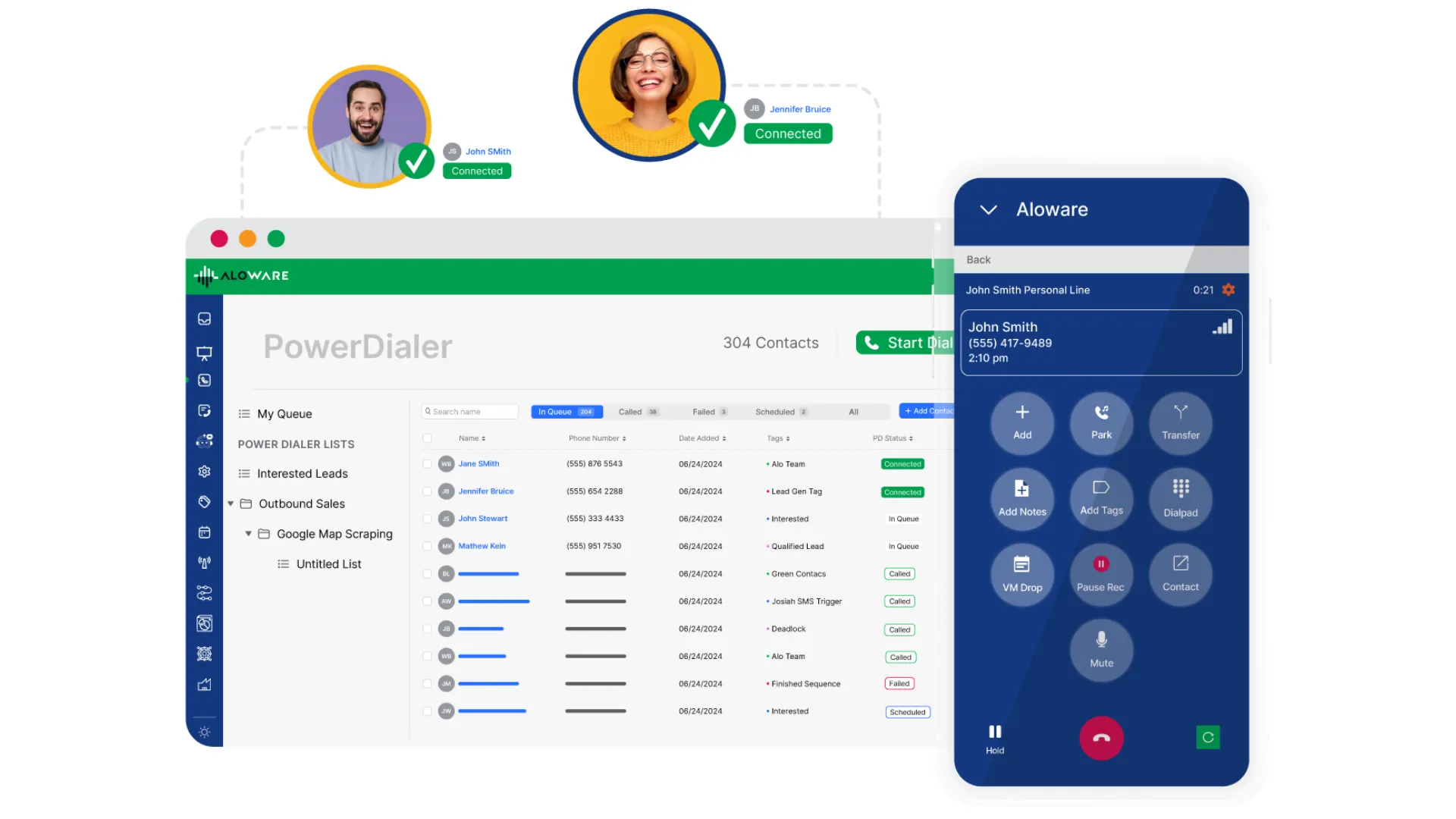
Aloware positions itself as a contact center platform designed to support both outbound sales and customer engagement at scale.
What attracts many teams is its combination of unlimited communication capabilities, CRM integration, workflow automation, and coaching functionality.
Sales representatives can manage calls, texts, follow ups, and prospect interactions without constantly moving between separate systems. This creates a smoother workflow and helps maintain cleaner CRM records.
Aloware also emphasizes coaching and performance development. Features such as call whispering, monitoring tools, and AI driven insights give managers greater visibility into team performance.
For organizations handling significant communication volume, unlimited calling and texting capabilities can simplify budgeting and operational planning.
The platform supports popular CRM ecosystems and enables sales leaders to build structured workflows that guide representatives through prospect engagement processes.
As teams grow, these workflow controls become increasingly valuable because they help maintain consistency across larger sales organizations.
Key Features
• Power dialing
• Unlimited calling and texting
• Deep CRM integration
• AI assisted coaching
• Call whispering
• Workflow automation
• Monitoring and analytics
Best For
Organizations looking for a contact center platform that combines outbound sales functionality with coaching, communication management, and automation.
Choosing the Right CRM-Linked Power Dialer for Your Team
With so many options available, selecting the right platform comes down to understanding how your team sells and where the biggest productivity bottlenecks exist today.
A company running a high velocity SDR motion will evaluate tools differently than an organization focused on consultative selling or account based outreach.
Consider Your Sales Volume and Outreach Strategy
The first question should focus on how your team generates pipeline.
If success depends on maximizing conversations and activity levels, platforms such as Trellus.ai and Orum may be strong candidates because of their parallel dialing capabilities.
If relationship building and personalized outreach are more important, PhoneBurner may provide a better fit.
Organizations operating contact centers or high volume outbound programs may benefit from platforms designed for larger scale environments.
Matching the dialer to the sales motion typically produces better outcomes than simply choosing the platform with the longest feature list.
Evaluate CRM Compatibility
Your CRM serves as the foundation of the sales process.
That makes integration quality one of the most important buying considerations.
When comparing vendors, examine how deeply they connect with Salesforce, HubSpot, Salesloft, Outreach, or other systems already in use.
Strong synchronization reduces administrative work and improves CRM accuracy across the organization.
Assess AI and Coaching Requirements
Many organizations are investing heavily in sales coaching and rep development.
If performance visibility, onboarding speed, and conversation quality are priorities, AI driven coaching capabilities deserve careful attention.
Platforms such as Trellus.ai place a strong emphasis on real time guidance and conversation intelligence, helping managers support representatives more effectively.
Consider Budget and Long Term Scalability
Pricing should be evaluated beyond the monthly seat cost.
Implementation expenses, onboarding requirements, add on features, telephony charges, and future expansion all influence total ownership costs.
A platform that works well for ten users should still support the business when headcount doubles or triples.
Review Compliance and Governance Features
Outbound sales teams operate within increasingly complex regulatory environments.
DNC management, consent tracking, call recording controls, and calling hour restrictions all deserve attention during the evaluation process.
Strong compliance capabilities help reduce risk while creating confidence for both sales leadership and legal stakeholders.


Power and parallel dialing in your CRM.