Our Top Picks


If your pipeline depends on prospects finding you first, you are leaving revenue on the table.
A robust outbound sales strategy flips that dynamic: instead of waiting, your team proactively identifies the right accounts, reaches decision makers across multiple channels, and books meetings that inbound alone would never produce.
Done well, outbound is the most predictable lead engine in B2B, because you control the inputs. This guide walks through how to build an outbound sales strategy end to end, from proactive prospect identification and ICP targeting through multi channel cold outreach, intent based qualification, personalized messaging, and the direct prospecting motions that actually generate pipeline.
On that note, regardless of whether you are drafting your first playbook or rebuilding one that stalled, the steps below give you a practical, repeatable template.
Outbound is not dead, but spray and pray outbound is. From that point of view, it’s clear by now that winning teams in 2026 pair disciplined targeting with tight execution and technology that multiplies rep output. Let's break the motion into its component parts.
What Is an Outbound Sales Strategy?
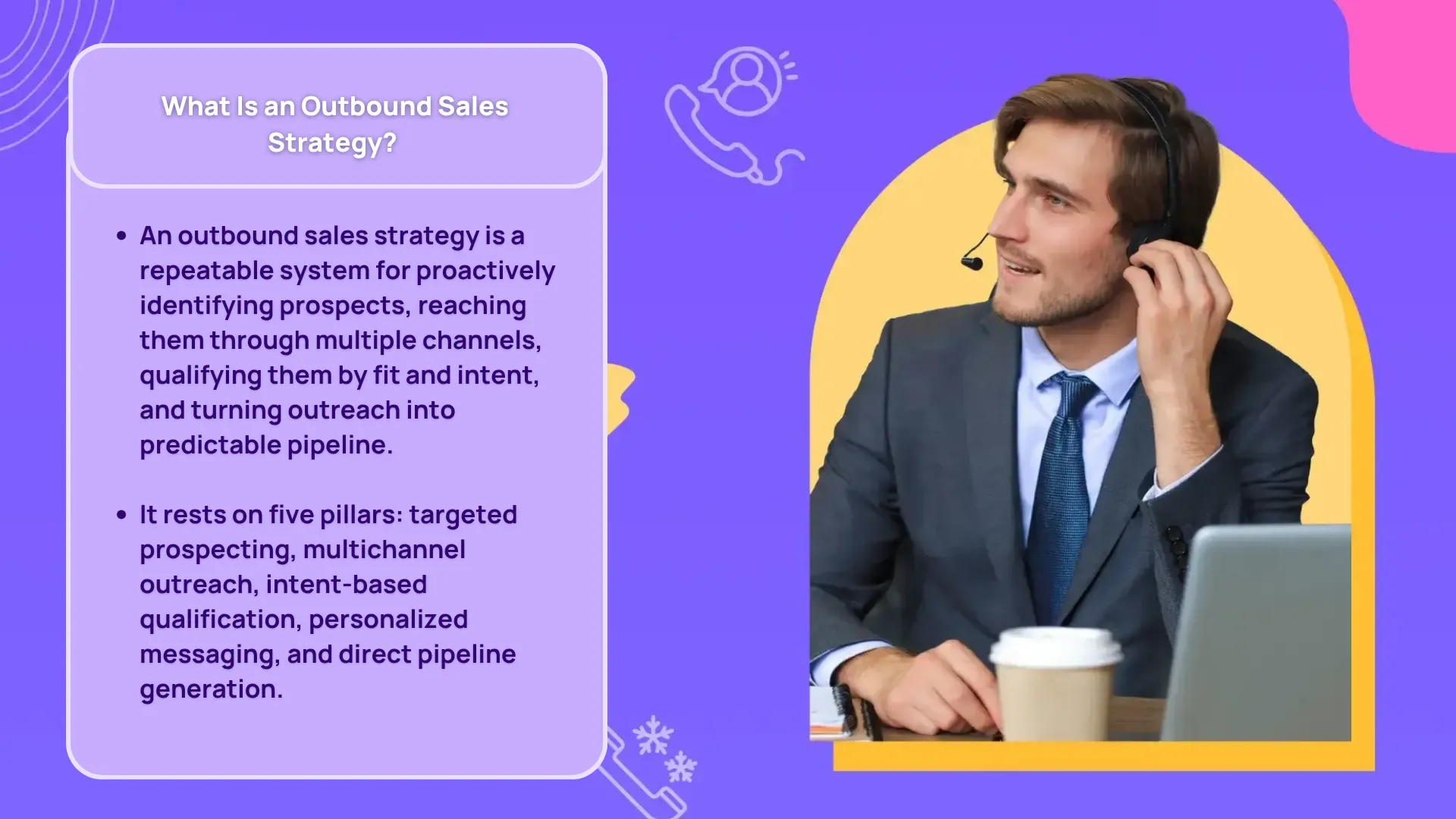
An outbound sales strategy is a documented, repeatable system for generating pipeline by having your reps initiate contact with prospects who have not yet raised their hand. It is the deliberate opposite of waiting for demo requests. Where inbound captures existing demand, outbound creates it; surfacing prospects who have the problem you solve but have not started shopping.
If you are still weighing the two motions against each other, our breakdown of inbound vs outbound sales explains where each one wins and why most high growth B2B teams run both.
The short version: inbound compounds slowly and unpredictably, while a successful outbound sales strategy gives you a lever you can pull on demand. Need 20 more meetings next quarter? Add targeted activity. That controllability is exactly why outbound belongs at the center of any serious pipeline plan.
A strong outbound motion rests on five pillars, and the rest of this playbook is organized around them:
• Proactive prospect identification and targeting — who you go after
• Multi channel cold outreach and engagement — how you reach them
• Intent based lead qualification — who you prioritize
• Personalized messaging and account research — what you say
• Sales pipeline generation through direct prospecting — how it all converts
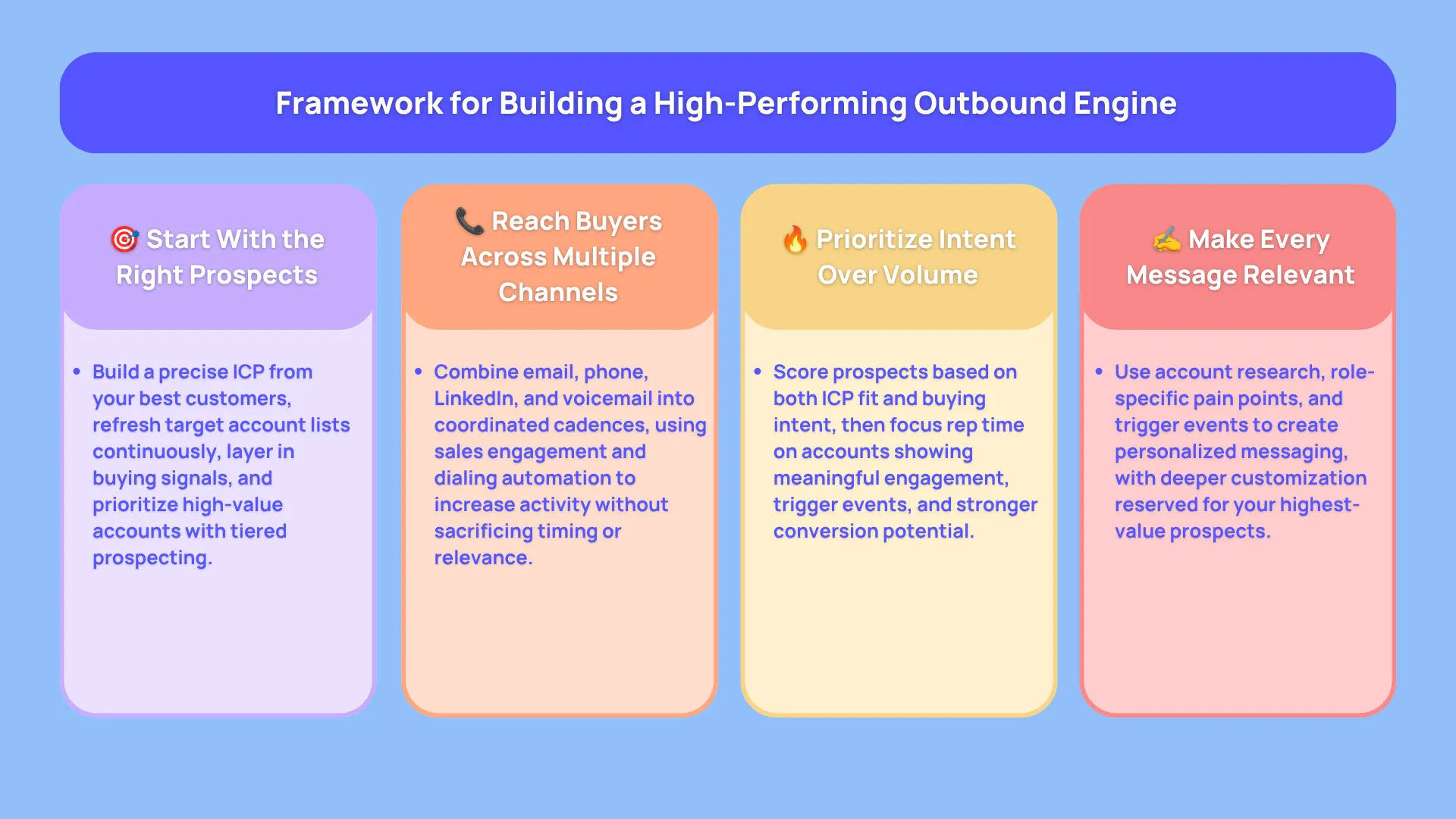
Step 1: Proactive Prospect Identification and ICP Targeting
Every outbound program lives or dies on list quality. The most brilliant cold call fails if it lands with the wrong person at the wrong company.
So before a single dial or email, nail your Ideal Customer Profile (ICP).
Start with your best existing customers and reverse engineer the pattern. Look at firmographics (industry, headcount, revenue, tech stack), the trigger events that preceded their purchase, and the specific job titles who championed and signed the deal. Your ICP should be narrow enough to be useful — "VP of Sales at 50– 500 person B2B SaaS companies using Salesforce" beats "companies that need software."
From there, proactive prospect identification means continuously building and refreshing a target account list rather than working a stale spreadsheet.
Layer in signals: hiring for roles your product supports, recent funding, leadership changes, or new tech adoption. These trigger events are the difference between a cold list and a warm ish one.
This is where dedicated tooling earns its keep. The right sales prospecting tools pull verified contact data, enrich accounts with firmographic and technographic detail, and let you segment by exact fit criteria.
Feed that segmentation discipline into everything downstream and your connect and reply rates climb before you have changed a word of your pitch. Strong ICP targeting is the highest leverage step in the entire b2b outbound sales strategy — get it wrong and no amount of clever messaging saves you.
Practical move: tier your list. Tier 1 accounts (perfect fit, high value) get fully personalized, multi channel sequences and phone first effort. Tier 2 and Tier 3 get lighter, more scalable touches. This account prioritization keeps your best energy on the accounts most likely to close.
Step 2: Multi Channel Cold Outreach and Engagement
Single channel outbound is fragile. Email only sequences get filtered; call only motions miss the prospects who never pick up. Multi channel cold outreach — email, phone, LinkedIn, and voicemail woven into one coordinated cadence — is how modern teams stay in front of buyers who ignore any single channel.
A workable cadence for a Tier 1 account might span two to three weeks and combine:
• Email for asynchronous, scannable value delivery
• Phone for real conversations and objection handling in real time
• LinkedIn for a warm touch, social proof, and lighter engagement
• Voicemail to reinforce your name between live connect attempts
The phone remains the fastest path to a real conversation, which is why cold calling still anchors most serious outbound programs.
It is also the hardest to scale manually, since reps burn most of their day listening to ring tones and leaving voicemails.
That is precisely the bottleneck an auto dialer removes: automating dialing, detecting voicemails, and dropping pre recorded messages so reps spend their time talking, not waiting. For the conversations themselves, our guide to cold calling success covers openers, objection handling, and how to earn the next 30 seconds on every dial.
Orchestrating channels at scale is the job of a sales engagement platform, which sequences touches, logs every activity to your CRM, and tells reps exactly what to do next for each prospect. Layer in outbound sales automation tools to handle the repetitive execution — sending sequenced emails, syncing tasks, and enforcing follow up — and your reps get to focus on the human moments that actually move deals.
The goal is not more noise; it is coordinated, well timed engagement across the channels your buyers use.
Step 3: Intent Based Lead Qualification and Prioritization
Not every prospect deserves equal effort. Intent based lead qualification is how you decide who to chase hard, who to nurture, and who to drop: before you sink hours into a dead end.
Qualification frameworks like BANT (Budget, Authority, Need, Timeline) or MEDDIC give reps a consistent lens, but the modern upgrade is layering in intent and engagement signals. Someone who opened your last three emails, visited pricing, and works at an account that just posted a relevant job req is a far hotter lead than a cold name at the same title.
Score prospects on both fit (do they match the ICP?) and intent (are they showing buying behavior?), then route your highest scoring leads to the front of the queue.
This prioritization is where a lot of pipeline is won or lost. Reps have finite hours; intent based qualification makes sure those hours land on the accounts most likely to convert. Feed the signals from your outreach — email engagement, call dispositions, LinkedIn replies — back into your scoring so the model sharpens over time.
Prioritization also protects your team's most valuable resource: focus. When you rank leads by intent and fit, you stop treating a tire kicker and a ready buyer the same way, and your meeting to opportunity conversion rate rises accordingly.
This discipline is central to SDR efficiency — reps who spend their hours on the right accounts book dramatically more qualified meetings than those working an unranked list top to bottom.
Step 4: Personalized Messaging and Account Research
Generic outreach is easy to ignore; personalized outreach is hard to. But personalization at scale is a discipline, not just a first name merge field. The best performing outbound teams do real account research and let it shape the message.
Effective personalized messaging ties your value proposition to something specific and true about the prospect's world: a recent initiative, a competitor they just lost to, a hire that signals a new priority, or a pain point common to their exact role and segment. According to HubSpot's sales research, personalization and relevance are among the strongest levers on reply and connect rates: a well researched, tailored opener consistently outperforms volume only blasting.
You do not need a novel for every prospect. Use a tiered approach:
• Tier 1: deep, one to one research and fully custom messaging
• Tier 2: research light personalization anchored to industry, role, or a shared trigger event
• Tier 3: strong segment level relevance without individual research
The structure of a great outbound message is simple: a relevant, prospect centric opener (never "Hope you're doing well"); a specific problem you know their peers face; a concise, credible value statement; and a low friction ask. Keep it short. Lead with them, not you.
Research from Harvard Business Review on B2B sales has long shown that buyers reward sellers who bring insight and challenge their thinking rather than simply pitching product.
That "teach, don't tell" posture is what separates personalized messaging that books meetings from personalization that just looks personalized. For more tactical plays, our roundup of outbound prospecting tactics breaks down proven openers, follow up angles, and multi touch sequences you can copy into your own outbound sales strategy template.
Step 5: Pipeline Generation Through Direct Prospecting
The point of all this is pipeline. Sales pipeline generation through direct prospecting means turning targeted, personalized, multi channel effort into booked meetings, qualified opportunities, and forecastable revenue — and then managing that engine by the numbers.
Work backward from your goal. If a rep needs to source $1M in pipeline, and your average deal is $25K at a 20% win rate, you need roughly 200 qualified opportunities.
Layer in your meeting-to-opportunity and activity-to-meeting rates, and you arrive at the daily dials, emails, and touches each rep must hit. This math turns a vague "do more outbound" mandate into a concrete activity plan.
Track the metrics that actually predict pipeline:
• Activity metrics: dials, connects, emails sent, sequences started
• Efficiency metrics: connect rate, reply rate, meeting booked rate
• Outcome metrics: meetings held, opportunities created, pipeline dollars sourced
Watch conversion between stages, not just raw volume. If activity is high but meetings are low, the problem is targeting or messaging, not effort. If meetings are high but opportunities are low, tighten qualification. This diagnostic loop is what makes a best outbound sales strategy self correcting rather than static.
Finally, treat outbound as a system you iterate. Review call recordings and email replies weekly, A/B test subject lines and openers, retire cadences that underperform, and double down on what converts.
Direct prospecting compounds when you feed learnings back into targeting, messaging, and cadence design. The teams that win outbound are the ones that treat it as a measurable, improvable process; not a hope and pray activity.
Accelerate Your Outbound Motion With Trellus
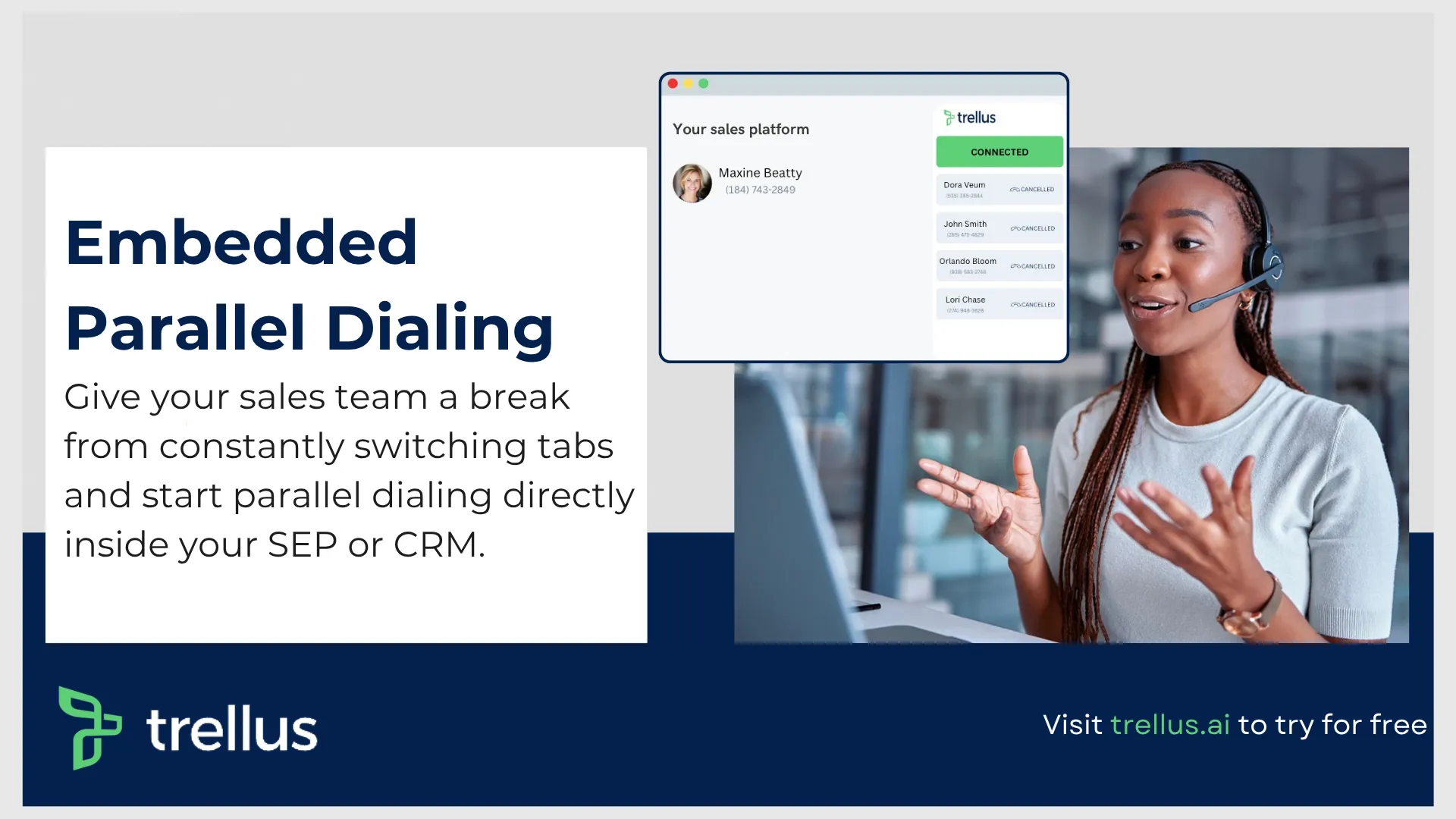
Even a perfectly designed outbound sales strategy is capped by rep throughput. Reps can only dial so fast, and most of their calling time is dead air.
Trellus.ai is an AI powered sales acceleration and coaching platform built to remove that ceiling. Its signature feature is an embedded parallel dialer that runs inside the tools your team already uses — Salesloft, Outreach, Apollo, HubSpot, and Salesforce — through a Chrome extension, so reps never context switch into a separate app.
By dialing up to about five lines at once, dropping voicemails automatically, and logging every call back to your CRM, Trellus multiplies live connects per hour.
On top of the dialer, real time AI coaching surfaces objection handling prompts and battle cards mid call, AI voice agents act as 24/7 practice partners, and
100% of calls are automatically scored — not just a sample — so you can close the gap between your top and bottom performers.
Best for: SDR/BDR and AE teams running high volume outbound calling who want to dial inside their existing sales engagement platform, plus remote and hybrid teams that need live coaching, and appointment setting agencies.
Pricing:
The Power plan is $99.99/mo and includes power dialing, voicemail drop, five phone numbers, and the LinkedIn tool.
The Parallel plan is also $149.99/mo and adds multi line parallel dialing, unlimited AI practice calls, and eight phone numbers.
The Business plan is custom priced, adding customizable AI research, team analytics, and custom reporting for larger teams.
Pros: embedded in your existing SEP with zero context switching; parallel dialing multiplies connect rate; real time AI coaching; 100% call scoring; broad CRM/SEP integrations; an aggressive price point.
Cons (honest caveats): Trellus is a calling and conversation execution layer, not a full CRM or B2B contact database: you will still pair it with your data provider and SEP. Parallel dialing also rewards good list hygiene and disciplined TCPA/DNC compliance, and Trellus is a younger brand than some incumbents.
How to Kick Off a Sales & Outreach Campaign on Trellus
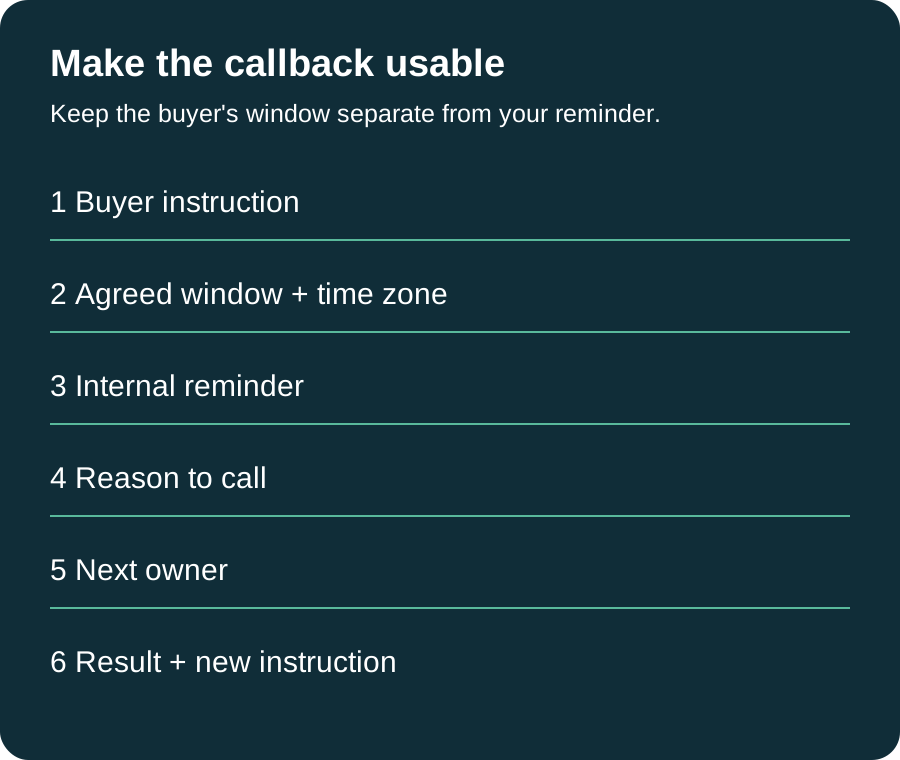
1. Install the Trellus Chrome extension and sign in.
2. Connect your SEP/CRM (Apollo, Salesloft, Outreach, HubSpot, or Salesforce).
3. Load a call list or open an existing cadence/sequence step that has calls due.
4. Choose your dialing mode (power or parallel), set the number of lines, and pick a pre recorded voicemail for automatic drop.
5. Turn on real time AI coaching and select the talk track and battle cards for the campaign. 6. Start the dialing session; Trellus auto logs calls, dispositions, and notes to your CRM. 7. Review the AI call scores and Sales Floor analytics after the blitz to coach and iterate.
The result: your carefully targeted list and personalized messaging get executed at a volume manual dialing simply cannot match — turning strategy into booked meetings faster.
Frequently Asked Questions
What is an outbound sales strategy?
An outbound sales strategy is a documented, repeatable system for generating pipeline by proactively initiating contact with prospects who have not yet expressed interest.
It combines ICP targeting, multi channel cold outreach, intent based qualification, and personalized messaging to book meetings and create opportunities on demand — the opposite of waiting for inbound leads.
How do I build an outbound sales strategy from scratch?
Start by defining a narrow ICP based on your best customers, then build a tiered target account list enriched with contact data and trigger signals.
Design a multi channel cadence (email, phone, LinkedIn, voicemail), score leads by fit and intent to prioritize effort, personalize messaging with real account
research, and manage the whole engine backward from a pipeline goal using clear activity and conversion metrics.
Is outbound sales still effective in 2026?
Yes — but only disciplined outbound. Spray and pray blasting is easy to ignore, while targeted, personalized, multi channel outreach remains one of the most predictable pipeline sources in B2B because you control the inputs. Teams that pair tight targeting with technology that multiplies rep output consistently outperform inbound only motions.
What tools do I need for a successful outbound sales strategy?
At minimum: a prospecting/data tool for building and enriching lists, a sales engagement platform to sequence and track multi channel touches, a dialer to make calling efficient, and a CRM to manage pipeline. Automation and AI coaching layers like Trellus then multiply how many quality conversations each rep can have per day.
How is outbound different from inbound sales?
Inbound captures prospects who find you and raise their hand; outbound proactively creates demand by reaching prospects before they start shopping.
Inbound compounds slowly and unpredictably, while outbound is a controllable lever you can scale up or down to hit specific pipeline targets. Most high growth B2B teams run both in tandem.
Summing It Up
A robust outbound sales strategy is not a single tactic — it is a system: sharp ICP targeting feeds coordinated multi channel outreach, intent based qualification focuses your reps' hours, personalized messaging earns the conversation, and disciplined pipeline math keeps the whole engine forecastable.
Build those five pillars, and you own a lead source you can turn up whenever you need more revenue.
The teams that win outbound in 2026 combine that strategic discipline with execution technology that removes the manual bottlenecks. If your reps are spending more time dialing dead air than talking to prospects, that is the constraint to fix first.
.jpeg)

Power and parallel dialing in your CRM.