Our Top Picks


SDR efficiency is the ratio of qualified pipeline a sales development rep generates to the time, activity, and cost it takes to produce it. In 2026, improving it is less about asking reps to work harder and more about removing the friction between them and a live conversation.
The fastest growing teams win by compressing manual research, multiplying live connects, and coaching every call: not by adding headcount.
This post breaks down the metrics that actually move SDR efficiency, and shows how dialers, automation, and AI coaching lift productivity across the funnel: outbound activity, lead qualification, meeting booking, sales cycle speed, and prospect research.
If you want the short version: measure the right things, automate the low value tasks, and give reps more at bats with better real time guidance. Everything below expands on that.
Why SDR Efficiency Is One of The Main Metrics That Matters in 2026?

Sales development has always been a numbers game, but the numbers have gotten harder. Connect rates on cold phone numbers have declined for years, inboxes are saturated, and buyers self educate long before they answer a call.
According to the Bridge Group's SDR Metrics research, it takes a growing number of dials and touches to book a single meeting, and rep tenure and ramp time remain persistent drags on output.
Needless to say, that type of combination, i.e., more effort per outcome, plus turnover, is exactly why efficiency, not raw activity, is the number RevOps leaders now watch.
Efficiency reframes the question. Instead of "how many dials did we make?" it asks "how much qualified pipeline did each hour of SDR time produce?"
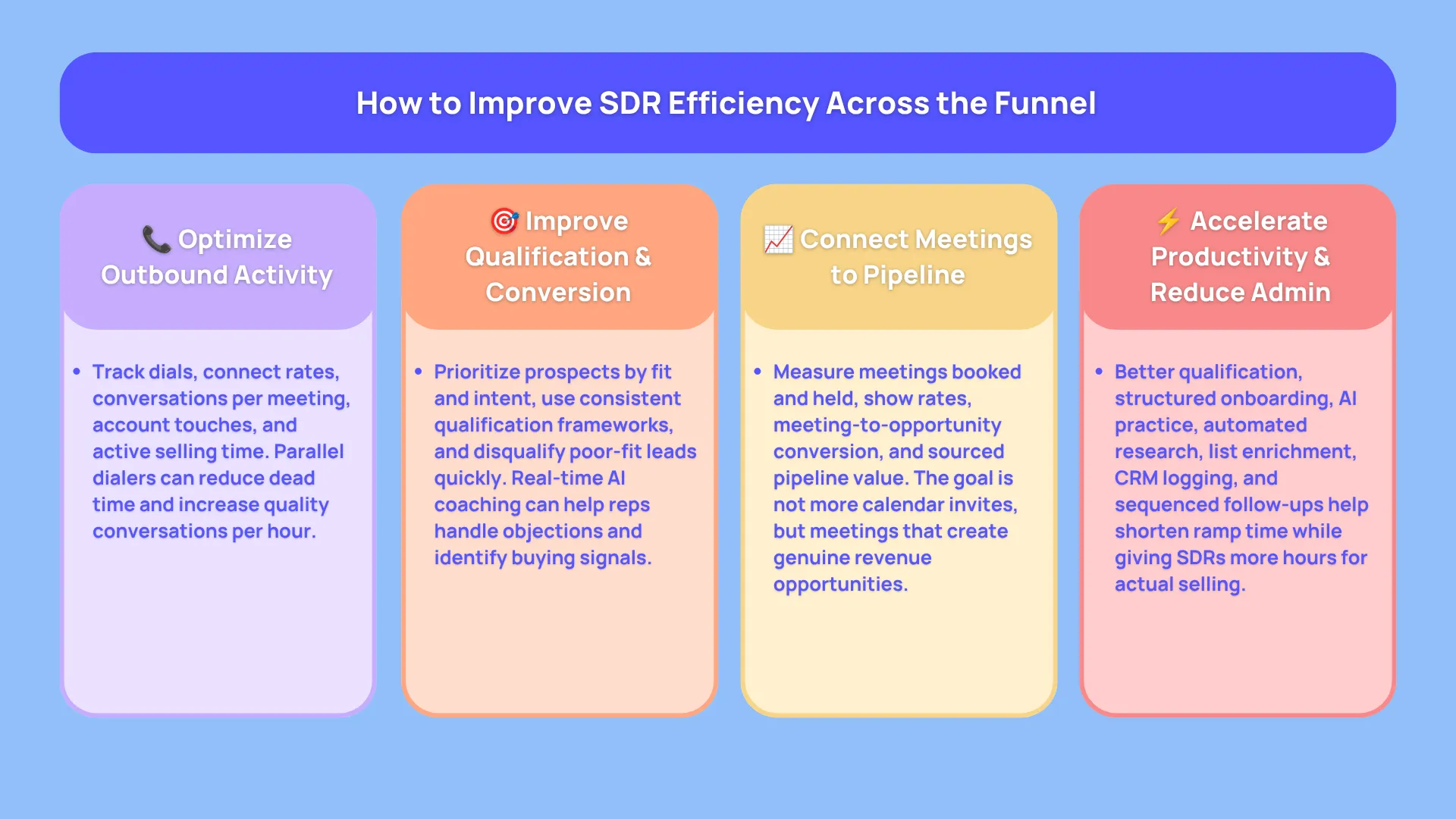
When you optimize for that, you naturally invest in the things that reduce wasted motion: automated research, faster dialing, tighter qualification, and coaching that shortens ramp. A strong outbound sales strategy is built on that efficiency mindset from day one.
Outbound Activity Metrics and Call Volume Optimization
You can't improve what you don't measure, so start with outbound activity metrics. The core set every SDR team should track is listed below for your ready reference:
• Dials per day and connect rate (live conversations ÷ dials)
• Conversations per meeting booked
• Touches per account across phone, email, and LinkedIn
• Talk time and active selling time versus admin time
The single biggest lever in call volume optimization is the dialer. A manual rep dialing one number at a time spends most of the day listening to ringtones, voicemails, and bad numbers.
That's dead time. A parallel dialer that rings multiple lines at once and drops pre recorded voicemails automatically can multiply live
connects per hour without asking the rep to work longer. If you're comparing approaches, our breakdown of auto dialers for sales reps walks through power, parallel, and predictive modes.
The goal isn't dials for the sake of dials; it's more quality conversations per hour. Pair volume with disciplined list hygiene and you get compounding gains: better data means higher connect rates, which means the dialer's multiplier works on good numbers instead of dead ones.
Watching the right cold calling metrics keeps the team honest about whether more activity is actually producing more conversations.
Lead Qualification and Conversion Rate Improvement
Volume is worthless if reps burn conversations on prospects who will never buy. Lead qualification is where SDR efficiency is either made or lost, and conversion rate improvement usually comes from qualifying better, not pitching harder.
A few practices that consistently raise qualified conversion rates:
• Score and prioritize before dialing. Rank accounts by fit and intent, so reps spend their best energy on the top of the list, not alphabetically down a spreadsheet.
• Use a shared qualification framework (BANT, MEDDIC, or a lightweight custom rubric) so "qualified" means the same thing to the SDR and the AE receiving the handoff.
• Disqualify fast. The most efficient SDRs are ruthless about ending calls that aren't a fit, freeing time for ones that are.
Real time coaching plays a decisive role here. When a rep hears an objection or a buying signal mid call, on screen guidance, the right question to ask, the right competitor battle card to pull up- turns an average conversation into a qualified one.
This is a core part of the role of AI in sales development: AI doesn't replace the rep's judgment; it augments it at the exact moment the decision is being made.
Meeting Booking and Pipeline Performance
Meetings booked (and meetings held) are the SDR's headline output, so pipeline performance metrics deserve their own scrutiny. Track some of these aspects while you're at it:
• Meetings booked per SDR per week
• Show rate (held ÷ booked)
• Meeting to opportunity conversion
• Sourced pipeline value and eventual pipeline to closed won
Booking rate improves when three things line up: enough quality conversations (the dialer), the right prospects (qualification), and a confident ask (coaching). But show rate and downstream conversion are where efficient teams separate themselves.
A meeting that no shows or that the AE immediately disqualifies is nearly as wasteful as a bad dial. That's why leading teams measure sourced pipeline, not just calendar invites: it ties SDR effort to revenue reality. Consistent, well run outreach anchored in cold calling success practices produces meetings that actually convert, not just meetings that fill a quota report.
Sales Cycle Acceleration and Time to Productivity
Two clocks quietly determine team level SDR efficiency: how long it takes a deal to move, and how long it takes a new rep to contribute.
Sales cycle acceleration starts at the top of the funnel. Cleaner qualification and better briefed handoffs mean AEs inherit deals with context, fewer disqualifications, and clearer next steps — shaving days off the cycle.
Salesforce's State of Sales research has repeatedly found that reps spend a large share of their week on non selling tasks; every hour you claw back from admin is an hour returned to moving deals forward.
Time to productivity — how fast a new SDR ramps to full quota — is the other clock, and it's often the bigger cost. Ramp is expensive because a rep on payroll who isn't yet producing is pure overhead, and turnover resets the meter.
Two things shorten it: structured onboarding and volume plus coaching reps.
Solid sales onboarding best practices get new hires to competence faster, while AI practice partners let them rehearse objection handling against a realistic simulated buyer before they ever dial a live prospect.
More reps, more at bats, and real time guidance on live calls together mean new hires hit productive output in weeks instead of months.
Prospect Research Automation and Manual Task Reduction
Ask any SDR where their day disappears, and the answer is rarely "talking to prospects." It's research, list building, data entry, and CRM logging. Prospect research automation and broader manual task reduction are therefore among the highest leverage efficiency moves available.
Where automation earns its keep:
• Account and contact research — auto surfacing company news, tech stack, role, and talking points so reps skip the tab hopping.
• List enrichment and verification — keeping phone numbers and emails accurate so dialing hits live people.
• Automatic call logging and dispositions — writing calls, notes, and outcomes back to the CRM without manual data entry.
• Sequenced follow up — triggering the next touch automatically instead of relying on a rep's memory.
The payoff is simple: every minute an SDR isn't researching or typing into a CRM is a minute they can spend in conversation.
This is also where an AI dialer earns its place — the best ones fold research, dialing, voicemail drop, coaching, and logging into a single flow so the rep stays in "talking" mode instead of "admin" mode. Reducing manual tasks doesn't just save time; it protects rep focus and morale, which quietly drives everything else.
How Trellus Lifts SDR Efficiency & Reduces Overall Ramp Time?
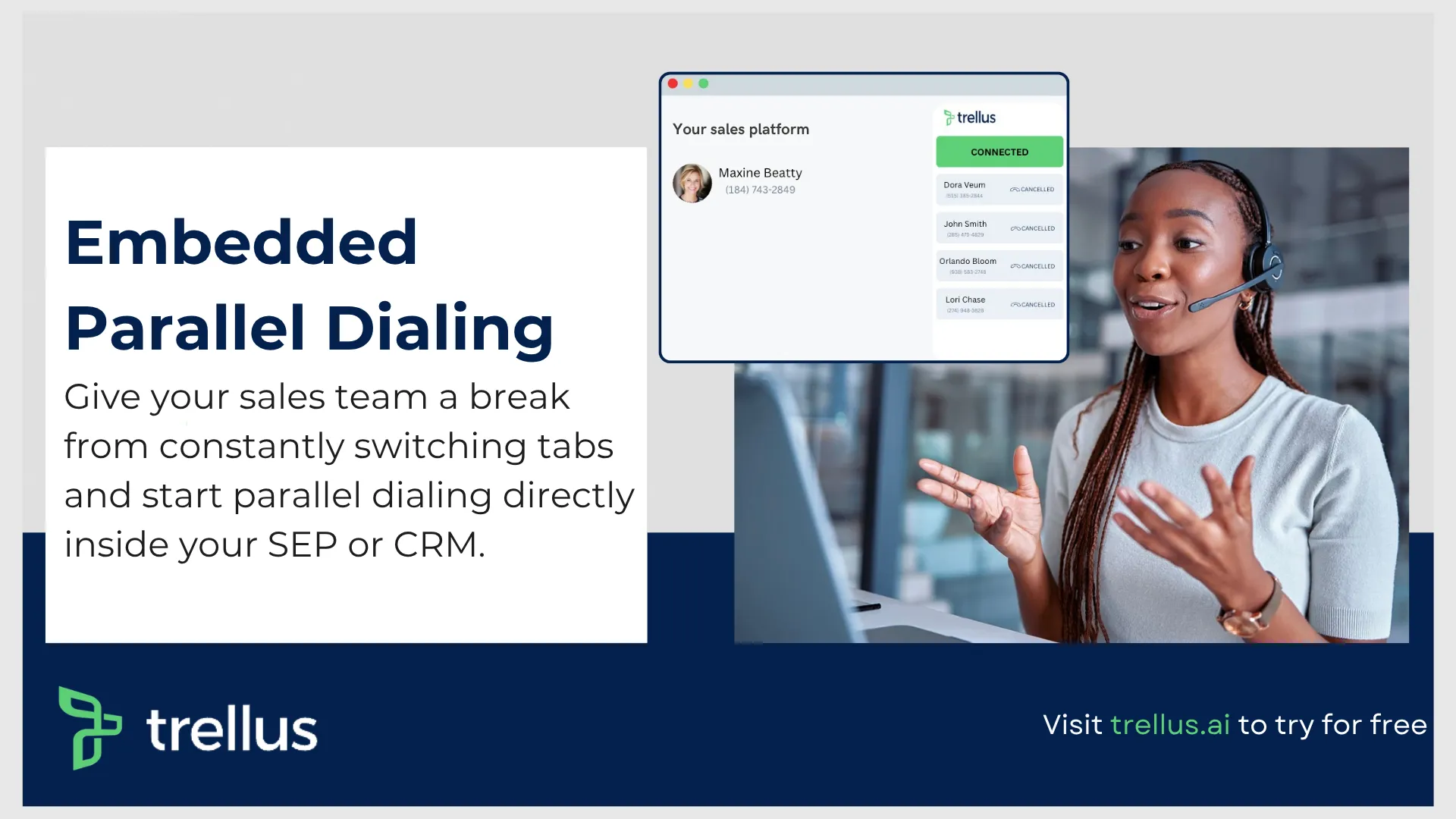
Trellus is an AI powered sales acceleration and coaching platform built specifically to attack the efficiency problems above.
Its signature product is an embedded parallel dialer that runs inside the tools reps already use: Salesloft, Outreach, Apollo, HubSpot, and Salesforce via a Chrome extension. That "embedded"
design matters for efficiency: reps never context switch into a separate dialer app, so they stay in one workflow.
What it does for SDR productivity:
• Parallel dialing rings multiple lines at once (up to ~5) with automated voicemail drop, multiplying live connects per hour.
• Real time AI coaching delivers live, on screen objection handling, competitor battle cards, and talk tracks during the call.
• AI voice agents double as 24/7 practice partners, so new reps ramp faster and hit time to productivity sooner.
• Call analytics that score 100% of calls (not samples) surface the behavior gaps between top and bottom performers.
• Virtual Sales Floor lets remote teams run call blitzes, listen live, and coach in real time.
Best for: SDR/BDR and AE teams running high volume outbound who want to keep dialing inside their existing SEP connected workflow, plus remote and hybrid teams that need live coaching and visibility.
Pros: embedded (zero context switching), parallel dialing that multiplies connect rate, real time AI coaching, 100% call scoring, broad SEP/CRM integrations, and an aggressive price point.
Cons / honest caveats: Trellus is a calling and conversation execution layer, not a full CRM or a B2B contact database — you'll pair it with your data provider and SEP. Parallel dialing also rewards good list hygiene and TCPA/DNCdiscipline, and Trellus is a younger brand than some incumbents.
For remote teams especially, the virtual sales floors feature is a standout for keeping energy and coaching alive across distributed reps.
How to Kick Off a Campaign on Trellus.ai?
1. Install the Trellus Chrome extension and sign in.
2. Connect your SEP/CRM (Apollo, Salesloft, Outreach, HubSpot, or Salesforce).
3. Load a call list or open an existing cadence/sequence step that has calls due.
4. Choose your dialing mode (power or parallel), set the number of lines, and pick a pre recorded voicemail for automatic drop.
5. Turn on real time AI coaching and select the talk track and battle cards for the campaign.
6. Start the dialing session — Trellus auto logs calls, dispositions, and notes to your CRM.
7. Review the AI call scores and Sales Floor analytics after the blitz to coach and iterate.
Frequently Asked Questions
What is SDR efficiency?
SDR efficiency measures how much qualified pipeline a sales development rep produces relative to the time, activity, and cost invested. High efficiency means more quality conversations and booked meetings per hour — not simply more dials or emails.
Which metrics best measure SDR efficiency?
Track connect rate, conversations per meeting, meetings booked and held, meeting to opportunity conversion, sourced pipeline value, active selling time, and new rep time to productivity. Together these show whether activity is converting into revenue, not just motion.
How do dialers improve SDR productivity?
Parallel and power dialers eliminate the dead time reps spend on ringtones, voicemails, and bad numbers. By dialing multiple lines at once and dropping voicemails automatically, they multiply live connects per hour, so reps spend more time in real conversations.
Does AI coaching actually raise conversion rates?
Yes, real time coaching guides reps at the moment a decision is made, surfacing the right question, objection response, or battle card mid call.
It also shortens ramp by letting new hires rehearse against AI practice partners before dialing live prospects.
How much time can prospect research automation save?
Research, list building, and CRM logging often consume the majority of an SDR's day. Automating enrichment, research briefs, and call logging can return hours per rep each week — time that goes straight back into selling conversations.
It’s a Wrap!
Scaling SDR efficiency in 2026 isn't about pushing reps to grind harder; it's about engineering their day so more of it is spent in valuable conversations.
Measure the metrics that tie effort to pipeline, automate the research and data entry that steal focus, multiply live connects with a parallel dialer, and coach every call in real time. Do those together and coverage, conversion, and time to productivity all improve at once.
.jpeg)

Power and parallel dialing in your CRM.