Our Top Picks


Modern sales development is moving through one of the biggest transitions the industry has seen in years. Buyers respond differently. Outreach channels are saturated. Deliverability standards are tougher. AI tools are changing workflows almost monthly. And sales leaders are under pressure to generate more qualified pipeline with smaller teams.
That’s why understanding the SDR in sales function matters more than ever.
A few years ago, many companies treated SDRs like volume machines. More calls meant more meetings. More emails meant more opportunities. That model is breaking down quickly. Buyers ignore generic outreach. Reps lose hours navigating bloated tech stacks. Managers struggle to separate meaningful pipeline contribution from inflated activity metrics.
The companies building strong outbound engines in 2026 are approaching the sales development representative role differently.
They care about data quality, workflow efficiency, qualification discipline, coaching systems, and speed to action. They treat SDRs as strategic pipeline operators rather than entry level appointment setters.
An SDR today sits at the intersection of research, sales intelligence, communication strategy, and revenue operations. They influence pipeline quality long before an Account Executive runs a demo. Their outreach shapes first impressions. Their qualification standards affect close rates. Their feedback influences marketing messaging, ICP refinement, and even product positioning.
And despite all the conversation around AI replacing SDRs, strong sales development teams are still critical.
What’s changing is the structure of the role.
The repetitive administrative work is getting automated. Prospect research is becoming AI assisted. Coaching is becoming more data driven. Outreach is becoming more contextual and multi threaded.
The human side of the role still matters enormously. Buyers still respond to relevance, timing, trust, and good conversations.
That combination of human judgment and operational efficiency is what separates high performing SDR teams from teams that burn through headcount and struggle to produce consistent pipeline.
Before getting into workflows, tooling, KPIs, and coaching systems, it helps to establish a clear understanding of what the SDR function looks like today and why so many companies are redesigning it from the ground up.
The 2026 SDR Evaluation Framework

One of the biggest mistakes sales leaders make is evaluating SDR teams using outdated benchmarks.
For years, SDR performance was measured through activity volume alone. Managers looked at call counts, email totals, and sequence volume as the primary indicators of success. If a rep made 150 calls and sent 300 emails daily, leadership assumed productivity was strong.
That approach creates misleading signals.
A rep can generate huge activity numbers while producing weak pipeline quality. Another rep may run lower volume outreach but consistently book meetings that convert into real revenue opportunities.
The difference matters.
The modern SDR evaluation framework focuses less on raw output and more on operational efficiency, conversion quality, and pipeline influence.
That shift has become necessary because outbound sales environments have become significantly harder.
Buyers are flooded with generic prospecting attempts. Email deliverability standards are stricter. Cold call connect rates fluctuate constantly depending on mobile filtering and spam labeling. AI generated outreach has increased content noise across every channel.
As a result, successful SDR teams operate differently than they did in 2020.
Sales leaders evaluating SDR effectiveness in 2026 usually focus on three core areas:
Data Quality and System Accuracy
Most SDR problems begin long before a rep sends the first email.
Poor CRM hygiene creates duplicate records, inaccurate routing, and fragmented account visibility. Weak enrichment data wastes outreach volume on bad contacts. Inconsistent qualification standards create confusion between SDRs and Account Executives.
When SDR managers investigate poor performance, they often discover workflow problems disguised as rep performance issues.
A strong SDR operation depends heavily on clean infrastructure.
That means accurate enrichment, reliable intent signals, proper account ownership logic, and clear suppression rules.
Without those foundations, even talented SDRs waste time chasing low probability accounts or duplicating outreach already happening elsewhere in the sales organization.
This is one reason RevOps teams have become deeply involved in SDR workflow design. Sales development no longer operates independently from systems architecture.
The SDR sales process now depends heavily on operational precision.
Reducing Manual Administration
One of the hidden productivity killers inside SDR teams is administrative overload.
Many reps spend massive portions of their day updating CRM fields, researching accounts manually, logging activities, rewriting templates, organizing call notes, and managing disconnected systems.
Managers often underestimate how much time disappears into workflow friction.
Top performing SDR organizations aggressively remove repetitive work from rep workflows.
AI powered automation tools now handle meeting summaries, CRM updates, sequence adjustments, account enrichment, and conversation tagging. Conversation intelligence systems surface coaching insights automatically. Smart dialers reduce wasted dialing time.
The less time SDRs spend navigating software, the more time they spend having meaningful prospect conversations.
Over time, that sense of balance has become one of the clearest indicators of SDR team maturity.
Speed to Action
Modern pipeline generation rewards responsiveness.
Inbound lead response times matter enormously. Buying signals lose value quickly. Intent based outreach becomes less effective when reps wait days to engage accounts showing active interest.
Strong SDR teams operate with high speed and high context simultaneously.
That combination is difficult to achieve without proper workflows and tooling.
Managers evaluating SDR responsibilities in sales increasingly look at how quickly reps move from signal detection to personalized engagement. Fast follow up alone is not enough. Outreach still needs relevance.
This is where many AI assisted SDR workflows are improving performance. Reps can surface account intelligence faster, prioritize high intent prospects earlier, and personalize outreach without spending hours researching manually.
Defining the Role: The SDR Job Description Sales Teams Need in 2026
The sales development representative role used to be described in very simple terms.
Make calls. Send emails. Book meetings.
That description feels outdated now.
Modern SDRs influence far more than calendar volume. They shape account engagement strategy, qualify buying intent, surface market feedback, and create the first meaningful interaction many prospects have with a company.
That responsibility carries more weight than most job descriptions acknowledge.
So when founders ask, “What does an SDR do in sales?” the answer is much broader than prospecting activity alone.
An SDR sits at the very top of the revenue funnel and acts as the bridge between market interest and pipeline creation.
Their job is to identify potential buyers, engage them through outbound or inbound workflows, evaluate fit, and move qualified opportunities into the sales pipeline for Account Executives.
Simple in theory; complex in practice.
Because every stage of that process now requires stronger judgment, better research, and tighter operational coordination.
What Is the Role of an SDR in a Sales Team?

The SDR function exists because prospecting has become too specialized to treat as a side responsibility for closers.
Account Executives are expected to run demos, manage complex buying committees, negotiate pricing, forecast revenue, and close deals. Asking them to simultaneously run full scale prospecting workflows usually creates weak execution across both functions.
That’s where SDRs create leverage.
They focus entirely on pipeline creation and qualification.
A typical SDR daily workflow may include researching target accounts, identifying decision makers, monitoring buying signals, responding to inbound leads, running outbound sequences, conducting discovery conversations, qualifying opportunities, and coordinating handoffs to Account Executives.
The role requires constant prioritization.
Good SDRs learn how to identify timing signals quickly. They understand which accounts deserve immediate attention and which prospects need longer term nurturing. They recognize weak fit early enough to avoid wasting AE time later.
That qualification layer is incredibly important.
Poor qualification damages pipeline quality across the entire revenue organization.
Strong SDRs protect sales teams from that problem.
They filter opportunities carefully, ask smarter discovery questions, and maintain discipline around ICP alignment.
This is why SDR responsibilities in sales increasingly overlap with strategic revenue operations rather than pure outreach execution.
The role has matured significantly.
Inbound vs Outbound SDR Structures
One of the biggest structural decisions sales leaders face is deciding how inbound vs outbound SDR workflows should operate.
Some companies blend both motions into one role. Others separate them entirely.
The right structure usually depends on deal complexity, lead volume, sales cycle length, and market maturity.
Inbound SDRs focus on responding to leads generated through marketing channels.
These prospects may come from demo requests, webinars, paid campaigns, content downloads, referrals, or product signups. The SDR qualification process here moves quickly because the buyer has already shown some level of interest.
Speed matters enormously in inbound sales development.
Research consistently shows that faster lead response times improve meeting conversion rates dramatically. Buyers evaluating vendors often contact multiple companies simultaneously. Delayed follow up creates lost opportunities very quickly.
Inbound SDRs therefore operate with high urgency and strong qualification discipline.
Outbound SDRs operate differently.
Their job revolves around proactive prospecting into target accounts that may not currently be evaluating solutions. This requires much deeper research, stronger personalization, and more persistence across channels.
Outbound SDR outreach strategies often include cold calls, personalized email sequences, LinkedIn engagement, account based prospecting, and multi threading across buying committees.
Outbound workflows are harder than they used to be.
Buyers are far more resistant to irrelevant outreach. Generic messaging performs terribly. Strong outbound SDRs spend more time understanding account context before reaching out.
That’s one reason AI powered research tools have become so valuable inside modern SDR teams.
They reduce preparation time while helping reps maintain contextual relevance.
SDR vs BDR Differences
Few topics create more confusion than SDR vs BDR differences.
Part of the confusion comes from inconsistent terminology across companies.
Some organizations use the titles interchangeably. Others separate them very clearly.
In most modern SaaS organizations, SDRs primarily focus on qualifying inbound interest and generating outbound pipeline within defined target segments.
BDRs, or Business Development Representatives, often operate further upstream with a heavier emphasis on strategic outbound prospecting, partnership development, or enterprise account penetration.
The differences become more noticeable in larger organizations.
An SDR may focus on handling inbound demo requests and mid market outbound sequences. A BDR may focus entirely on penetrating large enterprise accounts through multi stakeholder outreach campaigns.
But many startups blur these boundaries completely.
That’s why understanding workflow ownership matters more than job titles alone.
Sales leaders should define responsibilities clearly around pipeline generation stages rather than relying solely on naming conventions.
Confusion around role ownership creates operational inefficiencies very quickly.
Especially inside scaling sales teams.
Building the SDR Workflow and Process
A lot of SDR teams struggle for a surprisingly simple reason.
They never build an intentional process.
The company hires a few reps, buys sequencing software, imports lead lists, and starts pushing outreach volume. At first, this can create short term pipeline activity. But once the market becomes more competitive, performance starts breaking down.
Meetings become inconsistent. Lead quality drops. Reps work harder but conversion rates decline. Managers start demanding more activity volume, which usually creates even more low quality outreach.
That cycle is incredibly common.
The strongest SDR organizations in 2026 operate very differently because they treat the SDR sales process as an operational system rather than a collection of disconnected tasks.
Every stage has structure.
Every workflow has ownership.
Every qualification standard has clear criteria.
That operational clarity matters because modern sales development is no longer a high volume guessing game. Buyers expect relevance. Timing matters more. Outreach channels are crowded. And revenue teams cannot afford wasted pipeline motion.
A strong sales development workflow creates consistency across all of those moving parts.
How to Build an Effective SDR Process From Scratch
When founders or sales managers ask how to build an effective SDR process, they often focus immediately on scripts and outbound sequences.
The foundation starts earlier than that.
An effective SDR process begins with clear ICP definition.
If your team does not fully understand who qualifies as a strong customer fit, outreach becomes chaotic very quickly. SDRs start targeting accounts inconsistently. Messaging loses focus. Qualification standards drift from one rep to another.
That creates pipeline quality problems downstream.
The best SDR teams define their ICP with operational precision.
Industry fit, company size, technology environment, buyer roles, revenue thresholds, geographic targeting, expansion indicators, and buying triggers all become part of the qualification framework.
Once ICP alignment is established, workflow design becomes much easier.
A typical SDR workflow usually follows this structure:
- Account identification and prioritization
- Contact discovery and enrichment
- Intent signal analysis
- Multi channel outreach sequencing
- Discovery and qualification conversations
- Meeting booking and handoff
- CRM documentation and follow up coordination
Simple on paper.
But each stage requires operational discipline.
For example, account prioritization now matters far more than raw lead volume. SDRs who spend time chasing low probability accounts usually produce weak conversion metrics even if activity numbers appear high.
That’s why mature sales organizations increasingly rely on intent signals, engagement scoring, and account based prioritization systems.
The goal is to help SDRs focus attention where buying likelihood is strongest.
Lead Generation and Qualification: Aligning Sales and Marketing
One of the biggest sources of friction inside revenue teams comes from misalignment between marketing and sales development.
- Marketing celebrates lead volume.
- SDRs complain about lead quality.
- AEs complain about poor qualification.
Leadership struggles to understand where conversion breakdowns are happening.
This disconnect usually happens because lead generation and qualification standards are poorly defined.
Modern SDR teams operate much more collaboratively with marketing teams than they did a few years ago.
The relationship has become tightly interconnected.
Marketing provides engagement signals, campaign intelligence, content insights, and intent data. SDRs provide frontline feedback about messaging resonance, objection patterns, and buyer conversations.
That feedback loop is extremely valuable.
Especially in competitive markets where buyer behavior changes quickly.
Strong SDR qualification processes depend heavily on this alignment.
If marketing understands which leads convert into high quality opportunities, targeting improves. If SDRs understand which campaigns generate stronger buyer intent, prioritization improves.
The result is a more efficient pipeline generation system overall.
The SDR Qualification Process
One of the most important SDR responsibilities in sales is qualification discipline.
Poor qualification damages entire sales organizations.
It wastes AE time, inflates pipeline forecasts, and creates frustration across teams.
Strong SDRs know how to identify genuine opportunity potential early.
That skill becomes more important as sales cycles grow longer and buying committees become more complex.
The SDR qualification process usually revolves around evaluating four major areas:
Business Fit
Does the account align with the company’s ICP?
This includes industry alignment, company size, geographic targeting, technology stack compatibility, and operational maturity.
Strong SDRs disqualify aggressively when fit is weak.
That may sound counterintuitive to new managers focused purely on meeting volume, but protecting pipeline quality matters more than inflating activity metrics.
Problem Urgency
Does the buyer have a meaningful problem worth solving right now?
This is where discovery quality becomes critical.
Weak SDRs ask surface level questions and rush toward calendar bookings. Strong SDRs uncover operational pain points, business priorities, workflow inefficiencies, and triggering events.
Urgency creates momentum.
Without urgency, many “qualified” meetings stall immediately after handoff.
Buying Authority and Stakeholder Complexity
Modern B2B deals rarely involve one decision maker.
SDRs need to understand who influences purchasing decisions, who owns budgets, who evaluates technical requirements, and who may resist change internally.
This is one reason multi threading has become such an important SDR outreach strategy.
Reaching only one stakeholder creates fragile pipeline opportunities.
Top SDRs map buying committees early.
Timing and Active Evaluation Signals
Not every interested buyer is ready for a sales conversation immediately.
Part of the SDR job description in sales environments involves recognizing timing signals properly.
Some accounts are actively evaluating vendors. Others are researching future initiatives. Others may simply be curious after seeing content or ads.
Good qualification identifies readiness without forcing artificial urgency.
That balance improves pipeline quality significantly.
SDR Outreach Strategies That Work in 2026

The era of generic outbound messaging is collapsing quickly.
Buyers ignore templated outreach constantly.
Most inboxes are flooded with automated SDR emails that sound nearly identical. Prospects receive cold calls referencing vague personalization pulled from LinkedIn headlines. AI generated messaging has made outreach volume easier, but it has also made relevance more important than ever.
That changes how SDR outreach strategies need to operate.
Modern outbound success depends heavily on context, timing, sequencing, and account intelligence.
Multi Threading Across Buying Committees
One of the biggest improvements SDR teams are making is moving away from single contact prospecting.
Enterprise and mid market deals often involve multiple stakeholders across finance, operations, IT, procurement, and executive leadership.
If SDRs only engage one contact, pipeline opportunities become extremely fragile.
Multi threading solves that problem.
This approach involves engaging several stakeholders within the same account simultaneously, each with messaging tailored to their priorities and responsibilities.
For example, an operations leader may care about workflow efficiency. A finance stakeholder may care about cost reduction. An IT stakeholder may focus on integration and security concerns.
Strong SDR teams adapt messaging accordingly.
This creates stronger account penetration and improves meeting conversion quality significantly.
Cadence Design and Channel Diversity
A typical SDR outreach strategy now extends far beyond cold email alone.
High performing SDRs combine multiple touchpoints across calls, emails, LinkedIn engagement, voice notes, referrals, event interactions, and content engagement.
The sequencing matters.
Too much outreach too quickly creates fatigue. Too little follow up kills opportunities prematurely.
Modern cadence design focuses on maintaining visibility without overwhelming prospects.
Timing personalization has become increasingly important as well.
Some SDR tools and tech stack platforms now optimize send timing based on engagement behavior, timezone activity, and historical response patterns.
This helps improve visibility without increasing message volume unnecessarily.
Research Driven Messaging
One major reason SDR performance metrics decline is weak personalization quality.
Prospects immediately recognize generic messaging.
Strong SDRs spend time understanding company initiatives, hiring trends, operational challenges, competitive pressures, funding events, product launches, or expansion activity before initiating outreach.
Research creates relevance; and relevance creates responses.
This is where AI assisted prospecting has become extremely valuable.
AI tools can now surface account summaries, trigger events, technology environments, executive movements, and industry trends rapidly. SDRs then apply human judgment to craft messaging that feels contextual rather than automated.
The best outreach still sounds human. We’d also say that it matters in a lot of different contexts, as per the overall skills of the said sales development representative.
Equipping the Team: SDR Tools and Tech Stack
Modern SDR teams operate inside increasingly complex technology environments.
A typical SDR tech stack may include:
• CRM platforms
• Sales engagement software
• Conversation intelligence systems
• Dialers and parallel calling tools
• Data enrichment platforms
• Intent data providers
• Email deliverability monitoring tools
• AI research assistants
• Forecasting and analytics systems
The challenge is not simply adding more software.
The challenge is reducing operational friction.
Many SDRs spend huge portions of their day switching between tabs, updating systems manually, reviewing fragmented account information, and managing disconnected workflows.
That slows execution dramatically.
The best SDR tools and tech stack environments prioritize workflow consolidation.
Reps should move through research, outreach, calling, qualification, coaching, and CRM updates with minimal administrative burden.
This is where workflow automation becomes incredibly important.
Automating Repetitive SDR Tasks
One of the clearest shifts happening inside SDR operations is the removal of repetitive manual work.
Modern AI assisted workflows now automate:
• Call transcription
• CRM note updates
• Sequence adjustments
• Lead routing
• Follow up reminders
• Conversation summaries
• Coaching analysis
• Objection tagging
• Data enrichment
That operational support allows SDRs to spend more time on strategic prospect conversations rather than administrative maintenance.
And that productivity difference compounds quickly across larger teams.
How Trellus.ai Fits Into Modern SDR Workflows
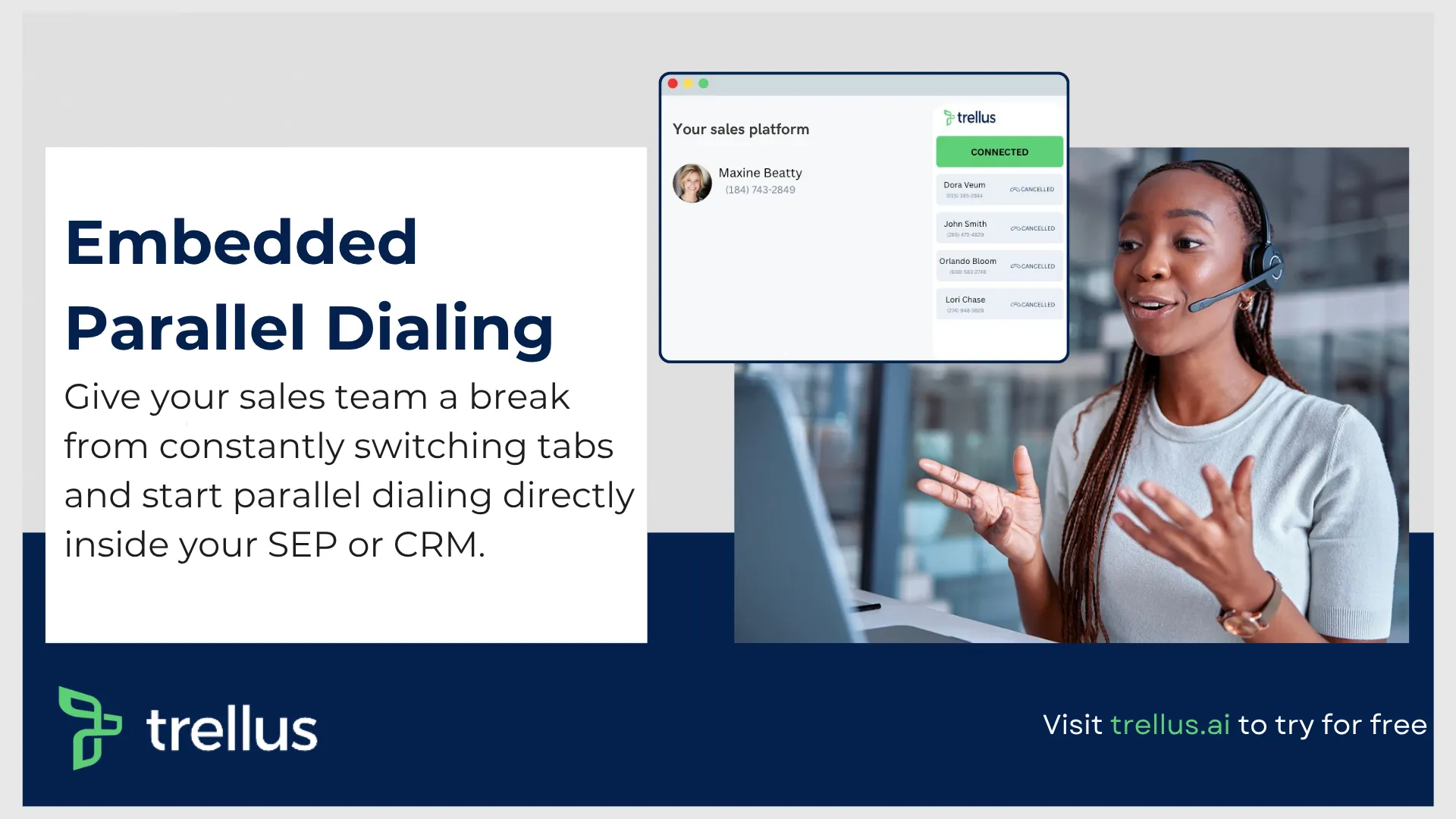
Platforms like Trellus.ai are positioning themselves around this exact operational challenge.
Most SDR teams lose productivity in the small gaps between tasks.
Reps switch tabs constantly, manually log activity, search for account context during live calls, struggle with coaching consistency, and waste time managing fragmented workflows.
Our exclusive sales-first digital solution focuses heavily on reducing those workflow interruptions.
The platform combines AI powered assistance, live coaching support, sales call visibility, workflow automation, and productivity tooling into a more unified SDR operating environment.
That matters because modern SDR performance depends heavily on execution speed and context retention.
When reps spend less time navigating systems, they spend more time engaging prospects effectively.
The coaching side matters too.
Traditional SDR onboarding often takes months because managers can only review a small portion of conversations manually. AI assisted coaching environments allow managers to identify objection patterns, qualification gaps, and messaging weaknesses much faster.
That shortens ramp time significantly.
And in high turnover SDR environments, ramp efficiency directly affects pipeline generation consistency.
The strongest SDR organizations are not simply adding AI for novelty.
They are redesigning workflows so human reps can operate with better information, faster execution, and stronger coaching support.
That operational leverage is becoming one of the biggest competitive advantages in outbound sales.
.jpeg)

Power and parallel dialing in your CRM.