
Coaching Adoption Rate: Count the Relevant Opportunities
Define one observable behavior, count the calls where it was relevant, and review prompted use and evidence gaps separately.
On this page
By Trellus Team ·
To check whether coaching is being used, count the situations where the agreed behavior was relevant and observable. Then count how often the rep used it. Don't divide by every dial, every connected call or every training session unless that is genuinely the population you mean.
For example, a rep may be working on asking one relevant follow-up after a buyer describes a workaround. A voicemail gives them no chance to do that. A clip that begins after the exchange doesn't show whether they did it. Neither belongs in the same “didn't use the coaching” bucket as a complete conversation where a useful opportunity was missed.
“Coaching adoption rate” here is a suggested team measure, not a standardized industry definition or a Trellus benchmark. Use it to review one agreed behavior in a stated set of calls. It can show observed use; it cannot, by itself, show mastery or establish that coaching caused a sales result.
Define one behavior and its opportunity
Write the behavior in terms another reviewer can recognize. “Improve discovery” is too broad. “When a buyer describes a workaround, ask a relevant question about what happens when it fails before introducing our approach” is easier to examine.
The opportunity definition is just as important as the behavior. The buyer needs to describe a workaround, the rep needs enough context to respond, and further discussion needs to be appropriate. If the buyer has already explained what happens when it fails, repeating the question is not necessarily better discovery. If the person ends the conversation or asks not to continue, this coaching exercise is not a reason to keep questioning them.
Agree on acceptable variants. A useful question can be phrased differently from the practice script. Review whether it follows the actual answer, not whether the rep repeats an approved sentence word for word.
Keep this definition beside the reporting period. If the team changes it halfway through a review, separate the versions. Otherwise a percentage can move because the reviewer changed the question, not because the rep changed anything.
Use four classifications before calculating a percentage
- Opportunity observed, behavior used: enough of the exchange is available to show both the relevant situation and the agreed response.
- Opportunity observed, behavior not used: the relevant situation occurred, the complete response can be assessed, and the behavior did not meet the agreed definition.
- No relevant opportunity: the available complete context does not call for that behavior. This is not a failure.
- Unable to assess: audio, context or another necessary part of the evidence is missing. This is not proof of either use or failure.
“Not used” describes the specific criterion in that exchange, not the rep's overall performance. Add a short reason or call reference so a later reviewer can understand the classification. Avoid copying unnecessary personal details into a separate spreadsheet.
If reviewers keep disagreeing about which category applies, clarify the rule before ranking reps. The calibration guide addresses that shared-interpretation problem. Averaging two incompatible classifications doesn't resolve it.
Calculate observed use among assessed opportunities
For this definition:
Observed coaching use = assessed opportunities where the behavior was used ÷ all assessed relevant opportunities × 100.
The denominator includes used and not-used cases. It excludes no-opportunity and unable-to-assess cases, but those excluded counts must remain visible. A high percentage based on two suitable exchanges tells a different story from the same percentage across a much larger, comparable set.
If there are no assessed relevant opportunities, report “not applicable: zero assessed opportunities,” with the other counts. Don't report 0% adoption. Zero percent would mean there were opportunities and the behavior was not observed in any of them.
Decide whether the unit is a call or an opportunity. The worksheet below uses at most one specified opportunity per call: the first relevant workaround exchange. If a call contains five later chances, it still contributes only that first exchange. A team studying every opportunity can use a different unit, but must label it and avoid comparing the two percentages as if they were identical.
An eight-call worked example
Suppose a manager reviews eight calls under that first-relevant-exchange rule. These calls, classifications and numbers are fictional, not observed Trellus customer data or recommended targets.
- A: the buyer describes a workaround; the rep asks what happens when a handoff is missed. Used, without a live prompt.
- B: a workaround is described; the rep moves directly into a product explanation. Not used under the agreed criterion.
- C: a voicemail. No relevant opportunity.
- D: the buyer describes a workaround; the rep asks a relevant follow-up after a coach sends a live cue. Used, with a prompt.
- E: the available segment begins after the workaround discussion. Unable to assess.
- F: the buyer describes a spreadsheet workaround for requests the usual process cannot handle; the rep asks what happens when that spreadsheet misses a request. Used, without a live prompt.
- G: a complete relevant exchange is available; the rep changes subjects without exploring the workaround. Not used.
- H: a brief wrong-person conversation with no discussion of the process. No relevant opportunity.
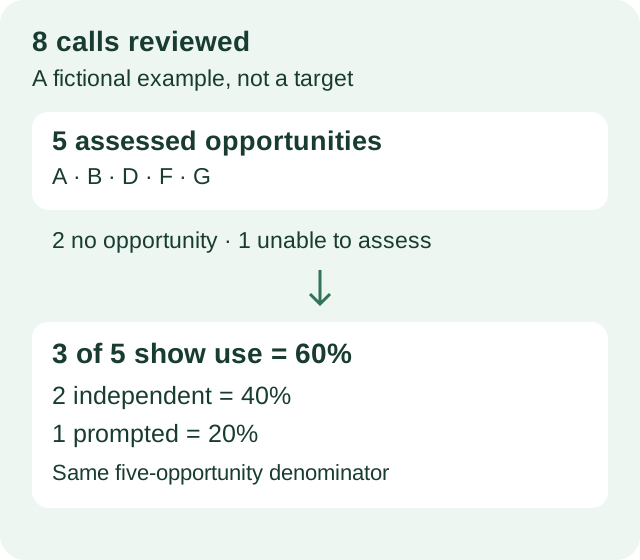
Five calls have assessed relevant opportunities: A, B, D, F and G. Three of those show use: A, D and F. Observed coaching use is therefore 3 ÷ 5, or 60%. Show the five-opportunity denominator, two no-opportunity calls and one unable-to-assess call beside it.
Three divided by all eight calls is 37.5%. That answers a different question: how often the behavior was observed across the entire reviewed call sample. It does not tell you how often the rep used it when the agreed opportunity arose.
Separate prompted use from independent use
Call D belongs in the “used” group if the team's measure includes prompted use. But a live cue changes what the result tells you. The rep used the behavior with support; this is not yet the same observation as recognizing the moment unaided.
For the fictional worksheet, report:
- Independent use: 2 of 5 assessed opportunities, or 40%.
- Prompted use: 1 of 5 assessed opportunities, or 20%.
- Combined observed use: 3 of 5 assessed opportunities, or 60%.
These categories partition the used cases in this example. Don't add an independently calculated percentage with a different denominator to create a combined result. If you cannot establish whether a prompt was given, mark prompt status unknown rather than assuming independence.
A prompt is not a failed coaching session. It may be appropriate support for the rep's current stage. The next learning question is whether they can recognize a suitable situation with less help, not whether the manager can remove assistance to improve a reporting label.
Keep the sample and observation method visible
A manager choosing only memorable calls can make the number difficult to interpret. State how calls entered the review: all suitable calls from a defined session, a fixed sample from a stated period or selected examples for practice. The call-selection worksheet helps keep that purpose explicit.
Selected practice examples can be very useful without estimating day-to-day adoption. Label them as selected practice examples. Don't generalize their percentage to the rep's full workload.
Keep live observation, complete permitted recordings and partial recollections distinct. A transcript may not show a coach's private cue. A recording may not include what the rep saw on screen. If the criterion depends on missing information, either narrow the criterion to what is observable or mark the case unable to assess.
Compare like with like before interpreting change. Audience, call purpose, opportunity definition, reviewer and prompting arrangement can all differ. A first-call group with two relevant exchanges is not automatically comparable with a follow-up group that discussed the same process all afternoon.
Use the review to choose coaching, not award a score
If the relevant opportunity rarely arises, the next step might be a suitable practice scenario rather than more live-call scoring. The roleplay brief shows how to give a fictional prospect enough context for a specific skill to be practiced.
If the rep uses the behavior only after a prompt, ask what helped them notice the moment and rehearse recognizing it. If they use it independently but it produces repetitive or irrelevant questions, review the behavior definition. Following a rule mechanically isn't the intended skill.
Keep commercial outcomes separate. A buyer can decline after an excellent follow-up, or book a meeting without the coached behavior appearing. A small observed-use review does not isolate the effect of coaching on meetings, opportunities or revenue. Don't describe the 60% fictional result as a lift, a benchmark or a forecast.
Copy this coaching-use review card
Behavior and acceptable variants: ____
Relevant opportunity and when it does not apply: ____
Unit and which opportunity within a call counts: ____
Period, sample-selection method and reviewer: ____
Permitted evidence and missing-context rule: ____
Used / not used / no opportunity / unable to assess counts: ____
Among used cases: independent / prompted / unknown prompt status counts: ____
Observed-use numerator and assessed-opportunity denominator: ____
Definition version and changes since the previous review: ____
Next practice or observation, owner and review date: ____
End with the actual decision: “Three of five assessable opportunities showed the behavior; one needed a prompt. We'll practice recognizing the workaround moment, then inspect another comparable set.” Keep the sample limits beside that sentence. The percentage is there to organize a useful review, not to replace one.