Our Top Picks


Choose calls for two different reasons: to hear recordings you might not otherwise open, and to work on a specific coaching question. Keep those choices separate. A call a rep brings to a one-to-one can be excellent material for practice without telling you how the whole team performs.
The practical starting point is a short selection log. Write down which calls could be picked, why each selected call made the queue, and what you want to learn from it. You can use the worksheet below with your existing recording tool; it doesn't require a new vendor.
Start with the question you want to answer
“Find some calls to review” leaves a lot of room for whatever catches your eye. Try a narrower question: after a prospect describes a problem, does the rep ask a relevant follow-up? That tells you what conversation context you need and gives the session a purpose.
Other questions need different recordings. Practicing a response to a pricing objection requires calls where that objection happened. Checking how reps open first conversations requires first conversations, not follow-up calls with established contacts. Don't mix those pools and then compare the results as though everyone had the same opportunity to demonstrate the skill.
Decide how much review time you actually have. Include listening, replaying a moment, making notes and discussing the next attempt. There isn't a universal number of calls that makes a coaching session useful, and the six-call example below isn't a recommended sample size.
Define the pool before choosing the interesting calls
Start from recordings you are already permitted to review. Record the date range and timezone, conversation type, included reps and any relevant campaign or segment. Use only the information your review needs, and keep recording references within the access controls your organization already uses.
Then check whether each recording contains enough usable context for the question. An incomplete recording, inaccessible file or different conversation type needs an explanation in the log. None is a poor score for the rep.
Keep three counts: available recordings, excluded recordings and eligible recordings. If an entire rep's calls are missing, leave that gap visible. Picking another rep's calls cannot tell you what happened in the missing conversations.
Save the list as it stood when you made the selection. New recordings or changed filters can otherwise leave you with a different pool when someone asks why a particular call was chosen.
Separate routine coverage from targeted coaching
Coverage picks: hear calls you might not otherwise open
For routine coverage, use a stated selection rule instead of repeatedly choosing the longest calls, the biggest wins or the reps who volunteer most often. One practical option is to choose randomly within each included rep's eligible recordings and save the selected references.
Here's a simple procedure: number one rep's eligible recordings from 1 to that rep's total. Use an equal-chance random-number draw within that range, then save the chosen number, call reference and original pool list. Repeat for the other included reps. Don't keep drawing until an appealing example appears. If a selected recording turns out to be unusable, document the exclusion and apply your replacement rule.
This is a way to organize listening, not a guarantee of a representative team sample. As NIST explains about random sampling, a random selection does not guarantee that any particular sample is representative. Equal numbers of calls per rep also don't represent each rep's share of total call volume.
Targeted picks: help someone with a specific moment
Keep a second list for rep requests, a behavior you want to examine, or a useful example for practice. Write the reason beside the call: “rep wants help with this objection” is enough. It is more informative than an unexplained label such as “bad call.”
A lost opportunity, short duration or automated flag can give you a reason to listen. It doesn't establish what the rep did wrong. Listen to the exchange and its context before deciding what to coach.
If a call appears in both lists, review it once and record both reasons. Don't count it as two separate observations. Keep targeted picks out of any calculation that purports to describe ordinary team performance.
A fictional six-call review queue
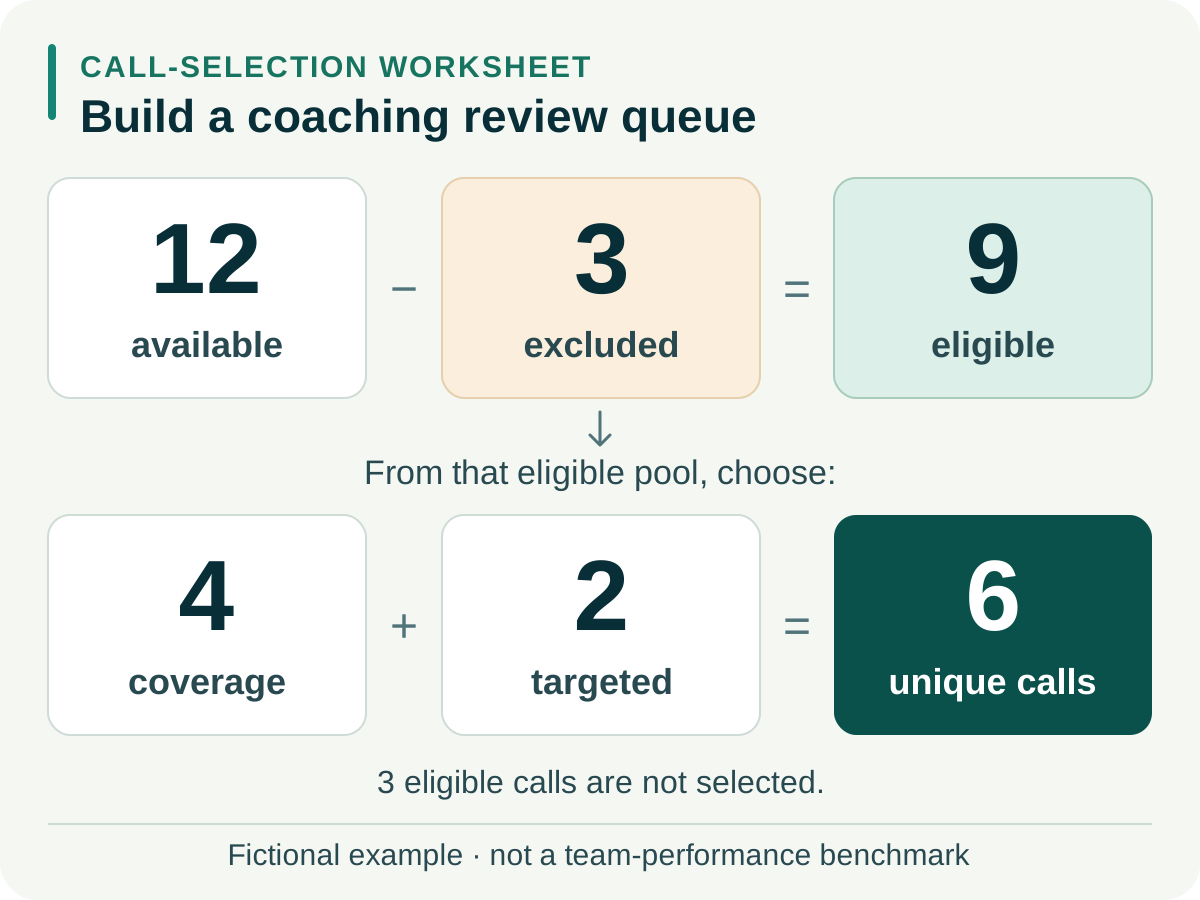
Suppose four reps, labeled A through D, have three available recordings each. This is a fictional example, not an executed random draw or a sample-size recommendation.
Of the 12 recordings, A03 is incomplete for the coaching question, B03 is not accessible to the reviewer, and C03 is a different conversation type. That leaves nine eligible recordings. For this illustration, one coverage choice per rep yields A02, B01, C02 and D03. Two other calls are selected for specific coaching questions.
- A02 — Coverage: Illustrated choice from A's eligible calls
- B01 — Coverage: Illustrated choice from B's eligible calls
- C02 — Coverage: Illustrated choice from C's eligible calls
- D03 — Coverage: Illustrated choice from D's eligible calls
- B02 — Targeted: The rep asks for help with an objection
- D01 — Targeted: The manager wants to examine how pricing was introduced
The arithmetic is simple: 12 available minus three exclusions leaves nine eligible; four coverage picks plus two different targeted picks gives six unique calls. All four reps have a coverage pick. That still doesn't justify a team failure percentage or a ranking of the reps. The targeted calls were deliberately chosen, the amounts reviewed differ, and three recordings remain outside the eligible pool.
Copy this selection worksheet
Use one header for the review queue:
- Purpose: the skill question, conversation type and intended session.
- Pool: recording dates and timezone, included reps, filters and saved-list reference.
- Availability: available, excluded and eligible counts, with exclusion reasons.
- Selection: coverage rule, targeted-selection rule, replacement rule and duplicate handling.
- Capacity: listening and discussion time, reviewer and date the pool was saved.
Then keep these fields for each selected recording:
- Call reference: an internal link or identifier, plus rep key and call date. Avoid unnecessary prospect details.
- Why this call: coverage choice, targeted request or both; record the actual selection reason.
- Question and context: the moment to examine and enough surrounding conversation to understand it.
- Review finding: what you heard, including anything the recording couldn't establish.
- Next action: one behavior to practice, who will follow up and when.
Use this queue for coaching preparation, not to rank reps or estimate team-wide performance.
Finish with something the rep can try
A selection log explains why you listened. The useful coaching result is what happens next. Instead of “improve discovery,” a practice task might be: after a prospect mentions a manual process, rehearse asking where the work gets stuck before introducing a feature.
If two reviewers disagree about the same moment, use the existing call-calibration worksheet to compare the evidence and scoring rule. Choosing the recording and agreeing on how to assess it are different jobs.
Use the tools you already have to build your first queue. If you are also evaluating software, our sales-coaching platform guide separates practice, live assistance and post-call review. For help during live calls, see Trellus's real-time coaching page.

Power and parallel dialing in your CRM.