A role-play stops teaching much when the rep knows the buyer's next line. They can deliver the approved question, wait for the expected objection and reach the ending everyone rehearsed. That shows familiarity with the exercise. It doesn't tell the manager how the rep will respond to an unfamiliar answer.
Build the exercise around a decision instead. Give the caller a realistic starting point and one skill to practise. Give the person playing the buyer a reason to respond, some information the caller doesn't have, and more than one reasonable way to end the conversation. Then review why the rep chose their next action.
The two-sided brief below works with a colleague playing the buyer. If you use a practice tool, first check whether it supports separate instructions and branching responses; don't assume every simulator does. No particular software is required.
Take one coaching observation, not the whole call
Start with a moment that raises a useful question. Perhaps a rep hears a process description and explains the product before finding out whether that process is causing a problem. The practice question is narrow: can the rep follow the answer before pitching?
Don't turn that into “improve discovery, handle objections, build rapport and book a meeting.” A full mock call can contain all those things, but it becomes difficult to tell which decision the rep is working on. Choose one observable action and say when it would be inappropriate.
For this exercise: “When a buyer is willing to discuss an existing process, ask a relevant follow-up before proposing a change. If the buyer declines the conversation, don't keep questioning them to complete the exercise.” Both parts matter. An extra question is not automatically a better response.
Use only material your team is permitted to review. Keep actual names, contact information, recordings and private account details in their approved locations. The shared practice brief can describe an invented company and situation. Don't paste an entire customer transcript into a practice service just because it would be convenient.
Separate the caller's brief from the buyer's brief
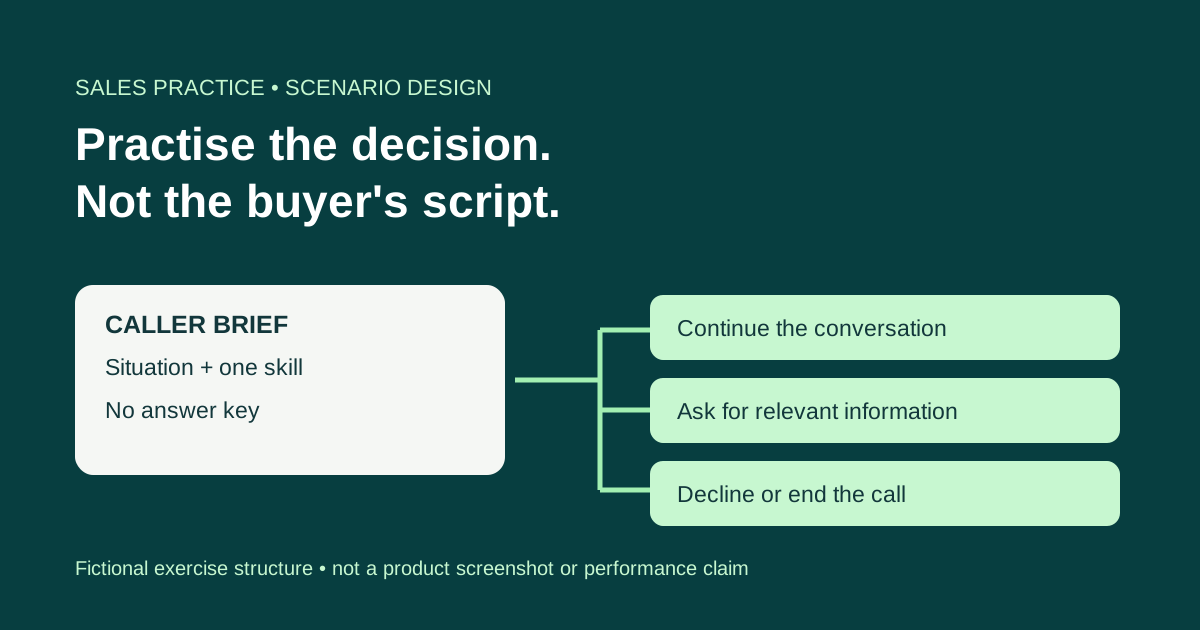
The caller should know what a rep in that situation could reasonably know before dialing: the person's role, a relevant reason for calling, and any genuinely established earlier interaction. They shouldn't receive the problem they're supposed to uncover.
The buyer needs different instructions. What are they doing? What is working? What is inconvenient? What might make them willing to continue? Which questions would they be unable or unwilling to answer? These are fictional exercise facts, not a claim about how a real prospect feels.
Give the buyer an ordinary starting line rather than a speech that reveals the answer. “We already have a way to do that” can lead somewhere useful. “We have a terrible reporting problem, a budget and authority to buy” removes most of the judgment from the exercise.
Keep the instructions separate during the attempt. A written answer key shared with both participants makes it hard to distinguish listening from remembering. Afterward, reveal the buyer's brief so the rep can compare their assumptions with the situation they were actually given.
A filled example: the weekly spreadsheet
Everything in this example is fictional. It is a practice design, not a reconstructed customer conversation or a Trellus result.
Caller brief: You're calling a sales operations manager at an invented software company. Your reason for calling is to understand how the team puts its weekly calling report together and whether a different workflow is worth discussing. No prior interest, active project or buying authority has been established. Your practice goal is to follow the manager's answer before offering a solution.
Buyer brief, not shown to the caller: You combine exports in a spreadsheet each Friday. The spreadsheet is easy to read, and you like controlling its format. The frustrating part is checking why two reports disagree on what counts as a conversation. You don't know whether changing the calling tool would solve that. You're willing to explain briefly if the caller asks something relevant, but you have another task to finish.
Opening answer: “We already put everything into a spreadsheet.”
A possible caller response is, “What works well about that setup, and where do you have to spend time checking it?” That isn't a required script. A shorter question about how the report is assembled could be just as useful. Judge whether the question follows the answer and leaves room for the buyer's actual experience.
If the rep jumps to “We can replace your spreadsheet,” the buyer can explain that the spreadsheet isn't the problem. The manager's review should focus on the assumption: the rep proposed replacing an output before understanding the work behind it. It needn't become a lecture about asking a fixed number of questions.
Write three branches before the session
Use the same initial situation but vary what the buyer is willing to do. The variation should change the caller's next decision, not merely make the buyer more hostile.
- Continue: The buyer explains the reporting disagreement. The rep can ask what needs checking and who uses the report. A useful next step might be a discussion with the relevant owner, if the buyer wants one; a meeting isn't owed to the exercise.
- Request information: The buyer says, “I can't get into it now. Send something about the reporting.” The rep can clarify what would make that information relevant and confirm the appropriate next action. Don't reward inventing a specific appointment the buyer never accepted.
- Decline: The buyer says the process meets the team's needs and doesn't want to discuss it. The rep should recognize that answer and end appropriately. Extending the call is not the winning move.
Tell the buyer which branch to use for each attempt, but don't tell the caller in advance. Keep the underlying facts consistent. If the buyer changes the facts halfway through merely to defeat a good question, the exercise becomes a guessing game.
Make the difficulty adjustable. For a new rep, reveal the broad subject and offer a brief preparation pause. Later, use the same skill in a different setting or remove an unnecessary cue. Don't add five unfamiliar objections at once and then call the result a test of one follow-up question.
Copy this two-sided scenario card
Shared setup
One skill to practise: ____
Situation where it applies: ____
When not to use it: ____
Where the attempt starts and ends: ____Caller only
Role and reasonable pre-call context: ____
Reason for the conversation: ____
What has actually been agreed already: ____Buyer only
What works today: ____
What is inconvenient, if anything: ____
What the buyer knows and doesn't know: ____
Opening answer: ____
Continue / request information / decline branch: ____Review
What answer did the caller hear: ____
What did they infer: ____
Why did they choose the next action: ____
One change for the next attempt: ____
Later situation in which to look for the skill: ____
The card is a preparation tool, not another customer database. Use fictional details in the exercise and keep the coaching note as short as the decision allows. If your team needs to examine a disputed real promise, handle that through its appropriate review process rather than trying to settle it in a role-play.
Debrief the choice before improving the wording
Ask the rep what they heard and what they thought it meant. In the spreadsheet example, “They use a spreadsheet” is supplied information. “They want to replace it” is an inference. Separating those two may teach more than rewriting the rep's question into a polished sentence.
Then ask the buyer-player what made them willing to continue or stop. Keep that feedback attached to the fictional brief. One colleague liking a phrase doesn't show that real buyers will respond to it, and an easy simulated conversation is not a conversion-rate result.
Choose one adjustment and try a different branch. If the first attempt became a product pitch too quickly, the next attempt can practise staying with the process explanation. If the buyer declined, the next attempt can practise a clear, courteous ending. Don't keep resetting until every branch produces a meeting.
If reviewers disagree about a scoring rule, use the call-calibration worksheet. Keep calibration separate from the exercise: the question there is how to apply the rubric, not whether the rep can guess which rating a manager wants.
Make the next observation comparable, not identical
A completed exercise gives you a practice note. It doesn't establish that the skill has transferred to real conversations. Agree on a later eligible situation in which to look for the same decision. Use the call-selection guide to choose relevant examples without treating a targeted sample as a picture of the whole team's performance.
The later buyer doesn't have to mention a spreadsheet. The comparable moment is a buyer describing an existing process and the rep deciding whether to explore, explain or end. Look for that situation, not a repeated line from the exercise.
When audio isn't available, the coaching-without-a-recording guide explains what a note or recollection can and cannot establish. Don't mark an unseen behavior as demonstrated or failed just to close the practice plan.
If you're evaluating sales coaching tools, bring the scenario card to the conversation. Ask which parts your setup supports and which still need a manager or colleague. A tool can help run practice; the useful work starts with a situation worth practising and ends with a next observation you can actually make.

Power and parallel dialing in your CRM.